
UNCLASSIFIED
PE 0604384BP: CHEMICAL/BIOLOGICAL DEFENSE (EMD)
UNCLASSIFIED
Chemical and Biological Defense Program Page 1 of 182 R-1 Line #127
Exhibit R-2, RDT&E Budget Item Justification: PB2023Chemical and Biological Defense Program
Date: April 2022
Appropriation/Budget Activity
0400: Research, Development, Test & Evaluation, Defense-Wide / BA 5:
System Development & Demonstration (SDD)
R-1 Program Element (Number/Name)
PE 0604384BP / CHEMICAL/BIOLOGICAL DEFENSE (EMD)
COST ($ in Millions)
Prior
Years FY 2021 FY 2022
FY 2023
Base
FY 2023
OCO
FY 2023
Total FY 2024 FY 2025 FY 2026 FY 2027
Cost To
Complete
Total
Cost
Total Program Element
- 353.472 299.848 312.148 - 312.148 276.205 259.927 201.075 143.983 Continuing Continuing
EN5: Enabling Investments
(SDD)
- 0.000 0.000 13.392 - 13.392 13.984 14.037 14.341 13.728 Continuing Continuing
MT5: Mitigate (SDD)
- 0.000 0.000 74.225 - 74.225 61.861 68.280 39.819 22.062 Continuing Continuing
PT5: Protect (SDD)
- 0.000 0.000 96.860 - 96.860 98.427 78.868 48.793 35.494 Continuing Continuing
UN5: Understand (SDD)
- 0.000 0.000 127.671 - 127.671 101.933 98.742 98.122 72.699 Continuing Continuing
CA5: Contamination Avoidance
(SDD)
- 129.914 82.295 0.000 - 0.000 0.000 0.000 0.000 0.000 0.000 212.209
CO5: Collective Protection
(SDD)
- 7.688 3.028 0.000 - 0.000 0.000 0.000 0.000 0.000 0.000 10.716
DE5: Decontamination (SDD)
- 17.274 7.874 0.000 - 0.000 0.000 0.000 0.000 0.000 0.000 25.148
IP5: Individual Protection (SDD)
- 17.129 18.941 0.000 - 0.000 0.000 0.000 0.000 0.000 0.000 36.070
IS5: Information Systems (SDD)
- 5.810 0.000 0.000 - 0.000 0.000 0.000 0.000 0.000 0.000 5.810
MB5: Medical Biological Defense
(SDD)
- 117.157 137.348 0.000 - 0.000 0.000 0.000 0.000 0.000 0.000 254.505
MC5: Medical Chemical Defense
(SDD)
- 52.505 50.362 0.000 - 0.000 0.000 0.000 0.000 0.000 0.000 102.867
TE5: Test & Evaluation (SDD)
- 5.995 0.000 0.000 - 0.000 0.000 0.000 0.000 0.000 0.000 5.995
A. Mission Description and Budget Item Justification
This program element (PE) resources System Development & Demonstration across the Enabling Investments, Mitigate, Protect, and Understand portfolios. CBDP
investments provide an integrated, layered capability to enable CWMD missions ranging from combat operations to DoD support to domestic incident prevention and
response. The projects in this PE support the development, build, and test of products to verify that all operational and derived requirements have been met, and to
support production or deployment decisions. The activities include mature system development, integration, and demonstration to support Milestone C decisions, and
conducting operational test and evaluation of production representative articles. FY23 funding accelerates characterization and situational awareness of emerging
biothreats and accelerates delivery of improved protection from and mitigation of biothreats, including rapid repurposing of available therapeutics and development of
new vaccines.
Individual Projects include:
Volume 4 - 249

UNCLASSIFIED
PE 0604384BP: CHEMICAL/BIOLOGICAL DEFENSE (EMD)
UNCLASSIFIED
Chemical and Biological Defense Program Page 2 of 182 R-1 Line #127
Exhibit R-2, RDT&E Budget Item Justification: PB2023Chemical and Biological Defense Program
Date: April 2022
Appropriation/Budget Activity
0400: Research, Development, Test & Evaluation, Defense-Wide / BA 5:
System Development & Demonstration (SDD)
R-1 Program Element (Number/Name)
PE 0604384BP / CHEMICAL/BIOLOGICAL DEFENSE (EMD)
- Enabling Investments (EN5): Provides fundamental knowledge, and technology demonstrations as key portfolio enablers integral to responding to emerging threats.
Dedicated funding in this Project supports National and Departmental incident response and preparedness regarding CB threats.
- Mitigate (MT5): Preserves combat power by mitigating exposure to CB hazards and restoring combat readiness of critical personnel and platforms. Enables Joint Force
lethality by providing capabilities for Warfighters to rapidly respond to and mitigate the adverse effects of CB hazards. Fields mitigation capabilities against engineered
biological agents, opioids and other Pharmaceutical-Based Agents, and Fourth Generation Agents (FGAs).
- Protect (PT5): Provides the Joint Force the ability to prevent the effects from exposure to chemical and biological hazards. Protects personnel against chemical,
biological, and radiological (CBR) liquid, vapor, and aerosol hazards through next-generation prototypes of masks, filters, and ensembles to reduce physiological,
psychological and logistical burdens to the Warfighter. Medical countermeasure efforts conducted during this phase include the development of a large scale
manufacturing process and validation of that process, nonclinical studies, demonstration of manufacturing consistency, and expanded clinical human safety studies.
Focuses on platform based approaches to accelerate development of prophylactic medical countermeasures that rapidly and durably protect against BWAs, toxins, non-
traditional and emerging chemical threats with minimal doses. The results of these efforts will be used to submit a Biologics License Application (BLA) to the FDA for
product licensure.
- Understand (UN5): Provides the Joint Force the ability to detect and identify hazards from traditional and emerging chemical and biological threats to improve the
timeliness and confidence of information for decision makers. Supports freedom of maneuver and informs commanders' decisions by predicting, locating, identifying,
analyzing, and warning of CB hazards.
- Contamination Avoidance (CA5), Collective Protection (CO5), Decontamination (DE5), Individual Protection (IP5), Information Systems (IS5), Medical Biological
Defense (MB5) and Medical Chemical Defense (MC5) are no longer active FY23 Projects due to budget restructure.
- Test and Evaluation (TE5) Project concluded in FY21.
The projects in this PE support the engineering and manufacturing development phase of the Department of Defense (DoD) acquisition system and are therefore
correctly placed in Budget Activity 5.
Middle Tier Acquisition programs:
The total cost of the Rapid Opioid Countermeasure System (ROCS) Middle Tier of Acquisition effort is $21.4 million, including RDT&E (Project MC5) and procurement of
prototype units (CBDP BLIN Protection & Hazard Mitigation). The ROCS program is fully funded across the Future Years Defense Program.
The total cost of the Forward Area Mobility Spray System (FAMS-S) Middle Tier of Acquisition effort is $30.5 million, including RDT&E (Project MT5) and procurement of
prototype units (CBDP BLIN Protection & Hazard Mitigation). The FAMS-S program is fully funded across the Future Years Defense Program.
Volume 4 - 250

UNCLASSIFIED
PE 0604384BP: CHEMICAL/BIOLOGICAL DEFENSE (EMD)
UNCLASSIFIED
Chemical and Biological Defense Program Page 3 of 182 R-1 Line #127
Exhibit R-2, RDT&E Budget Item Justification: PB2023Chemical and Biological Defense Program
Date: April 2022
Appropriation/Budget Activity
0400: Research, Development, Test & Evaluation, Defense-Wide / BA 5:
System Development & Demonstration (SDD)
R-1 Program Element (Number/Name)
PE 0604384BP / CHEMICAL/BIOLOGICAL DEFENSE (EMD)
The total cost of the Uniform Integrated Protective Ensemble Family of Systems Gloves (UIPE FOS GLOVES) Middle Tier of Acquisition effort is $38.4 million, including
RDT&E (Project PT5) and procurement of prototype units (CBDP BLIN Protection & Hazard Mitigation). The UIPE FOS GLOVES program is fully funded across the
Future Years Defense Program.
B. Program Change Summary ($ in Millions)
FY 2021 FY 2022 FY 2023 Base FY 2023 OCO FY 2023 Total
Previous President's Budget 356.472 299.848 0.000 - 0.000
Current President's Budget 353.472 299.848 312.148 - 312.148
Total Adjustments -3.000 0.000 312.148 - 312.148
• Congressional General Reductions - -
• Congressional Directed Reductions - -
• Congressional Rescissions - -
• Congressional Adds 0.000 -
• Congressional Directed Transfers 0.000 -
• Reprogrammings 8.351 -
• SBIR/STTR Transfer -11.351 -
• Other Adjustments 0.000 - 312.148 - 312.148
Congressional Add Details ($ in Millions, and Includes General Reductions)
FY 2021 FY 2022
Project: DE5: Decontamination (SDD)
Congressional Add: 1) Decontamination Technologies - Development and Testing
5.000 -
Congressional Add Subtotals for Project: DE5
5.000 -
Project: MB5: Medical Biological Defense (SDD)
Congressional Add: 1) Antiviral Prophylaxis Studies
4.500 -
Congressional Add: 2) Recombinant Botulinum and Plague Vaccines - Storage
1.000 -
Congressional Add: 3) Adaptive Clinical Trial
23.613 -
Congressional Add: 4) Recombinant Botulinum and Plague Vaccines - Stability Testing
2.383 -
Congressional Add Subtotals for Project: MB5
31.496 -
Congressional Add Totals for all Projects
36.496 -
Volume 4 - 251

UNCLASSIFIED
PE 0604384BP: CHEMICAL/BIOLOGICAL DEFENSE (EMD)
UNCLASSIFIED
Chemical and Biological Defense Program Page 4 of 182 R-1 Line #127
Exhibit R-2, RDT&E Budget Item Justification: PB2023Chemical and Biological Defense Program
Date: April 2022
Appropriation/Budget Activity
0400: Research, Development, Test & Evaluation, Defense-Wide / BA 5:
System Development & Demonstration (SDD)
R-1 Program Element (Number/Name)
PE 0604384BP / CHEMICAL/BIOLOGICAL DEFENSE (EMD)
Change Summary Explanation
Funding: FY 2021 (+$8.351 Million): Below threshold reprogramming to increase advanced development programs for Joint Nuclear Biological Chemical
Radiological System (JNBCRS) 1 CBRN sensor development and integration, Joint Biological Tactical Detection System (JBTDS) program test and evaluation,
Man Portable Diagnostic System (MPDS) product development, and Special Purpose Unit Rapid Capability Development and Deployment (SPU RCDD) program
development of specialized equipment for agent-specific threats.
FY 2021 (-$11.351 Million): Transfer of funding to support Small Business Innovative Research/Small Business Technology Transfer efforts.
FY 2021 (+$36.496 Million): Joint vaccine for botulinum and plague vaccines funding restoration (+$26.996 Million), Congressional Add for decontamination
technologies (+$5.000 Million), and Congressional Add for smallpox antiviral (+$4.500 Million) are all reflected in the Current President's Budget amount.
FY 2023: Funding increase reflects the fact that the FY 2022 President's Budget request did not include out-year funding. Funding includes specific increases
for enhanced biodefense and pandemic preparedness investments (+$60.500 Million), Departmental inflation rate adjustments (+$8.958 Million), Aerosol Vapor
Chemical Agent Detector (AVCAD) program network readiness and testing (+$6.456 Million), and the Mitigate portfolio medical countermeasures efforts and
Understand portfolio emerging chemical threats efforts (+$27.157 Million).
Schedule: N/A
Technical: N/A
Volume 4 - 252

UNCLASSIFIED
PE 0604384BP: CHEMICAL/BIOLOGICAL DEFENSE (EMD)
UNCLASSIFIED
Chemical and Biological Defense Program Page 5 of 182 R-1 Line #127
Exhibit R-2A, RDT&E Project Justification: PB2023Chemical and Biological Defense Program
Date: April 2022
Appropriation/Budget Activity
0400 / 5
R-1 Program Element (Number/Name)
PE 0604384BP / CHEMICAL/BIOLOGICAL
DEFENSE (EMD)
Project (Number/Name)
EN5 / Enabling Investments (SDD)
COST ($ in Millions)
Prior
Years FY 2021 FY 2022
FY 2023
Base
FY 2023
OCO
FY 2023
Total FY 2024 FY 2025 FY 2026 FY 2027
Cost To
Complete
Total
Cost
EN5: Enabling Investments
(SDD)
- 0.000 0.000 13.392 - 13.392 13.984 14.037 14.341 13.728 Continuing Continuing
Quantity of RDT&E Articles - - - - - - - - - -
A. Mission Description and Budget Item Justification
The Enabling Investments System Development & Demonstration (SDD) Project provides the capability to rapidly develop, manufacture, and approve medical
countermeasures through sustaining the DoD advanced development manufacturing facility. Enabling efforts in this area support dedicated infrastructure capabilities,
demonstrations, and overarching development support functions as portfolio enablers responding to emerging threats. Additional efforts facilitate incorporation of CB
survivability equipment into Service major acquisition programs.
Efforts included in this Project are:
(1) Chem Bio Incident Preparedness and Response - Advanced Development and Manufacturing (CBIPR-ADM), and
(2) Major Defense Acquisition Program (MDAP)
The CBIPR-ADM program maintains the DoD-ADM facility in a state of operational readiness so that it can rapidly develop and manufacture medical countermeasures
(MCMs) against current and emerging chemical and biological threats including pandemic response. Operational readiness is achieved by establishing and enhancing
proven biopharmaceutical manufacturing platform technologies and infrastructure at the facility. By establishing and enhancing proven manufacturing platform
technologies and infrastructure, the DoD-ADM facility will have the capability to accelerate development of MCMs at all stages of development, enhance preparedness
for existing threats, and rapidly respond to emerging threats as part of a medical integrated layered defense. MCMs impacted by these efforts include: Vaccines for
Viral Agents, Vaccines for Bacterial Agents and Toxins, monoclonal antibodies, antibody fragments and conjugates for therapeutic and prophylactic use across all agent
classes. Funds to support the facility in a state of operational readiness were previously provided via individual product development and manufacturing funding lines.
The Department is now providing dedicated funds. The CBIPR-ADM return on investment is an increased level of preparedness and responsiveness. In FY23, the
CBIPR-ADM program continues to establish and enhance new manufacturing platform technologies that will enable the development of MCMs against chemical and
biological threats.
The MDAP Chemical Biological Radiological and Nuclear (CBRN) Survivability Initiative ensures weapon system programs at all Acquisition Category (ACAT) levels,
as well as non-DoD agency programs such as those at the Department of Homeland Security (DHS), meet their CBRN defense requirements. This effort facilitates and
coordinates the research, development, test and evaluation, procurement, delivery, and life cycle sustainment of affordable CBRN defense materiel solutions for each
program's documented CBRN requirements.
B. Accomplishments/Planned Programs ($ in Millions)
FY 2021 FY 2022 FY 2023
Title: 1) Major Defense Acquisition Program (MDAP) - - 2.418
Volume 4 - 253

UNCLASSIFIED
PE 0604384BP: CHEMICAL/BIOLOGICAL DEFENSE (EMD)
UNCLASSIFIED
Chemical and Biological Defense Program Page 6 of 182 R-1 Line #127
Exhibit R-2A, RDT&E Project Justification: PB2023Chemical and Biological Defense Program
Date: April 2022
Appropriation/Budget Activity
0400 / 5
R-1 Program Element (Number/Name)
PE 0604384BP / CHEMICAL/BIOLOGICAL
DEFENSE (EMD)
Project (Number/Name)
EN5 / Enabling Investments (SDD)
B. Accomplishments/Planned Programs ($ in Millions)
FY 2021 FY 2022 FY 2023
Description: CBRN Survivability Support
FY 2023 Plans:
Continue to ensure CBRN survivability requirements are met for MDAP's by cross-walking requirements documents with program
execution plans. Attend meetings to address integration needs and present CBRN system and hardware options. Provide
subject matter expertise in the execution of CBRN survivability requirements for both materiel and non-material solutions. Review
and assist in document preparation for milestones and programs reviews. Conduct CBRN survivability compliance reviews for
Optionally Manned Fighting Vehicle, Robotic Combat Vehicle, Future Long Range Assault Aircraft, Future Attack Reconnaissance
Aircraft, Synthetic Training Environment, Precision Navigation and Timing, multiple Soldier Lethality programs, and other CBRN
survivability system integration in preparation for various program acquisition milestones, design reviews and low rate initial
production reviews.
FY 2022 to FY 2023 Increase/Decrease Statement:
Funding transferred from another Project due to budget restructure. FY22 funding ($2.291 Million) remains in DE5. Increase is
due to additional prototyping efforts within the MDAP programs.
Title: 2) Chem Bio Incident Preparedness and Response - Adv Dev Mfg (CBIPR - ADM)
Description: ADM Infrastructure
FY 2023 Plans:
Continue activities to maintain the DoD ADM's capabilities in a state of readiness to support Medical Countermeasure (MCM)
development and manufacturing.
FY 2022 to FY 2023 Increase/Decrease Statement:
Funding transferred from another Project due to budget restructure. FY22 funding ($10.363 Million) remains in MB5.
- - 10.974
Accomplishments/Planned Programs Subtotals
- - 13.392
C. Other Program Funding Summary ($ in Millions)
Line Item FY 2021 FY 2022
FY 2023
Base
FY 2023
OCO
FY 2023
Total FY 2024 FY 2025 FY 2026 FY 2027
Cost To
Complete Total Cost
• EN4: Enabling
Investments (ACD&P)
0.000 0.000 8.781 - 8.781 9.172 9.179 9.392 9.440 Continuing Continuing
• MB4: Medical Biological
Defense (ACD&P)
42.993 47.351 0.000 - 0.000 0.000 0.000 0.000 0.000 0.000 90.344
• DE5: Decontamination (SDD) 17.274 7.874 0.000 - 0.000 0.000 0.000 0.000 0.000 0.000 25.148
Volume 4 - 254

UNCLASSIFIED
PE 0604384BP: CHEMICAL/BIOLOGICAL DEFENSE (EMD)
UNCLASSIFIED
Chemical and Biological Defense Program Page 7 of 182 R-1 Line #127
Exhibit R-2A, RDT&E Project Justification: PB2023Chemical and Biological Defense Program
Date: April 2022
Appropriation/Budget Activity
0400 / 5
R-1 Program Element (Number/Name)
PE 0604384BP / CHEMICAL/BIOLOGICAL
DEFENSE (EMD)
Project (Number/Name)
EN5 / Enabling Investments (SDD)
C. Other Program Funding Summary ($ in Millions)
Line Item FY 2021 FY 2022
FY 2023
Base
FY 2023
OCO
FY 2023
Total FY 2024 FY 2025 FY 2026 FY 2027
Cost To
Complete Total Cost
• MB5: Medical Biological
Defense (SDD)
117.157 137.348 0.000 - 0.000 0.000 0.000 0.000 0.000 0.000 254.505
Remarks
D. Acquisition Strategy
MAJOR DEFENSE ACQUISITION PROGRAM (MDAP)
The MDAP program provides assistance to non-CBD programs with meeting and or optimizing their Chemical, Biological, Radiological, and Nuclear (CBRN) survivability
and force protection capabilities. The MDAP also provides systems engineering analyses to develop CBRN specific operational and technical requirements, identifies
performance gaps between existing materiel and technical requirements, develops cost and schedule estimates, conducts preliminary CBRN T&E and logistics planning,
develops CBRN defense architectures products, and performs trade space analyses for a number of non-CBD programs.
CHEM BIO INCIDENT PREPAREDNESS AND RESPONSE - (CBIPR-ADM)
A contract was awarded to Ology Bioservices (then Nanotherapeutics, Inc.) on 20 March 2013 to establish a Department of Defense (DoD) Advanced Development
and Manufacturing (ADM) capability that can rapidly develop and manufacture Medical Countermeasures (MCMs) from early stage development up through Food
and Drug Administration (FDA) licensure. The establishment of this capability consisted of designing, commissioning, and validating a biopharmaceutical facility (both
its infrastructure and equipment) that is equipped with two (2) advanced development and manufacturing suites, which utilize flexible, agile, single-use (disposable),
modular, and multi-product technologies that comply with Good Manufacturing Practices (GMPs) and can operate at Biological Safety Level-3 (BSL-3). The capability
was established on 31 March 2017.
Since its establishment, the DoD ADM has been sustained in a state of operational readiness so that it can continue to be an enduring domestic MCM manufacturing
capability that provides the DoD with priority access. The original sustainment strategy consisted of directly funding all costs/activities (i.e. calibration, maintenance,
etc.) via sustainment options on the original contract. The CBIPR funds requested support this critical DoD infrastructure. The CBIPR-ADM funding line supports the
infrastructure by funding new capability-building efforts (such as manufacturing platforms using FDA known technologies) that will enable new additional MCM product
development. This strategy will result in the self-sustainability of the DoD ADM by spreading the sustainment costs equally across all projects (including commercial
clients), which mimics the standard practice across the Contract Development and Manufacturing Organization (CDMO) industry.
Volume 4 - 255

UNCLASSIFIED
PE 0604384BP: CHEMICAL/BIOLOGICAL DEFENSE (EMD)
UNCLASSIFIED
Chemical and Biological Defense Program Page 8 of 182 R-1 Line #127
Exhibit R-3, RDT&E Project Cost Analysis: PB2023Chemical and Biological Defense Program
Date: April 2022
Appropriation/Budget Activity
0400 / 5
R-1 Program Element (Number/Name)
PE 0604384BP / CHEMICAL/BIOLOGICAL
DEFENSE (EMD)
Project (Number/Name)
EN5 / Enabling Investments (SDD)
Support ($ in Millions)
FY 2021 FY 2022
FY 2023
Base
FY 2023
OCO
FY 2023
Total
Cost Category Item
Contract
Method
& Type
Performing
Activity & Location
Prior
Years Cost
Award
Date Cost
Award
Date Cost
Award
Date Cost
Award
Date Cost
Cost To
Complete
Total
Cost
Target
Value of
Contract
MDAP - TD/D SB - IPT
and Technical Support
MIPR Various : Various 0.000 0.000 0.000 2.081 Nov 2022 0.000 2.081 Continuing Continuing 0.000
CBIPR-ADM -
Infrastructure
C/CPFF Ology : Alachua, FL 0.000 0.000 0.000 9.944 Dec 2022 0.000 9.944 Continuing Continuing 0.000
Subtotal
0.000 0.000 0.000 12.025 0.000 12.025 Continuing Continuing N/A
Management Services ($ in Millions)
FY 2021 FY 2022
FY 2023
Base
FY 2023
OCO
FY 2023
Total
Cost Category Item
Contract
Method
& Type
Performing
Activity & Location
Prior
Years Cost
Award
Date Cost
Award
Date Cost
Award
Date Cost
Award
Date Cost
Cost To
Complete
Total
Cost
Target
Value of
Contract
MDAP - PM/MS S -
Program Management
Support
MIPR Various : Various 0.000 0.000 0.000 0.337 Nov 2022 0.000 0.337 Continuing Continuing 0.000
CBIPR-ADM - PM/MS C -
Program Managment JPL
EB
MIPR
JPL CBRN EB :
Frederick, MD
0.000 0.000 0.000 0.348 Dec 2022 0.000 0.348 Continuing Continuing 0.000
CBIPR-ADM - PM/MS C
- Program Management
Support (SETA)
Various
JPL CBRN EB :
Frederick, MD
0.000 0.000 0.000 0.682 Dec 2022 0.000 0.682 Continuing Continuing 0.000
Subtotal
0.000 0.000 0.000 1.367 0.000 1.367 Continuing Continuing N/A
Prior
Years FY 2021 FY 2022
FY 2023
Base
FY 2023
OCO
FY 2023
Total
Cost To
Complete
Total
Cost
Target
Value of
Contract
Project Cost Totals
0.000 0.000 0.000 13.392 0.000 13.392 Continuing Continuing N/A
Remarks
Volume 4 - 256

UNCLASSIFIED
PE 0604384BP: CHEMICAL/BIOLOGICAL DEFENSE (EMD)
UNCLASSIFIED
Chemical and Biological Defense Program Page 9 of 182 R-1 Line #127
Exhibit R-4, RDT&E Schedule Profile: PB2023Chemical and Biological Defense Program
Date: April 2022
Appropriation/Budget Activity
0400 / 5
R-1 Program Element (Number/Name)
PE 0604384BP / CHEMICAL/BIOLOGICAL
DEFENSE (EMD)
Project (Number/Name)
EN5 / Enabling Investments (SDD)
FY 2021 FY 2022 FY 2023 FY 2024 FY 2025 FY 2026 FY 2027
1 2 3 4 1 2 3 4 1 2 3 4 1 2 3 4 1 2 3 4 1 2 3 4 1 2 3 4
MDAP - Armored Multi-Purpose Vehicle
(AMPV) LRIP
MDAP - Armored Multi-Purpose Vehicle
(AMPV) FRP
MDAP - Optionally Manned Fighting Vehicle
(OMFV) RP Contract
MDAP - Optionally Manned Fighting Vehicle
(OMFV) RFP 2
MDAP - Optionally Manned Fighting Vehicle
(OMFV) LRIP
MDAP - Robotic Combat Vehicle Experimental
Prototype Build
MDAP - Future Long Range Assault Aircraft
(FLRAA)
MDAP - Future Attack Reconnaissance Aircraft
(FARA)
CBIPR-ADM - MCM Enabling Manufacturing
Tech. (Vero Cell & Virus Like Particle
Platforms)
CBIPR-ADM - MCM Development and
Manufacturing Support (Infrastructure)
Volume 4 - 257

UNCLASSIFIED
PE 0604384BP: CHEMICAL/BIOLOGICAL DEFENSE (EMD)
UNCLASSIFIED
Chemical and Biological Defense Program Page 10 of 182 R-1 Line #127
Exhibit R-4A, RDT&E Schedule Details: PB2023Chemical and Biological Defense Program
Date: April 2022
Appropriation/Budget Activity
0400 / 5
R-1 Program Element (Number/Name)
PE 0604384BP / CHEMICAL/BIOLOGICAL
DEFENSE (EMD)
Project (Number/Name)
EN5 / Enabling Investments (SDD)
Schedule Details
Start End
Events Quarter Year Quarter Year
MDAP - Armored Multi-Purpose Vehicle (AMPV) LRIP 1 2021 4 2021
MDAP - Armored Multi-Purpose Vehicle (AMPV) FRP 3 2021 4 2023
MDAP - Optionally Manned Fighting Vehicle (OMFV) RP Contract 1 2021 2 2022
MDAP - Optionally Manned Fighting Vehicle (OMFV) RFP 2 2 2022 3 2023
MDAP - Optionally Manned Fighting Vehicle (OMFV) LRIP 3 2023 2 2026
MDAP - Robotic Combat Vehicle Experimental Prototype Build 1 2021 3 2023
MDAP - Future Long Range Assault Aircraft (FLRAA) 1 2021 4 2027
MDAP - Future Attack Reconnaissance Aircraft (FARA) 1 2021 4 2027
CBIPR-ADM - MCM Enabling Manufacturing Tech. (Vero Cell & Virus Like Particle
Platforms)
1 2021 4 2027
CBIPR-ADM - MCM Development and Manufacturing Support (Infrastructure) 1 2021 4 2027
Volume 4 - 258

UNCLASSIFIED
PE 0604384BP: CHEMICAL/BIOLOGICAL DEFENSE (EMD)
UNCLASSIFIED
Chemical and Biological Defense Program Page 11 of 182 R-1 Line #127
Exhibit R-2A, RDT&E Project Justification: PB2023Chemical and Biological Defense Program
Date: April 2022
Appropriation/Budget Activity
0400 / 5
R-1 Program Element (Number/Name)
PE 0604384BP / CHEMICAL/BIOLOGICAL
DEFENSE (EMD)
Project (Number/Name)
MT5 / Mitigate (SDD)
COST ($ in Millions)
Prior
Years FY 2021 FY 2022
FY 2023
Base
FY 2023
OCO
FY 2023
Total FY 2024 FY 2025 FY 2026 FY 2027
Cost To
Complete
Total
Cost
MT5: Mitigate (SDD)
- 0.000 0.000 74.225 - 74.225 61.861 68.280 39.819 22.062 Continuing Continuing
Quantity of RDT&E Articles - - - - - - - - - -
A. Mission Description and Budget Item Justification
The Mitigate System Development & Demonstration (SDD) Project provides the Joint Force the ability to recover from exposure to chemical and biological hazards and
quickly return to the fight. Efforts include development of FDA approved medical countermeasures (MCMs) to protect the lives and maintain the battle readiness of the
Warfighter. Efforts also provide safe, effective MCMs to enable Warfighter recovery and return to duty after exposure to chemical threat agents, and reduce logistics
needs of decontamination methods with operationally-relevant test methods and allows personnel to reduce MOPP levels as rapidly as possible. Activities in this project
realize considerable efficiencies through cost sharing agreements.
Efforts included in this Project are:
(1) Alternative Autoinjector Manufacturer Capability (AUTOINJ),
(2) Antiviral Therapeutics Program (AV TX),
(3) Countering Emerging Threats Rapid Acquisition and Investigation of Drugs for Repurposing (CET RAIDR),
(4) Countering Emerging Threats Rapid Acquisition and Investigation of Drugs for Repurposing-Enhanced Biodefense (CET RAIDR-ENBD),
(5) Decontamination Family of Systems Contamination Indicator Decontamination Assurance System (DFoS CIDAS BLISTER),
(6) Forward Area Mobility Spray - System (FAMS-S),
(7) Improved Nerve Agent Treatment System Centrally Acting (INATS CA), and
(8) Services Equipment Decontamination System (SEDS)
The AUTOINJ program provides for FDA approved alternative source(s) for autoinjectors that deliver DoD nerve agent antidote and treatment capabilities to the
warfighter; thereby mitigating capability fielding and operational readiness risks. This program augments legacy autoinjectors, ATNAA, 2-PAM, and Convulsant Antidote
for Nerve Agents (CANA) by providing alternative commercial sources which includes Dual Drug Delivery Device (D4), the Atropine Auto-Injector, and an anticonvulsant
autoinjector. In FY23, AUTOINJ will submit to the FDA an Emergency Use Authorization package for D4, submit New Drug Application packages to the FDA for D4
and Alternative-Diazepam, initiate activities for a wet-dry atropine autoinjector that provides an extended shelf-life compared to the fielded FDA approved Atropine Auto-
Injector, and initiate activities for an Alternative-Midazolam (anticonvulsant) autoinjector.
The AV TX program will develop and deliver FDA approved antiviral therapeutics for the warfighter. Based on the current gap in defense to the warfighter, the initial
therapeutic candidate is now for a treatment against the Marburg virus in lieu of Ebola Zaire to follow for approval of a PanFilo therapeutic. Other pathogens on the
biological warfare threat lists, including viruses of interest from Filoviridae, Arenaviridae, Bunyaviridae, and Flaviviridae, are targets of future interest. Developed broad
spectrum antiviral therapeutics will be employed after suspected or confirmed exposure to the relevant threat agents and AVTX Medical Countermeasures (MCMs)
Volume 4 - 259

UNCLASSIFIED
PE 0604384BP: CHEMICAL/BIOLOGICAL DEFENSE (EMD)
UNCLASSIFIED
Chemical and Biological Defense Program Page 12 of 182 R-1 Line #127
Exhibit R-2A, RDT&E Project Justification: PB2023Chemical and Biological Defense Program
Date: April 2022
Appropriation/Budget Activity
0400 / 5
R-1 Program Element (Number/Name)
PE 0604384BP / CHEMICAL/BIOLOGICAL
DEFENSE (EMD)
Project (Number/Name)
MT5 / Mitigate (SDD)
will ameliorate the effect of threat agents to the warfighter. In the event of a natural occurring outbreak, antiviral therapeutics can be provided to ensure freedom of
operation. FY23 funding is required for completion of efficacy studies and to prepare Food and Drug Administration (FDA) approval package.
The CET RAIDR program will develop repurposed drugs as medical countermeasures towards known, potential, and unknown and emerging threats, bridging the gap
from when a threat is identified until targeted countermeasures such as vaccines are available. CET RAIDR will leverage lessons learned in Coronavirus Aid, Relief, and
Economic Security (CARES) Act funded efforts under Coronavirus Disease (COVID) Repurposed Therapeutics (CR TX) and address advanced development portion
of Science and Technology (S&T) efforts from Development of Medical Countermeasures Against Novel Entities (DOMANE) program for new and emerging threats.
FY23 CET RAIDR funding is required to ensure development of up to two FDA-approved or late-stage products for repurposing against chemical and biological medical
indications. The FY23 CET RAIDR-ENBD funding enables the development of at least two FDA-approved or late stage products for repurposing against chemical and
biological medical indications.
The DFoS CIDAS Blister program addresses traditional blister agents, two separate threat scenarios that require different materiel solutions, modernizing a key
capability to help build a more lethal force, as outlined in the National Defense Strategy. In FY23, Program will award contract option with prime contractor to acquire
200 SSA Blister Kits and 45 LSA Blister Kits to complete DT, conduct System Verification Review (SVR), Production Readiness Review (PRR), Functional Configuration
Audit (FCA) and Logistics Demonstration, as well as award Low-Rate Initial Production (LRIP) option for production representative kits for 25 SSA-B kits and 30 LSKB
kits in support of Operational Test planned for 4QFY23.
The FAMS-S will provide Special Operations Forces (SOF) and SOF Task Forces (SOTFs) with transportable, rapidly-deployable decontamination systems in three
variants: man-portable, small vehicle-mounted, and large vehicle-mounted systems to rapidly decontaminate chemical and biological (CB) agents from the exterior of
vehicles and support equipment to a level that is clean enough for re-use during missions without the need for donning CB personal protective equipment. This will
maximize tactical flexibility and fighting strength while minimizing the logistical burden and the cost of conducting Countering Weapons of Mass Destruction (CWMD)
and CB operations. The FAMS-S will be developed using a Middle Tier Acquisition (MTA) approach. In FY23, FAMS-S completes prototype refinement and the
developmental and operational testing phase.
The INATS CA program will develop the centrally-acting anticholinergic, scopolamine, to increase survivability and decrease morbidity following exposure to toxic
nerve agents. When added to currently fielded nerve agent treatments, scopolamine will improve overall medical outcomes and will be available in both a vial for
use at definitive care, and in an autoinjector for use in the field. INATS CA includes modernization of Soman Nerve Agent Pretreatment Pyridostigmine (SNAPP;
pyridostigmine bromide [PB] tablets). In FY23, INATS CA will complete nonclinical work to refine the efficacious dose, complete functional and environmental testing
for the autoinjector, and begin manufacture of cGMP registration lots. Interaction with the FDA under PL115-92 will occur during nonclinical testing and autoinjector
development.
The SEDS program will develop reliable and modular hardware intended to decontaminate military equipment in operational environments including personal effects,
and weapons to pre-contamination conditions. This capability is needed to sustain the Joint Force military by reducing logistical burden to increase tactical agility and
sustain a resilient force posture, and align with the National Defense Strategy. SEDS will provide contamination mitigation capabilities for critical equipment that have
been exposed to chemical and biological contamination and achieve efficacy levels that allow unprotected post-decontamination exposures for long periods with less
Volume 4 - 260

UNCLASSIFIED
PE 0604384BP: CHEMICAL/BIOLOGICAL DEFENSE (EMD)
UNCLASSIFIED
Chemical and Biological Defense Program Page 13 of 182 R-1 Line #127
Exhibit R-2A, RDT&E Project Justification: PB2023Chemical and Biological Defense Program
Date: April 2022
Appropriation/Budget Activity
0400 / 5
R-1 Program Element (Number/Name)
PE 0604384BP / CHEMICAL/BIOLOGICAL
DEFENSE (EMD)
Project (Number/Name)
MT5 / Mitigate (SDD)
than negligible severity effects. In FY23, the Program will conduct MS B activities for Special Operation Forces (SOF) and Other Services, award contract to conduct
EMD testing, conduct Preliminary Design Review (PDR) for SOF and prepare for Operational Assessment for SOF and EDT for Other Services.
B. Accomplishments/Planned Programs ($ in Millions)
FY 2021 FY 2022 FY 2023
Title: 1) CET RAIDR
Description: Pandemic Preparedness
FY 2023 Plans:
Continue advanced development of up to two (2) FDA-approved and late-stage products for repurposing against CBRN
indications.
FY 2022 to FY 2023 Increase/Decrease Statement:
Funding transferred from another Project due to budget restructure. FY22 funding ($8.000 Million) remains in MB5.
- - 7.871
Title: 2) CET RAIDR - Enhanced Biodefense (ENBD)
Description: This effort will focus on Advanced Development Host Response Study
FY 2023 Plans:
Initiate nonclinical studies to evaluate FDA-approved and/or late-stage products to repurpose as a CBRN Medical
Countermeasure. Studies will generate safety and efficacy data to support the use of the tested product against a new CBRN
threat.
FY 2022 to FY 2023 Increase/Decrease Statement:
Additional investment in enhanced biodefense and pandemic preparedness.
- - 8.500
Title: 3) AUTOINJ
Description: FDA Coordination
FY 2023 Plans:
Submit FDA application for D4 and ALT- Diazepam.
FY 2022 to FY 2023 Increase/Decrease Statement:
Funding transferred from another Project due to budget restructure. FY22 funding ($1.000 Million) remains in MC5.
- - 0.656
Title: 4) AUTOINJ
Description: Wet/Dry Development
FY 2023 Plans:
- - 3.766
Volume 4 - 261

UNCLASSIFIED
PE 0604384BP: CHEMICAL/BIOLOGICAL DEFENSE (EMD)
UNCLASSIFIED
Chemical and Biological Defense Program Page 14 of 182 R-1 Line #127
Exhibit R-2A, RDT&E Project Justification: PB2023Chemical and Biological Defense Program
Date: April 2022
Appropriation/Budget Activity
0400 / 5
R-1 Program Element (Number/Name)
PE 0604384BP / CHEMICAL/BIOLOGICAL
DEFENSE (EMD)
Project (Number/Name)
MT5 / Mitigate (SDD)
B. Accomplishments/Planned Programs ($ in Millions)
FY 2021 FY 2022 FY 2023
Initiate development of a Wet/Dry atropine autoinjector.
FY 2022 to FY 2023 Increase/Decrease Statement:
Increase due to change in program/project schedule. The Wet/Dry Atropine activity starts in FY23.
Title: 5) AUTOINJ
Description: Alt Midazolam Development
FY 2023 Plans:
Initiate development of a Alt Midazolam autoinjector.
FY 2022 to FY 2023 Increase/Decrease Statement:
Increase due to change in program/project schedule. The Alt Midazolam activity of AUTOINJ starts in FY23.
- - 10.304
Title: 6) DFoS CIDAS BLISTER
Description: Blister Indicator Kits and Large Scale Applicators
FY 2023 Plans:
Award contract option with prime contractor to acquire 200 SSA Blister Kits and 45 LSA Blister Kits to complete DT. Conduct
System Verification Review (SVR), Production Readiness Review (PRR), Functional Configuration Audit (FCA) and Logistics
Demonstration. Award Low-Rate Initial Production (LRIP) option for production representative kits for 25 SSA-B kits and 30 LSKB
kits in support of Operational Test planned for 4QFY23.
FY 2022 to FY 2023 Increase/Decrease Statement:
Funding transferred from another Project due to budget restructure. FY22 funding ($2.840 Million) remains in DE5.
- - 3.681
Title: 7) Forward Area Mobility Spray - System
Description: Prototype Development
FY 2023 Plans:
Complete engineering and manufacturability development for the man-portable FAMS-S variant; complete developmental and
operational testing for the vehicle-mounted prototypes to include chemical and biological decontamination level assessment,
systems engineering and integration with vehicle platforms, and operational suitability and safety testing.
FY 2022 to FY 2023 Increase/Decrease Statement:
- - 2.967
Volume 4 - 262

UNCLASSIFIED
PE 0604384BP: CHEMICAL/BIOLOGICAL DEFENSE (EMD)
UNCLASSIFIED
Chemical and Biological Defense Program Page 15 of 182 R-1 Line #127
Exhibit R-2A, RDT&E Project Justification: PB2023Chemical and Biological Defense Program
Date: April 2022
Appropriation/Budget Activity
0400 / 5
R-1 Program Element (Number/Name)
PE 0604384BP / CHEMICAL/BIOLOGICAL
DEFENSE (EMD)
Project (Number/Name)
MT5 / Mitigate (SDD)
B. Accomplishments/Planned Programs ($ in Millions)
FY 2021 FY 2022 FY 2023
Funding transferred from another Project due to budget restructure. FY22 funding ($2.743 Million) remains in DE5. Increase due
to change in program/project technical parameters. Program completing prototype refinement and completing developmental and
operational testing phase in FY23.
Title: 8) Improved Nerve Agent Treatment System Centrally Acting (INATS CA)
Description: Clinical
FY 2023 Plans:
Complete drug/drug interaction clinical safety study.
FY 2022 to FY 2023 Increase/Decrease Statement:
Funding transferred to a new Project due to budget restructure. FY22 funding remains in MC5. Phase 2 study initiates in FY22.
- - 5.101
Title: 9) Improved Nerve Agent Treatment System Centrally Acting (INATS CA)
Description: Manufacturing/Auto-Injector
FY 2023 Plans:
Continue Auto-Injector Development and manufacturing activities of the drug product and autoinjector device.
Initiate manufacture of GMP registration lots. Initiate stability studies.
FY 2022 to FY 2023 Increase/Decrease Statement:
Funding transferred from another Project due to budget restructure. FY22 funding ($5.423 Million) remains in MC5.
- - 14.815
Title: 10) Improved Nerve Agent Treatment System Centrally Acting (INATS CA)
Description: Non-Clinical
FY 2023 Plans:
Complete Non-Clinical Animal Studies.
Complete Pivotal Animal Efficacy Studies.
FY 2022 to FY 2023 Increase/Decrease Statement:
Funding transferred from another Project due to budget restructure. FY22 funding ($20.142 Million) remains in MC5. Decrease
due to completion of Animal Studies and Efficacy Studies.
- - 3.063
Title: 11) Service Equipment Decontamination System (SEDS) - - 2.995
Volume 4 - 263
UNCLASSIFIED
PE 0604384BP: CHEMICAL/BIOLOGICAL DEFENSE (EMD)
UNCLASSIFIED
Chemical and Biological Defense Program Page 16 of 182 R-1 Line #127
Exhibit R-2A, RDT&E Project Justification: PB2023Chemical and Biological Defense Program
Date: April 2022
Appropriation/Budget Activity
0400 / 5
R-1 Program Element (Number/Name)
PE 0604384BP / CHEMICAL/BIOLOGICAL
DEFENSE (EMD)
Project (Number/Name)
MT5 / Mitigate (SDD)
B. Accomplishments/Planned Programs ($ in Millions)
FY 2021 FY 2022 FY 2023
Description: Engineering, Manufacturing and Development (EMD) activities and Product Development
FY 2023 Plans:
Conduct MS B activities for Special Operation Forces (SOF) and Other Services. Award contract to conduct EMD testing.
Conduct Preliminary Design Review (PDR) for SOF. Prepare for Operational Assessment for SOF and EDT for Other Services.
FY 2022 to FY 2023 Increase/Decrease Statement:
Program/project transitioned to Engineering and Manufacturing Development Phase. FY23 is the first year of budget activity 5
funding.
Title: 12) Antiviral Therapeutics Program (AV TX)
Description: Enabling Technologies
FY 2023 Plans:
Complete efficacy studies and prepare Food and Drug Administration (FDA) approval package.
FY 2022 to FY 2023 Increase/Decrease Statement:
Funding transferred from another Project due to budget restructure. FY22 funding ($14.476 Million) remains in MB5. Decrease in
costs of efficacy studies.
- - 10.506
Accomplishments/Planned Programs Subtotals
- - 74.225
C. Other Program Funding Summary ($ in Millions)
Line Item FY 2021 FY 2022
FY 2023
Base
FY 2023
OCO
FY 2023
Total FY 2024 FY 2025 FY 2026 FY 2027
Cost To
Complete Total Cost
• MT4: Mitigate (ACD&P) 0.000 0.000 20.986 - 20.986 13.556 12.702 20.846 18.167 Continuing Continuing
• DE5: Decontamination (SDD) 17.274 7.874 0.000 - 0.000 0.000 0.000 0.000 0.000 0.000 25.148
• MB5: Medical Biological
Defense (SDD)
117.157 137.348 0.000 - 0.000 0.000 0.000 0.000 0.000 0.000 254.505
• MC5: Medical Chemical
Defense (SDD)
52.505 50.362 0.000 - 0.000 0.000 0.000 0.000 0.000 0.000 102.867
• MC7: Medical Chemical
Defense (Op Sys Dev)
1.754 1.336 0.000 - 0.000 0.000 0.000 0.000 0.000 0.000 3.090
• MT7: Mitigate (Op Sys Dev) 0.000 0.000 5.098 - 5.098 3.879 6.747 4.360 3.419 Continuing Continuing
• JD0050: DECONTAMINATION
FAMILY OF SYSTEMS (DFoS)
11.474 4.166 5.795 - 5.795 8.562 8.673 8.820 18.518 Continuing Continuing
Volume 4 - 264

UNCLASSIFIED
PE 0604384BP: CHEMICAL/BIOLOGICAL DEFENSE (EMD)
UNCLASSIFIED
Chemical and Biological Defense Program Page 17 of 182 R-1 Line #127
Exhibit R-2A, RDT&E Project Justification: PB2023Chemical and Biological Defense Program
Date: April 2022
Appropriation/Budget Activity
0400 / 5
R-1 Program Element (Number/Name)
PE 0604384BP / CHEMICAL/BIOLOGICAL
DEFENSE (EMD)
Project (Number/Name)
MT5 / Mitigate (SDD)
C. Other Program Funding Summary ($ in Millions)
Line Item FY 2021 FY 2022
FY 2023
Base
FY 2023
OCO
FY 2023
Total FY 2024 FY 2025 FY 2026 FY 2027
Cost To
Complete Total Cost
• PHM007: SERVICE EQUIPMENT
DECONTAMINATION
SYSTEM (SEDS)
0.000 0.000 0.000 - 0.000 5.451 6.483 8.483 10.931 Continuing Continuing
• PHM025: FORWARD
AIR MOBILITY SPRAY
SYSTEM (FAMS-S)
0.000 0.000 4.607 - 4.607 4.824 4.724 4.724 4.724 Continuing Continuing
• PHM040: IMPROVED
NERVE AGENT TREATMENT
CENTRALLY ACTING (INATS CA)
0.000 0.000 0.000 - 0.000 0.000 0.000 31.888 33.051 Continuing Continuing
Remarks
D. Acquisition Strategy
COUNTERING EMERGING THREATS RAPID ACQUISITION AND INVESTIGATION OF DRUGS FOR REPURPOSING (CET RAIDR)
The Countering Emerging Threats - Rapid Acquisition and Investigation of Drugs for Repurposing (CET RAIDR) program will leverage lessons learned from the
COVID-19 response to conduct nonclinical studies and/or clinical trials to evaluate FDA-approved and late-stage development products against CBRN threats.
Data generated from these efforts will be used to support a future interim capability, such as repurposing reports to inform Clinical Practice Guidelines (CPGs), pre-
Emergency Use Authorizations (pre-EUAs) to stage products in preparation for emergencies, EUAs to rapidly treat warfighters once an emergency is declared, and data
for potential new approved FDA indications. This program is funded under both CET RAIDR and CET RAIDR-ENBD.
ALTERNATE AUTOINJECTOR MANUFACTURER CAPABILITY (AUTOINJ)
The Alternative Autoinjector Manufacturer Capability (AUTOINJ) will identify an alternative source(s) to develop and provide required FDA-approved autoinjector-
delivered nerve agent antidote and treatment capabilities to the DoD. The AUTOINJ effort leverages novel technologies and industrial base expansion in order to
develop the autoinjector products. AUTOINJ uses contracts and Other Transactional Agreements (OTAs) in which the performer shall be responsible for conducting
development and testing activities consistent with current Food and Drug Administration (FDA) regulations. The contractor shall sponsor the combination product to the
FDA and hold all approvals and/or licenses. Upon FDA approval, purchases for product sustainment will be made by the Defense Logistics Agency.
DFoS CONTAMINATION INDICATOR DECON ASSURANCE SPRAY BLISTER (DFoS CIDAS BLISTER)
The DFoS CIDAS Blister program will follow an evolutionary acquisition strategy. The program office coordinated with Science and Technology efforts to identify blister
technologies that met Service requirements. After further development, in 4QFY19 a sole-source performance based indefinite delivery indefinite quantity contract was
Volume 4 - 265

UNCLASSIFIED
PE 0604384BP: CHEMICAL/BIOLOGICAL DEFENSE (EMD)
UNCLASSIFIED
Chemical and Biological Defense Program Page 18 of 182 R-1 Line #127
Exhibit R-2A, RDT&E Project Justification: PB2023Chemical and Biological Defense Program
Date: April 2022
Appropriation/Budget Activity
0400 / 5
R-1 Program Element (Number/Name)
PE 0604384BP / CHEMICAL/BIOLOGICAL
DEFENSE (EMD)
Project (Number/Name)
MT5 / Mitigate (SDD)
awarded to develop blister indicator and small scale applicator systems with options for production. The program will leverage the contract to procure blister indicator
kits and conduct test and evaluation events for the EMD phase in preparation of MS C/FRP.
FORWARD AREA MOBILITY SPRAY SYSTEM (FAMS-S)
The FAMS-S will be developed using Middle Tier Acquisition (MTA) to advance decontamination technology and capability for Special Operations Forces (SOF)
and Special Operations Task Forces (SOTF) application to tactical and strategic platforms in accordance with MTA authorities and regulations and the Capability
Development Document (CDD). FAMS-S will reduce technological risk by reviewing existing materials and technologies as well as designs, configurations, and test
data from mature legacy and commercial decontamination systems. The program will utilize the CWMD Other Transaction Authority (OTA) agreement to competitively
award projects to three vendors for the man-portable and three vendors for the vehicle-mounted variants followed by a prototype down-select. The program will
perform technical evaluations, undergo developmental and operational testing, and early user assessments to inform the final prototype design across each variant in
preparation for the man-portable variant production decision in FY23.
IMPROVED NERVE AGENT TREATMENT CENTRALLY ACTING (INATS CA)
In the Technology Maturation and Risk Reduction (TM&RR) phase, close collaborations will occur with the science and technology (S&T) and user communities to
assess technical viability, capability delivery options, and to refine operational concepts; the Government will be the systems integrator overseeing the conduct of
centrally acting formulation development efforts, nonclinical toxicology and efficacy studies and clinical safety studies. In the Engineering and Manufacturing
Development (EMD) phase, the Government will engage with commercial partner(s) to ensure that development and manufacture is in accordance with Food and Drug
Administration (FDA) regulations.
For scopolamine autoinjector development INATS CA uses contracts and Other Transactional Agreements (OTAs) in which the performer shall be responsible for
conducting development and testing activities consistent with current FDA regulations. The contractor shall sponsor the combination product to the FDA and hold all
approvals and/or licenses. Upon FDA approval, a follow-on procurement agreement will be used to procure initial operational capability (IOC) / full operational capability
(FOC).
The Soman Nerve Agent Pre-Treatment Pyridostigmine (SNAPP) effort under INATS CA is a modernization effort for pyridostigmine bromide (PB) tablet requirements
from the joint service users for the FDA approved SNAPP product. The effort uses OTAs for conducting development and testing activities consistent with current FDA
regulations.
SERVICE EQUIPMENT DECONTAMINATION SYSTEM (SEDS)
Volume 4 - 266

UNCLASSIFIED
PE 0604384BP: CHEMICAL/BIOLOGICAL DEFENSE (EMD)
UNCLASSIFIED
Chemical and Biological Defense Program Page 19 of 182 R-1 Line #127
Exhibit R-2A, RDT&E Project Justification: PB2023Chemical and Biological Defense Program
Date: April 2022
Appropriation/Budget Activity
0400 / 5
R-1 Program Element (Number/Name)
PE 0604384BP / CHEMICAL/BIOLOGICAL
DEFENSE (EMD)
Project (Number/Name)
MT5 / Mitigate (SDD)
The SEDS program will utilize the Countering Weapons of Mass Destruction Other Transaction Authority (CWMD OTA) to design and develop state of the art equipment
using competitive and iterative prototyping. The program will test prototypes against live chemical warfare agents and biological warfare agents, conduct reliability,
availability, and maintainability testing, conduct regular user evaluations to identify human system integration issues, and will conduct testing to ensure the system meets
military standards. The program achieved a Milestone A decision in 4QFY21. The OTA vehicle will be used to request prototype development. Completed Request for
Prototype Proposals (RPP) followed by award of Prototype Agreement. Started Developmental Testing (DT), and have a planned Milestone B approval in FY23 for the
United States Special Operations Command (SOCOM) and Joint Service variant.
ANTI-VIRAL THERAPEUTICS (AV TX)
The Anti-viral Therapeutics (AVTX) program acquisition strategy supports the development of therapeutics through the Engineering, Manufacturing and Development
(EMD) phase against the Ebola (Zaire), Marburg and Sudan bio warfare threats. The initial therapeutic candidate is now for a treatment against the Marburg virus in
lieu of Ebola Zaire based on the current gap in defense to the warfighter. The overall regulatory approach of the program remains to pursue development of products to
Food and Drug Administration (FDA) approval under the Animal Rule that was approved as the path, by the FDA in 1QFY19. The program completed a dose ranging
study for the Ebola Zaire indication and initiated a Natural History Study for Marburg that is part of the holistic FDA regulatory approach for a final indication of a broad
spectrum antiviral pan filo drug product. A natural history study for Marburg and Sudan and 3 pivotal animal studies per indication are required as part of the animal
rule requirements for the FDA) approved plan. The acquisition strategy for Marburg and Sudan indications will have the performer submitting amended New Drug
applications for the therapeutics during the EMD phase.
Volume 4 - 267

UNCLASSIFIED
PE 0604384BP: CHEMICAL/BIOLOGICAL DEFENSE (EMD)
UNCLASSIFIED
Chemical and Biological Defense Program Page 20 of 182 R-1 Line #127
Exhibit R-3, RDT&E Project Cost Analysis: PB2023Chemical and Biological Defense Program
Date: April 2022
Appropriation/Budget Activity
0400 / 5
R-1 Program Element (Number/Name)
PE 0604384BP / CHEMICAL/BIOLOGICAL
DEFENSE (EMD)
Project (Number/Name)
MT5 / Mitigate (SDD)
Product Development ($ in Millions)
FY 2021 FY 2022
FY 2023
Base
FY 2023
OCO
FY 2023
Total
Cost Category Item
Contract
Method
& Type
Performing
Activity & Location
Prior
Years Cost
Award
Date Cost
Award
Date Cost
Award
Date Cost
Award
Date Cost
Cost To
Complete
Total
Cost
Target
Value of
Contract
CET RAIDR-ENBD -
Nonclinical Studies
Various Various : Various 0.000 0.000 0.000 7.268 Dec 2022 0.000 7.268 Continuing Continuing 0.000
AUTOINJ - Midazolam
Autoinjector
Various TBD : N/A 0.000 0.000 0.000 7.994 Jan 2023 0.000 7.994 Continuing Continuing 0.000
AUTOINJ - Wet/Dry
Atropine Autoinjector
Various TBD : N/A 0.000 0.000 0.000 2.362 Jan 2023 0.000 2.362 Continuing Continuing 0.000
AUTOINJ - AUTOINJ
Product Development
Various Various : Various 0.000 0.000 0.000 1.405 Dec 2022 0.000 1.405 Continuing Continuing 0.000
DFoS CIDAS BLISTER -
HW S - Small and Large
Scale Applicators/Kits
SS/FPIF
FLIR Systems : Inc.,
Stillwater, OK
0.000 0.000 0.000 0.992 Dec 2022 0.000 0.992 Continuing Continuing 0.000
FAMS-S - HW S -
System Development and
Prototype Refinement
C/CPIF
ATI Solutions : Inc.,
Tysons Corner, VA
0.000 0.000 0.000 1.500 May 2023 0.000 1.500 Continuing Continuing 0.000
INATS CA - INATS CA
Product Development
Various Various : Various 0.000 0.000 0.000 1.329 Dec 2022 0.000 1.329 Continuing Continuing 0.000
INATS CA - HW C -
Clinical
C/CPFF
Battelle Memorial
Institute : Columbus,
OH
0.000 0.000 0.000 2.143 Dec 2022 0.000 2.143 Continuing Continuing 0.000
INATS CA - HW C -
Manufacturing
C/FFP
Aktivax : Boulder,
CO
0.000 0.000 0.000 11.008 Dec 2022 0.000 11.008 Continuing Continuing 0.000
INATS CA - HW C - Non-
Clinical
C/CPFF
Battelle Memorial
Institute : Columbus,
OH
0.000 0.000 0.000 3.904 Nov 2022 0.000 3.904 Continuing Continuing 0.000
SEDS - HW C - SEDS
Prototypes
C/FFP TBD : N/A 0.000 0.000 0.000 1.450 May 2023 0.000 1.450 Continuing Continuing 0.000
AV TX - Nonclinical Trials
- OTA
C/FP
Gilead Sciences :
San Francisco, CA
0.000 0.000 0.000 10.506 Dec 2022 0.000 10.506 Continuing Continuing 0.000
Subtotal
0.000 0.000 0.000 51.861 0.000 51.861 Continuing Continuing N/A
Volume 4 - 268

UNCLASSIFIED
PE 0604384BP: CHEMICAL/BIOLOGICAL DEFENSE (EMD)
UNCLASSIFIED
Chemical and Biological Defense Program Page 21 of 182 R-1 Line #127
Exhibit R-3, RDT&E Project Cost Analysis: PB2023Chemical and Biological Defense Program
Date: April 2022
Appropriation/Budget Activity
0400 / 5
R-1 Program Element (Number/Name)
PE 0604384BP / CHEMICAL/BIOLOGICAL
DEFENSE (EMD)
Project (Number/Name)
MT5 / Mitigate (SDD)
Support ($ in Millions)
FY 2021 FY 2022
FY 2023
Base
FY 2023
OCO
FY 2023
Total
Cost Category Item
Contract
Method
& Type
Performing
Activity & Location
Prior
Years Cost
Award
Date Cost
Award
Date Cost
Award
Date Cost
Award
Date Cost
Cost To
Complete
Total
Cost
Target
Value of
Contract
DFoS CIDAS BLISTER
- TD/D S - IPT and
Technical Support
MIPR Various : Various 0.000 0.000 0.000 0.656 Dec 2022 0.000 0.656 Continuing Continuing 0.000
FAMS-S - ES S - Systems
Engineer/Technical SME
Support
MIPR Various : Various 0.000 0.000 0.000 0.750 Dec 2022 0.000 0.750 Continuing Continuing 0.000
SEDS - ES SB - Logistics,
Engineering and IPT
Support
MIPR Various : Various 0.000 0.000 0.000 0.900 Mar 2023 0.000 0.900 Continuing Continuing 0.000
Subtotal
0.000 0.000 0.000 2.306 0.000 2.306 Continuing Continuing N/A
Test and Evaluation ($ in Millions)
FY 2021 FY 2022
FY 2023
Base
FY 2023
OCO
FY 2023
Total
Cost Category Item
Contract
Method
& Type
Performing
Activity & Location
Prior
Years Cost
Award
Date Cost
Award
Date Cost
Award
Date Cost
Award
Date Cost
Cost To
Complete
Total
Cost
Target
Value of
Contract
CET RAIDR - DTE C -
Non-Clinical and Clinical
Studies
Various Various : Various 0.000 0.000 0.000 6.964 Dec 2022 0.000 6.964 Continuing Continuing 0.000
DFoS CIDAS BLISTER -
DFoS CIDAS BLISTER -
OTHT S - DT/OT
MIPR Various : Various 0.000 0.000 0.000 1.750 Dec 2022 0.000 1.750 Continuing Continuing 0.000
FAMS-S - DTE SB - Decon
Solution Analysis
Various TBD : N/A 0.000 0.000 0.000 0.288 Jan 2023 0.000 0.288 Continuing Continuing 0.000
SEDS - DTE C - SEDS -
OTHT S - SEDS T&E IPR
Test Planning
MIPR Various : Various 0.000 0.000 0.000 0.425 Mar 2023 0.000 0.425 Continuing Continuing 0.000
Subtotal
0.000 0.000 0.000 9.427 0.000 9.427 Continuing Continuing N/A
Volume 4 - 269

UNCLASSIFIED
PE 0604384BP: CHEMICAL/BIOLOGICAL DEFENSE (EMD)
UNCLASSIFIED
Chemical and Biological Defense Program Page 22 of 182 R-1 Line #127
Exhibit R-3, RDT&E Project Cost Analysis: PB2023Chemical and Biological Defense Program
Date: April 2022
Appropriation/Budget Activity
0400 / 5
R-1 Program Element (Number/Name)
PE 0604384BP / CHEMICAL/BIOLOGICAL
DEFENSE (EMD)
Project (Number/Name)
MT5 / Mitigate (SDD)
Management Services ($ in Millions)
FY 2021 FY 2022
FY 2023
Base
FY 2023
OCO
FY 2023
Total
Cost Category Item
Contract
Method
& Type
Performing
Activity & Location
Prior
Years Cost
Award
Date Cost
Award
Date Cost
Award
Date Cost
Award
Date Cost
Cost To
Complete
Total
Cost
Target
Value of
Contract
CET RAIDR - PM/MS SB -
Program Management
Various Various : Various 0.000 0.000 0.000 0.907 Dec 2022 0.000 0.907 Continuing Continuing 0.000
CET RAIDR-ENBD - PM -
Program Management
Various Various : Various 0.000 0.000 0.000 1.232 Dec 2022 0.000 1.232 Continuing Continuing 0.000
AUTOINJ - JPM/JPEO
Management Services
Various Various : Various 0.000 0.000 0.000 2.965 Dec 2022 0.000 2.965 Continuing Continuing 0.000
DFoS CIDAS BLISTER
- PM/MS S - Program
Management Support
MIPR Various : Various 0.000 0.000 0.000 0.283 Dec 2022 0.000 0.283 Continuing Continuing 0.000
FAMS-S - PM/MS S
- Indirect Program
Management
MIPR Various : Various 0.000 0.000 0.000 0.429 Dec 2022 0.000 0.429 Continuing Continuing 0.000
INATS CA - JPM/JPEO
Management Services
Various
JPEO Chem : Bio,
Rad, and Nuc
Defense (JPEO-
CBRND)
0.000 0.000 0.000 4.595 Dec 2022 0.000 4.595 Continuing Continuing 0.000
SEDS - PM/MS C - SEDS
- PM/MS S - Program
Management Support
MIPR Various : Various 0.000 0.000 0.000 0.220 Mar 2023 0.000 0.220 Continuing Continuing 0.000
Subtotal
0.000 0.000 0.000 10.631 0.000 10.631 Continuing Continuing N/A
Prior
Years FY 2021 FY 2022
FY 2023
Base
FY 2023
OCO
FY 2023
Total
Cost To
Complete
Total
Cost
Target
Value of
Contract
Project Cost Totals
0.000 0.000 0.000 74.225 0.000 74.225 Continuing Continuing N/A
Remarks
Volume 4 - 270

UNCLASSIFIED
PE 0604384BP: CHEMICAL/BIOLOGICAL DEFENSE (EMD)
UNCLASSIFIED
Chemical and Biological Defense Program Page 23 of 182 R-1 Line #127
Exhibit R-4, RDT&E Schedule Profile: PB2023Chemical and Biological Defense Program
Date: April 2022
Appropriation/Budget Activity
0400 / 5
R-1 Program Element (Number/Name)
PE 0604384BP / CHEMICAL/BIOLOGICAL
DEFENSE (EMD)
Project (Number/Name)
MT5 / Mitigate (SDD)
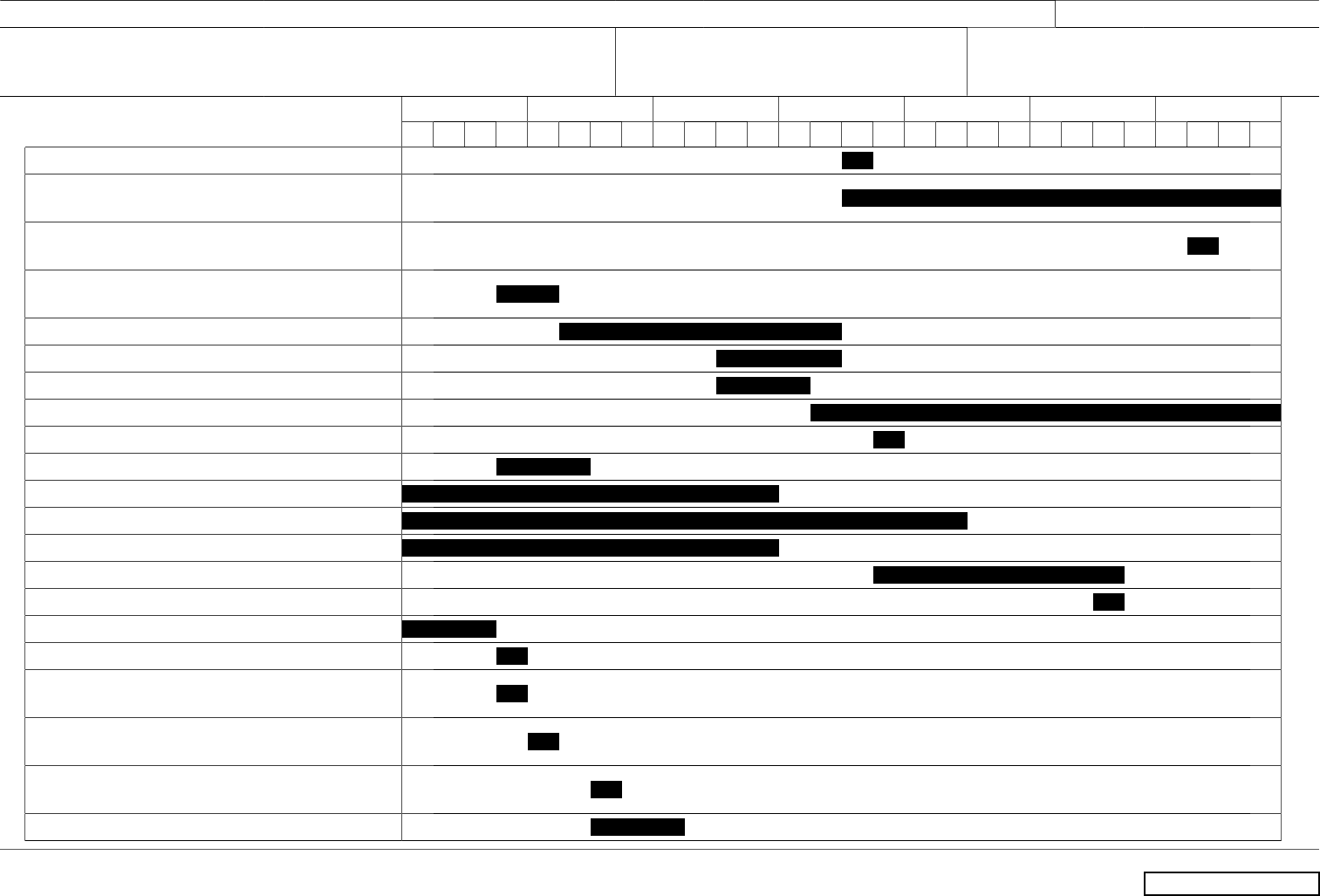
FY 2021 FY 2022 FY 2023 FY 2024 FY 2025 FY 2026 FY 2027
1 2 3 4 1 2 3 4 1 2 3 4 1 2 3 4 1 2 3 4 1 2 3 4 1 2 3 4
CET RAIDR - Advance Development Efforts to
Repurpose FDA Approved Products
CET RAIDR-ENBD - Advance Development
Efforts to Repurpose FDA Approved Products
AUTOINJ - Development
AUTOINJ - Manufacturing
AUTOINJ - Prototyping and Testing
AUTOINJ - FDA Coordination
AUTOINJ - Government Testing
AUTOINJ - Alt Midazolam Development
AUTOINJ - Wet/Dry Atropine Development
DFoS CIDAS BLISTER - Sustainment Cost
Reduction Plan (SCRP)
DFoS CIDAS BLISTER - Developmental
Testing (DT) phase 1
DFoS CIDAS BLISTER - Developmental
Testing (DT) phase 2
DFoS CIDAS BLISTER - System Verification
Review (SVR)/Production Readiness Review
DFoS CIDAS BLISTER - Functional
Configuration Audit (FCA)
DFoS CIDAS BLISTER - CIDAS Blister
Operational Testing (OT)
DFoS CIDAS BLISTER - Manufacturing
Readiness Assessment
DFoS CIDAS BLISTER - Physical
Configuration Audit
Volume 4 - 271
UNCLASSIFIED
PE 0604384BP: CHEMICAL/BIOLOGICAL DEFENSE (EMD)
UNCLASSIFIED
Chemical and Biological Defense Program Page 24 of 182 R-1 Line #127
Exhibit R-4, RDT&E Schedule Profile: PB2023Chemical and Biological Defense Program
Date: April 2022
Appropriation/Budget Activity
0400 / 5
R-1 Program Element (Number/Name)
PE 0604384BP / CHEMICAL/BIOLOGICAL
DEFENSE (EMD)
Project (Number/Name)
MT5 / Mitigate (SDD)
FY 2021 FY 2022 FY 2023 FY 2024 FY 2025 FY 2026 FY 2027
1 2 3 4 1 2 3 4 1 2 3 4 1 2 3 4 1 2 3 4 1 2 3 4 1 2 3 4
DFoS CIDAS BLISTER - Milestone C
DFoS CIDAS BLISTER - Full Rate Production
(FRP)
DFoS CIDAS BLISTER - Initial Operational
Capability (IOC)
FAMS-S - System Development and Prototype
Refinement
FAMS-S - DT/OT
FAMS-S - MS C
FAMS-S - Low Rate Initial Production
FAMS-S - Full Rate Production
FAMS-S - IOC
INATS CA - MS B
INATS CA - Clinical Trials
INATS CA - Manufacturing/Auto-Injector
INATS CA - Non-Clinical Studies
INATS CA - NDA Submission Activities
INATS CA - FDA Approval
SEDS - MS A Preparation (SOF)
SEDS - MS A (SOF)
SEDS - Acquisition Decision
Memorandum(ADM) (SOF)
SEDS - Request For Prototype Proposal (RPP)
(SOF and Other Services)
SEDS - Prototype Agreement Award (SOF and
Other Services)
SEDS - Developmental Testing (SOF)
Volume 4 - 272

UNCLASSIFIED
PE 0604384BP: CHEMICAL/BIOLOGICAL DEFENSE (EMD)
UNCLASSIFIED
Chemical and Biological Defense Program Page 25 of 182 R-1 Line #127
Exhibit R-4, RDT&E Schedule Profile: PB2023Chemical and Biological Defense Program
Date: April 2022
Appropriation/Budget Activity
0400 / 5
R-1 Program Element (Number/Name)
PE 0604384BP / CHEMICAL/BIOLOGICAL
DEFENSE (EMD)
Project (Number/Name)
MT5 / Mitigate (SDD)
FY 2021 FY 2022 FY 2023 FY 2024 FY 2025 FY 2026 FY 2027
1 2 3 4 1 2 3 4 1 2 3 4 1 2 3 4 1 2 3 4 1 2 3 4 1 2 3 4
SEDS - Early Developmental Testing (Other
Services)
SEDS - Capability Development Document
(CDD) (Other Services)
SEDS - MS B (SOF)
SEDS - MS B (Other Services)
SEDS - Developmental Testing (DT) (Other
Services)
SEDS - MS C/Full Rate Production (SOF)
SEDS - Initial Operational Capability (SOF)
SEDS - MS C/ Low Rate Initial Production
Decision (Other Services)
SEDS - Full Rate Production (Other Services)
AV TX - Natural History Study (Marburg)
AV TX - Animal Efficacy Studies (Marburg)
AV TX - sNDA (Marburg)
Volume 4 - 273

UNCLASSIFIED
PE 0604384BP: CHEMICAL/BIOLOGICAL DEFENSE (EMD)
UNCLASSIFIED
Chemical and Biological Defense Program Page 26 of 182 R-1 Line #127
Exhibit R-4A, RDT&E Schedule Details: PB2023Chemical and Biological Defense Program
Date: April 2022
Appropriation/Budget Activity
0400 / 5
R-1 Program Element (Number/Name)
PE 0604384BP / CHEMICAL/BIOLOGICAL
DEFENSE (EMD)
Project (Number/Name)
MT5 / Mitigate (SDD)
Schedule Details
Start End
Events Quarter Year Quarter Year
CET RAIDR - Advance Development Efforts to Repurpose FDA Approved Products 1 2022 4 2027
CET RAIDR-ENBD - Advance Development Efforts to Repurpose FDA Approved
Products
1 2023 4 2027
AUTOINJ - Development 1 2021 1 2022
AUTOINJ - Manufacturing 1 2021 4 2022
AUTOINJ - Prototyping and Testing 1 2021 2 2023
AUTOINJ - FDA Coordination 1 2021 3 2023
AUTOINJ - Government Testing 1 2021 2 2022
AUTOINJ - Alt Midazolam Development 1 2023 4 2026
AUTOINJ - Wet/Dry Atropine Development 1 2023 4 2027
DFoS CIDAS BLISTER - Sustainment Cost Reduction Plan (SCRP) 1 2021 3 2022
DFoS CIDAS BLISTER - Developmental Testing (DT) phase 1 2 2021 3 2021
DFoS CIDAS BLISTER - Developmental Testing (DT) phase 2 4 2022 4 2023
DFoS CIDAS BLISTER - System Verification Review (SVR)/Production Readiness
Review
2 2023 2 2023
DFoS CIDAS BLISTER - Functional Configuration Audit (FCA) 3 2023 3 2023
DFoS CIDAS BLISTER - CIDAS Blister Operational Testing (OT) 4 2023 4 2023
DFoS CIDAS BLISTER - Manufacturing Readiness Assessment 1 2024 1 2024
DFoS CIDAS BLISTER - Physical Configuration Audit 2 2024 2 2024
DFoS CIDAS BLISTER - Milestone C 3 2024 3 2024
DFoS CIDAS BLISTER - Full Rate Production (FRP) 3 2024 4 2027
DFoS CIDAS BLISTER - Initial Operational Capability (IOC) 2 2027 2 2027
FAMS-S - System Development and Prototype Refinement 4 2021 1 2022
Volume 4 - 274

UNCLASSIFIED
PE 0604384BP: CHEMICAL/BIOLOGICAL DEFENSE (EMD)
UNCLASSIFIED
Chemical and Biological Defense Program Page 27 of 182 R-1 Line #127
Exhibit R-4A, RDT&E Schedule Details: PB2023Chemical and Biological Defense Program
Date: April 2022
Appropriation/Budget Activity
0400 / 5
R-1 Program Element (Number/Name)
PE 0604384BP / CHEMICAL/BIOLOGICAL
DEFENSE (EMD)
Project (Number/Name)
MT5 / Mitigate (SDD)
Start End
Events Quarter Year Quarter Year
FAMS-S - DT/OT 2 2022 2 2024
FAMS-S - MS C 3 2023 2 2024
FAMS-S - Low Rate Initial Production 3 2023 1 2024
FAMS-S - Full Rate Production 2 2024 4 2027
FAMS-S - IOC 4 2024 4 2024
INATS CA - MS B 4 2021 2 2022
INATS CA - Clinical Trials 1 2021 4 2023
INATS CA - Manufacturing/Auto-Injector 1 2021 2 2025
INATS CA - Non-Clinical Studies 1 2021 4 2023
INATS CA - NDA Submission Activities 4 2024 3 2026
INATS CA - FDA Approval 3 2026 3 2026
SEDS - MS A Preparation (SOF) 1 2021 3 2021
SEDS - MS A (SOF) 4 2021 4 2021
SEDS - Acquisition Decision Memorandum(ADM) (SOF) 4 2021 4 2021
SEDS - Request For Prototype Proposal (RPP) (SOF and Other Services) 1 2022 1 2022
SEDS - Prototype Agreement Award (SOF and Other Services) 3 2022 3 2022
SEDS - Developmental Testing (SOF) 3 2022 1 2023
SEDS - Early Developmental Testing (Other Services) 3 2022 3 2023
SEDS - Capability Development Document (CDD) (Other Services) 2 2023 2 2023
SEDS - MS B (SOF) 2 2023 2 2023
SEDS - MS B (Other Services) 4 2023 4 2023
SEDS - Developmental Testing (DT) (Other Services) 2 2024 4 2025
SEDS - MS C/Full Rate Production (SOF) 4 2024 4 2024
SEDS - Initial Operational Capability (SOF) 4 2025 4 2025
SEDS - MS C/ Low Rate Initial Production Decision (Other Services) 3 2026 3 2026
Volume 4 - 275
UNCLASSIFIED
PE 0604384BP: CHEMICAL/BIOLOGICAL DEFENSE (EMD)
UNCLASSIFIED
Chemical and Biological Defense Program Page 28 of 182 R-1 Line #127
Exhibit R-4A, RDT&E Schedule Details: PB2023Chemical and Biological Defense Program
Date: April 2022
Appropriation/Budget Activity
0400 / 5
R-1 Program Element (Number/Name)
PE 0604384BP / CHEMICAL/BIOLOGICAL
DEFENSE (EMD)
Project (Number/Name)
MT5 / Mitigate (SDD)
Start End
Events Quarter Year Quarter Year
SEDS - Full Rate Production (Other Services) 4 2027 4 2027
AV TX - Natural History Study (Marburg) 1 2021 1 2022
AV TX - Animal Efficacy Studies (Marburg) 4 2021 4 2023
AV TX - sNDA (Marburg) 4 2023 4 2023
Volume 4 - 276

UNCLASSIFIED
PE 0604384BP: CHEMICAL/BIOLOGICAL DEFENSE (EMD)
UNCLASSIFIED
Chemical and Biological Defense Program Page 29 of 182 R-1 Line #127
Exhibit R-2A, RDT&E Project Justification: PB2023Chemical and Biological Defense Program
Date: April 2022
Appropriation/Budget Activity
0400 / 5
R-1 Program Element (Number/Name)
PE 0604384BP / CHEMICAL/BIOLOGICAL
DEFENSE (EMD)
Project (Number/Name)
PT5 / Protect (SDD)
COST ($ in Millions)
Prior
Years FY 2021 FY 2022
FY 2023
Base
FY 2023
OCO
FY 2023
Total FY 2024 FY 2025 FY 2026 FY 2027
Cost To
Complete
Total
Cost
PT5: Protect (SDD)
- 0.000 0.000 96.860 - 96.860 98.427 78.868 48.793 35.494 Continuing Continuing
Quantity of RDT&E Articles - - - - - - - - - -
A. Mission Description and Budget Item Justification
The Protect System Development & Demonstration (SDD) Project enhances mission performance and provides effective protection against current and emerging threats
by rapidly developing and fielding modernized protection capabilities. Developmental efforts focus on advances in materials and systems engineering to enhance
protective properties against a broader array of hazards, while reducing CWMD operational challenges and logistical burdens. Developmental efforts focus on advanced
medical countermeasures that provide safe and effective medical defenses against biological agents (bacteria, toxins, and viruses), emerging infectious diseases, and
chemical agents.
Efforts included in this Project are:
(1) Botulinum Monoclonal Antibodies (BOT MAB),
(2) Uniform Integrated Protection Ensemble Family of Systems Air (UIPE FOS AIR),
(3) UIPE FOS General Purpose (UIPE FOS GP),
(4) UIPE FOS Gloves (UIPE FOS GLOVES),
(5) Special Immunizations Program (VAC SIP) ,
(6) Advanced System for Protection and Integrated Reduction of Encumbrances-Enhanced Biodefense (ASPIRE-ENBD) ,
(7) Collective Protection Conex-Enhanced Biodefense (COL PRO CONEX-ENBD), and
(8) Portable Biocontainment Patient Transport System-Enhanced Biodefense (PPTS-ENBD)
The BOT MAB program was initiated by the Medical Countermeasure Platform Technologies (MCMPT). The goal of BOT MAB advanced development effort is to
counter exposure to BOT A & B toxins. The program is leveraging the advanced platform technology developed within the DoD's Advanced Development Manufacturing
(ADM) facility that was initiated by the MCMPT. The BOT MAB will be a monoclonal antibody cocktail that protects the warfighter against exposure to BOT A&B
serotypes. FY23 funding is required to ensure large scale Good Manufacturing Practices (GMP) and execution product/process characterization /validation meets
schedule.
The UIPE FoS Air program will provide the Warfighter percutaneous protection from operationally relevant traditional and non-traditional Chemical, Biological,
Radiological, Nuclear (CBRN) threats. UIPE FoS Air will improve aircrew performance and survivability under CBRN conditions by reducing thermal burden and
bulk, while increasing mobility and resulting in an increase operational effectiveness. The UIPE FoS Air is composed of two variants. The UIPE FoS Air Chemical,
Biological, Radiological Layer (CBRL) to address the specific requirements of the United States Air Force (USAF) tactical/ejection fixed wing platforms and the Two
Piece Undergarment (2PUG) to address the remaining USAF and United States Navy / United States Marine Corps tactical/ejection seat (rotary wing) and non-ejection
Volume 4 - 277

UNCLASSIFIED
PE 0604384BP: CHEMICAL/BIOLOGICAL DEFENSE (EMD)
UNCLASSIFIED
Chemical and Biological Defense Program Page 30 of 182 R-1 Line #127
Exhibit R-2A, RDT&E Project Justification: PB2023Chemical and Biological Defense Program
Date: April 2022
Appropriation/Budget Activity
0400 / 5
R-1 Program Element (Number/Name)
PE 0604384BP / CHEMICAL/BIOLOGICAL
DEFENSE (EMD)
Project (Number/Name)
PT5 / Protect (SDD)
(fixed wing) platforms. In FY23, UIPE FoS Air will finalize EMD testing and conduct integration testing on 40+ USAF, USN, and USMC platforms for airworthiness, safe
to fly and final flight clearance.
UIPE FoS GP is part of a family of systems that will give the Warfighter percutaneous protection from operationally relevant traditional, non-traditional, and advanced
CBRN/Toxic Industrial Material (TIM) threats likely to be encountered during joint force operations. The legacy chemical biological garment is nearing the end of its
service life and does not meet updated requirements such as emerging threats, aerosol protection, and flame resistance. The UIPE FoS GP is a two-piece lightweight
(compared to the legacy system) duty uniform replacement that has an aerosol liner, is flame resistant, and does not reduce Warfighter effectiveness in the areas of
mobility and thermal burden. In FY23, UIPE FoS GP will conduct System Verification Review, complete MOT&E, award production contract, and conduct Production
Verification Testing (PVT). In FY23, UIPE FoS GP program will obtain a MS C Low Rate Initial Production decision and conduct a Multi-Service Operational Test and
Evaluation.
UIPE FoS Gloves provides percutaneous protection to the hand and wrist interface of the warfighter against traditional and non-traditional CBRN threats. UIPE FoS
Gloves will provide improved comfort, tactility and dexterity and for certain mission profiles enhanced touch screen and flame resistant capability. The UIPE FoS Gloves
will be developed using a Middle Tier Acquisition (MTA) approach. In FY23 the UIPE FoS Gloves program will continue to conduct prototype development on multiple
prototypes for multiple mission profiles (General Purpose, Aviation Heavy and Aviation Light).
The SIP continually manages, updates, and executes the Investigational New Drugs (INDs) of selected prophylaxis, treatments and diagnostics development products
which provide additional protection to individuals that are at high risk of exposure to CBRN agents. These vaccines will be used to provide additional levels of
protection to laboratory workers conducting research. DoD has the mission to maintain IND vaccines in Good Manufacturing Practice (GMP) storage and to conduct the
periodic potency and stability testing of these materials to support submissions to the FDA. In FY23 SIP continues storage, distribution, potency testing, and biosurety
compliance activities.
ASPIRE-ENBD, a new start program in FY23, supports unencumbering warfighters and revolutionizing respiratory and ocular protection against CBRN threats, including
protection from biological, toxic industrial chemicals, and other emerging threats. ASPIRE provides a revolutionary new capability to address interface issues with new
and emerging equipment. ASPIRE will unencumber the warfighter while still providing respiratory and ocular protection against CBRN agents, provide durable and
extended wear capability, and incorporate anti-microbial materials to develop a reusable respirator. The solution will be optimized to minimize impact on the wearer's
performance to continue lethality in CB environment by reducing burden, improving filtration capability, utilizing powered and supplied air systems as required, and
integrate with existing and future equipment that cannot be integrated with current mask systems. ASPIRE will provide a revolutionized capability to the Services for
the next generation of respiratory and ocular protection. The ASPIRE Enhanced Biodefense effort will develop half masks / bio-masks that are low-burden, provide
protection against bio threats, and are designed as a reusable system with modularity and/or scalability for additional ocular protection.
COL PRO CONEX-ENBD, a new start program in FY23, will provide rest and relief for aircrew in a Chemical, Biological, Radiological, and Nuclear (CBRN) environment.
The CPC CBRN defense system provides an isolation area to treat infectious personnel and protecting embarked crew from infection. It is a modified container/Conex
box that can be transported to host platform with minimal setup.
Volume 4 - 278

UNCLASSIFIED
PE 0604384BP: CHEMICAL/BIOLOGICAL DEFENSE (EMD)
UNCLASSIFIED
Chemical and Biological Defense Program Page 31 of 182 R-1 Line #127
Exhibit R-2A, RDT&E Project Justification: PB2023Chemical and Biological Defense Program
Date: April 2022
Appropriation/Budget Activity
0400 / 5
R-1 Program Element (Number/Name)
PE 0604384BP / CHEMICAL/BIOLOGICAL
DEFENSE (EMD)
Project (Number/Name)
PT5 / Protect (SDD)
The PPTS-ENBD, a new start program in FY23, is a patient transport system that enables safe transport of asymptomatic, symptomatic, or infected patients while
ensuring that the medical attending personnel and platform crew members are protected from exposure.
B. Accomplishments/Planned Programs ($ in Millions)
FY 2021 FY 2022 FY 2023
Title: 1) ASPIRE - Enhanced Biodefense (ENBD)
Description: This effort will focus on Low Burden Half Mask
FY 2023 Plans:
Award CWMD OTA task for development of biodefense half-masks and start first round of prototype evaluations.
FY 2022 to FY 2023 Increase/Decrease Statement:
Additional investment in enhanced biodefense and pandemic preparedness.
- - 1.600
Title: 2) COL PRO CONEX - Enhanced Biodefense (ENBD)
Description: This effort will focus on Collective Protection CONEX (CPC) which is a Chemical, Biological, Radiological, and
Nuclear (CBRN) defense system that provides an isolation area to treat infectious personnel and protecting embarked crew from
infection. It is a modified container/Conex box that can be transported to host platform with minimal setup.
FY 2023 Plans:
Complete concept design, system planning and conduct an initial concept demonstration.
FY 2022 to FY 2023 Increase/Decrease Statement:
Additional investment in enhanced biodefense and pandemic preparedness.
- - 1.900
Title: 3) PPTS - Enhanced Biodefense (ENBD)
Description: This effort will focus on Portable Biocontainment Patient Transport System (PPTS) which is a patient transport
system that enables safe transport of asymptomatic, symptomatic, or infected patients while ensuring that the medical attending
personnel and platform crew members are protected from exposure.
FY 2023 Plans:
Complete concept design and test strategy development.
FY 2022 to FY 2023 Increase/Decrease Statement:
Additional investment in enhanced biodefense and pandemic preparedness.
- - 4.200
Title: 4) Botulinum Monoclonal Antibodies (BOT MAB)
Description: Manufacturing
- - 37.741
Volume 4 - 279

UNCLASSIFIED
PE 0604384BP: CHEMICAL/BIOLOGICAL DEFENSE (EMD)
UNCLASSIFIED
Chemical and Biological Defense Program Page 32 of 182 R-1 Line #127
Exhibit R-2A, RDT&E Project Justification: PB2023Chemical and Biological Defense Program
Date: April 2022
Appropriation/Budget Activity
0400 / 5
R-1 Program Element (Number/Name)
PE 0604384BP / CHEMICAL/BIOLOGICAL
DEFENSE (EMD)
Project (Number/Name)
PT5 / Protect (SDD)
B. Accomplishments/Planned Programs ($ in Millions)
FY 2021 FY 2022 FY 2023
FY 2023 Plans:
Continue large scale Good Manufacturing Practices (GMP) and execute product/process characterization and validation required.
FY 2022 to FY 2023 Increase/Decrease Statement:
Funding transferred from another Project due to budget restructure. FY22 funding ($33.000 Million) remains in MB5. Increase is
due to cost increase in the production of manufacturing runs.
Title: 5) Botulinum Monoclonal Antibodies (BOT MAB)
Description: Clinical and Nonclinical Studies
FY 2023 Plans:
Obtain results from the Phase 2 clinical trial and along with the pivotal animal studies and initiate Phase 3 clinical study, and
continue manufacturing for PPQ lots to support clinical study and IOC.
FY 2022 to FY 2023 Increase/Decrease Statement:
Funding transferred from another Project due to budget restructure. FY22 funding ($27.723 Million) remains in MB5.
- - 27.000
Title: 6) UIPE FoS General Purpose (GP)
Description: Development of the next generation protective ensembles.
FY 2023 Plans:
Conduct System Verification Review, complete MOT&E, award production contract, and conduct Production Verification Testing
(PVT).
FY 2022 to FY 2023 Increase/Decrease Statement:
Funding transferred from another Project due to budget restructure. FY22 funding ($8.167M) remains in IP5. Increase due to
funding needed for Multi-Service Operational Test and Evaluation.
- - 9.640
Title: 7) UIPE FoS Air
Description: Design, Test, and Integration of the 2PUG
FY 2023 Plans:
Finalize EMD testing and conduct integration testing on 40+ USAF, USN, and USMC platforms for airworthiness, safe to fly and
final flight clearance.
FY 2022 to FY 2023 Increase/Decrease Statement:
- - 5.132
Volume 4 - 280
UNCLASSIFIED
PE 0604384BP: CHEMICAL/BIOLOGICAL DEFENSE (EMD)
UNCLASSIFIED
Chemical and Biological Defense Program Page 33 of 182 R-1 Line #127
Exhibit R-2A, RDT&E Project Justification: PB2023Chemical and Biological Defense Program
Date: April 2022
Appropriation/Budget Activity
0400 / 5
R-1 Program Element (Number/Name)
PE 0604384BP / CHEMICAL/BIOLOGICAL
DEFENSE (EMD)
Project (Number/Name)
PT5 / Protect (SDD)
B. Accomplishments/Planned Programs ($ in Millions)
FY 2021 FY 2022 FY 2023
Funding transferred from another Project due to budget restructure. FY22 funding ($3.858 Million) remains in IP5. Increase due
to expansion of integration, flight clearance, and airworthiness testing.
Title: 8) UIPE FoS Gloves
Description: Development of the Next Generation Protective Glove
FY 2023 Plans:
Continue to conduct prototype development on multiple prototypes for multiple mission profiles (General Purpose, Aviation
Heavy and Aviation Light). Conduct testing such as tactility, dexterity, chemical protection, flame resistance, wear trials, and
interoperability will be conducted as well as analytical framework analysis and down-selects.
FY 2022 to FY 2023 Increase/Decrease Statement:
Funding transferred from another Project due to budget restructure. FY22 funding ($1.182M) remains in IP5. Program/project
transitioned to Engineering and Manufacturing Development Phase.
- - 2.699
Title: 9) VAC SIP
Description: Storage, Distribution, Potency Testing
FY 2023 Plans:
Continue storage, distribution, potency testing, and biosurety compliance activities in support of the Special Immunization
Program.
FY 2022 to FY 2023 Increase/Decrease Statement:
Funding transferred from another Project due to budget restructure. FY22 funding ($6.631 Million) remains in MB5. Increase due
to change in program/project technical parameters.
- - 6.948
Accomplishments/Planned Programs Subtotals
- - 96.860
C. Other Program Funding Summary ($ in Millions)
Line Item FY 2021 FY 2022
FY 2023
Base
FY 2023
OCO
FY 2023
Total FY 2024 FY 2025 FY 2026 FY 2027
Cost To
Complete Total Cost
• IP4: Individual Protection (ACD&P) 3.448 3.968 0.000 - 0.000 0.000 0.000 0.000 0.000 0.000 7.416
• PT4: Protect (ACD&P) 0.000 0.000 203.689 - 203.689 183.220 139.375 113.754 105.176 Continuing Continuing
• IP5: Individual Protection (SDD) 17.129 18.941 0.000 - 0.000 0.000 0.000 0.000 0.000 0.000 36.070
• MB5: Medical Biological
Defense (SDD)
117.157 137.348 0.000 - 0.000 0.000 0.000 0.000 0.000 0.000 254.505
Volume 4 - 281

UNCLASSIFIED
PE 0604384BP: CHEMICAL/BIOLOGICAL DEFENSE (EMD)
UNCLASSIFIED
Chemical and Biological Defense Program Page 34 of 182 R-1 Line #127
Exhibit R-2A, RDT&E Project Justification: PB2023Chemical and Biological Defense Program
Date: April 2022
Appropriation/Budget Activity
0400 / 5
R-1 Program Element (Number/Name)
PE 0604384BP / CHEMICAL/BIOLOGICAL
DEFENSE (EMD)
Project (Number/Name)
PT5 / Protect (SDD)
C. Other Program Funding Summary ($ in Millions)
Line Item FY 2021 FY 2022
FY 2023
Base
FY 2023
OCO
FY 2023
Total FY 2024 FY 2025 FY 2026 FY 2027
Cost To
Complete Total Cost
• PHM032: UNIFORM
INTEGRATED PROTECTIVE
ENSEMBLE FOS GLOVES
(UIPE FOS GLOVES)
0.000 0.000 0.000 - 0.000 7.478 7.974 7.974 8.328 Continuing Continuing
• PHM033: UNIFORM
INTEGRATED PROTECTIVE
ENSEMBLE GENERAL
PURPOSE (UIPE FOS GP)
0.000 17.686 51.130 - 51.130 101.486 174.124 194.691 264.433 Continuing Continuing
• PHM034: UNIFORM
INTEGRATED PROTECTION
ENSEMBLE FOS
AIR (UIPE FOS AIR)
4.786 34.568 23.407 - 23.407 25.794 26.195 26.403 17.586 Continuing Continuing
• PHM039: BOTULINUM
MONOCLONAL
ANTIBODIES (BOT MAB)
0.000 0.000 0.000 - 0.000 0.000 0.000 20.157 21.299 Continuing Continuing
Remarks
D. Acquisition Strategy
ADVANCED SYSTEM FOR PROTECTION AND INTEGRATED REDUCTION OF ENCUMBRANCES-ENHANCED BIODEFENSE (ASPIRE-ENBD)
Efforts will be accomplished by awarding an agreement through the Countering Weapons of Mass Destruction Other Transaction Authority (CWMD OTA) to develop
multiple prototypes for further development and evaluation to select down to a final solution.
COLLECTIVE PROTECTION CONEX-ENHANCED BIODEFENSE (COL PRO CONEX-ENBD)
Resource prototype system design and development through the CWMD OTA contract.
PORTABLE PATIENT TRANSPORT SYSTEM-ENHANCED BIODEFENSE (PPTS-ENBD)
Resource prototype system design and development through the Countering Weapons of Mass Destruction (CWMD) Other Transactional Authority (OTA) contract.
Leverage lessons learned from previous efforts to optimize performance and minimize total ownership cost.
Volume 4 - 282

UNCLASSIFIED
PE 0604384BP: CHEMICAL/BIOLOGICAL DEFENSE (EMD)
UNCLASSIFIED
Chemical and Biological Defense Program Page 35 of 182 R-1 Line #127
Exhibit R-2A, RDT&E Project Justification: PB2023Chemical and Biological Defense Program
Date: April 2022
Appropriation/Budget Activity
0400 / 5
R-1 Program Element (Number/Name)
PE 0604384BP / CHEMICAL/BIOLOGICAL
DEFENSE (EMD)
Project (Number/Name)
PT5 / Protect (SDD)
BOTULINUM MONOCLONAL ANTIBODIES (BOT MAB)
The BOT MAB program was initiated by the Medical Countermeasure Platform Technologies (MCMPT). The regulatory approach of the program is to pursue
development of products for FDA approval. The program will conduct clinical and non-clinical studies to confirm duration of protection and on-set of protection. The
performer will complete small model development and procure long lead items during the Technology Maturation and Risk Reduction (TMRR) phase in order to mitigate
risk and accelerate the schedule activities for BLA submission during the Product &Development (P&D) phase. The performer will continue large scale manufacturing
during the Engineering and Manufacturing Development (EMD) phase in order to accelerate the schedule activities for the prophylactic indication.
UNIFORM INTEGRATED PROTECTIVE ENSEMBLE GENERAL PURPOSE (UIPE FOS GP)
UIPE FoS GP used an Other Transaction Authority (OTA) and Government designed prototypes produced in conjunction with an Industry Partner to acquire prototypes
for early user testing. Warfighter feedback, trade space analysis, and chemical testing resulted in three government designed candidates being down selected in
3QFY20. These three candidates are designed to minimize operational burden and provide improved form, fit, function, and integration with the current Warfighter
kits compared to legacy systems. Additional testing, review of the results, stakeholder guidance, and a risk analysis led to the selection of one candidate in FY21 - the
Integrated Chemical Biological Lightweight Improved Thermal Ensemble Flame Resistant (ICBLITE FR). UIPE FoS GP will be executing multiple awards in the next 3
years, where production occurring before the milestone to allow for completion of UIPE evaluation (effectiveness, suitability and survivability) prior to award of a high
ceiling production contract. This will allow the vendor to better estimate pricing (labor and material) with an initial production ramp up; and Mitigates schedule risk for
award of a high ceiling production contract.
UNIFORM INTEGRATED PROTECTION ENSEMBLE FOS AIR (UIPE FOS AIR)
The UIPE FoS Air utilizes a streamlined acquisition strategy that identifies mature technology and capitalizes on work accomplished by the USAF IAE and UIPE FoS
General Purpose programs. The UIPE FoS Air will utilize an Milestone A-C acquisition strategy that will accelerate fielding to the Warfighter. The contract strategy
leverages the USAF Integrated Aircrew Ensemble (IAE) SBIR Phase III contract to procure UIPE Air CBRL. The UIPE FoS Air 2PUG will be procured utilizing a
Government design on a separate contract.
UNIFORM INTEGRATED PROTECTIVE ENSEMBLE FOS GLOVES (UIPE FOS GLOVES)
The UIPE FoS Glove program conducted market research through both Requests For Information (RFIs) and a call for White Papers through an Other Transaction
Authority (OTA) contracting approach. Eight white papers were deemed acceptable and will be pursued through a Mid-Tier Acquisition Rapid Prototyping strategy.
Candidate technologies will undergo Early User Tests/Wear events and material and system level testing to identify available capabilities as well as Analytical framework
analyses to determine the most suitable solution(s) per mission profile.
SPECIAL IMMUNIZATION PROGRAM (VAC SIP)
Volume 4 - 283

UNCLASSIFIED
PE 0604384BP: CHEMICAL/BIOLOGICAL DEFENSE (EMD)
UNCLASSIFIED
Chemical and Biological Defense Program Page 36 of 182 R-1 Line #127
Exhibit R-2A, RDT&E Project Justification: PB2023Chemical and Biological Defense Program
Date: April 2022
Appropriation/Budget Activity
0400 / 5
R-1 Program Element (Number/Name)
PE 0604384BP / CHEMICAL/BIOLOGICAL
DEFENSE (EMD)
Project (Number/Name)
PT5 / Protect (SDD)
The SIP effort continually manages, updates, and executes the Investigational New Drugs (INDs) of selected prophylaxis, treatments and diagnostics development
products which provide additional protection to individuals that are at high risk of exposure to CBRN agents. Efforts span Good Manufacturing Practices (GMP), Good
Laboratory Practices guidelines necessary to conduct storage and periodic potency testing, as well as clinical administration of products in accordance with the FDA
regulated Investigational New Drug requirements. This Department of Defense program supports the Federal interagency with this effort, as well as academic and
industry partners.
Volume 4 - 284

UNCLASSIFIED
PE 0604384BP: CHEMICAL/BIOLOGICAL DEFENSE (EMD)
UNCLASSIFIED
Chemical and Biological Defense Program Page 37 of 182 R-1 Line #127
Exhibit R-3, RDT&E Project Cost Analysis: PB2023Chemical and Biological Defense Program
Date: April 2022
Appropriation/Budget Activity
0400 / 5
R-1 Program Element (Number/Name)
PE 0604384BP / CHEMICAL/BIOLOGICAL
DEFENSE (EMD)
Project (Number/Name)
PT5 / Protect (SDD)
Product Development ($ in Millions)
FY 2021 FY 2022
FY 2023
Base
FY 2023
OCO
FY 2023
Total
Cost Category Item
Contract
Method
& Type
Performing
Activity & Location
Prior
Years Cost
Award
Date Cost
Award
Date Cost
Award
Date Cost
Award
Date Cost
Cost To
Complete
Total
Cost
Target
Value of
Contract
ASPIRE-ENBD - HW C -
Bio half-mask Prototype
Development
Various Various : Various 0.000 0.000 0.000 1.127 Dec 2022 0.000 1.127 Continuing Continuing 0.000
COL PRO CONEX-ENBD -
HW S - Concept Design
Various TBD : N/A 0.000 0.000 0.000 0.761 Dec 2022 0.000 0.761 Continuing Continuing 0.000
PPTS-ENBD - HW S -
Prototyping Contract
Various TBD : N/A 0.000 0.000 0.000 2.048 Dec 2022 0.000 2.048 Continuing Continuing 0.000
UIPE FOS GP - HW C -
Prototype Development
MIPR TBD : N/A 0.000 0.000 0.000 0.839 Nov 2022 0.000 0.839 Continuing Continuing 0.000
UIPE FOS AIR - HW C -
Prototype Development
(2PUG)
Various Various : Various 0.000 0.000 0.000 0.330 Nov 2022 0.000 0.330 Continuing Continuing 0.000
UIPE FOS GLOVES
- HW C - Prototype
Manufacturing,
Demonstration and Down-
select
MIPR Various : Various 0.000 0.000 0.000 0.562 Nov 2022 0.000 0.562 Continuing Continuing 0.000
Subtotal
0.000 0.000 0.000 5.667 0.000 5.667 Continuing Continuing N/A
Support ($ in Millions)
FY 2021 FY 2022
FY 2023
Base
FY 2023
OCO
FY 2023
Total
Cost Category Item
Contract
Method
& Type
Performing
Activity & Location
Prior
Years Cost
Award
Date Cost
Award
Date Cost
Award
Date Cost
Award
Date Cost
Cost To
Complete
Total
Cost
Target
Value of
Contract
ASPIRE-ENBD - ES S -
Engineering and Technical
Support
Various Various : Various 0.000 0.000 0.000 0.286 Dec 2022 0.000 0.286 Continuing Continuing 0.000
COL PRO CONEX-ENBD
- ES S - Engineering,
Logistics, Technical, IPT
Support
MIPR Various : Various 0.000 0.000 0.000 0.745 Dec 2022 0.000 0.745 Continuing Continuing 0.000
PPTS-ENBD - ES S -
Engineering, Logistics,
Techinical, IPT Support
MIPR Various : Various 0.000 0.000 0.000 1.504 Dec 2022 0.000 1.504 Continuing Continuing 0.000
Volume 4 - 285

UNCLASSIFIED
PE 0604384BP: CHEMICAL/BIOLOGICAL DEFENSE (EMD)
UNCLASSIFIED
Chemical and Biological Defense Program Page 38 of 182 R-1 Line #127
Exhibit R-3, RDT&E Project Cost Analysis: PB2023Chemical and Biological Defense Program
Date: April 2022
Appropriation/Budget Activity
0400 / 5
R-1 Program Element (Number/Name)
PE 0604384BP / CHEMICAL/BIOLOGICAL
DEFENSE (EMD)
Project (Number/Name)
PT5 / Protect (SDD)
Support ($ in Millions)
FY 2021 FY 2022
FY 2023
Base
FY 2023
OCO
FY 2023
Total
Cost Category Item
Contract
Method
& Type
Performing
Activity & Location
Prior
Years Cost
Award
Date Cost
Award
Date Cost
Award
Date Cost
Award
Date Cost
Cost To
Complete
Total
Cost
Target
Value of
Contract
UIPE FOS GP - ES C -
Engineering & Technical
IPT Support / SME
Support
Various Various : Various 0.000 0.000 0.000 2.477 Nov 2022 0.000 2.477 Continuing Continuing 0.000
UIPE FOS GP - ILS S -
Integrated Log Support-
System
Various Various : Various 0.000 0.000 0.000 0.608 Nov 2022 0.000 0.608 Continuing Continuing 0.000
UIPE FOS AIR - ES C
- Engineering and IPT
Support
Various Various : Various 0.000 0.000 0.000 1.821 Nov 2022 0.000 1.821 Continuing Continuing 0.000
UIPE FOS GLOVES - ES
C - Engineering, Logistics,
Technical, IPT Support
MIPR Various : Various 0.000 0.000 0.000 0.812 Nov 2022 0.000 0.812 Continuing Continuing 0.000
VAC SIP - Storage and
Distribution of Vaccines
SS/FP
Fisher BioServices :
Rockville, MD
0.000 0.000 0.000 1.365 Mar 2023 0.000 1.365 Continuing Continuing 0.000
Subtotal
0.000 0.000 0.000 9.618 0.000 9.618 Continuing Continuing N/A
Test and Evaluation ($ in Millions)
FY 2021 FY 2022
FY 2023
Base
FY 2023
OCO
FY 2023
Total
Cost Category Item
Contract
Method
& Type
Performing
Activity & Location
Prior
Years Cost
Award
Date Cost
Award
Date Cost
Award
Date Cost
Award
Date Cost
Cost To
Complete
Total
Cost
Target
Value of
Contract
ASPIRE-ENBD - OTHT C -
Prototype Evaluation
Various Various : Various 0.000 0.000 0.000 0.075 Dec 2022 0.000 0.075 Continuing Continuing 0.000
COL PRO CONEX-ENBD -
DTE C - T&E Support
MIPR Various : Various 0.000 0.000 0.000 0.271 Dec 2022 0.000 0.271 Continuing Continuing 0.000
PPTS-ENBD - DTE S -
T&E Support
MIPR Various : Various 0.000 0.000 0.000 0.376 Dec 2022 0.000 0.376 Continuing Continuing 0.000
BOT MAB - DTE C - BOT
MONO
C/CPFF
Ology Bioservices :
Inc., Alachua, FL
0.000 0.000 0.000 59.164 Dec 2022 0.000 59.164 Continuing Continuing 0.000
UIPE FOS GP - DTE C -
DT/OT
Various Various : Various 0.000 0.000 0.000 5.022 Nov 2022 0.000 5.022 Continuing Continuing 0.000
Volume 4 - 286

UNCLASSIFIED
PE 0604384BP: CHEMICAL/BIOLOGICAL DEFENSE (EMD)
UNCLASSIFIED
Chemical and Biological Defense Program Page 39 of 182 R-1 Line #127
Exhibit R-3, RDT&E Project Cost Analysis: PB2023Chemical and Biological Defense Program
Date: April 2022
Appropriation/Budget Activity
0400 / 5
R-1 Program Element (Number/Name)
PE 0604384BP / CHEMICAL/BIOLOGICAL
DEFENSE (EMD)
Project (Number/Name)
PT5 / Protect (SDD)
Test and Evaluation ($ in Millions)
FY 2021 FY 2022
FY 2023
Base
FY 2023
OCO
FY 2023
Total
Cost Category Item
Contract
Method
& Type
Performing
Activity & Location
Prior
Years Cost
Award
Date Cost
Award
Date Cost
Award
Date Cost
Award
Date Cost
Cost To
Complete
Total
Cost
Target
Value of
Contract
UIPE FOS AIR - DTE C -
System Level Testing
Various Various : Various 0.000 0.000 0.000 2.587 Nov 2022 0.000 2.587 Continuing Continuing 0.000
UIPE FOS GLOVES - DTE
C - Early User Testing,
Developmental Testing
MIPR Various : Various 0.000 0.000 0.000 1.153 Nov 2022 0.000 1.153 Continuing Continuing 0.000
VAC SIP - OTHT C
- Potency Testing of
Vaccines
C/CPFF
Battelle Memorial
Institute : Columbus,
OH
0.000 0.000 0.000 1.642 Jan 2023 0.000 1.642 Continuing Continuing 0.000
VAC SIP - OTHT C - BOT
& PLG Stability
C/CPFF TBD : N/A 0.000 0.000 0.000 2.080 Jan 2023 0.000 2.080 Continuing Continuing 0.000
VAC SIP - OTHT C
- Potency Testing of
Vaccines #2
MIPR
US Army Medical
Research Institute of
Infectious Disease
(USAMRIID) : Fort
Detrick, MD
0.000 0.000 0.000 1.196 Mar 2023 0.000 1.196 Continuing Continuing 0.000
Subtotal
0.000 0.000 0.000 73.566 0.000 73.566 Continuing Continuing N/A
Management Services ($ in Millions)
FY 2021 FY 2022
FY 2023
Base
FY 2023
OCO
FY 2023
Total
Cost Category Item
Contract
Method
& Type
Performing
Activity & Location
Prior
Years Cost
Award
Date Cost
Award
Date Cost
Award
Date Cost
Award
Date Cost
Cost To
Complete
Total
Cost
Target
Value of
Contract
ASPIRE-ENBD - PM/MS
C - Program Management
Support
Various Various : Various 0.000 0.000 0.000 0.112 Dec 2022 0.000 0.112 Continuing Continuing 0.000
COL PRO CONEX-ENBD
- PM/MS S - Program
Management
MIPR Various : Various 0.000 0.000 0.000 0.123 Dec 2022 0.000 0.123 Continuing Continuing 0.000
PPTS-ENBD - PM/MS S -
Program Management
MIPR Various : Various 0.000 0.000 0.000 0.272 Dec 2022 0.000 0.272 Continuing Continuing 0.000
BOT MAB - PM/MS C -
BOT MONO
Various
JPEO Chem : Bio,
Rad, and Nuc
Defense (JPEO-
CBRND)
0.000 0.000 0.000 5.577 Dec 2022 0.000 5.577 Continuing Continuing 0.000
Volume 4 - 287

UNCLASSIFIED
PE 0604384BP: CHEMICAL/BIOLOGICAL DEFENSE (EMD)
UNCLASSIFIED
Chemical and Biological Defense Program Page 40 of 182 R-1 Line #127
Exhibit R-3, RDT&E Project Cost Analysis: PB2023Chemical and Biological Defense Program
Date: April 2022
Appropriation/Budget Activity
0400 / 5
R-1 Program Element (Number/Name)
PE 0604384BP / CHEMICAL/BIOLOGICAL
DEFENSE (EMD)
Project (Number/Name)
PT5 / Protect (SDD)
Management Services ($ in Millions)
FY 2021 FY 2022
FY 2023
Base
FY 2023
OCO
FY 2023
Total
Cost Category Item
Contract
Method
& Type
Performing
Activity & Location
Prior
Years Cost
Award
Date Cost
Award
Date Cost
Award
Date Cost
Award
Date Cost
Cost To
Complete
Total
Cost
Target
Value of
Contract
UIPE FOS GP - PM/MS C
- Program Management
Support
Various Various : Various 0.000 0.000 0.000 0.694 Nov 2022 0.000 0.694 Continuing Continuing 0.000
UIPE FOS AIR - PM/MS
C - Program Management
Services
MIPR Various : Various 0.000 0.000 0.000 0.394 Nov 2022 0.000 0.394 Continuing Continuing 0.000
UIPE FOS GLOVES
- PM/MS C - Program
Management Support
Various Various : Various 0.000 0.000 0.000 0.172 Dec 2022 0.000 0.172 Continuing Continuing 0.000
VAC SIP - PM Support Various
JPL CBRN EB :
Frederick, MD
0.000 0.000 0.000 0.665 Jan 2023 0.000 0.665 Continuing Continuing 0.000
Subtotal
0.000 0.000 0.000 8.009 0.000 8.009 Continuing Continuing N/A
Prior
Years FY 2021 FY 2022
FY 2023
Base
FY 2023
OCO
FY 2023
Total
Cost To
Complete
Total
Cost
Target
Value of
Contract
Project Cost Totals
0.000 0.000 0.000 96.860 0.000 96.860 Continuing Continuing N/A
Remarks
Volume 4 - 288

UNCLASSIFIED
PE 0604384BP: CHEMICAL/BIOLOGICAL DEFENSE (EMD)
UNCLASSIFIED
Chemical and Biological Defense Program Page 41 of 182 R-1 Line #127
Exhibit R-4, RDT&E Schedule Profile: PB2023Chemical and Biological Defense Program
Date: April 2022
Appropriation/Budget Activity
0400 / 5
R-1 Program Element (Number/Name)
PE 0604384BP / CHEMICAL/BIOLOGICAL
DEFENSE (EMD)
Project (Number/Name)
PT5 / Protect (SDD)
FY 2021 FY 2022 FY 2023 FY 2024 FY 2025 FY 2026 FY 2027
1 2 3 4 1 2 3 4 1 2 3 4 1 2 3 4 1 2 3 4 1 2 3 4 1 2 3 4
ASPIRE-ENBD - Prototype Development
ASPIRE-ENBD - Prototype Testing and
Evaluation
COL PRO CONEX-ENBD - Concept Design
and System Planning
COL PRO CONEX-ENBD - Initial Concept
Demonstration
COL PRO CONEX-ENBD - Iterative
Prototyping
COL PRO CONEX-ENBD - ILS Development
COL PRO CONEX-ENBD - Training
Development
PPTS-ENBD - Concept Development and
System Planning
PPTS-ENBD - CWMD OTA Contract Award
PPTS-ENBD - MOT&E
PPTS-ENBD - User Demonstrations
PPTS-ENBD - Logistics Demonstration
PPTS-ENBD - Technical Design Package
Complete
PPTS-ENBD - Logistics/Sustainment Package
Complete
PPTS-ENBD - Final Prototype Purchase
Contract
BOT MAB - Clinical and Nonclinical
BOT MAB - Platform Development
BOT MAB - Manufacturing
Volume 4 - 289

UNCLASSIFIED
PE 0604384BP: CHEMICAL/BIOLOGICAL DEFENSE (EMD)
UNCLASSIFIED
Chemical and Biological Defense Program Page 42 of 182 R-1 Line #127
Exhibit R-4, RDT&E Schedule Profile: PB2023Chemical and Biological Defense Program
Date: April 2022
Appropriation/Budget Activity
0400 / 5
R-1 Program Element (Number/Name)
PE 0604384BP / CHEMICAL/BIOLOGICAL
DEFENSE (EMD)
Project (Number/Name)
PT5 / Protect (SDD)
FY 2021 FY 2022 FY 2023 FY 2024 FY 2025 FY 2026 FY 2027
1 2 3 4 1 2 3 4 1 2 3 4 1 2 3 4 1 2 3 4 1 2 3 4 1 2 3 4
BOT MAB - MS B
BOT MAB - MS C
BOT MAB - BLA Submission
UIPE FOS GP - Self Assessment Joint
Independent Logistics Assessment
UIPE FOS GP - Capability Development
Document (CDD)
UIPE FOS GP - Test & Evaluation Master Plan
(TEMP) Update
UIPE FOS GP - Milestone B
UIPE FOS GP - DT/OT
UIPE FOS GP - Critical Design Review (CDR)
UIPE FOS GP - Operational Assessment
UIPE FOS GP - Production Initiation Contract
UIPE FOS GP - Manufacturing Readiness
Assessment (MRA)
UIPE FOS GP - Joint Independent Logistics
Assessment (JILA)
UIPE FOS GP - Capability Development
Document (CDD) Update
UIPE FOS GP - Milestone C LRIP
UIPE FOS GP - Production Contract Award
UIPE FOS GP - Multi-Service Operational Test
and Evaluation (MOT&E)
UIPE FOS GP - MS C FRP
UIPE FOS AIR - Prototype Development
(2PUG)
Volume 4 - 290

UNCLASSIFIED
PE 0604384BP: CHEMICAL/BIOLOGICAL DEFENSE (EMD)
UNCLASSIFIED
Chemical and Biological Defense Program Page 43 of 182 R-1 Line #127
Exhibit R-4, RDT&E Schedule Profile: PB2023Chemical and Biological Defense Program
Date: April 2022
Appropriation/Budget Activity
0400 / 5
R-1 Program Element (Number/Name)
PE 0604384BP / CHEMICAL/BIOLOGICAL
DEFENSE (EMD)
Project (Number/Name)
PT5 / Protect (SDD)
FY 2021 FY 2022 FY 2023 FY 2024 FY 2025 FY 2026 FY 2027
1 2 3 4 1 2 3 4 1 2 3 4 1 2 3 4 1 2 3 4 1 2 3 4 1 2 3 4
UIPE FOS AIR - Swatch and System Level
Testing
UIPE FOS AIR - Aircraft Integration Testing
UIPE FOS AIR - Human Factors Testing
UIPE FOS AIR - Fixed Wing Ejection Aircraft
Integration Testing
UIPE FOS AIR - Fixed Wing Non-Ejection
Aircraft Testing
UIPE FOS AIR - Rotary Wing Aircraft
Integration Testing
UIPE FOS AIR - Developmental/Operational
Testing (DT/OT)
UIPE FOS AIR - Safe-to-Fly and Airworthiness
Testing
UIPE FOS AIR - 2PUG Full Rate Production
(FRP)
UIPE FOS AIR - Capability Development
Document (CDD) Update
UIPE FOS AIR - Safe to Fly Certification
UIPE FOS AIR - 2 PUG Initial Operational
Capability (IOC)
UIPE FOS GLOVES - Early User, material and
system level testing
UIPE FOS GLOVES - Draft CDD
UIPE FOS GLOVES - Mid-Tier Acquistion
Rapid Prototype Initiation
UIPE FOS GLOVES - Mid-Tier Acquisition DT/
OT
Volume 4 - 291

UNCLASSIFIED
PE 0604384BP: CHEMICAL/BIOLOGICAL DEFENSE (EMD)
UNCLASSIFIED
Chemical and Biological Defense Program Page 44 of 182 R-1 Line #127
Exhibit R-4, RDT&E Schedule Profile: PB2023Chemical and Biological Defense Program
Date: April 2022
Appropriation/Budget Activity
0400 / 5
R-1 Program Element (Number/Name)
PE 0604384BP / CHEMICAL/BIOLOGICAL
DEFENSE (EMD)
Project (Number/Name)
PT5 / Protect (SDD)
FY 2021 FY 2022 FY 2023 FY 2024 FY 2025 FY 2026 FY 2027
1 2 3 4 1 2 3 4 1 2 3 4 1 2 3 4 1 2 3 4 1 2 3 4 1 2 3 4
UIPE FOS GLOVES - Trade Space Analysis
Decision
UIPE FOS GLOVES - Mid-Tier Acquisition IPR
UIPE FOS GLOVES - Mid-Tier Acquisition
Decision Point
UIPE FOS GLOVES - Mid-Tier Acquisition
Rapid Fielding OR/Milestone C
VAC SIP - Storage, distribution, potency
testing, biosurety compliance activities
Volume 4 - 292

UNCLASSIFIED
PE 0604384BP: CHEMICAL/BIOLOGICAL DEFENSE (EMD)
UNCLASSIFIED
Chemical and Biological Defense Program Page 45 of 182 R-1 Line #127
Exhibit R-4A, RDT&E Schedule Details: PB2023Chemical and Biological Defense Program
Date: April 2022
Appropriation/Budget Activity
0400 / 5
R-1 Program Element (Number/Name)
PE 0604384BP / CHEMICAL/BIOLOGICAL
DEFENSE (EMD)
Project (Number/Name)
PT5 / Protect (SDD)
Schedule Details
Start End
Events Quarter Year Quarter Year
ASPIRE-ENBD - Prototype Development 1 2023 3 2025
ASPIRE-ENBD - Prototype Testing and Evaluation 4 2023 4 2025
COL PRO CONEX-ENBD - Concept Design and System Planning 1 2023 3 2023
COL PRO CONEX-ENBD - Initial Concept Demonstration 4 2023 4 2023
COL PRO CONEX-ENBD - Iterative Prototyping 4 2023 3 2025
COL PRO CONEX-ENBD - ILS Development 3 2024 4 2025
COL PRO CONEX-ENBD - Training Development 4 2024 3 2025
PPTS-ENBD - Concept Development and System Planning 1 2023 4 2023
PPTS-ENBD - CWMD OTA Contract Award 4 2023 4 2023
PPTS-ENBD - MOT&E 4 2025 4 2025
PPTS-ENBD - User Demonstrations 3 2024 4 2024
PPTS-ENBD - Logistics Demonstration 4 2025 4 2025
PPTS-ENBD - Technical Design Package Complete 3 2026 3 2026
PPTS-ENBD - Logistics/Sustainment Package Complete 3 2026 4 2026
PPTS-ENBD - Final Prototype Purchase Contract 4 2026 4 2026
BOT MAB - Clinical and Nonclinical 1 2021 4 2024
BOT MAB - Platform Development 1 2021 4 2025
BOT MAB - Manufacturing 3 2021 4 2025
BOT MAB - MS B 2 2022 2 2022
BOT MAB - MS C 3 2023 3 2023
BOT MAB - BLA Submission 4 2025 4 2025
UIPE FOS GP - Self Assessment Joint Independent Logistics Assessment 1 2021 1 2021
Volume 4 - 293

UNCLASSIFIED
PE 0604384BP: CHEMICAL/BIOLOGICAL DEFENSE (EMD)
UNCLASSIFIED
Chemical and Biological Defense Program Page 46 of 182 R-1 Line #127
Exhibit R-4A, RDT&E Schedule Details: PB2023Chemical and Biological Defense Program
Date: April 2022
Appropriation/Budget Activity
0400 / 5
R-1 Program Element (Number/Name)
PE 0604384BP / CHEMICAL/BIOLOGICAL
DEFENSE (EMD)
Project (Number/Name)
PT5 / Protect (SDD)
Start End
Events Quarter Year Quarter Year
UIPE FOS GP - Capability Development Document (CDD) 1 2021 1 2021
UIPE FOS GP - Test & Evaluation Master Plan (TEMP) Update 3 2021 3 2021
UIPE FOS GP - Milestone B 3 2021 3 2021
UIPE FOS GP - DT/OT 1 2022 3 2023
UIPE FOS GP - Critical Design Review (CDR) 3 2022 3 2022
UIPE FOS GP - Operational Assessment 4 2022 1 2023
UIPE FOS GP - Production Initiation Contract 4 2022 4 2022
UIPE FOS GP - Manufacturing Readiness Assessment (MRA) 3 2023 3 2023
UIPE FOS GP - Joint Independent Logistics Assessment (JILA) 4 2023 4 2023
UIPE FOS GP - Capability Development Document (CDD) Update 4 2023 4 2023
UIPE FOS GP - Milestone C LRIP 4 2023 4 2023
UIPE FOS GP - Production Contract Award 1 2024 1 2024
UIPE FOS GP - Multi-Service Operational Test and Evaluation (MOT&E) 2 2024 2 2024
UIPE FOS GP - MS C FRP 1 2025 1 2025
UIPE FOS AIR - Prototype Development (2PUG) 1 2021 3 2022
UIPE FOS AIR - Swatch and System Level Testing 2 2021 3 2022
UIPE FOS AIR - Aircraft Integration Testing 3 2021 3 2022
UIPE FOS AIR - Human Factors Testing 3 2021 3 2022
UIPE FOS AIR - Fixed Wing Ejection Aircraft Integration Testing 3 2021 3 2023
UIPE FOS AIR - Fixed Wing Non-Ejection Aircraft Testing 3 2021 3 2023
UIPE FOS AIR - Rotary Wing Aircraft Integration Testing 3 2021 3 2023
UIPE FOS AIR - Developmental/Operational Testing (DT/OT) 1 2022 3 2022
UIPE FOS AIR - Safe-to-Fly and Airworthiness Testing 1 2022 3 2023
UIPE FOS AIR - 2PUG Full Rate Production (FRP) 4 2022 4 2022
UIPE FOS AIR - Capability Development Document (CDD) Update 4 2022 4 2022
Volume 4 - 294

UNCLASSIFIED
PE 0604384BP: CHEMICAL/BIOLOGICAL DEFENSE (EMD)
UNCLASSIFIED
Chemical and Biological Defense Program Page 47 of 182 R-1 Line #127
Exhibit R-4A, RDT&E Schedule Details: PB2023Chemical and Biological Defense Program
Date: April 2022
Appropriation/Budget Activity
0400 / 5
R-1 Program Element (Number/Name)
PE 0604384BP / CHEMICAL/BIOLOGICAL
DEFENSE (EMD)
Project (Number/Name)
PT5 / Protect (SDD)
Start End
Events Quarter Year Quarter Year
UIPE FOS AIR - Safe to Fly Certification 4 2023 4 2023
UIPE FOS AIR - 2 PUG Initial Operational Capability (IOC) 2 2024 2 2024
UIPE FOS GLOVES - Early User, material and system level testing 2 2021 2 2024
UIPE FOS GLOVES - Draft CDD 3 2021 3 2021
UIPE FOS GLOVES - Mid-Tier Acquistion Rapid Prototype Initiation 4 2021 1 2022
UIPE FOS GLOVES - Mid-Tier Acquisition DT/OT 2 2022 3 2023
UIPE FOS GLOVES - Trade Space Analysis Decision 3 2022 3 2022
UIPE FOS GLOVES - Mid-Tier Acquisition IPR 2 2023 2 2023
UIPE FOS GLOVES - Mid-Tier Acquisition Decision Point 2 2024 2 2024
UIPE FOS GLOVES - Mid-Tier Acquisition Rapid Fielding OR/Milestone C 3 2024 3 2024
VAC SIP - Storage, distribution, potency testing, biosurety compliance activities 1 2021 4 2026
Volume 4 - 295

UNCLASSIFIED
PE 0604384BP: CHEMICAL/BIOLOGICAL DEFENSE (EMD)
UNCLASSIFIED
Chemical and Biological Defense Program Page 48 of 182 R-1 Line #127
Exhibit R-2A, RDT&E Project Justification: PB2023Chemical and Biological Defense Program
Date: April 2022
Appropriation/Budget Activity
0400 / 5
R-1 Program Element (Number/Name)
PE 0604384BP / CHEMICAL/BIOLOGICAL
DEFENSE (EMD)
Project (Number/Name)
UN5 / Understand (SDD)
COST ($ in Millions)
Prior
Years FY 2021 FY 2022
FY 2023
Base
FY 2023
OCO
FY 2023
Total FY 2024 FY 2025 FY 2026 FY 2027
Cost To
Complete
Total
Cost
UN5: Understand (SDD)
- 0.000 0.000 127.671 - 127.671 101.933 98.742 98.122 72.699 Continuing Continuing
Quantity of RDT&E Articles - - - - - - - - - -
A. Mission Description and Budget Item Justification
The Understand System Development & Demonstration (SDD) Project provides the Joint Force the ability to continually receive information about the CBRN situation
at a desired time and place by detecting, identifying, and quantifying CBRN hazards in air, water, or on land, and on personnel, equipment or facilities. These efforts
support the ability to conduct early warning (informing protective posture) and employment of rapid detection, identification, and analysis tools needed to address
emerging biological threats. Efforts also keep the Joint Force ahead of emerging chemical threats with portable, reduced size, weight, and power, cost detectors to
protect general and specialized forces and to enhance operations on the battlefield by providing early warning and field analytics. Medical diagnostic activities develop
FDA approved products for the Warfighter at the point of care to inform far-forward medical and protection decisions.
Efforts included in this Project are:
(1) Advanced Emerging Threat Defense (AET DEFENSE),
(2) Aerosol & Vapor Chemical Agent Detector (AVCAD),
(3) Compact Vapor Chemical Agent Detector (CVCAD),
(4) Multi-Phase Chemical Agent Detector (MPCAD),
(5) Chemical Biological Radiological and Nuclear (CBRN) Sensor Integration on Robotics Platforms (CSIRP), **Progressed from CA5 in FY2022**
(6) Defense Biological Products Assurance Program (DBPAP),
(7) Defense Biological Products Assurance Program-Enhanced Biodefense (DBPAP-ENBD),
(8) Joint Biological Tactical Detection System (JBTDS),
(9) Nuclear Biological Chemical Reconnaissance Vehicle Sensor Suite Upgrade (NBCRV SSU),
(10) Next Generation Diagnostic System Increment 2 Chemical Diagnostic (NGDS 2 CHEMDX),
(11) NGDS 2 Man Portable Diagnostic System (NGDS 2 MPDS),
(12) Special Purpose Unit Rapid Capability Development and Deployment (SPU RCDD),
(13) Surveillance and Pathogen Characterization - Enhanced BioDefense (SPCHAR-ENBD), and
(14) Chemical and Biological Wearables - Enhanced Biodefense (CB Wearables - ENBD)
The AET DEFENSE program continues to address the highest priority CBRN gaps and supports the Chemical Biological Defense Program (CBDP) Strategic Line of
Effort to meet current and emerging threats by anticipating CB hazards and developing capabilities to counter emerging and future threats. The AET Defense program
collaborates with the Joint Services, interagency, and international partners to align RDT&E resources to determine readiness against emerging threats, to include
NTAs, such as Novichoks and Pharmaceutical-Based Agents (PBA) (e.g. synthetic opioids), emerging biological threats, and other advanced and emerging threats as
Volume 4 - 296

UNCLASSIFIED
PE 0604384BP: CHEMICAL/BIOLOGICAL DEFENSE (EMD)
UNCLASSIFIED
Chemical and Biological Defense Program Page 49 of 182 R-1 Line #127
Exhibit R-2A, RDT&E Project Justification: PB2023Chemical and Biological Defense Program
Date: April 2022
Appropriation/Budget Activity
0400 / 5
R-1 Program Element (Number/Name)
PE 0604384BP / CHEMICAL/BIOLOGICAL
DEFENSE (EMD)
Project (Number/Name)
UN5 / Understand (SDD)
they are identified across the entire CBDP enterprise portfolio. In FY23, AET Defense continues to broaden data set for emerging biological threats and PBAs to better
assess detection and decontamination capabilities.
The AVCAD is a man portable system to detect aerosol and vapor chemical agents. AVCAD fills critical gaps in current Joint Force chemical sensor capabilities, in
the areas of liquid, solid and dusty aerosol Chemical Warfare Agent detection, and detection of specific advanced threats/Non-Traditional Agents. The AVCAD will
also detect low-level off-gassing, or residual vapors, to prevent/mitigate health effects associated with low concentration exposures, and perform remote alarm warning
and reporting. AVCAD will support chemical and biological defense missions, including monitoring, collective protection, base defense, decontamination, unmasking,
reconnaissance, and shipboard and aviation platform chemical detection. In FY23, AVCAD will award the LRIP option and start P&D Testing.
CVCAD is designed to be an unobtrusive, low-profile chemical detection capability that will continuously, and autonomously, monitor and alert general and specialized
units to an unsafe environment without further burdening the warfighters payload or interfering with the primary mission. The small form factor (less than 2 lbs) is
amenable to both man-worn and unmanned aerial or ground system operations to enable timely personnel protective action and other force protection decisions.
In FY23 the four competing prototypes will undergo down selects based on performance. CVCAD will brief Acquisition Steering Panel (ASP) in 2QFY23 to inform
milestone decision and prepare for next milestone, Milestone B or Middle Tier Acquisition (MTA).
The MPCAD is a two-man portable system that will conduct near real-time, near-laboratory grade analysis of solid, liquid, and vapor samples collected by the
operator in a presumptively contaminated area. The MPCAD results will support the Commander's tactical and operational decisions regarding maneuver, protection,
decontamination, and treatment measures. The Army and Marine Corps will employ MPCAD in Dismounted Reconnaissance and Site Assessment missions to
substantiate presumptive detector results. The Air Force will employ the MPCAD to support Post-Event Reconnaissance in support of Reconnaissance and Surveillance
missions by monitoring the environment at airbases after a chemical release. The Air Force will continuously monitor contaminated areas for chronic health effects
levels through analysis of samples from collectors deployed at the contamination site and brought back to the analyzer for identification and quantification. This
information will support commander decisions to determine Mission Oriented Protective Posture (MOPP) levels and eventual termination of cordon restrictions. In FY23,
MPCAD will complete the LRIP contracts, systems engineering support, and complete operational testing.
CSIRP is a prototyping and fielding effort that will focus on repackaging and integrating modular CBRN sensor solutions to enhance Unmanned Aircraft Systems (UAS)
and Unmanned Ground Vehicles (UGV) to provide situational awareness across the echelons of command in order to enable freedom of maneuver and action on the
battlefield. An integrated CSIRP capability will exploit advances in artificial intelligence, machine learning and autonomy, sensing and communication capabilities that
enable timely and accurate detection, warning and reporting of CBRN hazards. This reduces risk at tactical and operational echelons in mounted and dismounted
configurations. CSIRP gives the Joint Force an opportunity to enhance capabilities and maintain operational advantage in a lethal and sophisticated operating
environment. In FY23, CSIRP will integrate a chemical sensor on a UAS to support NBCRV SSU program and continue user evaluation for other robotic platforms.
The DBPAP program facilitates new technology transition to advanced development, efficient production, and timely distribution. The DBPAP serves as the principal
resource for critical biological assays and reagents. The DBPAP also resources the Targeted Acquisition of Reference Materials Augmenting Capabilities (TARMAC),
which generates data on biodefense pathogens to inform product development. The DBPAP establishes a core research and development capability by developing
biological threat agent reference materials (strains, antigens, antibodies and nucleic acids) and detection/diagnostic assays for biothreat agent detection. These
Volume 4 - 297

UNCLASSIFIED
PE 0604384BP: CHEMICAL/BIOLOGICAL DEFENSE (EMD)
UNCLASSIFIED
Chemical and Biological Defense Program Page 50 of 182 R-1 Line #127
Exhibit R-2A, RDT&E Project Justification: PB2023Chemical and Biological Defense Program
Date: April 2022
Appropriation/Budget Activity
0400 / 5
R-1 Program Element (Number/Name)
PE 0604384BP / CHEMICAL/BIOLOGICAL
DEFENSE (EMD)
Project (Number/Name)
UN5 / Understand (SDD)
reagents/assays are leveraged across multiple programs to meet the requirements of the Warfighter and Joint biological defense systems and support the biological
defense community. Through the TARMAC initiative, the DBPAP will use a systematic approach to the introduction of new materials and information into medical
countermeasure development. This includes advanced platform technologies within the DoD's Advanced Development and manufacturing facility. In FY23 the DBPAP
continues development/expansion of biological threat agent reference materials to known and emerging threats. The DBPAP Enhanced Biodefense effort will increase
capabilities supporting biothreat identification and data information collection and management. The rapid detection and assessment of environmental biothreats and
indicators of population-level exposure to enable and enhance force protection decisions and maintain lethality and Force operations tempo (OPTEMPO).
The JBTDS is the first tactical lightweight, low-cost biological surveillance system to detect, collect, and identify Biological Warfare Agent (BWA) aerosols. JBTDS
components are man-portable, battery operable and easy to employ by any military user. JBTDS provides notification of a hazard and enhances battle-space
awareness to protect and preserve the forces and can archive a sample for follow up analysis. When networked, JBTDS augments existing biological detection systems
providing a theater-wide array capable of biological detection, identification and warning to support time sensitive force protection decisions. The JBTDS provides
surface sampling capability which interfaces with the JBTDS identifier to support sensitive site exploitation missions. In FY23, JBTDS will conduct LRIP T&E.
The NBCRV SSU provides maneuver formations with the ability to conduct mounted reconnaissance and surveillance missions of CBRN named areas of interest
(NAIs). The NBCRV SSU will answer the commanders' priority intelligence requirements (PIR) and facilitate proactive risk-based decisions to ensure freedom of action
and survivability. A modern and capable NBCRV SSU is a critical component for Joint Force success when operating in the complex CBRN environment. Operating
with combat vehicles fighting against increasingly capable and determined enemies requires like capability in protection, mobility, and lethality. The NBCRV SSU will
accomplish this by integrating the capability for command and control of unmanned systems with CBRN payload. The NBCRV SSU will provide a CBRN detection,
tipping and queuing system to accomplish desired standoff distances to keep the warfighter out of harm's way and reduce sustainment costs over the current system. In
FY23 the NBCRV SSU will complete Government Developmental and Operational Test to support a future Materiel Release decision.
The NGDS 2 ChemDx program will provide a rapid, hand-held, point-of-care device, for the quantitative detection of acetyl cholinesterase (AChE) activity in finger stick
and venous whole blood samples of individuals suspected of being exposed to cholinesterase inhibiting substances, such as chemical nerve agents. NGDS 2 ChemDx
will be employed by the Army, Air Force, Navy, Marines and SOCOM at multiple echelons of healthcare. NGDS 2 ChemDx test results are to be used to aid in the
diagnosis and treatment of individuals suspected of having exposure to chemical nerve agents. In FY23, NGDS 2 ChemDx continues Engineering & Manufacturing
Development.
The NGDS 2 MPDS program will provide a simple-to-use, portable diagnostic device capability that can be used in austere battlefield environments to assist in the
diagnosis of infectious diseases and biological warfare agents. The MPDS will enable earlier patient diagnosis improve decision support for treatment, evacuation
and command situational awareness, and mitigate the effects of exposure to unknown infectious disease and biological agents. In FY23, NGDS 2 MPDS concludes
hardware, software, assay design, including planning for Initial Operational Test and Evaluation (IOT&E) and completion of two clinical trials, for the device and two
assay panels, and continues development of third assay panel.
SPU RCDD facilitates Joint Special Operations Command (JSOC) rapid response requirements to near-term and emergent chemical-biological defensive capabilities.
This includes select elements from across the Special Operations Force (SOF) Enterprise such as Combatant Commanders Response Forces (CRFs) and other Joint
Volume 4 - 298

UNCLASSIFIED
PE 0604384BP: CHEMICAL/BIOLOGICAL DEFENSE (EMD)
UNCLASSIFIED
Chemical and Biological Defense Program Page 51 of 182 R-1 Line #127
Exhibit R-2A, RDT&E Project Justification: PB2023Chemical and Biological Defense Program
Date: April 2022
Appropriation/Budget Activity
0400 / 5
R-1 Program Element (Number/Name)
PE 0604384BP / CHEMICAL/BIOLOGICAL
DEFENSE (EMD)
Project (Number/Name)
UN5 / Understand (SDD)
Force enabling units such as the 20th Chemical, Biological, Radiological, Nuclear and Explosives Command. SPU RCDD mitigates risk across the Chemical Biological
Defense Program (CBDP) by creating a portfolio of operationally-relevant CB capabilities that can be quickly transitioned in response to the articulated, emergent
capability needs of the geographic combatant commanders. These objectives are met by the early transitioning of promising science and technologies (S&T); the
focused conduct of combat evaluations and mission-oriented operational assessments to assess technological and mission suitability; and the active leveraging of
existing Commercial-Off-The-Shelf (COTS) and Government-Off-The-Shelf (GOTS) products along with novel redesign approaches to optimize existing solutions to
new challenges supported by "buy-try-decide-acquire" acquisition strategies. SPU RCDD initiates efforts such as respiratory breathing systems, biological identification,
unmanned aerial and ground platform sensor integration, development of enhanced and augmented reality systems, and modernization of protective Chemical and
Biological ensembles that have gone through requirements validation, and continues product enhancement development and technology upgrades on currently fielded
SOF equipment to counter emerging threats, conduct limited user evaluations and operational assessment.
The SPCHAR-ENBD (contact tracing) integrates innovative and emerging contact tracing capabilities into the pre-symptomatic exposure wearable system outlined
in CB WEARABLES-ENBD. This effort will leverage on-going COVID-19 investments in contact tracing stemming from the joint service response to Joint Emergent
Operational Needs Statement (JEONS) JS-0003. It will include person-worn digital proximity tools for logging close contacts with the infected. SPCHAR-ENBD directly
supports the strategic goals of the Chemical Biological Defense Program's (CBDP's) Enhanced Biodefense effort.
CB Wearables - ENBD will develop an integrated physiological monitoring and surveillance capability that leverages Artificial Intelligence / Machine Learning (AI/ML)
analytics to detect and alert anomalies that may indicate exposure to Biological Warfare Agents (BWA) or other emerging threats. Directly interface and integrate with
existing Joint Force computing environments to provide surveillance, detection, and situational understanding, and response planning of potential emerging threat
outbreaks within the force. CB WEARABLES-ENBD directly supports the strategic goals of the CBDP's Enhanced Biodefense effort.
B. Accomplishments/Planned Programs ($ in Millions)
FY 2021 FY 2022 FY 2023
Title: 1) Aerosol & Vapor Chemical Agent Detector (AVCAD)
Description: Product Development/Testing
FY 2023 Plans:
Complete Low Rate Initial Production (LRIP) contract activities and Pharmaceutical Based Agents (PBA) algorithm development to
support the Full Rate Production decision. Continue Systems Engineering and other IPTs for product development and materiel
release. Complete Multi-Service Operational Test and Evaluation (MOT&E) in support of a Full Rate Production decision.
FY 2022 to FY 2023 Increase/Decrease Statement:
Funding transferred from another Project due to budget restructure. FY22 funding ($17.878 Million) remains in CA5. Product
Development and Testing bullets in CA5 were merged into one bullet under UN5. Funding decrease due to Program transitions to
Production/Deployment Phase in FY23.
- - 12.972
Title: 2) Aerosol & Vapor Chemical Agent Detector (AVCAD)
Description: Support Costs/Program Management
- - 3.972
Volume 4 - 299

UNCLASSIFIED
PE 0604384BP: CHEMICAL/BIOLOGICAL DEFENSE (EMD)
UNCLASSIFIED
Chemical and Biological Defense Program Page 52 of 182 R-1 Line #127
Exhibit R-2A, RDT&E Project Justification: PB2023Chemical and Biological Defense Program
Date: April 2022
Appropriation/Budget Activity
0400 / 5
R-1 Program Element (Number/Name)
PE 0604384BP / CHEMICAL/BIOLOGICAL
DEFENSE (EMD)
Project (Number/Name)
UN5 / Understand (SDD)
B. Accomplishments/Planned Programs ($ in Millions)
FY 2021 FY 2022 FY 2023
FY 2023 Plans:
Continue Program management and administration processes to include but not limited to program oversight, resource
justification, budgeting and programming, milestone and schedule tracking. Continue OGA Support for logistics and test
evaluation results in support of a Full Rate Production decision.
FY 2022 to FY 2023 Increase/Decrease Statement:
Funding transferred from another Project due to budget restructure. FY22 funding ($4.691 Million) remains in CA5. Minor change
due to routine program adjustments.
Title: 3) Compact Vapor Chemical Agent Detector (CVCAD)
Description: Product Development and Program Management Support
FY 2023 Plans:
Initiate award Phase III engineering and development tasks following Milestone decision and programmatic activities.
FY 2022 to FY 2023 Increase/Decrease Statement:
Funding transferred from another Project due to budget restructure. FY22 funding remains in Project Contamination Avoidance
(CA). Budget Activity 4 (BA4) funding ends in FY22 and BA5 funding line begins in FY23 to initiate Milestone B or Middle Tier
Acquisition activities.
- - 3.606
Title: 4) Special Purpose Unit Rapid Capability Development & Deployment (SPU RCDD)
Description: Development of specialized equipment for agent-specific threats.
FY 2023 Plans:
Continue developing, prototyping, and maturing CBRND technologies to rapidly equip users with capabilities in response to
new and emerging threats and opportunities. Continue developing SOCOM-specific Unmanned Ground Vehicle (UGV) and
Unmanned Aerial Vehicle (UAV) sensor integration and closing JSOC capability gaps.
FY 2022 to FY 2023 Increase/Decrease Statement:
Funding transferred from another Project due to budget restructure. FY22 funding ($4.581 Million) remains in IP5. Increase is to
address additional JSOC-validated requirements in FY23.
- - 6.863
Title: 5) Multi-Phase Chemical Agent Detector (MPCAD)
Description: Product Development, Testing & Program Management
FY 2023 Plans:
- - 2.103
Volume 4 - 300

UNCLASSIFIED
PE 0604384BP: CHEMICAL/BIOLOGICAL DEFENSE (EMD)
UNCLASSIFIED
Chemical and Biological Defense Program Page 53 of 182 R-1 Line #127
Exhibit R-2A, RDT&E Project Justification: PB2023Chemical and Biological Defense Program
Date: April 2022
Appropriation/Budget Activity
0400 / 5
R-1 Program Element (Number/Name)
PE 0604384BP / CHEMICAL/BIOLOGICAL
DEFENSE (EMD)
Project (Number/Name)
UN5 / Understand (SDD)
B. Accomplishments/Planned Programs ($ in Millions)
FY 2021 FY 2022 FY 2023
Complete two Low Rate Initial Procurement (LRIP) contracts, Government and contracted Integrated Product Development
team, systems engineering and IPT Support. Complete operational testing, OGA support of development and testing of MPCAD
systems including development of logistics products, test plans, and reports. No additional LRIP test articles will be items
purchased in FY23. Complete program management efforts including Government system engineering, program/financial
management, costing, personnel support and travel.
FY 2022 to FY 2023 Increase/Decrease Statement:
Funding transferred from another Project due to budget restructure. FY22 funding ($10.754 Million) remains in CA5. Funding
decrease due to Program/project transitioned to Production and Deployment Phase. Bullets under CA5 moved to one bullet under
UN5.
Title: 6) CBRN Sensor Integration onto Robotic Platforms (CSIRP)
Description: Product Development, Program Management, Test and Evaluation and Support.
FY 2023 Plans:
Continue chemical sensor integration on an Unmanned Air Systems (UAS) to support the NBCRV SSU program, as part of
Prototype Plan #2. Continue coordination of demonstrations and test events for additional Service end users. Continue program
office management and administration processes to include, but not limited to, program oversight, resource justification, budgeting
and programming, milestone and schedule tracking. Continue evaluation of capability and development of CONOPS.
FY 2022 to FY 2023 Increase/Decrease Statement:
Funding transferred from another Project due to budget restructure. FY22 funding ($16.581 Million) remains in CA5. Decrease
due to fact of life change in the program/project.
- - 12.730
Title: 7) NGDS 2 Chemical Diagnostic (NGDS 2 CHEMDX)
Description: Chemical Diagnostic System (CHEMDX)
FY 2023 Plans:
Continue engineering and manufacturing development, conduct developmental and operational testing, and initiate clinical trials.
FY 2022 to FY 2023 Increase/Decrease Statement:
Funding transferred from another Project due to budget restructure. FY22 funding ($4.929 Million) remains in MB5. Minor change
due to routine program adjustments.
- - 5.288
Title: 8) JBTDS
Description: Test & Evaluation
- - 2.596
Volume 4 - 301

UNCLASSIFIED
PE 0604384BP: CHEMICAL/BIOLOGICAL DEFENSE (EMD)
UNCLASSIFIED
Chemical and Biological Defense Program Page 54 of 182 R-1 Line #127
Exhibit R-2A, RDT&E Project Justification: PB2023Chemical and Biological Defense Program
Date: April 2022
Appropriation/Budget Activity
0400 / 5
R-1 Program Element (Number/Name)
PE 0604384BP / CHEMICAL/BIOLOGICAL
DEFENSE (EMD)
Project (Number/Name)
UN5 / Understand (SDD)
B. Accomplishments/Planned Programs ($ in Millions)
FY 2021 FY 2022 FY 2023
FY 2023 Plans:
Conduct Low Rate Initial Production T&E activities.
FY 2022 to FY 2023 Increase/Decrease Statement:
Funding transferred from another Project due to budget restructure. FY22 funding remains in CA5. Program/project transitioned to
Production and Deployment Phase. BA5 funding decreases in FY23 as program completes EMD and prepares for MS C.
Title: 9) NGDS 2 MPDS
Description: Product Development
FY 2023 Plans:
Concludes hardware, software, assay development, and completes two clinical trials; starts a third clinical trial; management of
hardware and software configurations. Plans for production.
FY 2022 to FY 2023 Increase/Decrease Statement:
Funding transferred from another Project due to budget restructure. FY22 funding ($8.308 Million) remains in MB5. Program/
project transitioned to Production and Deployment Phase.
- - 6.914
Title: 10) CB WEARABLES - Enhanced Biodefense (ENBD)
Description: This effort will focus on Wearables to Monitor for Pre-Symptomatic Exposure
FY 2023 Plans:
Develops, tests, and evaluates a series of interfaces that connect a family of wearable devices to service-operated combat
networks and architectures operating within all phases of multi-domain operations. Conducts advanced development on
algorithmic tools used to monitor and predict joint Warfighter exposure to emerging threats and CBRN hazards.
FY 2022 to FY 2023 Increase/Decrease Statement:
Additional investment in enhanced biodefense and pandemic preparedness.
- - 38.700
Title: 11) SPCHAR - Enhanced Biodefense (ENBD)
Description: This effort will focus on Innovative Contact Tracing
FY 2023 Plans:
Integrates innovative and emerging contact tracing capabilities stemming from the JEONS JS-0003 response into the pre-
symptomatic exposure wearable system outlined in CB WEARABLES-ENBD.
FY 2022 to FY 2023 Increase/Decrease Statement:
- - 3.000
Volume 4 - 302

UNCLASSIFIED
PE 0604384BP: CHEMICAL/BIOLOGICAL DEFENSE (EMD)
UNCLASSIFIED
Chemical and Biological Defense Program Page 55 of 182 R-1 Line #127
Exhibit R-2A, RDT&E Project Justification: PB2023Chemical and Biological Defense Program
Date: April 2022
Appropriation/Budget Activity
0400 / 5
R-1 Program Element (Number/Name)
PE 0604384BP / CHEMICAL/BIOLOGICAL
DEFENSE (EMD)
Project (Number/Name)
UN5 / Understand (SDD)
B. Accomplishments/Planned Programs ($ in Millions)
FY 2021 FY 2022 FY 2023
Additional investment in enhanced biodefense and pandemic preparedness.
Title: 12) DBPAP
Description: Development
FY 2023 Plans:
Continue development/expansion of biological threat agents reference materials to known and emerging threats. Continue
development of assays and nucleic acid based genomic assays to support fielded and developmental systems. Continue QA/
QC testing to encompass the transition and fielding of biological detection assays. Continue to maintain yearly accreditation
audits such as ISO 9001, 17025, and Guide 34 certifications. Continue quality actions throughout to maintain the quality
managed systems. Continue development of prototypes/information for strains contained in Unified Culture Collection. Supports
establishment of a Common Reference Repository - a single source for well-characterized, traceable test articles and vital
information for biological defense, effective verification of proficiency testing, improved acquisition of emerging technologies, all at
a decreased cost for the individual organizations.
FY 2022 to FY 2023 Increase/Decrease Statement:
Funding transferred from another Project due to budget restructure. FY22 funding ($8.043 Million) remains in MB5. Minor change
due to routine program adjustments.
- - 8.163
Title: 13) DBPAP - Enhanced Biodefense (ENBD)
Description: Development
FY 2023 Plans:
Expansion of site locations for increased sequencing capabilities to monitor critical assay performance that detect biothreats, and
exchange critical data (sequence information) collected at these sites. (One Site Per Year through FY28).
Expanding the repository of collected biothreat genomic information to a government access controlled,cloud-based information
center in order to support analytics from the field.
Enable exchange of data by creating data compression/decompression capabilities prior to storage and retrieval on GARDIC.
Expansion of biorepository of targeted biothreats and toxins strategically against emerging diseases and potential pandemics.
Maintain information storage capabilities on DoD Accredited sites
FY 2022 to FY 2023 Increase/Decrease Statement:
Additional investment in enhanced biodefense and pandemic preparedness.
- - 2.600
Title: 14) NBCRV SSU - - 15.224
Volume 4 - 303

UNCLASSIFIED
PE 0604384BP: CHEMICAL/BIOLOGICAL DEFENSE (EMD)
UNCLASSIFIED
Chemical and Biological Defense Program Page 56 of 182 R-1 Line #127
Exhibit R-2A, RDT&E Project Justification: PB2023Chemical and Biological Defense Program
Date: April 2022
Appropriation/Budget Activity
0400 / 5
R-1 Program Element (Number/Name)
PE 0604384BP / CHEMICAL/BIOLOGICAL
DEFENSE (EMD)
Project (Number/Name)
UN5 / Understand (SDD)
B. Accomplishments/Planned Programs ($ in Millions)
FY 2021 FY 2022 FY 2023
Description: CBRN Sensor Development and Integration
FY 2023 Plans:
Continue government strategic planning, systems engineering, logistics, training, test and evaluation, technical support,
integration, and system level developmental testing.
FY 2022 to FY 2023 Increase/Decrease Statement:
Funding transferred from another Project due to budget restructure. FY22 funding ($18.159 Million) remains in CA5. Decrease
due to less effort required because of work already completed and baseline of the system established with the Conditional
Materiel Release version of the system. In FY23 primary focus will be on developing sensors and to integrate sensor suite
prototype development for the final system configuration (Full Materiel Release version).
Title: 15) NBCRV SSU
Description: Program Management Support
FY 2023 Plans:
Continue program office management and administration processes to include but not limited to program oversight, resource
justification, budgeting and programming, milestone and schedule tracking.
FY 2022 to FY 2023 Increase/Decrease Statement:
Funding transferred from another Project due to budget restructure. FY22 funding ($3.182 Million) remains in CA5. Minor change
due to routine program adjustments
- - 1.692
Title: 16) Advanced Emerging Threat (AET) Defense
Description: This effort will focus on Expand capabilities of Defense Biological Product Assurance Office. This effort includes
Program Management, Product Development, Support, and Testing of technologies that have been demonstrated to be TRL 6 or
higher in order to rapidly field solutions to combat emerging threats.
FY 2023 Plans:
Continue efforts to leverage expanded requirements to broaden data set for emerging biological threats and PBAs. Produce
additional data to better assess detection and decontamination capabilities against new requirements and inform rapid fielding
decisions. Conduct field exercises to support Joint Service and interagency tactics, techniques, and procedures (TTP)
development and gap analysis for materiel solutions. Assess potential upgrades to systems in the Engineering and Manufacturing
Development (EMD) phase of acquisitions to add emerging threat capability prior to or shortly after fielding.
FY 2022 to FY 2023 Increase/Decrease Statement:
- - 1.248
Volume 4 - 304

UNCLASSIFIED
PE 0604384BP: CHEMICAL/BIOLOGICAL DEFENSE (EMD)
UNCLASSIFIED
Chemical and Biological Defense Program Page 57 of 182 R-1 Line #127
Exhibit R-2A, RDT&E Project Justification: PB2023Chemical and Biological Defense Program
Date: April 2022
Appropriation/Budget Activity
0400 / 5
R-1 Program Element (Number/Name)
PE 0604384BP / CHEMICAL/BIOLOGICAL
DEFENSE (EMD)
Project (Number/Name)
UN5 / Understand (SDD)
B. Accomplishments/Planned Programs ($ in Millions)
FY 2021 FY 2022 FY 2023
Funding transferred from another Project due to budget restructure. FY22 funding ($2.626 Million) remains in CA5. Decrease due
to change in program/project schedule.
Accomplishments/Planned Programs Subtotals
- - 127.671
C. Other Program Funding Summary ($ in Millions)
Line Item FY 2021 FY 2022
FY 2023
Base
FY 2023
OCO
FY 2023
Total FY 2024 FY 2025 FY 2026 FY 2027
Cost To
Complete Total Cost
• CA4: Contamination
Avoidance (ACD&P)
9.367 32.923 0.000 - 0.000 0.000 0.000 0.000 0.000 0.000 42.290
• MB4: Medical Biological
Defense (ACD&P)
42.993 47.351 0.000 - 0.000 0.000 0.000 0.000 0.000 0.000 90.344
• UN4: Understand (ACD&P) 0.000 0.000 57.908 - 57.908 55.291 59.174 57.358 33.474 Continuing Continuing
• CA5: Contamination
Avoidance (SDD)
129.914 82.295 0.000 - 0.000 0.000 0.000 0.000 0.000 0.000 212.209
• IP5: Individual Protection (SDD) 17.129 18.941 0.000 - 0.000 0.000 0.000 0.000 0.000 0.000 36.070
• MB5: Medical Biological
Defense (SDD)
117.157 137.348 0.000 - 0.000 0.000 0.000 0.000 0.000 0.000 254.505
• IP7: Individual
Protection (Op Sys Dev)
7.605 11.724 0.000 - 0.000 0.000 0.000 0.000 0.000 0.000 19.329
• UN7: Understand (Op Sys Dev) 0.000 0.000 42.856 - 42.856 35.884 42.602 42.603 44.196 Continuing Continuing
• JX0210: DEFENSE BIOLOGICAL
PRODUCTS ASSURANCE
PROGRAM (DBPAP)
2.845 2.760 2.736 - 2.736 2.736 2.736 2.736 2.736 Continuing Continuing
• MX0001: JOINT BIO TACTICAL
DETECTION SYSTEM (JBTDS)
0.000 17.060 11.193 - 11.193 21.424 22.238 17.385 44.150 Continuing Continuing
• PHM018: SPU RAPID
CAPABILITY DEVELOPMENT
AND DEMO (SPU RCDD)
8.808 6.946 13.739 - 13.739 5.973 5.974 5.980 5.980 Continuing Continuing
• SA0005: CBRN SENSOR
INTEGRATION ON ROBOTIC
PLATFORMS (CSIRP)
0.503 3.461 2.099 - 2.099 2.626 3.014 3.753 4.563 Continuing Continuing
Volume 4 - 305

UNCLASSIFIED
PE 0604384BP: CHEMICAL/BIOLOGICAL DEFENSE (EMD)
UNCLASSIFIED
Chemical and Biological Defense Program Page 58 of 182 R-1 Line #127
Exhibit R-2A, RDT&E Project Justification: PB2023Chemical and Biological Defense Program
Date: April 2022
Appropriation/Budget Activity
0400 / 5
R-1 Program Element (Number/Name)
PE 0604384BP / CHEMICAL/BIOLOGICAL
DEFENSE (EMD)
Project (Number/Name)
UN5 / Understand (SDD)
C. Other Program Funding Summary ($ in Millions)
Line Item FY 2021 FY 2022
FY 2023
Base
FY 2023
OCO
FY 2023
Total FY 2024 FY 2025 FY 2026 FY 2027
Cost To
Complete Total Cost
• SA0015: AEROSOL
VAPOR CHEMICAL AGENT
DETECTOR (AVCAD)
0.000 0.000 0.000 - 0.000 66.193 78.210 69.497 81.409 Continuing Continuing
• SA0017: MULTIPHASE
CHEMICAL AGENT
DETECTOR (MPCAD)
0.000 9.302 11.912 - 11.912 21.826 21.852 36.758 39.520 Continuing Continuing
• SA0024: COMPACT
VAPOR CHEMICAL AGENT
DETECTOR (CVCAD)
0.000 0.000 0.000 - 0.000 0.000 0.000 11.854 9.444 Continuing Continuing
• SA0043: NEXT GEN DIAG
2 CHEMICAL DIAGNOSTICS
(NGDS 2 CHEM DX)
0.000 0.000 0.000 - 0.000 7.778 12.730 12.730 12.730 Continuing Continuing
• SA0044: NEXT GEN DIAG 2
MAN PORTABLE DIAGNOSTIC
SYSTEM (NGDS 2 MPDS)
0.000 4.624 3.126 - 3.126 4.915 5.374 3.006 0.538 Continuing Continuing
Remarks
D. Acquisition Strategy
AEROSOL VAPOR CHEMICAL AGENT DETECTOR (AVCAD)
Aerosol & Vapor Chemical Agent Detector (AVCAD) awarded two MS B Engineering and Manufacturing Development (EMD) contracts with production options. The
AVCAD program is conducting full EMD DT Record Testing in support of the Milestone C decision. If supported by EMD Test Data and funding, the program may
conduct P&D phase testing with LRIP units from both vendors to promote FRP price competition.
COMPACT VAPOR CHEMICAL AGENT DETECTOR (CVCAD)
The CVCAD program will use the Combating Weapons of Mass Destruction Other Transaction Authority (CWMD OTA) contract vehicle to transition four technologies
from Science & Technology (S&T) into the program of record. This streamlined acquisition approach is broken into four phases uses one contracting mechanism to
award one contract with follow-on acquisition awards; Phase I S&T advanced development, Phase II technology transition maturation evaluation, Phase III competitive
prototyping down select and Engineering decision. CVCAD will brief Acquisition Steering Panel (ASP) in 2QFY23 to inform milestone decision and prepare for next
milestone, Milestone B or Middle Tier Acquisition (MTA). Phase IV will execute Production and Development for low rate initial production systems.
Volume 4 - 306

UNCLASSIFIED
PE 0604384BP: CHEMICAL/BIOLOGICAL DEFENSE (EMD)
UNCLASSIFIED
Chemical and Biological Defense Program Page 59 of 182 R-1 Line #127
Exhibit R-2A, RDT&E Project Justification: PB2023Chemical and Biological Defense Program
Date: April 2022
Appropriation/Budget Activity
0400 / 5
R-1 Program Element (Number/Name)
PE 0604384BP / CHEMICAL/BIOLOGICAL
DEFENSE (EMD)
Project (Number/Name)
UN5 / Understand (SDD)
SPU RAPID CAPABILITY DEVELOPMENT AND DEPLOYMENT (SPU RCDD)
The SPU RCDD overall acquisition strategy allows for rapid prototyping and testing of mission critical capabilities needed to enhance mission success, and will use
technical and functional evaluations of currently-fielded items to introduce and incorporate operationally-relevant system developments. This will be accomplished
through competitive contracting vehicles and by awarding agreements under the Countering Weapons of Mass Destruction Other Transaction Authority (CWMD OTA)
for the development of prototype test assets. The OTA consists of a consortium of all potential industry, research institutions, and non-traditional government that could
be potential solvers for the program, and will be used to procure test prototypes and test articles of possible solutions. Procurement will be through either the OTAs, a
Small Business Innovative Research contract, or a more traditional contracting vehicle.
MULTI-PHASE CHEMICAL AGENT DETECTOR (MPCAD)
The Multi-Phase Chemical Agent Detector (MPCAD) (formerly NGCD 3) is using a streamlined acquisition strategy. The MPCAD contract(s) are utilizing the Countering
Weapons of Mass Destruction (CWMD) Other Transaction Authority (OTA) for EMD and LRIP items. The MPCAD will procure production items through a follow-
on Federal Acquisition Regulation based contract. The program will develop and validate the systems during EMD and LRIP utilizing two contractors to increase
competition and minimize production price.
CBRN SENSOR INTEGRATION ON ROBOTIC PLATFORMS (CSIRP)
CSIRP is a streamlined and tailored acquisition effort to rapidly prototype and field CBRN payload capabilities for unmanned platforms. CSIRP will provide and integrate
unmanned CBRN payload prototypes in cyclic prototyping plan cycles based on service requirements. The prototyping plans will use a streamlined acquisition process
in order to keep pace with industry and the rapid advancement of technologies. The CSIRP strategy is to utilize the rapid prototyping process enabled by the Other
Transactional Agreements (OTA) contract vehicle. Upon award, the awardees will have two to three years to produce prototype sensors that are integrated onto
service selected (air and/or ground) platforms. These prototypes will be demonstrated, evaluated and tested by the Services as well as laboratories and academia.
Successful prototypes will be transitioned to the platforms and services for the next steps in acquisition, production and eventual fielding across the services. BA4
funding provided market research to support the refinement and the building of technologically mature prototypes. BA5 funding provides integration, demonstrations,
testing and operational assessments of prototypes to support transition decisions for residual capabilities and final configurations to Program of Record (PoR) or
sustained capability.
NEXT GEN DIAG 2 CHEMICAL DIAGNOSTICS (NGDS 2 CHEMDX)
NGDS Increment 2 ChemDx is using an Other Transactions Authority (OTA) agreement to take advantage of nontraditional Defense contractor offerings. NGDS 2
ChemDx will use the agreement holder to conduct system development, clinical trials and pre-developmental testing (pre-DT) testing. ChemDx will use Department of
Defense (DoD) test agencies to conduct Development Testing and operational user evaluations. Clinical trials will inform approval of the ChemDx system by the U.S.
Food and Drug Administration for "Prescription Home Use."
Volume 4 - 307

UNCLASSIFIED
PE 0604384BP: CHEMICAL/BIOLOGICAL DEFENSE (EMD)
UNCLASSIFIED
Chemical and Biological Defense Program Page 60 of 182 R-1 Line #127
Exhibit R-2A, RDT&E Project Justification: PB2023Chemical and Biological Defense Program
Date: April 2022
Appropriation/Budget Activity
0400 / 5
R-1 Program Element (Number/Name)
PE 0604384BP / CHEMICAL/BIOLOGICAL
DEFENSE (EMD)
Project (Number/Name)
UN5 / Understand (SDD)
JOINT BIO TACTICAL DETECTION SYSTEM (JBTDS)
The JBTDS program awarded a full and open contract to Chemring Sensors and Electronic Systems (CSES) in the 3rd Quarter of FY15 for Engineering and
Manufacturing Development (EMD) with options for Low Rate Initial Production (LRIP) and Full Rate Production (FRP). The JBTDS program uses an evolutionary
acquisition strategy. Under this approach, capability is developed based on current technologies, recognizing up front the need for potential technology insertion as
technology advances to provide better and more cost effective capabilities. Technology insertions will provide militarily useful and supportable operational capabilities
that can be developed, produced, deployed, and sustained. Based on the results at Biological Point System Assessment (BPSA), JBTDS selected integration with the
TacBio2 as the detector and Joint Handheld Biological Identifier (JHBI) as the identification capability. These technologies will offer significant production and O&S cost
savings.
NEXT GEN DIAG 2 MAN PORTABLE DIAGNOSTIC SYSTEM (NGDS 2 MPDS)
NGDS 2 MPDS is currently in engineering and manufacturing development (EMD). MPDS is using Other Transactions Authority (OTA) agreements to take advantage of
nontraditional Defense contractor offerings. MPDS will use the agreement holder to conduct the clinical trials and pre-developmental testing (pre-DT) instrument testing.
MPDS will be using DoD clinical trial sites to support the agreement holder. MPDS will be using Department of Defense (DoD) agencies to conduct DT, operational
assessment (OA), and Initial Operational Test & Evaluation (IOT&E). For the Production/Deployment Phase, the NGDS 2 MPDS will be using a COVID established
Indefinite Delivery/Indefinite Quantity (IDIQ) contract with the EMD performer to procure prime mission product, support, and assays.
CHEMICAL AND BIOLOGICAL WEARABLES-ENHANCED BIODEFENSE (CB WEARABLES-ENBD)
CB Wearables-ENBD Develops deployable software algorithms and integrated wearable capabilities that combine emerging threat exposure with additional tactical,
readiness, and performance monitoring functions. The system will include a family of wearable devices, predictive algorithms, and network interfaces operating securely
on existing Joint Force networks. The desired outcome is a person-worn multi-functional capability that provides integrated early warning and surveillance of potential
exposure and infection at the tactical and operational level throughout the Joint Force.
SURVEILLANCE AND PATHOGEN CHARACTERIZATION-ENHANCED BIODEFENSE (SPCHAR-ENBD)
SPCHAR-ENBD develops secure interfaces between the joint service contact tracing solutions emerging from the JEONS JS-0003 response and the pre-symptomatic
exposure wearable capabilities outlined in CB WEARABLES-ENBD. The integrated system will provide case management contact tracing and digital proximity tools that
enable commanders to identify, notify, monitor, and case manage service members that test positive for an emerging threat. The result is a consolidated system that 1)
predicts potential infection via pre-symptomatic exposure wearable capabilities, and 2) directly supports and manages response actions for infected individuals.
Pathogenicity Studies will investigate pathogenesis, biomarkers, endpoints, or disease surrogates of selected CBRN threat agents and/or verify usefulness of
pathogenicity models. Results from these studies will be utilized to: identify targets for potential MCMs and MCM development, test and evaluate MCMs, and identify
groups of CBRN threat agents that can be treated by broad-spectrum MCMs.
Volume 4 - 308

UNCLASSIFIED
PE 0604384BP: CHEMICAL/BIOLOGICAL DEFENSE (EMD)
UNCLASSIFIED
Chemical and Biological Defense Program Page 61 of 182 R-1 Line #127
Exhibit R-2A, RDT&E Project Justification: PB2023Chemical and Biological Defense Program
Date: April 2022
Appropriation/Budget Activity
0400 / 5
R-1 Program Element (Number/Name)
PE 0604384BP / CHEMICAL/BIOLOGICAL
DEFENSE (EMD)
Project (Number/Name)
UN5 / Understand (SDD)
DEFENSE BIOLOGICAL PRODUCTS ASSURANCE PROGRAM (DBPAP)
The Defense Biological Products Assurance Program's (DBPAP) strategy establishes a core research and development capability to develop biological threat agent
reference materials (antigens, nucleic acids, and antibodies) as well as detection and diagnostic assays for bio-threat agent detection that shall be used across multiple
detection and diagnostic platforms. In addition, this strategy includes a formal, validated advanced development process for transitioning new assays into production
and subsequent integration with the appropriate detection/diagnostic platform. DBPAP provides a centralized management function for the establishment of a common
repository of standardized biological materials to effectively support the Department of Defense (DoD)'s and the Department of Homeland Security's (DHS) mission of
providing consistent capabilities and a capacity for customers to mitigate biological events.
DEFENSE BIOLOGICAL PRODUCTS ASSURANCE PROGRAM-ENHANCED BIODEFENSE (DBPAP-ENBD)
The DBPAP strategy supports biodefense efforts, in part, through its Targeted Acquisition of Reference Materials Augmenting Capabilities (TARMAC) initiative.
The support is directed at modernization and acceleration of these on-going activities i.e. expansion of sites for targeted acquisition of reference materials and
information. Data generated through the use of products and partnership coordinated through TARMAC is collected and curated into a database otherwise known
as the Government Assay and Reagents for Defense Information Center (GARDIC). This data is available to other agencies within the DOD and across the U.S.
government. The DBPAP will continue to coordinate with international and interagency partners to set the conditions to sequence strains of interest that characterize
the virus at fixed and far forward locations. Additionally, DBPAP works with allies and partners to generate data on pathogens of interest and analyze the data to inform
product development. The DBPAP uses internally developed as well as commercially acquired analytical tools to determine the efficacy of the government assays and
supports development of appropriate countermeasures. DBPAP will supports rapid innovation of new biological technologies by facilitating transitions and coordinating
their advanced development, efficient production, and timely distribution.
NBCRV SSU (NBCRV SSU)
The acquisition strategy for the Stryker NBCRV SSU is to integrate mature sensors into the Stryker NBCRV to support the Joint Modernization Focused Assessment
and system level testing. The Joint Modernization Command Focused Assessment provided user feedback and operational data to support programmatic and technical
decisions. Following the testing and demonstration, the hardware and software was fixed and updated for government developmental and operational testing. Materiel
Release decision will be held after system testing is conducted, to approve a Production Decision and Modification Work Order for fielding the first increment at an
accelerated pace, defined as Capability Set 2.1 (CS2.1). Additional capability will be added to the system and tested as part of Capability Set 2.2 (CS2.2) in FY23-25.
The production and fielding of both Capability Sets are funded using Army funds.
ADVANCED AND EMERGING THREAT DEFENSE (AET DEFENSE)
The AET Defense program will use a variety of acquisition approaches to survey, develop, assess, and rapidly field technologies to inform and fill advanced and
emerging threat gaps. The program will utilize an existing Multiple Award Indefinite Delivery Indefinite Quantify Task Order Contract to provide technical support
Volume 4 - 309

UNCLASSIFIED
PE 0604384BP: CHEMICAL/BIOLOGICAL DEFENSE (EMD)
UNCLASSIFIED
Chemical and Biological Defense Program Page 62 of 182 R-1 Line #127
Exhibit R-2A, RDT&E Project Justification: PB2023Chemical and Biological Defense Program
Date: April 2022
Appropriation/Budget Activity
0400 / 5
R-1 Program Element (Number/Name)
PE 0604384BP / CHEMICAL/BIOLOGICAL
DEFENSE (EMD)
Project (Number/Name)
UN5 / Understand (SDD)
to studies and assessments of performance against emerging threats. For Program of Record (PoR) systems currently in development that will be assessed for
performance against emerging threats, those PoR's existing contracts will be modified to incorporate development engineering and test support for emerging threat
capability. The AET Defense program will utilize OTAs for system development and prototyping activities and Government Agencies and Federally Funded Research
and Development Centers to provide development, testing and technical support.
Volume 4 - 310

UNCLASSIFIED
PE 0604384BP: CHEMICAL/BIOLOGICAL DEFENSE (EMD)
UNCLASSIFIED
Chemical and Biological Defense Program Page 63 of 182 R-1 Line #127
Exhibit R-3, RDT&E Project Cost Analysis: PB2023Chemical and Biological Defense Program
Date: April 2022
Appropriation/Budget Activity
0400 / 5
R-1 Program Element (Number/Name)
PE 0604384BP / CHEMICAL/BIOLOGICAL
DEFENSE (EMD)
Project (Number/Name)
UN5 / Understand (SDD)
Product Development ($ in Millions)
FY 2021 FY 2022
FY 2023
Base
FY 2023
OCO
FY 2023
Total
Cost Category Item
Contract
Method
& Type
Performing
Activity & Location
Prior
Years Cost
Award
Date Cost
Award
Date Cost
Award
Date Cost
Award
Date Cost
Cost To
Complete
Total
Cost
Target
Value of
Contract
AVCAD - SW C - PBA
Development
C/CPIF TBD : N/A 0.000 0.000 0.000 0.600 Nov 2022 0.000 0.600 Continuing Continuing 0.000
AVCAD - HW P&D -
Government Product
Development Team Labor
MIPR Various : Various 0.000 0.000 0.000 2.200 Nov 2022 0.000 2.200 Continuing Continuing 0.000
AVCAD - HW S - P&D
Contract- Smiths Detection
C/CPIF
Smiths Detection :
Edgewood, MD
0.000 0.000 0.000 6.019 Nov 2022 0.000 6.019 Continuing Continuing 0.000
CVCAD - HW S - CWMD
OTA Phase 3 Task Awards
MIPR
Advanced
Technologies
International :
Summerville, SC
0.000 0.000 0.000 3.572 Jun 2023 0.000 3.572 Continuing Continuing 0.000
SPU RCDD - HW C -
Prototype Procurement
Various Various : Various 0.000 0.000 0.000 4.802 Dec 2022 0.000 4.802 Continuing Continuing 0.000
MPCAD - HW S - EMD
Contract - FLIR
C/CPFF
FLIR Systems : Inc.,
West Lafayette, IN
0.000 0.000 0.000 0.750 Nov 2022 0.000 0.750 Continuing Continuing 0.000
MPCAD - PM/MS S -
Government Team Labor
MIPR
U.S. Army Combat
Capabilities
Development
Command
(DEVCOM) Chemical
Biological Center
(CBC) : Aberdeen
Proving Ground, MD
0.000 0.000 0.000 0.200 Nov 2022 0.000 0.200 Continuing Continuing 0.000
MPCAD - HW S - EMD
Contract - Sig Sci
C/CPFF
Signature Science :
Austin, TX
0.000 0.000 0.000 0.639 Nov 2022 0.000 0.639 Continuing Continuing 0.000
CSIRP - HW C -
Government Product
Development Team Labor
MIPR
U.S. Army Combat
Capabilities
Development
Command
(DEVCOM) Chemical
Biological Center
(CBC) : Aberdeen
Proving Ground, MD
0.000 0.000 0.000 1.900 Nov 2022 0.000 1.900 Continuing Continuing 0.000
Volume 4 - 311

UNCLASSIFIED
PE 0604384BP: CHEMICAL/BIOLOGICAL DEFENSE (EMD)
UNCLASSIFIED
Chemical and Biological Defense Program Page 64 of 182 R-1 Line #127
Exhibit R-3, RDT&E Project Cost Analysis: PB2023Chemical and Biological Defense Program
Date: April 2022
Appropriation/Budget Activity
0400 / 5
R-1 Program Element (Number/Name)
PE 0604384BP / CHEMICAL/BIOLOGICAL
DEFENSE (EMD)
Project (Number/Name)
UN5 / Understand (SDD)
Product Development ($ in Millions)
FY 2021 FY 2022
FY 2023
Base
FY 2023
OCO
FY 2023
Total
Cost Category Item
Contract
Method
& Type
Performing
Activity & Location
Prior
Years Cost
Award
Date Cost
Award
Date Cost
Award
Date Cost
Award
Date Cost
Cost To
Complete
Total
Cost
Target
Value of
Contract
CSIRP - SW C - UAS and
Sensor Manufacturing and
Design
C/CPFF
T2S Solutions (T2S :
LLC), Belcamp, MD
0.000 0.000 0.000 1.468 Nov 2022 0.000 1.468 Continuing Continuing 0.000
CSIRP - SW C - Sensor
Integration
C/CPFF
Charles Stark Draper
Laboratories : Inc.,
Cambridge, MA
0.000 0.000 0.000 1.000 Nov 2022 0.000 1.000 Continuing Continuing 0.000
CSIRP - HW C - UAS
Manufacturing and Design
MIPR Various : Various 0.000 0.000 0.000 3.000 Nov 2022 0.000 3.000 Continuing Continuing 0.000
CSIRP - HW C -
Contractor Product
Development Team Labor
C/FFP
Kalman & Company
Inc. : Virginia Beach,
VA
0.000 0.000 0.000 0.500 Feb 2023 0.000 0.500 Continuing Continuing 0.000
CSIRP - HW C - Chem
Sensor Design
Various Various : Various 0.000 0.000 0.000 1.300 Nov 2022 0.000 1.300 Continuing Continuing 0.000
NGDS 2 CHEMDX - HW C
- Product Management
Various Various : Various 0.000 0.000 0.000 1.904 Dec 2022 0.000 1.904 Continuing Continuing 0.000
NGDS 2 CHEMDX - HW C
- Product Development
C/CPFF
MRIGlobal : Palm
Bay, FL
0.000 0.000 0.000 1.248 Dec 2022 0.000 1.248 Continuing Continuing 0.000
NGDS 2 MPDS - HW C -
Product Management
Various Various : Various 0.000 0.000 0.000 0.988 Dec 2022 0.000 0.988 Continuing Continuing 0.000
NGDS 2 MPDS - HW C -
Man Portable Diagnostic
System (MPDS)
C/CPFF
Cepheid : Sunnyvale,
CA
0.000 0.000 0.000 4.175 Dec 2022 0.000 4.175 Continuing Continuing 0.000
CB WEARABLES-ENBD
- HW C - Wearables
Platform Development
C/CPFF Various : Various 0.000 0.000 0.000 19.816 Jan 2023 0.000 19.816 Continuing Continuing 0.000
CB WEARABLES-ENBD
- SW C - Wearables
Software Interface
Development
C/CPFF Various : Various 0.000 0.000 0.000 10.460 Jan 2023 0.000 10.460 Continuing Continuing 0.000
SPCHAR-ENBD - SW
C - JEONS JS 0003
Integration
C/CPFF Various : Various 0.000 0.000 0.000 2.600 Jan 2023 0.000 2.600 Continuing Continuing 0.000
Volume 4 - 312

UNCLASSIFIED
PE 0604384BP: CHEMICAL/BIOLOGICAL DEFENSE (EMD)
UNCLASSIFIED
Chemical and Biological Defense Program Page 65 of 182 R-1 Line #127
Exhibit R-3, RDT&E Project Cost Analysis: PB2023Chemical and Biological Defense Program
Date: April 2022
Appropriation/Budget Activity
0400 / 5
R-1 Program Element (Number/Name)
PE 0604384BP / CHEMICAL/BIOLOGICAL
DEFENSE (EMD)
Project (Number/Name)
UN5 / Understand (SDD)
Product Development ($ in Millions)
FY 2021 FY 2022
FY 2023
Base
FY 2023
OCO
FY 2023
Total
Cost Category Item
Contract
Method
& Type
Performing
Activity & Location
Prior
Years Cost
Award
Date Cost
Award
Date Cost
Award
Date Cost
Award
Date Cost
Cost To
Complete
Total
Cost
Target
Value of
Contract
DBPAP - HW C -
Development of Select
Biological Threat Agent
Reference Materials and
Assays
MIPR Various : Various 0.000 0.000 0.000 3.618 Mar 2023 0.000 3.618 Continuing Continuing 0.000
DBPAP-ENBD - HW C
- Targeted Acquisition
of Reference Materials
Augmenting Capabilities
(TARMAC) initiative
MIPR Various : Various 0.000 0.000 0.000 2.600 Feb 2023 0.000 2.600 Continuing Continuing 0.000
NBCRV SSU - SW C -
Integration
C/FFP
FLIR Systems Inc. :
Elkridge, MD
0.000 0.000 0.000 2.223 Nov 2022 0.000 2.223 Continuing Continuing 0.000
NBCRV SSU - HW C
- Government Product
Development Team Labor
MIPR
U.S. Army Combat
Capabilities
Development
Command
(DEVCOM) Chemical
Biological Center
(CBC) : Aberdeen
Proving Ground, MD
0.000 0.000 0.000 2.535 Nov 2022 0.000 2.535 Continuing Continuing 0.000
NBCRV SSU - HW C -
Virtual Trainer
Various Various : Various 0.000 0.000 0.000 1.419 Nov 2022 0.000 1.419 Continuing Continuing 0.000
NBCRV SSU - HW C -
Contractor Team Labor
C/FFP Various : Various 0.000 0.000 0.000 0.549 Feb 2023 0.000 0.549 Continuing Continuing 0.000
AET DEFENSE - SW
C - Prototyping and
Modification
Various Various : Various 0.000 0.000 0.000 0.197 Feb 2023 0.000 0.197 Continuing Continuing 0.000
AET DEFENSE - HW S -
System Prototyping and
Modification
Various Various : Various 0.000 0.000 0.000 0.197 Feb 2023 0.000 0.197 Continuing Continuing 0.000
AET DEFENSE - HW S -
Emerging threat detection/
decontamination/protection
capability engineering
development
Various Various : Various 0.000 0.000 0.000 0.197 Jan 2023 0.000 0.197 Continuing Continuing 0.000
Volume 4 - 313

UNCLASSIFIED
PE 0604384BP: CHEMICAL/BIOLOGICAL DEFENSE (EMD)
UNCLASSIFIED
Chemical and Biological Defense Program Page 66 of 182 R-1 Line #127
Exhibit R-3, RDT&E Project Cost Analysis: PB2023Chemical and Biological Defense Program
Date: April 2022
Appropriation/Budget Activity
0400 / 5
R-1 Program Element (Number/Name)
PE 0604384BP / CHEMICAL/BIOLOGICAL
DEFENSE (EMD)
Project (Number/Name)
UN5 / Understand (SDD)
Product Development ($ in Millions)
FY 2021 FY 2022
FY 2023
Base
FY 2023
OCO
FY 2023
Total
Cost Category Item
Contract
Method
& Type
Performing
Activity & Location
Prior
Years Cost
Award
Date Cost
Award
Date Cost
Award
Date Cost
Award
Date Cost
Cost To
Complete
Total
Cost
Target
Value of
Contract
Subtotal
0.000 0.000 0.000 82.676 0.000 82.676 Continuing Continuing N/A
Support ($ in Millions)
FY 2021 FY 2022
FY 2023
Base
FY 2023
OCO
FY 2023
Total
Cost Category Item
Contract
Method
& Type
Performing
Activity & Location
Prior
Years Cost
Award
Date Cost
Award
Date Cost
Award
Date Cost
Award
Date Cost
Cost To
Complete
Total
Cost
Target
Value of
Contract
AVCAD - ES C - OGAs MIPR Various : Various 0.000 0.000 0.000 3.017 Nov 2022 0.000 3.017 Continuing Continuing 0.000
SPU RCDD - ES C -
Engineering Support
Various Various : Various 0.000 0.000 0.000 0.626 Dec 2022 0.000 0.626 Continuing Continuing 0.000
CSIRP - ES C - Eng
Support
Various Various : Various 0.000 0.000 0.000 0.390 Nov 2022 0.000 0.390 Continuing Continuing 0.000
CB WEARABLES-ENBD -
ES S - Wearables Systems
Engineering Support
Services
MIPR Various : Various 0.000 0.000 0.000 4.023 Jan 2023 0.000 4.023 Continuing Continuing 0.000
DBPAP - ES C - Select
Biological Threat Agent
Reference Material
Support
MIPR Various : Various 0.000 0.000 0.000 1.683 Mar 2023 0.000 1.683 Continuing Continuing 0.000
DBPAP - ES C - Select
Biological Threat Agent
Reference Material
Regulatory/Quality
Assurance (QA) Support
MIPR
Edgewood Chemical
Biological Center
(ECBC) : Aberdeen
Proving Ground, MD
0.000 0.000 0.000 1.699 Mar 2023 0.000 1.699 Continuing Continuing 0.000
NBCRV SSU - ES C -
Contract and Product
Support
Various Various : Various 0.000 0.000 0.000 1.350 Nov 2022 0.000 1.350 Continuing Continuing 0.000
NBCRV SSU - ES
C - Stryker NBCRV
Maintenance
C/FFP
General Dynamics
Land Systems :
Detroit, MI
0.000 0.000 0.000 4.043 Nov 2022 0.000 4.043 Continuing Continuing 0.000
NBCRV SSU - ILS C -
Logistic Support
C/FFP TBD : N/A 0.000 0.000 0.000 0.250 Nov 2022 0.000 0.250 Continuing Continuing 0.000
Subtotal
0.000 0.000 0.000 17.081 0.000 17.081 Continuing Continuing N/A
Volume 4 - 314

UNCLASSIFIED
PE 0604384BP: CHEMICAL/BIOLOGICAL DEFENSE (EMD)
UNCLASSIFIED
Chemical and Biological Defense Program Page 67 of 182 R-1 Line #127
Exhibit R-3, RDT&E Project Cost Analysis: PB2023Chemical and Biological Defense Program
Date: April 2022
Appropriation/Budget Activity
0400 / 5
R-1 Program Element (Number/Name)
PE 0604384BP / CHEMICAL/BIOLOGICAL
DEFENSE (EMD)
Project (Number/Name)
UN5 / Understand (SDD)
Test and Evaluation ($ in Millions)
FY 2021 FY 2022
FY 2023
Base
FY 2023
OCO
FY 2023
Total
Cost Category Item
Contract
Method
& Type
Performing
Activity & Location
Prior
Years Cost
Award
Date Cost
Award
Date Cost
Award
Date Cost
Award
Date Cost
Cost To
Complete
Total
Cost
Target
Value of
Contract
AVCAD - OTE C - DT/OT
Test Activities
MIPR Various : Various 0.000 0.000 0.000 3.300 Nov 2022 0.000 3.300 Continuing Continuing 0.000
SPU RCDD - DTE C -
Testing and Evaluation
MIPR
U.S. Army Combat
Capabilities
Development
Command
(DEVCOM) Chemical
Biological Center
(CBC) : Aberdeen
Proving Ground, MD
0.000 0.000 0.000 0.449 Dec 2022 0.000 0.449 Continuing Continuing 0.000
MPCAD - DTE C - DT/OT
Chemical Chamber Event
MIPR
West Desert Test
Center : Dugway, UT
0.000 0.000 0.000 0.164 Nov 2022 0.000 0.164 Continuing Continuing 0.000
MPCAD - DTE C -
Program Management
Evaluation for Solid/Liquid
Vapor Testing
MIPR
West Desert Test
Center : Dugway, UT
0.000 0.000 0.000 0.150 Nov 2022 0.000 0.150 Continuing Continuing 0.000
CSIRP - DTE C CSIRP
Testing and Evaluation
Various Various : Various 0.000 0.000 0.000 1.500 Nov 2022 0.000 1.500 Continuing Continuing 0.000
CSIRP - DTE C MIPR
Johns Hopkins
University - Applied
Physics Lab : Laurel,
MD
0.000 0.000 0.000 0.400 Nov 2022 0.000 0.400 Continuing Continuing 0.000
NGDS 2 CHEMDX - DTE
S - Testing
MIPR Various : Various 0.000 0.000 0.000 1.116 Dec 2022 0.000 1.116 Continuing Continuing 0.000
JBTDS - DTE SB -
Identifier Live Agent
Trials / Developmental
Testing
MIPR
U.S. Army Combat
Capabilities
Development
Command
(DEVCOM) Chemical
Biological Center
(CBC) : Aberdeen
Proving Ground, MD
0.000 0.000 0.000 1.126 Nov 2022 0.000 1.126 Continuing Continuing 0.000
JBTDS - DTE - Testing MIPR Various : Various 0.000 0.000 0.000 0.321 Nov 2022 0.000 0.321 Continuing Continuing 0.000
Volume 4 - 315

UNCLASSIFIED
PE 0604384BP: CHEMICAL/BIOLOGICAL DEFENSE (EMD)
UNCLASSIFIED
Chemical and Biological Defense Program Page 68 of 182 R-1 Line #127
Exhibit R-3, RDT&E Project Cost Analysis: PB2023Chemical and Biological Defense Program
Date: April 2022
Appropriation/Budget Activity
0400 / 5
R-1 Program Element (Number/Name)
PE 0604384BP / CHEMICAL/BIOLOGICAL
DEFENSE (EMD)
Project (Number/Name)
UN5 / Understand (SDD)
Test and Evaluation ($ in Millions)
FY 2021 FY 2022
FY 2023
Base
FY 2023
OCO
FY 2023
Total
Cost Category Item
Contract
Method
& Type
Performing
Activity & Location
Prior
Years Cost
Award
Date Cost
Award
Date Cost
Award
Date Cost
Award
Date Cost
Cost To
Complete
Total
Cost
Target
Value of
Contract
JBTDS - DTE - ARCA
Chamber and Record Test
Support
C/FFP
Battelle Memorial
Institute : Columbus,
OH
0.000 0.000 0.000 0.395 Jan 2023 0.000 0.395 Continuing Continuing 0.000
JBTDS - OT - Operational
Assessment
MIPR Various : Various 0.000 0.000 0.000 0.754 Nov 2022 0.000 0.754 Continuing Continuing 0.000
NGDS 2 MPDS - OTHT S -
BSL4 Testing
MIPR
US Army Medical
Research and
Development
Command
(USAMRDC) : Fort
Detrick, MD
0.000 0.000 0.000 0.286 Dec 2022 0.000 0.286 Continuing Continuing 0.000
NGDS 2 MPDS - DTE S -
System Test & Evaluation
MIPR Various : Various 0.000 0.000 0.000 0.131 Dec 2022 0.000 0.131 Continuing Continuing 0.000
CB WEARABLES-ENBD
- DTE S - Wearables
System DT&E
MIPR Various : Various 0.000 0.000 0.000 0.725 Jan 2023 0.000 0.725 Continuing Continuing 0.000
NBCRV SSU - DTE C -
Test and Evaluation
Various TBD : N/A 0.000 0.000 0.000 2.855 Nov 2022 0.000 2.855 Continuing Continuing 0.000
AET DEFENSE - OTHT C
- Product Demonstration
Events for Users
MIPR Various : Various 0.000 0.000 0.000 0.284 Feb 2023 0.000 0.284 Continuing Continuing 0.000
AET DEFENSE - DTE S -
Technology Assessments
Various Various : Various 0.000 0.000 0.000 0.284 Dec 2022 0.000 0.284 Continuing Continuing 0.000
Subtotal
0.000 0.000 0.000 14.240 0.000 14.240 Continuing Continuing N/A
Management Services ($ in Millions)
FY 2021 FY 2022
FY 2023
Base
FY 2023
OCO
FY 2023
Total
Cost Category Item
Contract
Method
& Type
Performing
Activity & Location
Prior
Years Cost
Award
Date Cost
Award
Date Cost
Award
Date Cost
Award
Date Cost
Cost To
Complete
Total
Cost
Target
Value of
Contract
AVCAD - PM/MS S -
Program Management
MIPR Various : Various 0.000 0.000 0.000 1.808 Nov 2022 0.000 1.808 Continuing Continuing 0.000
Volume 4 - 316

UNCLASSIFIED
PE 0604384BP: CHEMICAL/BIOLOGICAL DEFENSE (EMD)
UNCLASSIFIED
Chemical and Biological Defense Program Page 69 of 182 R-1 Line #127
Exhibit R-3, RDT&E Project Cost Analysis: PB2023Chemical and Biological Defense Program
Date: April 2022
Appropriation/Budget Activity
0400 / 5
R-1 Program Element (Number/Name)
PE 0604384BP / CHEMICAL/BIOLOGICAL
DEFENSE (EMD)
Project (Number/Name)
UN5 / Understand (SDD)
Management Services ($ in Millions)
FY 2021 FY 2022
FY 2023
Base
FY 2023
OCO
FY 2023
Total
Cost Category Item
Contract
Method
& Type
Performing
Activity & Location
Prior
Years Cost
Award
Date Cost
Award
Date Cost
Award
Date Cost
Award
Date Cost
Cost To
Complete
Total
Cost
Target
Value of
Contract
CVCAD - PM/MS C -
Program Management
Support
MIPR Various : Various 0.000 0.000 0.000 0.034 Dec 2022 0.000 0.034 Continuing Continuing 0.000
SPU RCDD - PM/MS C
- Program Management
Support
Various Various : Various 0.000 0.000 0.000 0.986 Dec 2022 0.000 0.986 Continuing Continuing 0.000
MPCAD - PM/MS S -
Program Management
Support
MIPR Various : Various 0.000 0.000 0.000 0.200 Nov 2022 0.000 0.200 Continuing Continuing 0.000
CSIRP - PM/MS S
Program Management
Support
Various Various : Various 0.000 0.000 0.000 1.272 Jan 2023 0.000 1.272 Continuing Continuing 0.000
NGDS 2 CHEMDX -
PM/MS S - JPM/JPEO
Management Services
Various Various : Various 0.000 0.000 0.000 1.020 Dec 2022 0.000 1.020 Continuing Continuing 0.000
NGDS 2 MPDS - PM/MS S
- JPM/JPEO Management
Services
Various Various : Various 0.000 0.000 0.000 1.334 Dec 2022 0.000 1.334 Continuing Continuing 0.000
CB WEARABLES-ENBD
- PM/MS C - Program
Management
MIPR Various : Various 0.000 0.000 0.000 3.676 Jan 2023 0.000 3.676 Continuing Continuing 0.000
SPCHAR-ENBD - PM/MS
C - Program Management
MIPR Various : Various 0.000 0.000 0.000 0.400 Jan 2023 0.000 0.400 Continuing Continuing 0.000
DBPAP - PM/MS C -
Product Management
Contractor Support
SS/FFP Various : Various 0.000 0.000 0.000 1.163 Mar 2023 0.000 1.163 Continuing Continuing 0.000
NBCRV SSU - PM/MS S
- Program Management
Support
MIPR Various : Various 0.000 0.000 0.000 1.692 Jan 2023 0.000 1.692 Continuing Continuing 0.000
AET DEFENSE - PM/MS
S - IPT Support/Program
Management
MIPR
JPEO Chem : Bio,
Rad, and Nuc
Defense (JPEO-
CBRND)
0.000 0.000 0.000 0.089 Dec 2022 0.000 0.089 Continuing Continuing 0.000
Subtotal
0.000 0.000 0.000 13.674 0.000 13.674 Continuing Continuing N/A
Volume 4 - 317

UNCLASSIFIED
PE 0604384BP: CHEMICAL/BIOLOGICAL DEFENSE (EMD)
UNCLASSIFIED
Chemical and Biological Defense Program Page 70 of 182 R-1 Line #127
Exhibit R-3, RDT&E Project Cost Analysis: PB2023Chemical and Biological Defense Program
Date: April 2022
Appropriation/Budget Activity
0400 / 5
R-1 Program Element (Number/Name)
PE 0604384BP / CHEMICAL/BIOLOGICAL
DEFENSE (EMD)
Project (Number/Name)
UN5 / Understand (SDD)
Prior
Years FY 2021 FY 2022
FY 2023
Base
FY 2023
OCO
FY 2023
Total
Cost To
Complete
Total
Cost
Target
Value of
Contract
Project Cost Totals
0.000 0.000 0.000 127.671 0.000 127.671 Continuing Continuing N/A
Remarks
Volume 4 - 318

UNCLASSIFIED
PE 0604384BP: CHEMICAL/BIOLOGICAL DEFENSE (EMD)
UNCLASSIFIED
Chemical and Biological Defense Program Page 71 of 182 R-1 Line #127
Exhibit R-4, RDT&E Schedule Profile: PB2023Chemical and Biological Defense Program
Date: April 2022
Appropriation/Budget Activity
0400 / 5
R-1 Program Element (Number/Name)
PE 0604384BP / CHEMICAL/BIOLOGICAL
DEFENSE (EMD)
Project (Number/Name)
UN5 / Understand (SDD)
FY 2021 FY 2022 FY 2023 FY 2024 FY 2025 FY 2026 FY 2027
1 2 3 4 1 2 3 4 1 2 3 4 1 2 3 4 1 2 3 4 1 2 3 4 1 2 3 4
AVCAD - EMD Contract
AVCAD - MS C
AVCAD - LRIP
AVCAD - FRP Decision
AVCAD - IOC
CVCAD - CDD
CVCAD - Milestone B
CVCAD - Critical Design Review
CVCAD - CPD
CVCAD - Milestone C
SPU RCDD - Low Temperature Plasma Mass
Spectrometer (LTPMS)
SPU RCDD - Development Efforts
SPU RCDD - SEDS Prototype
SPU RCDD - CBRN Hydration Resupply
SPU RCDD - Assault Respirator
SPU RCDD - USSOCOM-specific UGV_UAS
Sensor Integration
MPCAD - EMD Contract
MPCAD - MS C
MPCAD - LRIP
MPCAD - FRP Decision
CSIRP - Transition Decision - Prototyping Plan
#1
Volume 4 - 319

UNCLASSIFIED
PE 0604384BP: CHEMICAL/BIOLOGICAL DEFENSE (EMD)
UNCLASSIFIED
Chemical and Biological Defense Program Page 72 of 182 R-1 Line #127
Exhibit R-4, RDT&E Schedule Profile: PB2023Chemical and Biological Defense Program
Date: April 2022
Appropriation/Budget Activity
0400 / 5
R-1 Program Element (Number/Name)
PE 0604384BP / CHEMICAL/BIOLOGICAL
DEFENSE (EMD)
Project (Number/Name)
UN5 / Understand (SDD)
FY 2021 FY 2022 FY 2023 FY 2024 FY 2025 FY 2026 FY 2027
1 2 3 4 1 2 3 4 1 2 3 4 1 2 3 4 1 2 3 4 1 2 3 4 1 2 3 4
CSIRP - Request for White Papers -
Prototyping Plan #2
CSIRP - OTA Award and Execution for
Prototyping Plan #2
CSIRP - Test and Evaluation of Prototypes -
Prototyping Plan #2
CSIRP - Transition Decision - Prototyping Plan
#2
CSIRP - Request for White Papers -
Prototyping Plan #3
CSIRP - OTA Award and Execution for
Prototyping Plan #3
CSIRP - Test and Evaluation of Prototypes -
Prototyping Plan #3
NGDS 2 CHEMDX Increment 2 - MS B
NGDS 2 CHEMDX Increment 2 - EMD
NGDS 2 CHEMDX Increment 2 - MS C
JBTDS - Milestone C
JBTDS - LRIP Contract Award
JBTDS - LRIP Production
JBTDS - PVT
JBTDS - MOT&E
JBTDS - FRP Decision
JBTDS - FRP Award
JBTDS - IOC
NGDS 2 MPDS - EMD
NGDS 2 MPDS - MS C / LRIP
Volume 4 - 320

UNCLASSIFIED
PE 0604384BP: CHEMICAL/BIOLOGICAL DEFENSE (EMD)
UNCLASSIFIED
Chemical and Biological Defense Program Page 73 of 182 R-1 Line #127
Exhibit R-4, RDT&E Schedule Profile: PB2023Chemical and Biological Defense Program
Date: April 2022
Appropriation/Budget Activity
0400 / 5
R-1 Program Element (Number/Name)
PE 0604384BP / CHEMICAL/BIOLOGICAL
DEFENSE (EMD)
Project (Number/Name)
UN5 / Understand (SDD)
FY 2021 FY 2022 FY 2023 FY 2024 FY 2025 FY 2026 FY 2027
1 2 3 4 1 2 3 4 1 2 3 4 1 2 3 4 1 2 3 4 1 2 3 4 1 2 3 4
NGDS 2 MPDS - FRP
CB WEARABLES-ENBD - Wearables CDD
CB WEARABLES-ENBD - Software
Development & Integration
SPCHAR-ENBD - Integration OTA Release
(Wearables)
SPCHAR-ENBD - Contact Tracing Integration
into CB Wearables - ENBD
DBPAP - Expand Select Biological Threat
Agent Reference Material
DBPAP - Development and Implementation of
Quality Initiatives
DBPAP - Optimization and Development of
Nucleic Acid Assays
DBPAP - ISO Certification
DBPAP - PCR assay validation
DBPAP - Enabling early warning tools and
information exchange
DBPAP - Surveillance capabilities
DBPAP-ENBD - Expansion of Site Locations
for Sequencing Capabilities
DBPAP-ENBD - Expanding the Repository of
Collected Biothreat Genomic Information
DBPAP-ENBD - Data Compression/
Decompression Capabilities
DBPAP-ENBD - Expansion of Biorepository
DBPAP-ENBD - Maintain Information Storage
Capabilities
Volume 4 - 321

UNCLASSIFIED
PE 0604384BP: CHEMICAL/BIOLOGICAL DEFENSE (EMD)
UNCLASSIFIED
Chemical and Biological Defense Program Page 74 of 182 R-1 Line #127
Exhibit R-4, RDT&E Schedule Profile: PB2023Chemical and Biological Defense Program
Date: April 2022
Appropriation/Budget Activity
0400 / 5
R-1 Program Element (Number/Name)
PE 0604384BP / CHEMICAL/BIOLOGICAL
DEFENSE (EMD)
Project (Number/Name)
UN5 / Understand (SDD)
FY 2021 FY 2022 FY 2023 FY 2024 FY 2025 FY 2026 FY 2027
1 2 3 4 1 2 3 4 1 2 3 4 1 2 3 4 1 2 3 4 1 2 3 4 1 2 3 4
NBCRV SSU - Component Test & System
Level Test 1
NBCRV SSU - Modification Work Order IPR
NBCRV SSU - Design and Fabrication Phase 3
(CS2.2)
NBCRV SSU - Limited User Test (LUT)
AET DEFENSE - Technology Assessments
AET DEFENSE - Systems Engineering/
Program Management
AET DEFENSE - System Development and
Prototyping
Volume 4 - 322

UNCLASSIFIED
PE 0604384BP: CHEMICAL/BIOLOGICAL DEFENSE (EMD)
UNCLASSIFIED
Chemical and Biological Defense Program Page 75 of 182 R-1 Line #127
Exhibit R-4A, RDT&E Schedule Details: PB2023Chemical and Biological Defense Program
Date: April 2022
Appropriation/Budget Activity
0400 / 5
R-1 Program Element (Number/Name)
PE 0604384BP / CHEMICAL/BIOLOGICAL
DEFENSE (EMD)
Project (Number/Name)
UN5 / Understand (SDD)
Schedule Details
Start End
Events Quarter Year Quarter Year
AVCAD - EMD Contract 1 2021 2 2023
AVCAD - MS C 2 2023 2 2023
AVCAD - LRIP 2 2023 1 2025
AVCAD - FRP Decision 1 2025 1 2025
AVCAD - IOC 2 2027 2 2027
CVCAD - CDD 2 2023 2 2023
CVCAD - Milestone B 4 2023 4 2023
CVCAD - Critical Design Review 3 2024 3 2024
CVCAD - CPD 3 2025 3 2025
CVCAD - Milestone C 4 2025 4 2025
SPU RCDD - Low Temperature Plasma Mass Spectrometer (LTPMS) 2 2021 2 2023
SPU RCDD - Development Efforts 1 2021 4 2027
SPU RCDD - SEDS Prototype 1 2021 4 2021
SPU RCDD - CBRN Hydration Resupply 1 2021 4 2022
SPU RCDD - Assault Respirator 1 2021 4 2022
SPU RCDD - USSOCOM-specific UGV_UAS Sensor Integration 3 2021 4 2023
MPCAD - EMD Contract 1 2021 3 2022
MPCAD - MS C 4 2022 4 2022
MPCAD - LRIP 4 2022 3 2024
MPCAD - FRP Decision 4 2024 4 2024
CSIRP - Transition Decision - Prototyping Plan #1 3 2022 3 2022
CSIRP - Request for White Papers - Prototyping Plan #2 4 2021 1 2022
Volume 4 - 323

UNCLASSIFIED
PE 0604384BP: CHEMICAL/BIOLOGICAL DEFENSE (EMD)
UNCLASSIFIED
Chemical and Biological Defense Program Page 76 of 182 R-1 Line #127
Exhibit R-4A, RDT&E Schedule Details: PB2023Chemical and Biological Defense Program
Date: April 2022
Appropriation/Budget Activity
0400 / 5
R-1 Program Element (Number/Name)
PE 0604384BP / CHEMICAL/BIOLOGICAL
DEFENSE (EMD)
Project (Number/Name)
UN5 / Understand (SDD)
Start End
Events Quarter Year Quarter Year
CSIRP - OTA Award and Execution for Prototyping Plan #2 3 2022 3 2025
CSIRP - Test and Evaluation of Prototypes - Prototyping Plan #2 3 2023 3 2025
CSIRP - Transition Decision - Prototyping Plan #2 3 2025 3 2025
CSIRP - Request for White Papers - Prototyping Plan #3 4 2024 1 2025
CSIRP - OTA Award and Execution for Prototyping Plan #3 3 2025 4 2027
CSIRP - Test and Evaluation of Prototypes - Prototyping Plan #3 3 2026 4 2027
NGDS 2 CHEMDX Increment 2 - MS B 1 2022 1 2022
NGDS 2 CHEMDX Increment 2 - EMD 1 2022 3 2024
NGDS 2 CHEMDX Increment 2 - MS C 3 2024 3 2024
JBTDS - Milestone C 4 2022 4 2022
JBTDS - LRIP Contract Award 4 2022 4 2022
JBTDS - LRIP Production 4 2022 4 2023
JBTDS - PVT 1 2023 3 2023
JBTDS - MOT&E 1 2023 2 2023
JBTDS - FRP Decision 1 2024 1 2024
JBTDS - FRP Award 1 2024 1 2024
JBTDS - IOC 4 2027 4 2027
NGDS 2 MPDS - EMD 1 2021 1 2024
NGDS 2 MPDS - MS C / LRIP 2 2023 2 2023
NGDS 2 MPDS - FRP 2 2024 2 2024
CB WEARABLES-ENBD - Wearables CDD 2 2022 2 2023
CB WEARABLES-ENBD - Software Development & Integration 2 2023 1 2025
SPCHAR-ENBD - Integration OTA Release (Wearables) 1 2022 4 2022
SPCHAR-ENBD - Contact Tracing Integration into CB Wearables - ENBD 2 2023 4 2023
DBPAP - Expand Select Biological Threat Agent Reference Material 1 2021 4 2027
Volume 4 - 324

UNCLASSIFIED
PE 0604384BP: CHEMICAL/BIOLOGICAL DEFENSE (EMD)
UNCLASSIFIED
Chemical and Biological Defense Program Page 77 of 182 R-1 Line #127
Exhibit R-4A, RDT&E Schedule Details: PB2023Chemical and Biological Defense Program
Date: April 2022
Appropriation/Budget Activity
0400 / 5
R-1 Program Element (Number/Name)
PE 0604384BP / CHEMICAL/BIOLOGICAL
DEFENSE (EMD)
Project (Number/Name)
UN5 / Understand (SDD)
Start End
Events Quarter Year Quarter Year
DBPAP - Development and Implementation of Quality Initiatives 1 2021 4 2027
DBPAP - Optimization and Development of Nucleic Acid Assays 1 2021 4 2027
DBPAP - ISO Certification 1 2021 4 2027
DBPAP - PCR assay validation 1 2021 4 2027
DBPAP - Enabling early warning tools and information exchange 1 2021 4 2027
DBPAP - Surveillance capabilities 1 2021 4 2027
DBPAP-ENBD - Expansion of Site Locations for Sequencing Capabilities 1 2023 4 2027
DBPAP-ENBD - Expanding the Repository of Collected Biothreat Genomic Information 1 2023 4 2027
DBPAP-ENBD - Data Compression/Decompression Capabilities 1 2023 4 2027
DBPAP-ENBD - Expansion of Biorepository 1 2023 4 2027
DBPAP-ENBD - Maintain Information Storage Capabilities 1 2023 4 2027
NBCRV SSU - Component Test & System Level Test 1 4 2021 4 2023
NBCRV SSU - Modification Work Order IPR 3 2023 4 2023
NBCRV SSU - Design and Fabrication Phase 3 (CS2.2) 4 2023 4 2024
NBCRV SSU - Limited User Test (LUT) 3 2023 4 2023
AET DEFENSE - Technology Assessments 1 2022 4 2027
AET DEFENSE - Systems Engineering/Program Management 1 2022 4 2027
AET DEFENSE - System Development and Prototyping 1 2022 4 2027
Volume 4 - 325

UNCLASSIFIED
PE 0604384BP: CHEMICAL/BIOLOGICAL DEFENSE (EMD)
UNCLASSIFIED
Chemical and Biological Defense Program Page 78 of 182 R-1 Line #127
Exhibit R-2A, RDT&E Project Justification: PB2023Chemical and Biological Defense Program
Date: April 2022
Appropriation/Budget Activity
0400 / 5
R-1 Program Element (Number/Name)
PE 0604384BP / CHEMICAL/BIOLOGICAL
DEFENSE (EMD)
Project (Number/Name)
CA5 / Contamination Avoidance (SDD)
COST ($ in Millions)
Prior
Years FY 2021 FY 2022
FY 2023
Base
FY 2023
OCO
FY 2023
Total FY 2024 FY 2025 FY 2026 FY 2027
Cost To
Complete
Total
Cost
CA5: Contamination Avoidance
(SDD)
- 129.914 82.295 0.000 - 0.000 0.000 0.000 0.000 0.000 0.000 212.209
Quantity of RDT&E Articles - - - - - - - - - -
A. Mission Description and Budget Item Justification
This project supports Engineering and Manufacturing Development (EMD) and Low Rate Initial Production (LRIP) of an array of reconnaissance, detection and
identification equipment, and warning systems. In FY2023, the CBDP RDT&E Projects have been restructured to align to the CBDP portfolio. CA5 efforts in FY2022
progress to the Understand (UN5) portfolio. This restructuring is intended to provide standardization and alignment across CBDP research, development and acquisition
efforts.
Efforts included in this Project are:
(1) Aerosol & Vapor Chemical Agent Detector (AVCAD) **Progresses to UN5 in FY2023**,
(2) Multi-Phase Chemical Agent Detector (MPCAD) **Progresses to UN5 in FY2023**,
(3) Chemical Biological Radiological and Nuclear (CBRN) Sensor Integration on Robotics Platforms (CSIRP) **Progresses to UN5 in FY2023**,
(4) Compact Vapor Chemical Agent Detector (CVCAD) **Progresses to UN5 in FY2023**,
(5) Joint Biological Tactical Detection System (JBTDS) **Progresses to UN5 in FY2023**,
(6) Joint Nuclear Biological Chemical Radiological System (JNBCRS) 1, renamed NBCRV SSU in FY22
(7) Nuclear Biological Chemical Reconnaissance Vehicle Sensor Suite Upgrade (NBCRV SSU) **Progresses to UN5 in FY2023**,
(8) Mounted Enhanced Radiac Long Range Imaging Networkable (MERLIN),
(9) Non-Traditional Agent Defense (NTA DEFENSE),
(10) Advanced Emerging Threat Defense (AET DEFENSE) **Progresses to UN5 in FY2023**, and
(11) Reactive Chemistry Orthogonal Surface and Environmental Threat Ticket Array (ROSETTA)
The AVCAD is a man portable system to detect aerosol and vapor chemical agents. AVCAD fills critical gaps in current Joint Force chemical sensor capabilities, in
the areas of liquid, solid and dusty aerosol Chemical Warfare Agent detection, and detection of specific advanced threats/Non-Traditional Agents. The AVCAD will
also detect low-level off-gassing, or residual vapors, to prevent/mitigate health effects associated with low concentration exposures, and perform remote alarm warning
and reporting. AVCAD will support chemical and biological defense missions, including monitoring, collective protection, base defense, decontamination, unmasking,
reconnaissance, and shipboard and aviation platform chemical detection. In FY23, AVCAD will award the LRIP option and start P&D Testing.
The MPCAD is a two-person portable system that will conduct near real-time, near-laboratory grade analysis of solid, liquid, and vapor samples collected by the
operator in a presumptively contaminated area. The MPCAD results will support the Commander's tactical and operational decisions regarding maneuver, protection,
decontamination, and treatment measures. The Army and Marine Corps will employ MPCAD in Dismounted Reconnaissance and Site Assessment missions to
Volume 4 - 326

UNCLASSIFIED
PE 0604384BP: CHEMICAL/BIOLOGICAL DEFENSE (EMD)
UNCLASSIFIED
Chemical and Biological Defense Program Page 79 of 182 R-1 Line #127
Exhibit R-2A, RDT&E Project Justification: PB2023Chemical and Biological Defense Program
Date: April 2022
Appropriation/Budget Activity
0400 / 5
R-1 Program Element (Number/Name)
PE 0604384BP / CHEMICAL/BIOLOGICAL
DEFENSE (EMD)
Project (Number/Name)
CA5 / Contamination Avoidance (SDD)
substantiate presumptive detector results. The Air Force will employ the MPCAD to support Post-Event Reconnaissance in support of Reconnaissance and Surveillance
missions by monitoring the environment at airbases after a chemical release. The Air Force will continuously monitor contaminated areas for chronic health effects
levels through analysis of samples from collectors deployed at the contamination site and brought back to the analyzer for identification and quantification. This
information will support commander decisions to determine Mission Oriented Protective Posture (MOPP) levels and eventual termination of cordon restrictions. In FY23,
MPCAD will complete the LRIP contracts, systems engineering support, and complete operational testing.
CSIRP is a prototyping and fielding effort that will focus on repackaging and integrating modular CBRN sensor solutions to enhance Unmanned Aircraft Systems (UAS)
and Unmanned Ground Vehicles (UGV) to provide situational awareness across the echelons of command in order to enable freedom of maneuver and action on the
battlefield. An integrated CSIRP capability will exploit advances in artificial intelligence, machine learning and autonomy, sensing and communication capabilities that
enable timely and accurate detection, warning and reporting of CBRN hazards. This reduces risk at tactical and operational echelons in mounted and dismounted
configurations. CSIRP gives the Joint Force an opportunity to enhance capabilities and maintain operational advantage in a lethal and sophisticated operating
environment. In FY23, CSIRP will integrate a chemical sensor on a UAS to support NBCRV SSU program, initiate integration on USV to support USN/USMC, and
continue user evaluation for other robotic platforms.
The JBTDS is the first tactical lightweight, low-cost biological surveillance system to detect, collect, and identify Biological Warfare Agent (BWA) aerosols. JBTDS
components are man-portable, battery operable and easy to employ by any military user. JBTDS provides notification of a hazard and enhances battle-space
awareness to protect and preserve the forces and can archive a sample for follow up analysis. When networked, JBTDS augments existing biological detection systems
providing a theater-wide array capable of biological detection, identification and warning to support time sensitive force protection decisions. The JBTDS provides
surface sampling capability which interfaces with the JBTDS identifier to support sensitive site exploitation missions. In FY23, JBTDS will conduct LRIP T&E.
The JNBCRS 1, renamed NBCRV SSU in FY22, provides maneuver formations the ability to conduct mounted reconnaissance and surveillance missions of CBRN
named areas of interest (NAIs). The NBCRV SSU will answer the commander's priority intelligence requirements (PIR), and facilitate proactive risk-based decisions to
ensure freedom of action and survivability. A modern and capable NBCRV SSU is a critical component for Joint Force success when operating in the complex CBRN
environment. Operating with combat vehicles fighting against increasingly capable and determined enemies requires like capability with regard to protection, mobility,
and lethality. The NBCRV SSU will accomplish this by integrating the capability for command and control of unmanned systems with CBRN payload. The NBCRV SSU
will provide a CBRN detection, tipping and queueing to accomplish desired standoff distances to keep the warfighter out of harm's way and reduce sustainment costs
over the current system. In FY22 the NBCRV SSU will continue Government Developmental and Operational Test to support a future Materiel Release decision.
MERLIN is a set of externally mounted sensors used in joint operations on the Stryker NBCRV Sensor Suite Upgrade with the potential for integration on other Army
platforms within the formation. The system supports manned and unmanned platform-mounted reconnaissance and surveillance of radiological and nuclear hazards at
standoff distances. It is the first and only standoff radiological and nuclear detection capability for the Army; all previously fielded detectors require platforms to travel
dangerously close to hazardous areas to detect radiological threats, which puts manned platform crews at risk of radiation exposure and presents contamination issues
for the vehicle (be it manned or unmanned). The MERLIN funding in FY21 supported integration of the MERLIN system designed for the NBCRV SSU.
Volume 4 - 327

UNCLASSIFIED
PE 0604384BP: CHEMICAL/BIOLOGICAL DEFENSE (EMD)
UNCLASSIFIED
Chemical and Biological Defense Program Page 80 of 182 R-1 Line #127
Exhibit R-2A, RDT&E Project Justification: PB2023Chemical and Biological Defense Program
Date: April 2022
Appropriation/Budget Activity
0400 / 5
R-1 Program Element (Number/Name)
PE 0604384BP / CHEMICAL/BIOLOGICAL
DEFENSE (EMD)
Project (Number/Name)
CA5 / Contamination Avoidance (SDD)
The AET DEFENSE program, formerly known as the NTA DEFENSE program, continues to address the highest priority CBRN gaps and supports the Chemical
Biological Defense Program (CBDP) Strategic Line of Effort to meet current and emerging threats by anticipating CB hazards and developing capabilities to counter
emerging and future threats. The AET Defense program collaborates with the Joint Services, interagency, and international partners to align RDT&E resources to
determine readiness against emerging threats, to include NTAs, such as Novichoks and Pharmaceutical-Based Agents (PBA) (e.g. synthetic opioids), emerging
biological threats, and other advanced and emerging threats as they are identified across the entire CBDP enterprise portfolio. NTA DEFENSE efforts transition to the
AET DEFENSE program in FY22 to better align with strategic guidance and expand to threats beyond those identified specifically as NTAs. In FY23, AET Defense
continues to broaden data set for emerging biological threats and PBSs to better assess detection and decontamination capabilities.
The ROSETTA is a modernization effort to provide a higher confidence chemical hazard detection tickets in the currently fielded M256A2 kit for the Warfighter to make
timely decisions for the general forces. These decisions will reduce casualties and improve the combat effectiveness of troops engaged in conflicts involving the use of
chemical threats. ROSETTA is based on colorimetric technologies and will be eye-readable and ease the Warfighter from current training and operational burden. In
addition, the ROSETTA tickets will provide improved hazard detection performance with reduced false alarm rate, potential for increased number of chemicals detected,
reduced detection time especially for compounds of interest (CWAs, PBAs, NTAs and TICs), and potential for integration onto unmanned platforms especially micro-
sized unmanned aerial sensors. In FY22, ROSETTA will transition to BA7 funding line to continue modernization efforts that include developmental and Testing for
Vapor.
CVCAD is designed to be an unobtrusive, low-profile chemical detection capability that will continuously, and autonomously, monitor and alert general and specialized
units to an unsafe environment without further burdening the warfighters payload or interfering with the primary mission. The small form factor is amenable to both man-
worn and unmanned aerial or ground system operations to enable timely personnel protective action and other force protection decisions. In FY23 the four competing
prototypes will undergo down selects based on performance to prepare for Milestone B and EMD awards in FY23.
B. Accomplishments/Planned Programs ($ in Millions)
FY 2021 FY 2022 FY 2023
Title: 1) Aerosol & Vapor Chemical Agent Detector (AVCAD)
Description: Product Development
FY 2022 Plans:
Continue EMD Phase of development contracts in support of system reliability improvement data for MS C and LRIP decisions.
Continue Systems Engineering and other IPTs for product development of AVCAD.
FY 2022 to FY 2023 Increase/Decrease Statement:
Funding transferred to a new Project due to budget restructure. FY23 funding transferred to UN5.
18.730 12.745 -
Title: 2) Aerosol & Vapor Chemical Agent Detector (AVCAD)
Description: Test and Evaluation
FY 2022 Plans:
5.805 5.133 -
Volume 4 - 328

UNCLASSIFIED
PE 0604384BP: CHEMICAL/BIOLOGICAL DEFENSE (EMD)
UNCLASSIFIED
Chemical and Biological Defense Program Page 81 of 182 R-1 Line #127
Exhibit R-2A, RDT&E Project Justification: PB2023Chemical and Biological Defense Program
Date: April 2022
Appropriation/Budget Activity
0400 / 5
R-1 Program Element (Number/Name)
PE 0604384BP / CHEMICAL/BIOLOGICAL
DEFENSE (EMD)
Project (Number/Name)
CA5 / Contamination Avoidance (SDD)
B. Accomplishments/Planned Programs ($ in Millions)
FY 2021 FY 2022 FY 2023
Complete EMD chamber testing and Soldier Touch Point to collect system reliability improvement data for Operational Test
Agency Milestone Assessment Report in support of Milestone C.
FY 2022 to FY 2023 Increase/Decrease Statement:
Funding transferred to a new Project due to budget restructure. FY23 funding transferred to UN5.
Title: 3) Aerosol & Vapor Chemical Agent Detector (AVCAD)
Description: Management Services
FY 2022 Plans:
Continue Program office management and administration processes to include but not limited to program oversight, resource
justification, budgeting and programming, milestone and schedule tracking.
FY 2022 to FY 2023 Increase/Decrease Statement:
Funding transferred to a new Project due to budget restructure. FY23 funding transferred to UN5.
3.603 3.441 -
Title: 4) Aerosol & Vapor Chemical Agent Detector (AVCAD)
Description: Support Costs - OGA Support costs for logistics, test evaluation results and safety and reliability.
FY 2022 Plans:
Continue OGA Support for logistics and test evaluation results in support of MS C decision.
FY 2022 to FY 2023 Increase/Decrease Statement:
Funding transferred to a new Project due to budget restructure. FY23 funding transferred to UN5.
1.832 1.250 -
Title: 5) ROSETTA (M8)
Description: Product Development & Technical Assessment of the M256A2 Kit.
FY 2022 Plans:
Continue program management and transition to TACOM including initial 6 month supply of ROSETTA M8 tickets.
FY 2022 to FY 2023 Increase/Decrease Statement:
Funding transferred to a new Project due to budget restructure. Rosetta efforts transition to Budget Activity BA7 starting in FY22
under Project CA7. FY23 funding transfers to new Project UN7. Engineering change proposal (ECP) to existing M256A2 kit.
6.566 1.037 -
Title: 6) Multi-Phase Chemical Agent Detector (MPCAD)
Description: Product Development
18.800 6.271 -
Volume 4 - 329

UNCLASSIFIED
PE 0604384BP: CHEMICAL/BIOLOGICAL DEFENSE (EMD)
UNCLASSIFIED
Chemical and Biological Defense Program Page 82 of 182 R-1 Line #127
Exhibit R-2A, RDT&E Project Justification: PB2023Chemical and Biological Defense Program
Date: April 2022
Appropriation/Budget Activity
0400 / 5
R-1 Program Element (Number/Name)
PE 0604384BP / CHEMICAL/BIOLOGICAL
DEFENSE (EMD)
Project (Number/Name)
CA5 / Contamination Avoidance (SDD)
B. Accomplishments/Planned Programs ($ in Millions)
FY 2021 FY 2022 FY 2023
FY 2022 Plans:
Continue both contracts, Government and contracted Integrated Product Development team, systems engineering and IPT
Support. Conduct LRIP Liquid/Solid testing and operational testing. Continue EMD Vapor development and testing.
FY 2022 to FY 2023 Increase/Decrease Statement:
Funding transferred to a new Project due to budget restructure. FY23 funding transferred to UN5.
Title: 7) Multi-Phase Chemical Agent Detector (MPCAD)
Description: Testing
FY 2022 Plans:
Complete LRIP Liquid/Solid testing and continue EMD vapor testing. Continue OGA support of development and testing of
MPCAD systems including development of logistics products, test plans, and reports.
FY 2022 to FY 2023 Increase/Decrease Statement:
Funding transferred to a new Project due to budget restructure. FY23 funding transferred to UN5.
10.658 3.323 -
Title: 8) Multi-Phase Chemical Agent Detector (MPCAD)
Description: Program Management Support
FY 2022 Plans:
Continue Program office management and administration processes to include but not limited to program oversight, resource
justification, budgeting and programming, milestone and schedule tracking.
FY 2022 to FY 2023 Increase/Decrease Statement:
Funding transferred to a new Project due to budget restructure. FY23 funding transferred to UN5.
3.321 1.160 -
Title: 9) CBRN Sensor Integration onto Robotic Platforms (CSIRP)
Description: Product Development, Program Management, Test and Evaluation and Support.
FY 2022 Plans:
Prototype #2 will continue multiple sensor integration efforts to improve on Prototype #1 for unmanned ground and air platforms
for multiple services. Continue coordination of demonstrations and test events for additional service end users evaluating the
capabilities of the integrated sensor prototypes onto the Unmanned Air Systems (UAS) and Unmanned Ground Vehicles (UGV).
Continue Program office management and administration processes to include but not limited to program oversight, resource
10.861 16.581 -
Volume 4 - 330

UNCLASSIFIED
PE 0604384BP: CHEMICAL/BIOLOGICAL DEFENSE (EMD)
UNCLASSIFIED
Chemical and Biological Defense Program Page 83 of 182 R-1 Line #127
Exhibit R-2A, RDT&E Project Justification: PB2023Chemical and Biological Defense Program
Date: April 2022
Appropriation/Budget Activity
0400 / 5
R-1 Program Element (Number/Name)
PE 0604384BP / CHEMICAL/BIOLOGICAL
DEFENSE (EMD)
Project (Number/Name)
CA5 / Contamination Avoidance (SDD)
B. Accomplishments/Planned Programs ($ in Millions)
FY 2021 FY 2022 FY 2023
justification, budgeting and programming, milestone and schedule tracking. Initiate evaluation of capability and development of
CONOPS.
FY 2022 to FY 2023 Increase/Decrease Statement:
Funding transferred to a new Project due to budget restructure. FY23 Funding ($12.730 Million) transferred to UN5.
Title: 10) JBTDS
Description: EMD Contract & Program Management
FY 2022 Plans:
Continue program office management and administration processes to include but not limited to program oversight, resource
justification, budgeting and programming, milestone and schedule tracking. Conduct failure analysis and corrective action of
issues identified in EMD testing. Complete preparation of MS C documents, negotiate and award LRIP contract. Conduct a
Milestone C decision and move into Low Rate Initial Production (LRIP).
FY 2022 to FY 2023 Increase/Decrease Statement:
Funding transferred to a new Project due to budget restructure. FY23 funding transferred to UN5. Program completes EMD and
completes MS C in FY23.
7.792 1.620 -
Title: 11) JBTDS
Description: Test & Evaluation
FY 2022 Plans:
Complete Engineering Manufacturing and Development (EMD) and Operational Evaluation Report (OER). Finalize development
of TEMP update to support MS C. Conduct Low Rate Initial Production (LRIP) testing, continue combat developer and test
community support.
FY 2022 to FY 2023 Increase/Decrease Statement:
Funding transferred to a new Project due to budget restructure. FY23 funding transferred to UN5.
7.782 5.767 -
Title: 12) JNBCRS 1 (NBCRV SSU)
Description: CBRN Sensor Development and Integration
26.508 - -
Title: 13) JNBCRS 1 (NBCRV SSU)
Description: Program Management Support
3.252 - -
Title: 14) NBCRV SSU - 18.159 -
Volume 4 - 331

UNCLASSIFIED
PE 0604384BP: CHEMICAL/BIOLOGICAL DEFENSE (EMD)
UNCLASSIFIED
Chemical and Biological Defense Program Page 84 of 182 R-1 Line #127
Exhibit R-2A, RDT&E Project Justification: PB2023Chemical and Biological Defense Program
Date: April 2022
Appropriation/Budget Activity
0400 / 5
R-1 Program Element (Number/Name)
PE 0604384BP / CHEMICAL/BIOLOGICAL
DEFENSE (EMD)
Project (Number/Name)
CA5 / Contamination Avoidance (SDD)
B. Accomplishments/Planned Programs ($ in Millions)
FY 2021 FY 2022 FY 2023
Description: CBRN Sensor Development and Integration
FY 2022 Plans:
Continue CBRN sensor and integrated sensor suite prototype development, maturation, and procurement. Continue government
strategic planning, systems engineering, logistics, training, test and evaluation, technical support, integration, and the bulk of
component and system level developmental testing.
FY 2022 to FY 2023 Increase/Decrease Statement:
Funding transferred to a new Project due to budget restructure. FY23 funding ($15.224 Million) transferred to UN5.
Title: 15) NBCRV SSU
Description: Program Management Support
FY 2022 Plans:
Continue program office management and administration processes to include but not limited to program oversight, resource
justification, budgeting and programming, milestone and schedule tracking.
FY 2022 to FY 2023 Increase/Decrease Statement:
Funding transferred to a new Project due to budget restructure. FY23 funding ($1.692 Million) transferred to UN5.
- 3.182 -
Title: 16) Mounted Enhanced Radiac Long Range Imaging Networkable (MERLIN)
Description: Risk reduction efforts for integration onto Army platforms.
1.249 - -
Title: 17) NTA Defense
Description: Program Management, Product Development, Support, and Testing of technologies that have been demonstrated to
be TRL 6 or higher in order to rapidly field solutions to combat emerging threats.
3.155 - -
Title: 18) Advanced Emerging Threat (AET) Defense
Description: Program Management, Product Development, Support, and Testing of technologies that have been demonstrated to
be TRL 6 or higher in order to rapidly field solutions to combat emerging threats.
FY 2022 Plans:
Continue efforts from NTA Defense to leverage expanded requirements to broaden data set for emerging biological threats
and PBAs. Produce additional data to better assess detection and decontamination capabilities against new requirements and
inform rapid fielding decisions. Conduct table top exercises and field exercises to support Joint Service and interagency tactics,
- 2.626 -
Volume 4 - 332

UNCLASSIFIED
PE 0604384BP: CHEMICAL/BIOLOGICAL DEFENSE (EMD)
UNCLASSIFIED
Chemical and Biological Defense Program Page 85 of 182 R-1 Line #127
Exhibit R-2A, RDT&E Project Justification: PB2023Chemical and Biological Defense Program
Date: April 2022
Appropriation/Budget Activity
0400 / 5
R-1 Program Element (Number/Name)
PE 0604384BP / CHEMICAL/BIOLOGICAL
DEFENSE (EMD)
Project (Number/Name)
CA5 / Contamination Avoidance (SDD)
B. Accomplishments/Planned Programs ($ in Millions)
FY 2021 FY 2022 FY 2023
techniques, and procedures (TTP) development and gap analysis for materiel solutions. Assess potential upgrades to systems in
the Engineering and Manufacturing Development (EMD) phase of acquisitions to add emerging threat capability prior to or shortly
after fielding.
FY 2022 to FY 2023 Increase/Decrease Statement:
Funding transferred to a new Project due to budget restructure. FY23 funding ($1.248 Million) transferred to UN5.
Accomplishments/Planned Programs Subtotals
129.914 82.295 -
C. Other Program Funding Summary ($ in Millions)
Line Item FY 2021 FY 2022
FY 2023
Base
FY 2023
OCO
FY 2023
Total FY 2024 FY 2025 FY 2026 FY 2027
Cost To
Complete Total Cost
• CA4: Contamination
Avoidance (ACD&P)
9.367 32.923 0.000 - 0.000 0.000 0.000 0.000 0.000 0.000 42.290
• UN5: Understand (SDD) 0.000 0.000 127.671 - 127.671 101.933 98.742 98.122 72.699 Continuing Continuing
• CA7: Contamination
Avoidance (Op Sys Dev)
14.557 15.051 0.000 - 0.000 0.000 0.000 0.000 0.000 0.000 29.608
• UN7: Understand (Op Sys Dev) 0.000 0.000 42.856 - 42.856 35.884 42.602 42.603 44.196 Continuing Continuing
• MC0100: JOINT NBC
RECONNAISSANCE
SYSTEM (JNBCRS)
1.433 0.000 0.000 - 0.000 0.000 0.000 0.000 0.000 0.000 1.433
• MX0001: JOINT BIO TACTICAL
DETECTION SYSTEM (JBTDS)
0.000 17.060 11.193 - 11.193 21.424 22.238 17.385 44.150 Continuing Continuing
• SA0005: CBRN SENSOR
INTEGRATION ON ROBOTIC
PLATFORMS (CSIRP)
0.503 3.461 2.099 - 2.099 2.626 3.014 3.753 4.563 Continuing Continuing
• SA0015: AEROSOL
VAPOR CHEMICAL AGENT
DETECTOR (AVCAD)
0.000 0.000 0.000 - 0.000 66.193 78.210 69.497 81.409 Continuing Continuing
• SA0017: MULTIPHASE
CHEMICAL AGENT
DETECTOR (MPCAD)
0.000 9.302 11.912 - 11.912 21.826 21.852 36.758 39.520 Continuing Continuing
• SA0046: MOUNTED ENHANCED
RADIAC LONG RANGE IMAGING
NETWORKABLE (MERLIN)
0.146 0.000 0.000 - 0.000 0.000 0.000 0.000 0.000 0.000 0.146
Volume 4 - 333

UNCLASSIFIED
PE 0604384BP: CHEMICAL/BIOLOGICAL DEFENSE (EMD)
UNCLASSIFIED
Chemical and Biological Defense Program Page 86 of 182 R-1 Line #127
Exhibit R-2A, RDT&E Project Justification: PB2023Chemical and Biological Defense Program
Date: April 2022
Appropriation/Budget Activity
0400 / 5
R-1 Program Element (Number/Name)
PE 0604384BP / CHEMICAL/BIOLOGICAL
DEFENSE (EMD)
Project (Number/Name)
CA5 / Contamination Avoidance (SDD)
C. Other Program Funding Summary ($ in Millions)
Line Item FY 2021 FY 2022
FY 2023
Base
FY 2023
OCO
FY 2023
Total FY 2024 FY 2025 FY 2026 FY 2027
Cost To
Complete Total Cost
Remarks
D. Acquisition Strategy
AEROSOL VAPOR CHEMICAL AGENT DETECTOR (AVCAD)
Aerosol & Vapor Chemical Agent Detector (AVCAD) awarded two MS B Engineering and Manufacturing Development (EMD) contracts with production options. The
AVCAD program is conducting full EMD DT Record Testing in support of the Milestone C decision. If supported by EMD Test Data and funding, the program may
conduct P&D phase testing with LRIP units from both vendors to promote FRP price competition.
REACTIVE CHEMISTRY ORTHOGONAL SURFACE AND ENVIRONMENTAL THREAT TICKET ARRAY (ROSETTA)
ROSETTA will use a streamlined approach to rapidly field multiple components of the modernization of the M256A2 kit. This approach is based on technology
that will transition from Science and Technology Efforts and/or commercial off the shelf (COTS) products to the M256 kit. These efforts will utilize multiple contract
vehicles including Countering Weapons of Mass Destruction (CWMD) Other Transactional Authority (OTA) and Joint Enterprise- Research, Development, Acquisition,
Production/Procurement (JERDAP) in order to streamline the acquisition of the products. The ROSETTA funding will complete the acquisition of the M8 component
to the M256 kit and will support the acquisition of a PBA ticket, the M256 vapor unmasking tool, and the other NTAs and TICs. These products will be transitioned to
TACOM for production.
MULTI-PHASE CHEMICAL AGENT DETECTOR (MPCAD)
The Multi-Phase Chemical Agent Detector (MPCAD) (formerly NGCD 3) is using a streamlined acquisition strategy. The MPCAD contract(s) are utilizing the Countering
Weapons of Mass Destruction (CWMD) Other Transaction Authority (OTA) for EMD and LRIP items. The MPCAD will procure production items through a follow-
on Federal Acquisition Regulation based contract. The program will develop and validate the systems during EMD and LRIP utilizing two contractors to increase
competition and minimize production price.
CBRN SENSOR INTEGRATION ON ROBOTIC PLATFORMS (CSIRP)
CSIRP is a streamlined and tailored acquisition effort to rapidly prototype and field CBRN payload capabilities for unmanned platforms. CSIRP will provide and integrate
unmanned CBRN payload prototypes in cyclic prototyping plan cycles based on service requirements. The prototyping plans will use a streamlined acquisition process
in order to keep pace with industry and the rapid advancement of technologies. The CSIRP strategy is to utilize the rapid prototyping process enabled by the Other
Transactional Agreements (OTA) contract vehicle. Upon award, the awardees will have two to three years to produce prototype sensors that are integrated onto
service selected (air and/or ground) platforms. These prototypes will be demonstrated, evaluated and tested by the Services as well as laboratories and academia.
Volume 4 - 334

UNCLASSIFIED
PE 0604384BP: CHEMICAL/BIOLOGICAL DEFENSE (EMD)
UNCLASSIFIED
Chemical and Biological Defense Program Page 87 of 182 R-1 Line #127
Exhibit R-2A, RDT&E Project Justification: PB2023Chemical and Biological Defense Program
Date: April 2022
Appropriation/Budget Activity
0400 / 5
R-1 Program Element (Number/Name)
PE 0604384BP / CHEMICAL/BIOLOGICAL
DEFENSE (EMD)
Project (Number/Name)
CA5 / Contamination Avoidance (SDD)
Successful prototypes will be transitioned to the platforms and services for the next steps in acquisition, production and eventual fielding across the services. BA4
funding provided market research to support the refinement and the building of technologically mature prototypes. BA5 funding provides integration, demonstrations,
testing and operational assessments of prototypes to support transition decisions for residual capabilities and final configurations to Program of Record (PoR) or
sustained capability.
JOINT BIO TACTICAL DETECTION SYSTEM (JBTDS)
The JBTDS program awarded a full and open contract to Chemring Sensors and Electronic Systems (CSES) in the 3rd Quarter of FY15 for Engineering and
Manufacturing Development (EMD) with options for Low Rate Initial Production (LRIP) and Full Rate Production (FRP). The JBTDS program uses an evolutionary
acquisition strategy. Under this approach, capability is developed based on current technologies, recognizing up front the need for potential technology insertion as
technology advances to provide better and more cost effective capabilities. Technology insertions will provide militarily useful and supportable operational capabilities
that can be developed, produced, deployed, and sustained. Based on the results at Biological Point System Assessment (BPSA), JBTDS selected integration with the
TacBio2 as the detector and Joint Handheld Biological Identifier (JHBI) as the identification capability. These technologies will offer significant production and O&S cost
savings.
JOINT NBC RECONNAISSANCE SYSTEM - STRYKER (JNBCRS)
Joint Nuclear Biological Chemical Radiological System (JNBCRS) was renamed to the Stryker Nuclear Biological Chemical Reconnaissance Vehicle Sensor Suite
Upgrade (NBCRV SSU) starting in FY22.
NBCRV SSU (NBCRV SSU)
The acquisition strategy for the Stryker NBCRV SSU is to integrate mature sensors into the Stryker NBCRV to support the Joint Modernization Focused Assessment
and system level testing. The Joint Modernization Command Focused Assessment provided user feedback and operational data to support programmatic and technical
decisions. Following the testing and demonstration, the hardware and software was fixed and updated for government developmental and operational testing. Materiel
Release decision will be held after system testing is conducted, to approve a Production Decision and Modification Work Order for fielding the first increment at an
accelerated pace, defined as Capability Set 2.1 (CS2.1). Additional capability will be added to the system and tested as part of Capability Set 2.2 (CS2.2) in FY23-25.
The production and fielding of both Capability Sets are funded using Army funds.
MOUNTED ENHANCED RADIAC LONG RANGE IMAGING NETWORKABLE (MMPRDS MERLIN)
The MERLIN BA5 line covers risk reduction efforts for the integration of the MERLIN system onto the NBCRV SSU. The work was accomplished through competition
using an Other Transaction Authority (OTA) utilizing the Countering Weapons of Mass Destruction (CWMD) OTA.
NON TRADITIONAL AGENT DEFENSE (NTA DEFENSE)
Volume 4 - 335

UNCLASSIFIED
PE 0604384BP: CHEMICAL/BIOLOGICAL DEFENSE (EMD)
UNCLASSIFIED
Chemical and Biological Defense Program Page 88 of 182 R-1 Line #127
Exhibit R-2A, RDT&E Project Justification: PB2023Chemical and Biological Defense Program
Date: April 2022
Appropriation/Budget Activity
0400 / 5
R-1 Program Element (Number/Name)
PE 0604384BP / CHEMICAL/BIOLOGICAL
DEFENSE (EMD)
Project (Number/Name)
CA5 / Contamination Avoidance (SDD)
The NTA Defense program transitions to the AET DEFENSE program starting in FY22.
ADVANCED AND EMERGING THREAT DEFENSE (AET DEFENSE)
The AET Defense program will use a variety of acquisition approaches to survey, develop, assess, and rapidly field technologies to inform and fill advanced and
emerging threat gaps. The program will utilize an existing Multiple Award Indefinite Delivery Indefinite Quantify Task Order Contract to provide technical support
to studies and assessments of performance against emerging threats. For Program of Record (PoR) systems currently in development that will be assessed for
performance against emerging threats, those PoR's existing contracts will be modified to incorporate development engineering and test support for emerging threat
capability. The AET Defense program will utilize OTAs for system development and prototyping activities and Government Agencies and Federally Funded Research
and Development Centers to provide development, testing and technical support.
Volume 4 - 336

UNCLASSIFIED
PE 0604384BP: CHEMICAL/BIOLOGICAL DEFENSE (EMD)
UNCLASSIFIED
Chemical and Biological Defense Program Page 89 of 182 R-1 Line #127
Exhibit R-3, RDT&E Project Cost Analysis: PB2023Chemical and Biological Defense Program
Date: April 2022
Appropriation/Budget Activity
0400 / 5
R-1 Program Element (Number/Name)
PE 0604384BP / CHEMICAL/BIOLOGICAL
DEFENSE (EMD)
Project (Number/Name)
CA5 / Contamination Avoidance (SDD)
Product Development ($ in Millions)
FY 2021 FY 2022
FY 2023
Base
FY 2023
OCO
FY 2023
Total
Cost Category Item
Contract
Method
& Type
Performing
Activity & Location
Prior
Years Cost
Award
Date Cost
Award
Date Cost
Award
Date Cost
Award
Date Cost
Cost To
Complete
Total
Cost
Target
Value of
Contract
AVCAD - HW -
Government Product
Development Team Labor
MIPR Various : Various 2.168 2.352 Nov 2020 1.303 Nov 2021 0.000 0.000 0.000 0.000 5.823 0.000
AVCAD - HW S - EMD
Contract- Smiths Detection
C/CPIF
Smiths Detection :
Edgewood, MD
13.159 7.816 Jun 2021 5.750 Nov 2021 0.000 0.000 0.000 0.000 26.725 0.000
AVCAD - HW S - EMD
Contract- Chemring
C/CPIF
Chemring Detection
Systems : Inc.,
Charlotte, NC
7.443 8.562 Jun 2021 5.750 Nov 2021 0.000 0.000 0.000 0.000 21.755 0.000
ROSETTA - HW C -
Product Development
C/FFP
ATI Solutions : Inc.,
Tysons Corner, VA
2.736 3.335 Jul 2021 0.000 0.000 0.000 0.000 0.000 6.071 0.000
ROSETTA - HW C -
Government Product
Development Team Labor
MIPR Various : Various 0.725 1.330 Nov 2021 0.680 Nov 2022 0.000 0.000 0.000 0.000 2.735 0.000
ROSETTA - HW C -
Government Product
Development Core Team
Labor
MIPR
JPM CBRN
Sensors : JPEO-
CBRND, Aberdeen
Proving Ground, MD
0.277 0.296 Nov 2021 0.054 Nov 2022 0.000 0.000 0.000 0.000 0.627 0.000
MPCAD - HW S - EMD
Contract - Sig Sci
C/CPFF
Signature Science :
Austin, TX
23.871 8.443 Dec 2020 1.450 Dec 2021 0.000 0.000 0.000 0.000 33.764 0.000
MPCAD - HW C -
Contractor Product
Development Team Labor
C/FFP
Kalman & Company
Inc. : Virginia Beach,
VA
0.208 0.200 Feb 2021 0.292 Dec 2021 0.000 0.000 0.000 0.000 0.700 0.000
MPCAD - PM/MS S -
Government Product
Development Team Labor
MIPR
U.S. Army Combat
Capabilities
Development
Command
(DEVCOM) Chemical
Biological Center
(CBC) : Aberdeen
Proving Ground, MD
3.673 2.289 Nov 2020 2.420 Nov 2021 0.000 0.000 0.000 0.000 8.382 0.000
MPCAD - HW S - EMD
Contract - FLIR
C/CPFF
FLIR Systems : Inc.,
West Lafayette, IN
14.652 7.868 Dec 2020 2.109 Dec 2021 0.000 0.000 0.000 0.000 24.629 0.000
Volume 4 - 337

UNCLASSIFIED
PE 0604384BP: CHEMICAL/BIOLOGICAL DEFENSE (EMD)
UNCLASSIFIED
Chemical and Biological Defense Program Page 90 of 182 R-1 Line #127
Exhibit R-3, RDT&E Project Cost Analysis: PB2023Chemical and Biological Defense Program
Date: April 2022
Appropriation/Budget Activity
0400 / 5
R-1 Program Element (Number/Name)
PE 0604384BP / CHEMICAL/BIOLOGICAL
DEFENSE (EMD)
Project (Number/Name)
CA5 / Contamination Avoidance (SDD)
Product Development ($ in Millions)
FY 2021 FY 2022
FY 2023
Base
FY 2023
OCO
FY 2023
Total
Cost Category Item
Contract
Method
& Type
Performing
Activity & Location
Prior
Years Cost
Award
Date Cost
Award
Date Cost
Award
Date Cost
Award
Date Cost
Cost To
Complete
Total
Cost
Target
Value of
Contract
CSIRP - HW C - Chemical
Sensor Prototype and
Integration
C/FFP
Intelligent Optical
Systems (IOS) :
Torrance, CA
0.000 0.485 Apr 2021 0.139 Nov 2021 0.000 0.000 0.000 0.000 0.624 0.000
CSIRP - HW C -
Government Product
Development Team Labor
MIPR
U.S. Army Combat
Capabilities
Development
Command
(DEVCOM) Chemical
Biological Center
(CBC) : Aberdeen
Proving Ground, MD
0.000 1.383 Mar 2021 2.550 Dec 2021 0.000 0.000 0.000 0.000 3.933 0.000
CSIRP - SW C - UAS and
Sensor Manufacturing and
Design
C/CPFF
T2S Solutions (T2S :
LLC), Belcamp, MD
0.000 1.687 Mar 2021 1.700 Dec 2021 0.000 0.000 0.000 0.000 3.387 0.000
CSIRP - SW C - Sensor
Integration
C/CPFF
FLIR Systems Inc. :
Elkridge, MD
0.000 0.000 2.193 Jun 2022 0.000 0.000 0.000 0.000 2.193 0.000
CSIRP - HW C - Chem
Sensor Design
MIPR Various : Various 0.000 0.430 Apr 2021 0.331 Dec 2021 0.000 0.000 0.000 0.000 0.761 0.000
CSIRP - HW C - RN
Sensor Prototype and
Integration
C/FFP
Radiation Monitoring
Devices : Inc,
Boston, MA
0.000 0.615 Apr 2021 0.000 0.000 0.000 0.000 0.000 0.615 0.000
CSIRP - SW C - Sensor
Integration #2
C/CPFF
Charles Stark Draper
Laboratories : Inc.,
Cambridge, MA
0.000 1.500 Mar 2021 2.342 Nov 2021 0.000 0.000 0.000 0.000 3.842 0.000
CSIRP - HW C - UAS
Manufacturing and Design
Various Various : Various 0.000 0.679 Apr 2021 0.000 0.000 0.000 0.000 0.000 0.679 0.000
CSIRP - HW C -
Contractor Product
Development Labor
C/FFP Various : Various 0.000 0.318 Apr 2021 0.499 Feb 2022 0.000 0.000 0.000 0.000 0.817 0.000
JBTDS - HW C - LRIP
Contract Award
C/CPIF
Chemring Sensors &
Electronic Systems :
Charlotte, NC
0.000 0.000 0.423 Jun 2022 0.000 0.000 0.000 0.000 0.423 0.000
Volume 4 - 338

UNCLASSIFIED
PE 0604384BP: CHEMICAL/BIOLOGICAL DEFENSE (EMD)
UNCLASSIFIED
Chemical and Biological Defense Program Page 91 of 182 R-1 Line #127
Exhibit R-3, RDT&E Project Cost Analysis: PB2023Chemical and Biological Defense Program
Date: April 2022
Appropriation/Budget Activity
0400 / 5
R-1 Program Element (Number/Name)
PE 0604384BP / CHEMICAL/BIOLOGICAL
DEFENSE (EMD)
Project (Number/Name)
CA5 / Contamination Avoidance (SDD)
Product Development ($ in Millions)
FY 2021 FY 2022
FY 2023
Base
FY 2023
OCO
FY 2023
Total
Cost Category Item
Contract
Method
& Type
Performing
Activity & Location
Prior
Years Cost
Award
Date Cost
Award
Date Cost
Award
Date Cost
Award
Date Cost
Cost To
Complete
Total
Cost
Target
Value of
Contract
JBTDS - HW GFPR - LRIP
Test Hardware
C/CPFF
Army Contracting
Command : Natick,
MA
0.000 0.000 0.654 Jun 2022 0.000 0.000 0.000 0.000 0.654 0.000
JBTDS - HW C - Product
Development - Correct
Limitation Identified in
EMD
MIPR
U.S. Army Combat
Capabilities
Development
Command
(DEVCOM) Chemical
Biological Center
(CBC) : Aberdeen
Proving Ground, MD
0.947 0.635 Jan 2021 0.206 Jan 2022 0.000 0.000 0.000 0.000 1.788 0.000
JBTDS - HW - EMD
Contract Award
C/CPIF
Chemring Detection
Systems : Inc.,
Charlotte, NC
34.954 2.067 Feb 2021 0.000 0.000 0.000 0.000 0.000 37.021 0.000
JBTDS - HW C -
Government Team Labor
MIPR Various : Various 25.199 3.348 Nov 2020 1.197 Nov 2021 0.000 0.000 0.000 0.000 29.744 0.000
JNBCRS 1 - HW-Sensor
Suite Development
Various Various : Various 7.845 0.207 Nov 2020 0.000 0.000 0.000 0.000 0.000 8.052 0.000
JNBCRS 1 - HW C -
Contractor Team Labor
C/FFP Various : Various 1.101 0.624 Feb 2021 0.000 0.000 0.000 0.000 0.000 1.725 0.000
JNBCRS 1 - SW C
Integration
C/FFP
FLIR Systems Inc. :
Elkridge, MD
19.275 17.872 Nov 2020 0.000 0.000 0.000 0.000 0.000 37.147 0.000
JNBCRS 1 - HW C -
Chemical Surface Detector
Development
C/CPFF Various : Various 1.932 1.832 Nov 2020 0.000 0.000 0.000 0.000 0.000 3.764 0.000
JNBCRS 1 - HW C -
Government Team Labor
MIPR
U.S. Army Combat
Capabilities
Development
Command
(DEVCOM) Chemical
Biological Center
(CBC) : Aberdeen
Proving Ground, MD
3.820 2.170 Nov 2020 0.000 0.000 0.000 0.000 0.000 5.990 0.000
Volume 4 - 339

UNCLASSIFIED
PE 0604384BP: CHEMICAL/BIOLOGICAL DEFENSE (EMD)
UNCLASSIFIED
Chemical and Biological Defense Program Page 92 of 182 R-1 Line #127
Exhibit R-3, RDT&E Project Cost Analysis: PB2023Chemical and Biological Defense Program
Date: April 2022
Appropriation/Budget Activity
0400 / 5
R-1 Program Element (Number/Name)
PE 0604384BP / CHEMICAL/BIOLOGICAL
DEFENSE (EMD)
Project (Number/Name)
CA5 / Contamination Avoidance (SDD)
Product Development ($ in Millions)
FY 2021 FY 2022
FY 2023
Base
FY 2023
OCO
FY 2023
Total
Cost Category Item
Contract
Method
& Type
Performing
Activity & Location
Prior
Years Cost
Award
Date Cost
Award
Date Cost
Award
Date Cost
Award
Date Cost
Cost To
Complete
Total
Cost
Target
Value of
Contract
NBCRV SSU - HW C
- Government Product
Development Team Labor
MIPR
U.S. Army Combat
Capabilities
Development
Command
(DEVCOM) Chemical
Biological Center
(CBC) : Aberdeen
Proving Ground, MD
0.000 0.000 3.032 Dec 2021 0.000 0.000 0.000 0.000 3.032 0.000
NBCRV SSU - SW C -
Integration
C/FFP
FLIR Systems Inc. :
Elkridge, MD
0.000 0.000 2.830 Dec 2021 0.000 0.000 0.000 0.000 2.830 0.000
NBCRV SSU - HW C -
Contractor Team Labor
C/FFP Various : Various 0.000 0.000 0.779 Feb 2022 0.000 0.000 0.000 0.000 0.779 0.000
NBCRV SSU - HW C -
Chemical Surface Detector
Development
C/CPFF
FLIR Systems Inc. :
Elkridge, MD
0.000 0.000 0.530 Jan 2022 0.000 0.000 0.000 0.000 0.530 0.000
MERLIN - HW C - Army
Platform Integration Kit
Development
Various Various : Various 0.000 0.757 Nov 2020 0.000 0.000 0.000 0.000 0.000 0.757 0.000
MERLIN - HW C -
Government Product
Development Team Labor
MIPR
U.S. Army Combat
Capabilities
Development
Command
(DEVCOM) Chemical
Biological Center
(CBC) : Aberdeen
Proving Ground, MD
0.000 0.349 Nov 2020 0.000 0.000 0.000 0.000 0.000 0.349 0.000
NTA DEFENSE - HW C
- Systems Prototyping &
Development
C/CPFF Various : Various 0.815 0.671 Dec 2020 0.000 0.000 0.000 0.000 0.000 1.486 0.000
AET DEFENSE - HW S -
System Prototyping and
Modification
Various Various : Various 0.000 0.000 0.178 Dec 2021 0.000 0.000 0.000 0.197 0.375 0.000
AET DEFENSE - SW
C - Prototyping and
Modification
Various Various : Various 0.000 0.000 0.931 Jan 2022 0.000 0.000 0.000 0.000 0.931 0.000
Volume 4 - 340

UNCLASSIFIED
PE 0604384BP: CHEMICAL/BIOLOGICAL DEFENSE (EMD)
UNCLASSIFIED
Chemical and Biological Defense Program Page 93 of 182 R-1 Line #127
Exhibit R-3, RDT&E Project Cost Analysis: PB2023Chemical and Biological Defense Program
Date: April 2022
Appropriation/Budget Activity
0400 / 5
R-1 Program Element (Number/Name)
PE 0604384BP / CHEMICAL/BIOLOGICAL
DEFENSE (EMD)
Project (Number/Name)
CA5 / Contamination Avoidance (SDD)
Product Development ($ in Millions)
FY 2021 FY 2022
FY 2023
Base
FY 2023
OCO
FY 2023
Total
Cost Category Item
Contract
Method
& Type
Performing
Activity & Location
Prior
Years Cost
Award
Date Cost
Award
Date Cost
Award
Date Cost
Award
Date Cost
Cost To
Complete
Total
Cost
Target
Value of
Contract
AET DEFENSE - HW S -
Emerging threat detection/
decontamination/protection
capability engineering
development
Various Various : Various 0.000 0.000 0.191 Dec 2021 0.000 0.000 0.000 0.000 0.191 0.000
Subtotal
164.800 80.120 40.513 0.000 0.000 0.000 0.197 285.630 N/A
Support ($ in Millions)
FY 2021 FY 2022
FY 2023
Base
FY 2023
OCO
FY 2023
Total
Cost Category Item
Contract
Method
& Type
Performing
Activity & Location
Prior
Years Cost
Award
Date Cost
Award
Date Cost
Award
Date Cost
Award
Date Cost
Cost To
Complete
Total
Cost
Target
Value of
Contract
AVCAD - ES ALD, ISA &
TACOM Support
MIPR Various : Various 0.000 0.000 1.250 Nov 2021 0.000 0.000 0.000 0.000 1.250 0.000
AVCAD - ES C - OGA
support (IPTs)
MIPR Various : Various 0.000 2.132 Jan 2021 0.000 0.000 0.000 0.000 0.000 2.132 0.000
ROSETTA - ES C -
Engineering and technical
services for ROSETTA
MIPR Various : Various 0.090 0.398 Nov 2020 0.000 0.000 0.000 0.000 0.000 0.488 0.000
CSIRP - ES C -
Engineering Support
MIPR
Edgewood Chemical
Biological Center
(ECBC) : Aberdeen
Proving Ground, MD
0.000 0.000 0.650 Dec 2021 0.000 0.000 0.000 0.000 0.650 0.000
CSIRP - ES C - Eng
Support
Various Various : Various 0.000 1.421 Apr 2021 1.378 Dec 2021 0.000 0.000 0.000 0.000 2.799 0.000
JBTDS - ES - Engineering
Support
MIPR Various : Various 1.166 0.436 Nov 2020 0.494 Jun 2022 0.000 0.000 0.000 0.000 2.096 0.000
JBTDS - ES - OTA/OGA
Service Representation
MIPR Various : Various 13.378 1.371 Jan 2021 0.000 0.000 0.000 0.000 0.000 14.749 0.000
JNBCRS 1 - ILS C -
Logistics Support
C/FFP Various : Various 1.893 1.084 Nov 2020 0.000 0.000 0.000 0.000 0.000 2.977 0.000
JNBCRS 1 - ES C -
Contract and Product
Support
Various Various : Various 1.068 0.889 Dec 2020 0.000 0.000 0.000 0.000 0.000 1.957 0.000
Volume 4 - 341

UNCLASSIFIED
PE 0604384BP: CHEMICAL/BIOLOGICAL DEFENSE (EMD)
UNCLASSIFIED
Chemical and Biological Defense Program Page 94 of 182 R-1 Line #127
Exhibit R-3, RDT&E Project Cost Analysis: PB2023Chemical and Biological Defense Program
Date: April 2022
Appropriation/Budget Activity
0400 / 5
R-1 Program Element (Number/Name)
PE 0604384BP / CHEMICAL/BIOLOGICAL
DEFENSE (EMD)
Project (Number/Name)
CA5 / Contamination Avoidance (SDD)
Support ($ in Millions)
FY 2021 FY 2022
FY 2023
Base
FY 2023
OCO
FY 2023
Total
Cost Category Item
Contract
Method
& Type
Performing
Activity & Location
Prior
Years Cost
Award
Date Cost
Award
Date Cost
Award
Date Cost
Award
Date Cost
Cost To
Complete
Total
Cost
Target
Value of
Contract
JNBCRS 1 - ES -
Engineering Support
MIPR Various : Various 2.818 0.296 Nov 2020 0.000 0.000 0.000 0.000 0.000 3.114 0.000
NBCRV SSU - ES C -
Contract and Product
Support
Various Various : Various 0.000 0.000 0.477 Dec 2021 0.000 0.000 0.000 0.000 0.477 0.000
NBCRV SSU - ES
C - Stryker NBCRV
Maintenance
C/FFP
General Dynamics
Land Systems :
Detroit, MI
0.000 0.000 2.603 Mar 2022 0.000 0.000 0.000 0.000 2.603 0.000
NBCRV SSU - ILS C -
Logistic Support
C/FFP TBD : N/A 0.000 0.000 0.798 Feb 2022 0.000 0.000 0.000 0.000 0.798 0.000
NBCRV SSU - ES C -
Engineering Support
MIPR Various : Various 0.000 0.000 1.048 Apr 2022 0.000 0.000 0.000 0.000 1.048 0.000
Subtotal
20.413 8.027 8.698 0.000 0.000 0.000 0.000 37.138 N/A
Test and Evaluation ($ in Millions)
FY 2021 FY 2022
FY 2023
Base
FY 2023
OCO
FY 2023
Total
Cost Category Item
Contract
Method
& Type
Performing
Activity & Location
Prior
Years Cost
Award
Date Cost
Award
Date Cost
Award
Date Cost
Award
Date Cost
Cost To
Complete
Total
Cost
Target
Value of
Contract
AVCAD - OTE C - DT/
OT Chem Chamber &
Chemicals
MIPR
West Desert Test
Center : Dugway, UT
0.000 0.000 3.300 Nov 2021 0.000 0.000 0.000 0.000 3.300 0.000
AVCAD - OTE C - DT/OT
Test Activities
MIPR Various : Various 3.990 3.605 Apr 2021 1.775 Nov 2021 0.000 0.000 0.000 0.000 9.370 0.000
AVCAD - OTE C - DT/
OT Chemical Chamber
& Chemical Purchase for
Chamber
MIPR
U.S. Army Combat
Capabilities
Development
Command
(DEVCOM) Chemical
Biological Center
(CBC) : Aberdeen
Proving Ground, MD
3.330 2.503 Mar 2021 0.000 0.000 0.000 0.000 0.000 5.833 0.000
ROSETTA - DTE C -
Development Testing
MIPR Various : Various 1.123 0.635 Nov 2020 0.000 0.000 0.000 0.000 0.000 1.758 0.000
Volume 4 - 342

UNCLASSIFIED
PE 0604384BP: CHEMICAL/BIOLOGICAL DEFENSE (EMD)
UNCLASSIFIED
Chemical and Biological Defense Program Page 95 of 182 R-1 Line #127
Exhibit R-3, RDT&E Project Cost Analysis: PB2023Chemical and Biological Defense Program
Date: April 2022
Appropriation/Budget Activity
0400 / 5
R-1 Program Element (Number/Name)
PE 0604384BP / CHEMICAL/BIOLOGICAL
DEFENSE (EMD)
Project (Number/Name)
CA5 / Contamination Avoidance (SDD)
Test and Evaluation ($ in Millions)
FY 2021 FY 2022
FY 2023
Base
FY 2023
OCO
FY 2023
Total
Cost Category Item
Contract
Method
& Type
Performing
Activity & Location
Prior
Years Cost
Award
Date Cost
Award
Date Cost
Award
Date Cost
Award
Date Cost
Cost To
Complete
Total
Cost
Target
Value of
Contract
MPCAD - DTE C - Various MIPR Various : Various 0.635 2.677 Jan 2021 0.579 Jan 2022 0.000 0.000 0.000 0.000 3.891 0.000
MPCAD - DTE C - MPCAD
support
MIPR
Aberdeen Test
Center (ATC) :
Aberdeen Proving
Ground, MD
0.996 1.268 Feb 2021 0.500 Nov 2021 0.000 0.000 0.000 0.000 2.764 0.000
MPCAD - DTE C - DT/OT
Chemical Chamber Event
MIPR
West Desert Test
Center : Dugway, UT
2.458 3.892 Dec 2020 1.644 Jan 2022 0.000 0.000 0.000 0.000 7.994 0.000
MPCAD - DTE C - OT
Limited Users Test
MIPR
Aberdeen Test
Center (ATC) :
Aberdeen Proving
Ground, MD
0.000 1.671 Mar 2021 0.000 0.000 0.000 0.000 0.000 1.671 0.000
MPCAD - OTE S - Multi-
Service Operational Test
(OTC)
MIPR
Operational Test
Command (OTC) :
Ft. Hood, TX
0.000 1.150 0.600 Feb 2021 0.000 0.000 0.000 0.000 1.750 0.000
CSIRP - DTE C Prototype
Testing and Evaluation
Various TBD : N/A 0.000 0.574 Aug 2021 1.372 Jun 2022 0.000 0.000 0.000 0.000 1.946 0.000
CSIRP - DTE C - CSIRP
Testing & Evalution
MIPR
Army Test and
Evaluation
Command (ATEC) :
Aberdeen Proving
Ground, MD
0.000 0.107 Aug 2021 0.000 0.000 0.000 0.000 0.000 0.107 0.000
CSIRP - DTE C - CSIRP
JHU-APL
MIPR
Johns Hopkins
University - Applied
Physics Lab : Laurel,
MD
0.000 0.400 Sep 2021 1.053 May 2022 0.000 0.000 0.000 0.000 1.453 0.000
JBTDS - DTE SB -
Identifier Live Agent
Trials / Developmental
Testing
MIPR
U.S. Army Combat
Capabilities
Development
Command
(DEVCOM) Chemical
Biological Center
(CBC) : Aberdeen
Proving Ground, MD
6.584 2.681 Nov 2020 0.883 Nov 2021 0.000 0.000 0.000 14.788 24.936 0.000
Volume 4 - 343

UNCLASSIFIED
PE 0604384BP: CHEMICAL/BIOLOGICAL DEFENSE (EMD)
UNCLASSIFIED
Chemical and Biological Defense Program Page 96 of 182 R-1 Line #127
Exhibit R-3, RDT&E Project Cost Analysis: PB2023Chemical and Biological Defense Program
Date: April 2022
Appropriation/Budget Activity
0400 / 5
R-1 Program Element (Number/Name)
PE 0604384BP / CHEMICAL/BIOLOGICAL
DEFENSE (EMD)
Project (Number/Name)
CA5 / Contamination Avoidance (SDD)
Test and Evaluation ($ in Millions)
FY 2021 FY 2022
FY 2023
Base
FY 2023
OCO
FY 2023
Total
Cost Category Item
Contract
Method
& Type
Performing
Activity & Location
Prior
Years Cost
Award
Date Cost
Award
Date Cost
Award
Date Cost
Award
Date Cost
Cost To
Complete
Total
Cost
Target
Value of
Contract
JBTDS - OTHT S - JHBI C/CPFF
Biomeme :
Philadelphia, PA
1.315 0.437 Nov 2020 0.000 0.000 0.000 0.000 0.000 1.752 0.000
JBTDS - DTE - Testing MIPR Various : Various 0.380 0.410 Nov 2020 0.504 Nov 2021 0.000 0.000 0.000 0.000 1.294 0.000
JBTDS - DTE - ARCA
Chamber and Record Test
Support
C/FFP
Battelle Memorial
Institute : Columbus,
OH
1.164 0.400 Jan 2021 0.284 Nov 2021 0.000 0.000 0.000 0.000 1.848 0.000
JBTDS - DTE - V&V of
JBTDS Military Utility
Model
FFRDC
Institute for Defense
Analysis (IDA) :
Alexandria, VA
0.200 0.675 Nov 2020 0.000 0.000 0.000 0.000 0.000 0.875 0.000
JBTDS - OT - Operational
Assessment
MIPR Various : Various 0.592 1.207 Jan 2021 1.262 Nov 2021 0.000 0.000 0.000 0.000 3.061 0.000
JBTDS - DTE - BPSA and
Other Test Events
C/FFP
Battelle Memorial
Institute : Columbus,
OH
3.066 0.377 Oct 2020 0.000 0.000 0.000 0.000 0.000 3.443 0.000
JNBCRS 1 - DTE - Test
and Evaluation
MIPR Various : Various 5.813 1.534 Nov 2020 0.000 0.000 0.000 0.000 0.000 7.347 0.000
NBCRV SSU - DTE S -
System Level Testing
MIPR Various : Various 0.000 0.000 1.134 Feb 2022 0.000 0.000 0.000 0.000 1.134 0.000
NBCRV SSU - DTE C -
Component Level Testing
MIPR Various : Various 0.000 0.000 1.689 Jan 2022 0.000 0.000 0.000 0.000 1.689 0.000
NBCRV SSU - DTE C -
Test and Evaluation
Various TBD : N/A 0.000 0.000 3.239 Apr 2022 0.000 0.000 0.000 0.000 3.239 0.000
NTA DEFENSE - DTE
C - Field-forward PBA
Detection
Various TBD : N/A 0.000 0.892 Nov 2020 0.000 0.000 0.000 0.000 0.000 0.892 0.000
NTA DEFENSE - DTE
C - System Prototype
Development
MIPR
U.S. Army Combat
Capabilities
Development
Command
(DEVCOM) Chemical
Biological Center
(CBC) : Aberdeen
Proving Ground, MD
0.255 1.000 Apr 2021 0.000 0.000 0.000 0.000 0.000 1.255 0.000
Volume 4 - 344

UNCLASSIFIED
PE 0604384BP: CHEMICAL/BIOLOGICAL DEFENSE (EMD)
UNCLASSIFIED
Chemical and Biological Defense Program Page 97 of 182 R-1 Line #127
Exhibit R-3, RDT&E Project Cost Analysis: PB2023Chemical and Biological Defense Program
Date: April 2022
Appropriation/Budget Activity
0400 / 5
R-1 Program Element (Number/Name)
PE 0604384BP / CHEMICAL/BIOLOGICAL
DEFENSE (EMD)
Project (Number/Name)
CA5 / Contamination Avoidance (SDD)
Test and Evaluation ($ in Millions)
FY 2021 FY 2022
FY 2023
Base
FY 2023
OCO
FY 2023
Total
Cost Category Item
Contract
Method
& Type
Performing
Activity & Location
Prior
Years Cost
Award
Date Cost
Award
Date Cost
Award
Date Cost
Award
Date Cost
Cost To
Complete
Total
Cost
Target
Value of
Contract
AET DEFENSE - DTE S -
Technology Assessments
Various Various : Various 0.000 0.000 0.745 Dec 2021 0.000 0.000 0.000 0.000 0.745 0.000
AET DEFENSE - OTHT C
- Product Demonstration
Events for Users
MIPR Various : Various 0.000 0.000 0.500 Feb 2022 0.000 0.000 0.000 0.000 0.500 0.000
Subtotal
31.901 28.095 21.063 0.000 0.000 0.000 14.788 95.847 N/A
Remarks
EMBD: $529k for misc organizations
Management Services ($ in Millions)
FY 2021 FY 2022
FY 2023
Base
FY 2023
OCO
FY 2023
Total
Cost Category Item
Contract
Method
& Type
Performing
Activity & Location
Prior
Years Cost
Award
Date Cost
Award
Date Cost
Award
Date Cost
Award
Date Cost
Cost To
Complete
Total
Cost
Target
Value of
Contract
AVCAD - PM/MS S -
Management Services
MIPR Various : Various 3.312 3.000 Jan 2021 3.441 Nov 2021 0.000 0.000 0.000 0.000 9.753 0.000
ROSETTA - PM/MS S -
Program Management
Support
MIPR Various : Various 0.298 0.572 Oct 2020 0.303 Oct 2021 0.000 0.000 0.000 0.000 1.173 0.000
MPCAD - PM/MS S -
Program Management
Support
MIPR Various : Various 7.171 3.321 Dec 2020 1.160 Dec 2021 0.000 0.000 0.000 0.000 11.652 0.000
CSIRP - PM/MS S
Program Management
Support
Various Various : Various 0.000 1.262 Feb 2021 2.374 Oct 2021 0.000 0.000 0.000 0.000 3.636 0.000
JBTDS - PM/MS S -
Program Management
Support
MIPR Various : Various 20.226 1.530 Nov 2020 1.480 Nov 2021 0.000 0.000 0.000 0.000 23.236 0.000
JNBCRS 1 - PM/MS S -
Program Management
Support
MIPR Various : Various 8.935 3.252 Nov 2020 0.000 0.000 0.000 0.000 0.000 12.187 0.000
Volume 4 - 345

UNCLASSIFIED
PE 0604384BP: CHEMICAL/BIOLOGICAL DEFENSE (EMD)
UNCLASSIFIED
Chemical and Biological Defense Program Page 98 of 182 R-1 Line #127
Exhibit R-3, RDT&E Project Cost Analysis: PB2023Chemical and Biological Defense Program
Date: April 2022
Appropriation/Budget Activity
0400 / 5
R-1 Program Element (Number/Name)
PE 0604384BP / CHEMICAL/BIOLOGICAL
DEFENSE (EMD)
Project (Number/Name)
CA5 / Contamination Avoidance (SDD)
Management Services ($ in Millions)
FY 2021 FY 2022
FY 2023
Base
FY 2023
OCO
FY 2023
Total
Cost Category Item
Contract
Method
& Type
Performing
Activity & Location
Prior
Years Cost
Award
Date Cost
Award
Date Cost
Award
Date Cost
Award
Date Cost
Cost To
Complete
Total
Cost
Target
Value of
Contract
NBCRV SSU - PM/MS S
- Program Management
Support
MIPR Various : Various 0.000 0.000 3.182 Oct 2021 0.000 0.000 0.000 0.000 3.182 0.000
MERLIN - PM/MS S -
Program Management
Support
MIPR Various : Various 0.000 0.143 Dec 2020 0.000 0.000 0.000 0.000 0.000 0.143 0.000
NTA DEFENSE - PM/MS
S - IPT Support/Program
Management
MIPR
JPEO Chem : Bio,
Rad, and Nuc
Defense (JPEO-
CBRND)
6.598 0.592 Nov 2020 0.000 0.000 0.000 0.000 0.000 7.190 0.000
AET DEFENSE - PM/MS
S - IPT Support/Program
Management
MIPR
JPEO Chem : Bio,
Rad, and Nuc
Defense (JPEO-
CBRND)
0.000 0.000 0.081 Dec 2021 0.000 0.000 0.000 0.000 0.081 0.000
Subtotal
46.540 13.672 12.021 0.000 0.000 0.000 0.000 72.233 N/A
Prior
Years FY 2021 FY 2022
FY 2023
Base
FY 2023
OCO
FY 2023
Total
Cost To
Complete
Total
Cost
Target
Value of
Contract
Project Cost Totals
263.654 129.914 82.295 0.000 0.000 0.000 14.985 490.848 N/A
Remarks
Volume 4 - 346

UNCLASSIFIED
PE 0604384BP: CHEMICAL/BIOLOGICAL DEFENSE (EMD)
UNCLASSIFIED
Chemical and Biological Defense Program Page 99 of 182 R-1 Line #127
Exhibit R-4, RDT&E Schedule Profile: PB2023Chemical and Biological Defense Program
Date: April 2022
Appropriation/Budget Activity
0400 / 5
R-1 Program Element (Number/Name)
PE 0604384BP / CHEMICAL/BIOLOGICAL
DEFENSE (EMD)
Project (Number/Name)
CA5 / Contamination Avoidance (SDD)
FY 2021 FY 2022 FY 2023 FY 2024 FY 2025 FY 2026 FY 2027
1 2 3 4 1 2 3 4 1 2 3 4 1 2 3 4 1 2 3 4 1 2 3 4 1 2 3 4
AVCAD - EMD Contract
AVCAD - MS C
AVCAD - LRIP
AVCAD - FRP Decision
AVCAD - IOC
ROSETTA - Engineering Design
ROSETTA - Testing & Demonstrations (M8)
MPCAD - EMD Contract
MPCAD - MS C
MPCAD - LRIP
MPCAD - FRP Decision
CSIRP - Transition Decision - Prototyping Plan
#1
CSIRP - Request for White Papers -
Prototyping Plan #2
CSIRP - OTA Award and Execution for
Prototyping Plan #2
CSIRP - Test and Evaluation of Prototypes -
Prototyping Plan #2
CSIRP - Transition Decision - Prototyping Plan
#2
CSIRP - Request for White Papers -
Prototyping Plan #3
CSIRP - OTA Award and Execution for
Prototyping Plan #3
Volume 4 - 347

UNCLASSIFIED
PE 0604384BP: CHEMICAL/BIOLOGICAL DEFENSE (EMD)
UNCLASSIFIED
Chemical and Biological Defense Program Page 100 of 182 R-1 Line #127
Exhibit R-4, RDT&E Schedule Profile: PB2023Chemical and Biological Defense Program
Date: April 2022
Appropriation/Budget Activity
0400 / 5
R-1 Program Element (Number/Name)
PE 0604384BP / CHEMICAL/BIOLOGICAL
DEFENSE (EMD)
Project (Number/Name)
CA5 / Contamination Avoidance (SDD)
FY 2021 FY 2022 FY 2023 FY 2024 FY 2025 FY 2026 FY 2027
1 2 3 4 1 2 3 4 1 2 3 4 1 2 3 4 1 2 3 4 1 2 3 4 1 2 3 4
CSIRP - Test and Evaluation of Prototypes -
Prototyping Plan #3
JBTDS - Milestone C
JBTDS - LRIP Contract Award
JBTDS - LRIP Production
JBTDS - PVT
JBTDS - MOT&E
JBTDS - FRP Decision
JBTDS - FRP Award
JBTDS - IOC
JNBCRS 1 - Design and Fabrication Phase 2
NBCRV SSU - Component Test & System
Level Test 1
NBCRV SSU - Modification Work Order IPR
NBCRV SSU - Design and Fabrication Phase 3
(CS2.2)
NBCRV SSU - Limited User Test (LUT)
MERLIN - Army Platform Integration
NTA DEFENSE - Capabilities Assessment
NTA DEFENSE - Strategic Coordination/
Information Management
NTA DEFENSE - Systems Prototyping and
Development
AET DEFENSE - Technology Assessments
AET DEFENSE - Systems Engineering/
Program Management
Volume 4 - 348

UNCLASSIFIED
PE 0604384BP: CHEMICAL/BIOLOGICAL DEFENSE (EMD)
UNCLASSIFIED
Chemical and Biological Defense Program Page 101 of 182 R-1 Line #127
Exhibit R-4, RDT&E Schedule Profile: PB2023Chemical and Biological Defense Program
Date: April 2022
Appropriation/Budget Activity
0400 / 5
R-1 Program Element (Number/Name)
PE 0604384BP / CHEMICAL/BIOLOGICAL
DEFENSE (EMD)
Project (Number/Name)
CA5 / Contamination Avoidance (SDD)
FY 2021 FY 2022 FY 2023 FY 2024 FY 2025 FY 2026 FY 2027
1 2 3 4 1 2 3 4 1 2 3 4 1 2 3 4 1 2 3 4 1 2 3 4 1 2 3 4
AET DEFENSE - System Development and
Prototyping
Volume 4 - 349

UNCLASSIFIED
PE 0604384BP: CHEMICAL/BIOLOGICAL DEFENSE (EMD)
UNCLASSIFIED
Chemical and Biological Defense Program Page 102 of 182 R-1 Line #127
Exhibit R-4A, RDT&E Schedule Details: PB2023Chemical and Biological Defense Program
Date: April 2022
Appropriation/Budget Activity
0400 / 5
R-1 Program Element (Number/Name)
PE 0604384BP / CHEMICAL/BIOLOGICAL
DEFENSE (EMD)
Project (Number/Name)
CA5 / Contamination Avoidance (SDD)
Schedule Details
Start End
Events Quarter Year Quarter Year
AVCAD - EMD Contract 1 2021 2 2023
AVCAD - MS C 2 2023 2 2023
AVCAD - LRIP 2 2023 1 2025
AVCAD - FRP Decision 1 2025 1 2025
AVCAD - IOC 2 2027 2 2027
ROSETTA - Engineering Design 4 2022 2 2023
ROSETTA - Testing & Demonstrations (M8) 1 2021 2 2022
MPCAD - EMD Contract 1 2021 3 2022
MPCAD - MS C 4 2022 4 2022
MPCAD - LRIP 4 2022 3 2024
MPCAD - FRP Decision 4 2024 4 2024
CSIRP - Transition Decision - Prototyping Plan #1 3 2022 3 2022
CSIRP - Request for White Papers - Prototyping Plan #2 4 2021 1 2022
CSIRP - OTA Award and Execution for Prototyping Plan #2 3 2022 3 2025
CSIRP - Test and Evaluation of Prototypes - Prototyping Plan #2 3 2023 3 2025
CSIRP - Transition Decision - Prototyping Plan #2 3 2025 3 2025
CSIRP - Request for White Papers - Prototyping Plan #3 4 2024 1 2025
CSIRP - OTA Award and Execution for Prototyping Plan #3 3 2025 4 2027
CSIRP - Test and Evaluation of Prototypes - Prototyping Plan #3 3 2026 4 2027
JBTDS - Milestone C 4 2022 4 2022
JBTDS - LRIP Contract Award 4 2022 4 2022
JBTDS - LRIP Production 4 2022 4 2023
Volume 4 - 350

UNCLASSIFIED
PE 0604384BP: CHEMICAL/BIOLOGICAL DEFENSE (EMD)
UNCLASSIFIED
Chemical and Biological Defense Program Page 103 of 182 R-1 Line #127
Exhibit R-4A, RDT&E Schedule Details: PB2023Chemical and Biological Defense Program
Date: April 2022
Appropriation/Budget Activity
0400 / 5
R-1 Program Element (Number/Name)
PE 0604384BP / CHEMICAL/BIOLOGICAL
DEFENSE (EMD)
Project (Number/Name)
CA5 / Contamination Avoidance (SDD)
Start End
Events Quarter Year Quarter Year
JBTDS - PVT 1 2023 3 2023
JBTDS - MOT&E 1 2023 2 2023
JBTDS - FRP Decision 1 2024 1 2024
JBTDS - FRP Award 1 2024 1 2024
JBTDS - IOC 4 2027 4 2027
JNBCRS 1 - Design and Fabrication Phase 2 1 2021 4 2021
NBCRV SSU - Component Test & System Level Test 1 4 2021 4 2023
NBCRV SSU - Modification Work Order IPR 3 2023 4 2023
NBCRV SSU - Design and Fabrication Phase 3 (CS2.2) 4 2023 4 2024
NBCRV SSU - Limited User Test (LUT) 3 2023 4 2023
MERLIN - Army Platform Integration 1 2021 4 2021
NTA DEFENSE - Capabilities Assessment 1 2021 4 2021
NTA DEFENSE - Strategic Coordination/Information Management 1 2021 4 2021
NTA DEFENSE - Systems Prototyping and Development 1 2021 4 2021
AET DEFENSE - Technology Assessments 1 2022 4 2027
AET DEFENSE - Systems Engineering/Program Management 1 2022 4 2027
AET DEFENSE - System Development and Prototyping 1 2022 4 2027
Volume 4 - 351

UNCLASSIFIED
PE 0604384BP: CHEMICAL/BIOLOGICAL DEFENSE (EMD)
UNCLASSIFIED
Chemical and Biological Defense Program Page 104 of 182 R-1 Line #127
Exhibit R-2A, RDT&E Project Justification: PB2023Chemical and Biological Defense Program
Date: April 2022
Appropriation/Budget Activity
0400 / 5
R-1 Program Element (Number/Name)
PE 0604384BP / CHEMICAL/BIOLOGICAL
DEFENSE (EMD)
Project (Number/Name)
CO5 / Collective Protection (SDD)
COST ($ in Millions)
Prior
Years FY 2021 FY 2022
FY 2023
Base
FY 2023
OCO
FY 2023
Total FY 2024 FY 2025 FY 2026 FY 2027
Cost To
Complete
Total
Cost
CO5: Collective Protection
(SDD)
- 7.688 3.028 0.000 - 0.000 0.000 0.000 0.000 0.000 0.000 10.716
Quantity of RDT&E Articles - - - - - - - - - -
A. Mission Description and Budget Item Justification
This project supports Engineering and Manufacturing Development and Low Rate Initial Production of Joint Service Chemical, Biological, and Radiological (CBR)
Collective Protection (CP) systems that are smaller, lighter, less costly to produce and maintain, and more logistically supportable. CP systems provide spaces safe
from the effects of CBR contamination enabling mission accomplishment in CBR environments.
The systems included in this Project are:
(1) Joint Expeditionary Collective Protection (JECP) Family of Systems
The JECP program provides the Joint Expeditionary Forces a collective protection capability that is lightweight, compact, modular, and affordable. JECP is a family
of systems, developed in two phases that will allow the application of CP to transportable soft-side shelters, enclosed spaces of opportunity and in remote austere
locations as a standalone resource. Phase 1 includes standalone CP systems and kits that provide existing host platforms and structures with CBRN protection. Phase
2 includes kits that provide CBRN protection to other host platforms and structures that were not explicitly designed in Phase 1. JECP will be capable of protecting
personnel groups of varying size, unencumbered by Individual Protective Equipment (IPE), from the effects of CB agents, Toxic Industrial Materials (TIMs), radiological
particles, heat, dust, and sand. The employment of JECP will reduce the need for personnel and equipment decontamination and is a strategic deterrence against state
adversaries and non-state actors from using weapons of mass destruction. FY22 is the last year of BA5 funding for this program.
B. Accomplishments/Planned Programs ($ in Millions)
FY 2021 FY 2022 FY 2023
Title: 1) JECP
Description: Phase 2 system Development and Demonstration Events
FY 2022 Plans:
Complete Technical Manual verification event. Finalize logistics products and finalize program acquisition documentation in
support of a Full Rate Production decision.
FY 2022 to FY 2023 Increase/Decrease Statement:
Program/project transitioned to Production and Deployment Phase.
7.688 3.028 -
Accomplishments/Planned Programs Subtotals
7.688 3.028 -
Volume 4 - 352

UNCLASSIFIED
PE 0604384BP: CHEMICAL/BIOLOGICAL DEFENSE (EMD)
UNCLASSIFIED
Chemical and Biological Defense Program Page 105 of 182 R-1 Line #127
Exhibit R-2A, RDT&E Project Justification: PB2023Chemical and Biological Defense Program
Date: April 2022
Appropriation/Budget Activity
0400 / 5
R-1 Program Element (Number/Name)
PE 0604384BP / CHEMICAL/BIOLOGICAL
DEFENSE (EMD)
Project (Number/Name)
CO5 / Collective Protection (SDD)
C. Other Program Funding Summary ($ in Millions)
Line Item FY 2021 FY 2022
FY 2023
Base
FY 2023
OCO
FY 2023
Total FY 2024 FY 2025 FY 2026 FY 2027
Cost To
Complete Total Cost
• CO7: Collective
Protection (Op Sys Dev)
7.950 8.442 0.000 - 0.000 0.000 0.000 0.000 0.000 0.000 16.392
• JP1111: JOINT
EXPEDITIONARY COLLECTIVE
PROTECTION (JECP)
14.496 22.719 30.737 - 30.737 37.128 23.201 23.060 23.060 Continuing Continuing
Remarks
D. Acquisition Strategy
JOINT EXPEDITIONARY COLLECTIVE PROTECTION (JECP)
JECP Family of Systems (FoS) (Phase 1 and Phase 2) involves multiple contract types throughout the Engineering and Manufacturing Development (EMD) and
Production and Deployment Phases of the program. Having achieved a Full Rate Production (FRP) decision for Phase 1 Systems in December 2016, the program
exercised Fixed Price Incentive (FPI) production options in FY17 & FY18 through the now expired contract with Leidos in support of Initial Operational Capability (IOC).
A competitive build-to print follow-on production delivery order contract was awarded June 2019 to Production Products Manufacturing and will support the remaining
production of Phase 1 Systems to meet Full Operational Capability (FOC). Phase 2 systems will be developed as engineering changes to the Phase 1 systems under
a separate competitive delivery order awarded March 2019 to Leidos and undergo limited developmental and operational testing in pursuit of a FRP decision and Full
Materiel Release. Production options are included in the delivery order to meet FOC for Phase 2 systems.
Volume 4 - 353

UNCLASSIFIED
PE 0604384BP: CHEMICAL/BIOLOGICAL DEFENSE (EMD)
UNCLASSIFIED
Chemical and Biological Defense Program Page 106 of 182 R-1 Line #127
Exhibit R-3, RDT&E Project Cost Analysis: PB2023Chemical and Biological Defense Program
Date: April 2022
Appropriation/Budget Activity
0400 / 5
R-1 Program Element (Number/Name)
PE 0604384BP / CHEMICAL/BIOLOGICAL
DEFENSE (EMD)
Project (Number/Name)
CO5 / Collective Protection (SDD)
Product Development ($ in Millions)
FY 2021 FY 2022
FY 2023
Base
FY 2023
OCO
FY 2023
Total
Cost Category Item
Contract
Method
& Type
Performing
Activity & Location
Prior
Years Cost
Award
Date Cost
Award
Date Cost
Award
Date Cost
Award
Date Cost
Cost To
Complete
Total
Cost
Target
Value of
Contract
JECP - HW S - Phase
2 System Product
Development/Phase 2
Prototype Manufacturing
C/FPIF
Leidos : Abingdon,
MD
6.732 2.087 Nov 2020 0.937 Nov 2021 0.000 0.000 0.000 0.000 9.756 0.000
Subtotal
6.732 2.087 0.937 0.000 0.000 0.000 0.000 9.756 N/A
Support ($ in Millions)
FY 2021 FY 2022
FY 2023
Base
FY 2023
OCO
FY 2023
Total
Cost Category Item
Contract
Method
& Type
Performing
Activity & Location
Prior
Years Cost
Award
Date Cost
Award
Date Cost
Award
Date Cost
Award
Date Cost
Cost To
Complete
Total
Cost
Target
Value of
Contract
JECP - ES S/ILS S -
Engineering, Logistics,
Technical, IPT Support
MIPR Various : Various 3.443 3.008 Dec 2020 1.116 Nov 2021 0.000 0.000 0.000 0.000 7.567 0.000
Subtotal
3.443 3.008 1.116 0.000 0.000 0.000 0.000 7.567 N/A
Test and Evaluation ($ in Millions)
FY 2021 FY 2022
FY 2023
Base
FY 2023
OCO
FY 2023
Total
Cost Category Item
Contract
Method
& Type
Performing
Activity & Location
Prior
Years Cost
Award
Date Cost
Award
Date Cost
Award
Date Cost
Award
Date Cost
Cost To
Complete
Total
Cost
Target
Value of
Contract
JECP - OTHT SB - Test
& Evaluation IPT/OTE S -
Operational Testing/DTE S
- Phase 2 Developmental
testing
MIPR Various : Various 10.999 1.443 Dec 2020 0.638 Dec 2021 0.000 0.000 0.000 0.000 13.080 0.000
Subtotal
10.999 1.443 0.638 0.000 0.000 0.000 0.000 13.080 N/A
Volume 4 - 354

UNCLASSIFIED
PE 0604384BP: CHEMICAL/BIOLOGICAL DEFENSE (EMD)
UNCLASSIFIED
Chemical and Biological Defense Program Page 107 of 182 R-1 Line #127
Exhibit R-3, RDT&E Project Cost Analysis: PB2023Chemical and Biological Defense Program
Date: April 2022
Appropriation/Budget Activity
0400 / 5
R-1 Program Element (Number/Name)
PE 0604384BP / CHEMICAL/BIOLOGICAL
DEFENSE (EMD)
Project (Number/Name)
CO5 / Collective Protection (SDD)
Management Services ($ in Millions)
FY 2021 FY 2022
FY 2023
Base
FY 2023
OCO
FY 2023
Total
Cost Category Item
Contract
Method
& Type
Performing
Activity & Location
Prior
Years Cost
Award
Date Cost
Award
Date Cost
Award
Date Cost
Award
Date Cost
Cost To
Complete
Total
Cost
Target
Value of
Contract
JECP - PM/MS S -
Program Management
Support
MIPR Various : Various 13.649 1.150 Dec 2020 0.337 Nov 2021 0.000 0.000 0.000 0.000 15.136 0.000
Subtotal
13.649 1.150 0.337 0.000 0.000 0.000 0.000 15.136 N/A
Prior
Years FY 2021 FY 2022
FY 2023
Base
FY 2023
OCO
FY 2023
Total
Cost To
Complete
Total
Cost
Target
Value of
Contract
Project Cost Totals
34.823 7.688 3.028 0.000 0.000 0.000 0.000 45.539 N/A
Remarks
Volume 4 - 355

UNCLASSIFIED
PE 0604384BP: CHEMICAL/BIOLOGICAL DEFENSE (EMD)
UNCLASSIFIED
Chemical and Biological Defense Program Page 108 of 182 R-1 Line #127
Exhibit R-4, RDT&E Schedule Profile: PB2023Chemical and Biological Defense Program
Date: April 2022
Appropriation/Budget Activity
0400 / 5
R-1 Program Element (Number/Name)
PE 0604384BP / CHEMICAL/BIOLOGICAL
DEFENSE (EMD)
Project (Number/Name)
CO5 / Collective Protection (SDD)
FY 2021 FY 2022 FY 2023 FY 2024 FY 2025 FY 2026 FY 2027
1 2 3 4 1 2 3 4 1 2 3 4 1 2 3 4 1 2 3 4 1 2 3 4 1 2 3 4
JECP - Phase 2 Development Testing (DT)
JECP - Phase 2 Operational Testing (OT)
JECP - Phase 2 Full Rate Production
JECP - Phase 2 Initial Operational Capability
(IOC)
Volume 4 - 356

UNCLASSIFIED
PE 0604384BP: CHEMICAL/BIOLOGICAL DEFENSE (EMD)
UNCLASSIFIED
Chemical and Biological Defense Program Page 109 of 182 R-1 Line #127
Exhibit R-4A, RDT&E Schedule Details: PB2023Chemical and Biological Defense Program
Date: April 2022
Appropriation/Budget Activity
0400 / 5
R-1 Program Element (Number/Name)
PE 0604384BP / CHEMICAL/BIOLOGICAL
DEFENSE (EMD)
Project (Number/Name)
CO5 / Collective Protection (SDD)
Schedule Details
Start End
Events Quarter Year Quarter Year
JECP - Phase 2 Development Testing (DT) 1 2021 2 2021
JECP - Phase 2 Operational Testing (OT) 3 2021 1 2022
JECP - Phase 2 Full Rate Production 3 2022 3 2022
JECP - Phase 2 Initial Operational Capability (IOC) 1 2023 1 2023
Volume 4 - 357

UNCLASSIFIED
PE 0604384BP: CHEMICAL/BIOLOGICAL DEFENSE (EMD)
UNCLASSIFIED
Chemical and Biological Defense Program Page 110 of 182 R-1 Line #127
Exhibit R-2A, RDT&E Project Justification: PB2023Chemical and Biological Defense Program
Date: April 2022
Appropriation/Budget Activity
0400 / 5
R-1 Program Element (Number/Name)
PE 0604384BP / CHEMICAL/BIOLOGICAL
DEFENSE (EMD)
Project (Number/Name)
DE5 / Decontamination (SDD)
COST ($ in Millions)
Prior
Years FY 2021 FY 2022
FY 2023
Base
FY 2023
OCO
FY 2023
Total FY 2024 FY 2025 FY 2026 FY 2027
Cost To
Complete
Total
Cost
DE5: Decontamination (SDD)
- 17.274 7.874 0.000 - 0.000 0.000 0.000 0.000 0.000 0.000 25.148
Quantity of RDT&E Articles - - - - - - - - - -
A. Mission Description and Budget Item Justification
This project supports the development of Contamination Mitigation (ConMit) systems utilizing solutions that remove and/or detoxify contaminated material without
damaging combat equipment, platforms, personnel, or the environment, helping sustain a resilient force posture, one of the efforts outlined in the National Defense
Strategy. ConMit systems provide a force restoration capability for units that become contaminated. Development efforts will provide systems that reduce operational
impact and logistics burden, reduce sustainment costs, increase safety, and minimize environmental effects associated with decontamination and contamination
mitigation operations. Experimentation and demonstration will be used in this phase to reduce risk and inform supporting materiel solutions, Concept of Operations and
Tactics, Techniques & Procedures. In FY2023, the CBDP RDT&E Projects have been restructured to align to the CBDP portfolio. DE5 efforts in FY2022 progress to the
Enabling Investments (EN5) and Mitigate (MT5) portfolios. This restructuring is intended to provide standardization and alignment across CBDP research, development
and acquisition efforts.
Efforts included in this Project are:
(1) Decontamination Family of Systems (DFoS) Contamination Indicator Decontamination Assurance System (CIDAS) Blister **Progresses to MT5 in FY2023**,
(2) DFoS CIDAS Nerve,
(3) Forward Area Mobility Spray - System (FAMS-S) **Progresses to MT5 in FY2023**,
(4) Joint Biological Agent Decontamination System (JBADS),
(5) Joint Biological Agent Decontamination System Lite (JBADS Lite) (Congressional Interest Item),
(6) Major Defense Acquisition Program (MDAP) **Progresses to EN5 in FY2023**, and
(7) Services Equipment Decontamination System (SEDS) **Progresses to MT5 in FY2023**
DFOS CIDAS is a contamination indicator and decontamination assurance technology. The indicator will be sprayed on tactical vehicles, ships, crew-served weapons,
and individual weapons that may have been exposed to traditional and non- traditional chemical contamination. DFoS CIDAS is a new capability for the Joint Forces
that will reduce the logistics burden of decontamination by indicating presence and location of traditional (Nerve and Blister) and non-traditional chemical agents on
militarily relevant surfaces pre- and post-decontamination. This helps sustain a resilient force posture, making the Joint Force more adaptable against the uncertainty
in a changing global strategic environment, an effort listed in the National Defense Strategy under building a more lethal force. It will consist of an indicator and an
applicator, with two applicator configurations -- small-scale and tactical large scale applicator -- and three indicator formulations -- nerve training, nerve and blister
indicators.
The DFoS CIDAS Blister program addresses traditional blister agents, two separate threat scenarios that require different materiel solutions, modernizing a key
capability to help build a more lethal force, as outlined in the National Defense Strategy.
Volume 4 - 358

UNCLASSIFIED
PE 0604384BP: CHEMICAL/BIOLOGICAL DEFENSE (EMD)
UNCLASSIFIED
Chemical and Biological Defense Program Page 111 of 182 R-1 Line #127
Exhibit R-2A, RDT&E Project Justification: PB2023Chemical and Biological Defense Program
Date: April 2022
Appropriation/Budget Activity
0400 / 5
R-1 Program Element (Number/Name)
PE 0604384BP / CHEMICAL/BIOLOGICAL
DEFENSE (EMD)
Project (Number/Name)
DE5 / Decontamination (SDD)
The DFoS CIDAS Nerve Program will provide the Joint Forces with a new capability to reduce the logistics burden of decontamination by indicating presence and
location of traditional Nerve and non-traditional chemical agents on militarily relevant surfaces pre- and post-decontamination. It will consist of an indicator and an
applicator, for which there will be two applicator configurations (small scale and tactical large scale) and two indicator formulations (nerve training and nerve). Post
application, the DFoS CIDAS Nerve will not cause material degradation other than that which is allowable in service platforms' specifications to complete primary mission
functions. FY21 is the last year of BA5 funding for this program.
The FAMS-S, which was a new start in FY21, will provide Special Operations Forces (SOF) and SOF Task Forces (SOTFs) with transportable, rapidly-deployable
decontamination systems in three variants: man-portable, small vehicle-mounted, and large vehicle-mounted systems to rapidly decontaminate chemical and biological
(CB) agents from the exterior of vehicles and support equipment to a level that is clean enough for re-use during missions without the need for donning CB personal
protective equipment. This will maximize tactical flexibility and fighting strength while minimizing the logistical burden and the cost of conducting Countering Weapons of
Mass Destruction (CWMD) and CB operations.
The Joint Biological Agent Decontamination System (JBADS) will provide the capability to conduct biological agent decontamination of the interior and exterior of aircraft.
There is currently no capability to decontaminate both the inside and outside of aircraft. Additionally, this design incorporates a chemical liner for potential chemical
agent decontamination ability. The JBADS capability set will include a decontamination delivery system using hot-humid air, shelter to encapsulate an airframe, an
environmental control and monitoring system(s), and other ancillary components. It will provide the capability to decontaminate biologically contaminated airframes
to safe levels, allow more rapid return to service and provides a key cornerstone to future decontamination capability. The JBADS focus is on the biological agent
decontamination of the C-130 aircraft and future efforts may address chemical and biological decontamination of other airframes and vehicles. FY21 is the last year of
BA5 funding for this program.
The JBADS Lite (Congressional Interest Item) effort will research and analyze, in coordination with the Department of Homeland Security, how JBADS decontamination
technology could be utilized in the pandemic preparedness of civilian transportation systems. This is a FY21 congressional interest item and no further funding is
anticipated.
The MDAP Chemical Biological Radiological and Nuclear (CBRN) Survivability Initiative ensures weapon system programs at all Acquisition Category (ACAT) levels, as
well as non-DoD agency programs such as those at the Department of Homeland Security (DHS), meet their CBRN defense requirements. In FY23, this effort continues
to facilitate and coordinate the research, development, test and evaluation, procurement, delivery, and life cycle sustainment of affordable CBRN defense materiel
solutions for each program's documented CBRN requirements.
The Service Equipment Decontamination System (SEDS) program will develop reliable and modular hardware intended to decontaminate military equipment in
operational environments including personal effects, and weapons to pre-contamination conditions for immediate re-use. This capability is needed to sustain the Joint
Force military by reducing logistical burden to increase tactical agility and sustain a resilient force posture, and align with the National Defense Strategy. SEDS will
provide contamination mitigation capabilities for critical equipment that have been exposed to chemical and biological contamination and achieve efficacy levels that
allow unprotected post-decontamination exposures for long periods with less than negligible severity effects.
Volume 4 - 359

UNCLASSIFIED
PE 0604384BP: CHEMICAL/BIOLOGICAL DEFENSE (EMD)
UNCLASSIFIED
Chemical and Biological Defense Program Page 112 of 182 R-1 Line #127
Exhibit R-2A, RDT&E Project Justification: PB2023Chemical and Biological Defense Program
Date: April 2022
Appropriation/Budget Activity
0400 / 5
R-1 Program Element (Number/Name)
PE 0604384BP / CHEMICAL/BIOLOGICAL
DEFENSE (EMD)
Project (Number/Name)
DE5 / Decontamination (SDD)
B. Accomplishments/Planned Programs ($ in Millions)
FY 2021 FY 2022 FY 2023
Title: 1) DFoS CIDAS NERVE
Description: Log Demo, Multi Service Operational Test & Evaluation (MOT&E) and Large Scale Applicators
0.710 - -
Title: 2) DFoS CIDAS BLISTER
Description: Blister Indicator Kits and Large Scale Applicators
FY 2022 Plans:
Award contract option to acquire associated CDRLs and complete Sustainment Cost Reduction efforts with Prime Contractor.
Continue planning and test preparation for Developmental Testing (DT) (CIDAS Level of Indication, detector, Individual Protective
Equipment testing), Logistics Demonstration and Operational Testing (OT) in support of MS C/FRP.
FY 2022 to FY 2023 Increase/Decrease Statement:
Funding transferred to a new Project due to budget restructure. FY23 funding ($3.681 Million) transferred to MT5.
4.621 2.840 -
Title: 3) Forward Area Mobility Spray - System
Description: Prototype Development
FY 2022 Plans:
Award follow-on development contract for improved prototype variants; conduct developmental and operational testing on 30
backpack variant prototypes to measure decontamination levels, user suitability and system interoperability effectiveness.
FY 2022 to FY 2023 Increase/Decrease Statement:
Funding transferred to a new Project due to budget restructure. FY23 funding ($2.967 Million) transferred to MT5.
1.264 2.743 -
Title: 4) Joint Biological Agent Decontamination System (JBADS)
Description: Development and Testing
4.679 - -
Title: 5) Major Defense Acquisition Program (MDAP)
Description: CBRN Survivability Support
FY 2022 Plans:
Continue to ensure CBRN survivability requirements are met for MDAP's by cross-walking requirements documents with program
execution plans. Attend meetings to address integration needs and present CBRN system and hardware options. Provide
subject matter expertise in the execution of CBRN survivability requirements for both materiel and non-material solutions. Review
and assist in document preparation for milestones and programs reviews. Conduct CBRN survivability compliance reviews for
1.000 2.291 -
Volume 4 - 360

UNCLASSIFIED
PE 0604384BP: CHEMICAL/BIOLOGICAL DEFENSE (EMD)
UNCLASSIFIED
Chemical and Biological Defense Program Page 113 of 182 R-1 Line #127
Exhibit R-2A, RDT&E Project Justification: PB2023Chemical and Biological Defense Program
Date: April 2022
Appropriation/Budget Activity
0400 / 5
R-1 Program Element (Number/Name)
PE 0604384BP / CHEMICAL/BIOLOGICAL
DEFENSE (EMD)
Project (Number/Name)
DE5 / Decontamination (SDD)
B. Accomplishments/Planned Programs ($ in Millions)
FY 2021 FY 2022 FY 2023
Optionally Manned Fighting Vehicle, Robotic Combat Vehicle, Future Long Range Assault Aircraft, Future Attack Reconnaissance
Aircraft, Littoral Combat Ship, European Reassurance Initiative, and other CBRN survivability system integration in preparation for
various program acquisition milestones, system and subsystem test events, design reviews and low rate initial production reviews.
FY 2022 to FY 2023 Increase/Decrease Statement:
Funding transferred to a new Project due to budget restructure. FY23 funding ($2.418 Million) transferred to EN5.
Accomplishments/Planned Programs Subtotals
12.274 7.874 -
FY 2021 FY 2022
Congressional Add: 1) Decontamination Technologies - Development and Testing
FY 2021 Accomplishments: Commenced research and analysis related to JBADS decontamination technology
that can aid in pandemic preparedness of civilian transportation systems.
5.000 -
Congressional Adds Subtotals
5.000 -
C. Other Program Funding Summary ($ in Millions)
Line Item FY 2021 FY 2022
FY 2023
Base
FY 2023
OCO
FY 2023
Total FY 2024 FY 2025 FY 2026 FY 2027
Cost To
Complete Total Cost
• DE4: Decontamination (ACD&P) 4.919 18.385 0.000 - 0.000 0.000 0.000 0.000 0.000 0.000 23.304
• EN5: Enabling Investments (SDD) 0.000 0.000 13.392 - 13.392 13.984 14.037 14.341 13.728 Continuing Continuing
• MT5: Mitigate (SDD) 0.000 0.000 74.225 - 74.225 61.861 68.280 39.819 22.062 Continuing Continuing
• JD0050: DECONTAMINATION
FAMILY OF SYSTEMS (DFoS)
11.474 4.166 5.795 - 5.795 8.562 8.673 8.820 18.518 Continuing Continuing
• JD0070: JOINT BIOLOGICAL
AGENT DECONTAMINATION
SYSTEM (JBADS)
5.096 26.367 13.519 - 13.519 1.512 0.000 0.000 0.000 0.000 46.494
• PHM025: FORWARD
AIR MOBILITY SPRAY
SYSTEM (FAMS-S)
0.000 0.000 4.607 - 4.607 4.824 4.724 4.724 4.724 Continuing Continuing
Remarks
D. Acquisition Strategy
DFoS CONTAMINATION INDICATOR DECON ASSURANCE SPRAY NERVE (DFoS CIDAS NERVE)
Volume 4 - 361

UNCLASSIFIED
PE 0604384BP: CHEMICAL/BIOLOGICAL DEFENSE (EMD)
UNCLASSIFIED
Chemical and Biological Defense Program Page 114 of 182 R-1 Line #127
Exhibit R-2A, RDT&E Project Justification: PB2023Chemical and Biological Defense Program
Date: April 2022
Appropriation/Budget Activity
0400 / 5
R-1 Program Element (Number/Name)
PE 0604384BP / CHEMICAL/BIOLOGICAL
DEFENSE (EMD)
Project (Number/Name)
DE5 / Decontamination (SDD)
The DFoS CIDAS program will follow an evolutionary acquisition strategy in consonance with user developed capability documents. Following MS A in 2011, the
program office collaborated with external efforts, including the Hazard Mitigation, Materiel and Equipment Restoration (HaMMER) Advanced Technology Development
(ATD) Operational Demonstration and Extended User Evaluations, and conducted technology demonstrations on candidate indicator and applicator technologies
to mitigate risk and identify affordable mature technologies that meet requirements. The DFoS CIDAS program determined the need for and initiated Government
designed a tactical large scale applicator to provide affordable solutions to meet specific User requirements. Following MS B in 2015, the program used full and open
competition to award a performance based indefinite quantity contract with fixed price incentive successive target contract line items, with options for Low Rate Initial
Production (LRIP) and Full Rate Production (FRP) for nerve indicator and small scale applicator systems. The program integrated the Contractor and Government
designed indicator and applicators and conducted developmental and operational testing.
DFoS CONTAMINATION INDICATOR DECON ASSURANCE SPRAY BLISTER (DFoS CIDAS BLISTER)
The DFoS CIDAS Blister program will follow an evolutionary acquisition strategy. The program office coordinated with Science and Technology efforts to identify blister
technologies that met Service requirements. After further development, in 4QFY19 a sole-source performance based indefinite delivery indefinite quantity contract was
awarded to develop blister indicator and small scale applicator systems with options for production. The program will leverage the contract to procure blister indicator
kits and conduct test and evaluation events for the EMD phase in preparation of MS C/FRP.
FORWARD AREA MOBILITY SPRAY SYSTEM (FAMS-S)
The FAMS-S will be developed using Middle Tier Acquisition (MTA) to advance decontamination technology and capability for Special Operations Forces (SOF)
and Special Operations Task Forces (SOTF) application to tactical and strategic platforms in accordance with MTA authorities and regulations and the Capability
Development Document (CDD). FAMS-S will reduce technological risk by reviewing existing materials and technologies as well as designs, configurations, and test
data from mature legacy and commercial decontamination systems. The program will utilize the CWMD Other Transaction Authority (OTA) agreement to competitively
award projects to three vendors for the man-portable and three vendors for the vehicle-mounted variants followed by a prototype down-select. The program will
perform technical evaluations, undergo developmental and operational testing, and early user assessments to inform the final prototype design across each variant in
preparation for the man-portable variant production decision in FY23.
JOINT BIOLOGICAL AGENT DECONTAMINATION SYSTEM (JBADS)
The JBADS acquisition approach is to leverage information and technology from the JBADS Joint Capability Technology Demonstration (JCTD) to support entry into
the Engineering and Manufacturing Development (EMD) phase of the acquisition cycle. Following testing, the JBADS will transition to Full Rate Production (FRP). The
JBADS will utilize Commercial-off-the-Shelf components for the shelter, the decontamination delivery system, the environmental control and monitoring system(s), and
other ancillary components with the award of a competitive delivery order to produce, operate, and sustain the system. The program as a whole utilizes the evolutionary
acquisition approach for future increments that may expand JBADS capabilities to include other platforms (aircraft and vehicles) as requirements dictate. The Future
Capabilities Analysis conducted studies, analyses, and prototyping based on the current JBADS concept to improve its readiness to meet potential future requirements
with minimal impact to the JBADS program.
Volume 4 - 362

UNCLASSIFIED
PE 0604384BP: CHEMICAL/BIOLOGICAL DEFENSE (EMD)
UNCLASSIFIED
Chemical and Biological Defense Program Page 115 of 182 R-1 Line #127
Exhibit R-2A, RDT&E Project Justification: PB2023Chemical and Biological Defense Program
Date: April 2022
Appropriation/Budget Activity
0400 / 5
R-1 Program Element (Number/Name)
PE 0604384BP / CHEMICAL/BIOLOGICAL
DEFENSE (EMD)
Project (Number/Name)
DE5 / Decontamination (SDD)
MAJOR DEFENSE ACQUISITION PROGRAM (MDAP)
The MDAP program provides assistance to non-CBD programs with meeting and or optimizing their Chemical, Biological, Radiological, and Nuclear (CBRN) survivability
and force protection capabilities. The MDAP also provides systems engineering analyses to develop CBRN specific operational and technical requirements, identifies
performance gaps between existing materiel and technical requirements, develops cost and schedule estimates, conducts preliminary CBRN T&E and logistics planning,
develops CBRN defense architectures products, and performs trade space analyses for a number of non-CBD programs.
CONGRESSIONAL INTEREST ITEMS
CONGRESSIONAL ADD
DECONTAMINATION TECHNOLOGIES:
The Joint Biological Agent Decontamination System (JBADS) Lite project will research and analyze how JBADS Lite could aid in the pandemic preparedness of civilian
transportation systems in coordination with the Department of Homeland Security (DHS). The JBADS Lite was created in response to the Coronavirus Disease 2019
(COVID-19) global pandemic. The JBADS Lite uses Biothermal Decontamination which is hot, humid air to decontaminate the interior of aircraft. Using existing
contract vehicles, this effort will research, analyze, and test prototypes to aid in decontamination of other platforms with DHS to aid in civilian transportation pandemic
preparedness.
Volume 4 - 363

UNCLASSIFIED
PE 0604384BP: CHEMICAL/BIOLOGICAL DEFENSE (EMD)
UNCLASSIFIED
Chemical and Biological Defense Program Page 116 of 182 R-1 Line #127
Exhibit R-3, RDT&E Project Cost Analysis: PB2023Chemical and Biological Defense Program
Date: April 2022
Appropriation/Budget Activity
0400 / 5
R-1 Program Element (Number/Name)
PE 0604384BP / CHEMICAL/BIOLOGICAL
DEFENSE (EMD)
Project (Number/Name)
DE5 / Decontamination (SDD)
Product Development ($ in Millions)
FY 2021 FY 2022
FY 2023
Base
FY 2023
OCO
FY 2023
Total
Cost Category Item
Contract
Method
& Type
Performing
Activity & Location
Prior
Years Cost
Award
Date Cost
Award
Date Cost
Award
Date Cost
Award
Date Cost
Cost To
Complete
Total
Cost
Target
Value of
Contract
DFoS CIDAS BLISTER
- HW S - Small Scale /
Large Scale Applicators/
Kits
SS/FPIF
FLIR Systems : Inc.,
Stillwater, OK
0.000 2.269 Dec 2020 0.565 Nov 2021 0.000 0.000 0.000 0.000 2.834 0.000
FAMS-S - HW S -
System Development and
Prototype Refinement
C/CPIF
ATI Solutions : Inc.,
Tysons Corner, VA
0.000 0.876 Aug 2021 1.372 Jan 2022 0.000 0.000 0.000 0.000 2.248 0.000
CONG - HW S -
JBADS Lite - Prototype
Development & Testing
Various TBD : N/A 0.000 3.810 Oct 2021 0.000 0.000 0.000 0.000 0.000 3.810 0.000
Subtotal
0.000 6.955 1.937 0.000 0.000 0.000 0.000 8.892 N/A
Remarks
CONG: Includes development, prototyping and testing to support pandemic preparedness of civilian transportation systems.
Support ($ in Millions)
FY 2021 FY 2022
FY 2023
Base
FY 2023
OCO
FY 2023
Total
Cost Category Item
Contract
Method
& Type
Performing
Activity & Location
Prior
Years Cost
Award
Date Cost
Award
Date Cost
Award
Date Cost
Award
Date Cost
Cost To
Complete
Total
Cost
Target
Value of
Contract
DFoS CIDAS NERVE - ES
C - Engineering Support
MIPR Various : Various 0.000 0.090 0.000 0.000 0.000 0.000 0.000 0.090 0.000
DFoS CIDAS BLISTER
- TD/D S - IPT and
Technical Support
MIPR Various : Various 0.000 0.980 Dec 2020 0.426 Dec 2021 0.000 0.000 0.000 0.000 1.406 0.000
FAMS-S - ES S - Systems
Engineer/Technical SME
Support
MIPR Various : Various 0.000 0.272 Mar 2021 0.686 Jan 2022 0.000 0.000 0.000 0.000 0.958 0.000
JBADS - TD/D S -
Logistics, Engineering, and
IPT Support
MIPR Various : Various 4.454 0.408 Nov 2021 0.000 0.000 0.000 0.000 0.000 4.862 0.000
MDAP - TD/D SB - IPT
and Technical Support
MIPR Various : Various 1.609 0.871 Nov 2020 2.081 Nov 2021 0.000 0.000 0.000 0.000 4.561 0.000
Subtotal
6.063 2.621 3.193 0.000 0.000 0.000 0.000 11.877 N/A
Volume 4 - 364

UNCLASSIFIED
PE 0604384BP: CHEMICAL/BIOLOGICAL DEFENSE (EMD)
UNCLASSIFIED
Chemical and Biological Defense Program Page 117 of 182 R-1 Line #127
Exhibit R-3, RDT&E Project Cost Analysis: PB2023Chemical and Biological Defense Program
Date: April 2022
Appropriation/Budget Activity
0400 / 5
R-1 Program Element (Number/Name)
PE 0604384BP / CHEMICAL/BIOLOGICAL
DEFENSE (EMD)
Project (Number/Name)
DE5 / Decontamination (SDD)
Support ($ in Millions)
FY 2021 FY 2022
FY 2023
Base
FY 2023
OCO
FY 2023
Total
Cost Category Item
Contract
Method
& Type
Performing
Activity & Location
Prior
Years Cost
Award
Date Cost
Award
Date Cost
Award
Date Cost
Award
Date Cost
Cost To
Complete
Total
Cost
Target
Value of
Contract
Remarks
CONG: Tech Scouting and Analysis to include prototyping and testing to support pandemic preparedness of civilian transportation systems.
Test and Evaluation ($ in Millions)
FY 2021 FY 2022
FY 2023
Base
FY 2023
OCO
FY 2023
Total
Cost Category Item
Contract
Method
& Type
Performing
Activity & Location
Prior
Years Cost
Award
Date Cost
Award
Date Cost
Award
Date Cost
Award
Date Cost
Cost To
Complete
Total
Cost
Target
Value of
Contract
DFoS CIDAS NERVE -
OTE C - CIDAS NERVE
LSA MOT&E
Various Various : Various 0.000 0.416 0.000 0.000 0.000 0.000 0.000 0.416 0.000
DFoS CIDAS NERVE -
OTHT C - Environmental
and Variant T&E
MIPR Various : Various 0.000 0.147 0.000 0.000 0.000 0.000 0.000 0.147 0.000
DFoS CIDAS BLISTER -
DFoS CIDAS BLISTER -
OTHT S - DT/OT
MIPR Various : Various 0.000 1.003 Dec 2020 1.637 Dec 2021 0.000 0.000 0.000 0.000 2.640 0.000
FAMS-S - DTE SB - Decon
Solution Analysis
Various TBD : N/A 0.000 0.100 Mar 2021 0.356 Feb 2022 0.000 0.000 0.000 0.000 0.456 0.000
JBADS - OTE S - Initial
Operational Test and
Evaluation
C/CPIF
AeroClave : LLC,
Winter Park, FL
0.000 3.363 Oct 2021 0.000 0.000 0.000 0.000 0.000 3.363 0.000
JBADS - Future
Capabilities
Various Various : Various 2.699 0.536 0.000 0.000 0.000 0.000 0.000 3.235 0.000
CONG - OTHT S - JBADS
Lite - Analysis and Test
Support
Various TBD : N/A 0.000 1.190 Mar 2022 0.000 0.000 0.000 0.000 0.000 1.190 0.000
Subtotal
2.699 6.755 1.993 0.000 0.000 0.000 0.000 11.447 N/A
Remarks
CONG: Support for JBADS Lite test events.
Volume 4 - 365

UNCLASSIFIED
PE 0604384BP: CHEMICAL/BIOLOGICAL DEFENSE (EMD)
UNCLASSIFIED
Chemical and Biological Defense Program Page 118 of 182 R-1 Line #127
Exhibit R-3, RDT&E Project Cost Analysis: PB2023Chemical and Biological Defense Program
Date: April 2022
Appropriation/Budget Activity
0400 / 5
R-1 Program Element (Number/Name)
PE 0604384BP / CHEMICAL/BIOLOGICAL
DEFENSE (EMD)
Project (Number/Name)
DE5 / Decontamination (SDD)
Management Services ($ in Millions)
FY 2021 FY 2022
FY 2023
Base
FY 2023
OCO
FY 2023
Total
Cost Category Item
Contract
Method
& Type
Performing
Activity & Location
Prior
Years Cost
Award
Date Cost
Award
Date Cost
Award
Date Cost
Award
Date Cost
Cost To
Complete
Total
Cost
Target
Value of
Contract
DFoS CIDAS NERVE
- PM/MS C - Program
Management Support
MIPR Various : Various 0.000 0.057 0.000 0.000 0.000 0.000 0.000 0.057 0.000
DFoS CIDAS BLISTER
- PM/MS S - Program
Management Support
MIPR Various : Various 0.000 0.369 Dec 2020 0.212 Dec 2021 0.000 0.000 0.000 0.000 0.581 0.000
FAMS-S - PM/MS S -
Program Management
MIPR Various : Various 0.000 0.016 Mar 2021 0.329 Dec 2021 0.000 0.000 0.000 0.000 0.345 0.000
JBADS - PM/MS S -
Program Management
Support
MIPR Various : Various 4.725 0.372 Dec 2020 0.000 0.000 0.000 0.000 0.000 5.097 0.000
MDAP - PM/MS S -
Program Management
Support
MIPR Various : Various 0.359 0.129 Nov 2020 0.210 Nov 2021 0.000 0.000 0.000 0.000 0.698 0.000
Subtotal
5.084 0.943 0.751 0.000 0.000 0.000 0.000 6.778 N/A
Prior
Years FY 2021 FY 2022
FY 2023
Base
FY 2023
OCO
FY 2023
Total
Cost To
Complete
Total
Cost
Target
Value of
Contract
Project Cost Totals
13.846 17.274 7.874 0.000 0.000 0.000 0.000 38.994 N/A
Remarks
Volume 4 - 366

UNCLASSIFIED
PE 0604384BP: CHEMICAL/BIOLOGICAL DEFENSE (EMD)
UNCLASSIFIED
Chemical and Biological Defense Program Page 119 of 182 R-1 Line #127
Exhibit R-4, RDT&E Schedule Profile: PB2023Chemical and Biological Defense Program
Date: April 2022
Appropriation/Budget Activity
0400 / 5
R-1 Program Element (Number/Name)
PE 0604384BP / CHEMICAL/BIOLOGICAL
DEFENSE (EMD)
Project (Number/Name)
DE5 / Decontamination (SDD)
FY 2021 FY 2022 FY 2023 FY 2024 FY 2025 FY 2026 FY 2027
1 2 3 4 1 2 3 4 1 2 3 4 1 2 3 4 1 2 3 4 1 2 3 4 1 2 3 4
DFoS CIDAS NERVE - CIDAS LSA Nerve
MOT&E
DFoS CIDAS NERVE - CIDAS Nerve MIL-STD
810G/Environmental Testing
DFoS CIDAS BLISTER - Sustainment Cost
Reduction Plan (SCRP)
DFoS CIDAS BLISTER - Developmental
Testing (DT) phase 1
DFoS CIDAS BLISTER - Developmental
Testing (DT) phase 2
DFoS CIDAS BLISTER - System Verification
Review (SVR)/Production Readiness Review
DFoS CIDAS BLISTER - Functional
Configuration Audit (FCA)
DFoS CIDAS BLISTER - CIDAS Blister
Operational Testing (OT)
DFoS CIDAS BLISTER - Manufacturing
Readiness Assessment
DFoS CIDAS BLISTER - Physical
Configuration Audit
DFoS CIDAS BLISTER - Milestone C
DFoS CIDAS BLISTER - Full Rate Production
(FRP)
DFoS CIDAS BLISTER - Initial Operational
Capability (IOC)
FAMS-S - System Development and Prototype
Refinement
Volume 4 - 367

UNCLASSIFIED
PE 0604384BP: CHEMICAL/BIOLOGICAL DEFENSE (EMD)
UNCLASSIFIED
Chemical and Biological Defense Program Page 120 of 182 R-1 Line #127
Exhibit R-4, RDT&E Schedule Profile: PB2023Chemical and Biological Defense Program
Date: April 2022
Appropriation/Budget Activity
0400 / 5
R-1 Program Element (Number/Name)
PE 0604384BP / CHEMICAL/BIOLOGICAL
DEFENSE (EMD)
Project (Number/Name)
DE5 / Decontamination (SDD)
FY 2021 FY 2022 FY 2023 FY 2024 FY 2025 FY 2026 FY 2027
1 2 3 4 1 2 3 4 1 2 3 4 1 2 3 4 1 2 3 4 1 2 3 4 1 2 3 4
FAMS-S - DT/OT
FAMS-S - MS C
FAMS-S - Low Rate Initial Production
FAMS-S - Full Rate Production
FAMS-S - IOC
JBADS - Initial Operational Test and Evaluation
(IOT&E)
JBADS - Full Rate Production (FRP)
JBADS - Initial Operational Capability (IOC)
JBADS - Milestone C
JBADS - Full Operational Capability
MDAP - Armored Multi-Purpose Vehicle
(AMPV) LRIP
MDAP - Armored Multi-Purpose Vehicle
(AMPV) FRP
MDAP - Optionally Manned Fighting Vehicle
(OMFV) RP Contract
MDAP - Optionally Manned Fighting Vehicle
(OMFV) RFP 2
MDAP - Optionally Manned Fighting Vehicle
(OMFV) LRIP
MDAP - Robotic Combat Vehicle Experimental
Prototype Build
MDAP - Future Long Range Assault Aircraft
(FLRAA)
MDAP - Future Attack Reconnaissance Aircraft
(FARA)
Volume 4 - 368

UNCLASSIFIED
PE 0604384BP: CHEMICAL/BIOLOGICAL DEFENSE (EMD)
UNCLASSIFIED
Chemical and Biological Defense Program Page 121 of 182 R-1 Line #127
Exhibit R-4, RDT&E Schedule Profile: PB2023Chemical and Biological Defense Program
Date: April 2022
Appropriation/Budget Activity
0400 / 5
R-1 Program Element (Number/Name)
PE 0604384BP / CHEMICAL/BIOLOGICAL
DEFENSE (EMD)
Project (Number/Name)
DE5 / Decontamination (SDD)
FY 2021 FY 2022 FY 2023 FY 2024 FY 2025 FY 2026 FY 2027
1 2 3 4 1 2 3 4 1 2 3 4 1 2 3 4 1 2 3 4 1 2 3 4 1 2 3 4
CONG - JBADS Lite - Development and
Testing
Volume 4 - 369

UNCLASSIFIED
PE 0604384BP: CHEMICAL/BIOLOGICAL DEFENSE (EMD)
UNCLASSIFIED
Chemical and Biological Defense Program Page 122 of 182 R-1 Line #127
Exhibit R-4A, RDT&E Schedule Details: PB2023Chemical and Biological Defense Program
Date: April 2022
Appropriation/Budget Activity
0400 / 5
R-1 Program Element (Number/Name)
PE 0604384BP / CHEMICAL/BIOLOGICAL
DEFENSE (EMD)
Project (Number/Name)
DE5 / Decontamination (SDD)
Schedule Details
Start End
Events Quarter Year Quarter Year
DFoS CIDAS NERVE - CIDAS LSA Nerve MOT&E 3 2021 3 2021
DFoS CIDAS NERVE - CIDAS Nerve MIL-STD 810G/Environmental Testing 3 2021 2 2022
DFoS CIDAS BLISTER - Sustainment Cost Reduction Plan (SCRP) 1 2021 3 2022
DFoS CIDAS BLISTER - Developmental Testing (DT) phase 1 2 2021 3 2021
DFoS CIDAS BLISTER - Developmental Testing (DT) phase 2 4 2022 4 2023
DFoS CIDAS BLISTER - System Verification Review (SVR)/Production Readiness
Review
2 2023 2 2023
DFoS CIDAS BLISTER - Functional Configuration Audit (FCA) 3 2023 3 2023
DFoS CIDAS BLISTER - CIDAS Blister Operational Testing (OT) 4 2023 4 2023
DFoS CIDAS BLISTER - Manufacturing Readiness Assessment 1 2024 1 2024
DFoS CIDAS BLISTER - Physical Configuration Audit 2 2024 2 2024
DFoS CIDAS BLISTER - Milestone C 3 2024 3 2024
DFoS CIDAS BLISTER - Full Rate Production (FRP) 3 2024 4 2027
DFoS CIDAS BLISTER - Initial Operational Capability (IOC) 2 2027 2 2027
FAMS-S - System Development and Prototype Refinement 4 2021 1 2022
FAMS-S - DT/OT 2 2022 2 2024
FAMS-S - MS C 3 2023 2 2024
FAMS-S - Low Rate Initial Production 3 2023 1 2024
FAMS-S - Full Rate Production 2 2024 4 2027
FAMS-S - IOC 4 2024 4 2024
JBADS - Initial Operational Test and Evaluation (IOT&E) 3 2021 1 2022
JBADS - Full Rate Production (FRP) 3 2022 3 2022
Volume 4 - 370

UNCLASSIFIED
PE 0604384BP: CHEMICAL/BIOLOGICAL DEFENSE (EMD)
UNCLASSIFIED
Chemical and Biological Defense Program Page 123 of 182 R-1 Line #127
Exhibit R-4A, RDT&E Schedule Details: PB2023Chemical and Biological Defense Program
Date: April 2022
Appropriation/Budget Activity
0400 / 5
R-1 Program Element (Number/Name)
PE 0604384BP / CHEMICAL/BIOLOGICAL
DEFENSE (EMD)
Project (Number/Name)
DE5 / Decontamination (SDD)
Start End
Events Quarter Year Quarter Year
JBADS - Initial Operational Capability (IOC) 3 2022 3 2022
JBADS - Milestone C 3 2022 3 2022
JBADS - Full Operational Capability 4 2023 4 2023
MDAP - Armored Multi-Purpose Vehicle (AMPV) LRIP 1 2021 4 2021
MDAP - Armored Multi-Purpose Vehicle (AMPV) FRP 3 2021 4 2023
MDAP - Optionally Manned Fighting Vehicle (OMFV) RP Contract 1 2021 2 2022
MDAP - Optionally Manned Fighting Vehicle (OMFV) RFP 2 2 2022 3 2023
MDAP - Optionally Manned Fighting Vehicle (OMFV) LRIP 3 2023 2 2026
MDAP - Robotic Combat Vehicle Experimental Prototype Build 1 2021 3 2023
MDAP - Future Long Range Assault Aircraft (FLRAA) 1 2021 4 2027
MDAP - Future Attack Reconnaissance Aircraft (FARA) 1 2021 4 2027
CONG - JBADS Lite - Development and Testing 2 2021 4 2022
Volume 4 - 371

UNCLASSIFIED
PE 0604384BP: CHEMICAL/BIOLOGICAL DEFENSE (EMD)
UNCLASSIFIED
Chemical and Biological Defense Program Page 124 of 182 R-1 Line #127
Exhibit R-2A, RDT&E Project Justification: PB2023Chemical and Biological Defense Program
Date: April 2022
Appropriation/Budget Activity
0400 / 5
R-1 Program Element (Number/Name)
PE 0604384BP / CHEMICAL/BIOLOGICAL
DEFENSE (EMD)
Project (Number/Name)
IP5 / Individual Protection (SDD)
COST ($ in Millions)
Prior
Years FY 2021 FY 2022
FY 2023
Base
FY 2023
OCO
FY 2023
Total FY 2024 FY 2025 FY 2026 FY 2027
Cost To
Complete
Total
Cost
IP5: Individual Protection (SDD)
- 17.129 18.941 0.000 - 0.000 0.000 0.000 0.000 0.000 0.000 36.070
Quantity of RDT&E Articles - - - - - - - - - -
A. Mission Description and Budget Item Justification
This project provides Engineering & Manufacturing Development Phase and Low Rate Initial Production (EMD/LRIP) for individual protection equipment, with the goal
of providing equipment that allows the individual Soldier, Sailor, Airman, or Marine to operate in a contaminated Nuclear, Biological and Chemical (NBC) environment
with little or no degradation of his/her performance. In FY2023, the CBDP RDT&E Projects have been restructured to align to the CBDP portfolio. IP5 efforts in
FY2022 progress to the Protect (PT5) and Understand (UN5) portfolios. This restructuring is intended to provide standardization and alignment across CBDP research,
development and acquisition efforts.
Efforts included in this Project are:
(1) Joint Service Aircrew Mask for Strategic Aircraft (JSAM SA)
(2) Special Purpose Unit Rapid Capability Development and Deployment (SPU RCDD) - **Progresses to UN5 in FY2023**
(3) UIPE FoS General Purpose (GP) - **Progresses to PT5 in FY2023**
(4) UIPE FoS Air - **Progresses to PT5 in FY2023**
(5) UIPE FoS Gloves - **Progresses to PT5 in FY2023**
JSAM SA will provide individual respiratory, ocular, and percutaneous protection of chemical and biological warfare agents, and select toxic industrial chemicals for
USAF, Aeromedical personnel, USN, USMC, and USA strategic aircrew. The mask components will be optimized to minimize their impact on the wearer's performance
to continue lethality in a chemical biological (CB) environment and maximize its ability to interface with aircrew protective clothing. JSAM SA will provide pressure
breathing for altitude for aircraft that do not require pressure breathing for gravity. JSAM SA will integrate with aircraft subsystems which include aviation life support
equipment, aircrew flight equipment, aircraft seating, portable aircrew systems, communications systems, and aircraft oxygen systems. FY22 is the last year of BA5
funding for this program, all activities will be completed.
SPU RCDD facilitates Joint Special Operations Command (JSOC) rapid response requirements to near-term and emergent chemical-biological defensive capabilities.
This includes select elements from across the Special Operations Force (SOF) Enterprise such as Combatant Commanders Response Forces (CRFs) and other Joint
Force enabling units such as the 20th Chemical, Biological, Radiological, Nuclear and Explosives Command. SPU RCDD mitigates risk across the Chemical Biological
Defense Program (CBDP) by creating a portfolio of operationally-relevant CB capabilities that can be quickly transitioned in response to the articulated, emergent
capability needs of the geographic combatant commanders. These objectives are met by the early transitioning of promising science and technologies (S&T); the
focused conduct of combat evaluations and mission-oriented operational assessments to assess technological and mission suitability; and the active leveraging of
existing Commercial-Off-The-Shelf (COTS) and Government-Off-The-Shelf (GOTS) products along with novel redesign approaches to optimize existing solutions to
new challenges supported by "buy-try-decide-acquire" acquisition strategies. SPU RCDD initiates efforts such as respiratory breathing systems, biological identification,
Volume 4 - 372

UNCLASSIFIED
PE 0604384BP: CHEMICAL/BIOLOGICAL DEFENSE (EMD)
UNCLASSIFIED
Chemical and Biological Defense Program Page 125 of 182 R-1 Line #127
Exhibit R-2A, RDT&E Project Justification: PB2023Chemical and Biological Defense Program
Date: April 2022
Appropriation/Budget Activity
0400 / 5
R-1 Program Element (Number/Name)
PE 0604384BP / CHEMICAL/BIOLOGICAL
DEFENSE (EMD)
Project (Number/Name)
IP5 / Individual Protection (SDD)
unmanned aerial and ground platform sensor integration, development of enhanced and augmented reality systems, and modernization of protective Chemical and
Biological ensembles that have gone through requirements validation, and continues product enhancement development and technology upgrades on currently fielded
SOF equipment to counter emerging threats, conduct limited user evaluations and operational assessment.
The UIPE FoS is a family of systems that provides the broad spectrum of users with individual percutaneous protective equipment allowing the ability to operate in a
contaminated environment with no or minimal degradation in performance. UIPE FoS provides protection from operationally relevant traditional and non-traditional
CBRN threats likely to be encountered during joint force operations.
UIPE FoS GP is part of a family of systems that will give the Warfighter percutaneous protection from operationally relevant traditional, non-traditional, and advanced
CBRN/Toxic Industrial Material (TIM) threats likely to be encountered during joint force operations. The legacy chemical biological garment is nearing the end of its
service life and does not meet updated requirements such as emerging threats, aerosol protection, and flame resistance. The UIPE FoS GP is a two-piece lightweight
(compared to the legacy system) duty uniform replacement that has an aerosol liner, is flame resistant, and does not reduce Warfighter effectiveness in the areas of
mobility and thermal burden. The Tactical All-Hazards Threat Protective Ensemble (TATPE) will provide high risk Special Operations Forces (SOF) and Explosive
Ordnance Disposal (EOD) personnel with increased protection against non-traditional and advanced threat agents during CWMD crisis and response missions in a
more athletic fit combining a level of protection and performance not previously available together. TATPE will capitalize on the protection factor of commercial Level
A with design modifications to align with the necessary operational requirements. The TATPE is a system consisting of a protective garment that integrates with a
Self-Contained Breathing Apparatus (SCBA), M53 protective mask, and cooling and hydration systems. The TATPE serves as an additional tool in the arsenal until
technology matures to the point of delivering a similar capability applied against the range of military operations in all environments under all conditions. In FY22, the
TATPE will obtain a MS C Low Rate Initial Production decision and expects to achieve an Initial Operations Capability (IOC) for SOF, EOD, and Special Mission Units
within SOCOM.
UIPE FoS Air program will provide the Warfighter percutaneous protection from operationally relevant traditional and non-traditional Chemical, Biological, Radiological,
Nuclear (CBRN) threats. UIPE FoS Air will improve aircrew performance and survivability under CBRN conditions by reducing thermal burden and bulk, while increasing
mobility and resulting in an increase operational effectiveness. The UIPE FoS Air is composed of two variants. The UIPE FoS Air Chemical, Biological, Radiological
Layer (CBRL) to address the specific requirements of the United States Air Force (USAF) tactical/ejection fixed wing platforms and the Two Piece Undergarment (2PUG)
to address the remaining USAF and United States Navy / United States Marine Corps tactical/ejection seat (rotary wing) and non-ejection (fixed wing) platforms.
UIPE FoS Gloves provides percutaneous protection to the hand and wrist interface of the warfighter against traditional and non-traditional CBRN threats. UIPE FoS
Gloves will provide improved comfort, tactility and dexterity and for certain mission profiles enhanced touch screen and flame resistant capability.
B. Accomplishments/Planned Programs ($ in Millions)
FY 2021 FY 2022 FY 2023
Title: 1) Joint Service Aircrew Mask for Strategic Aircraft (JSAM SA)
Description: Operational Testing and Evaluation (OT&E)
FY 2022 Plans:
1.060 1.153 -
Volume 4 - 373

UNCLASSIFIED
PE 0604384BP: CHEMICAL/BIOLOGICAL DEFENSE (EMD)
UNCLASSIFIED
Chemical and Biological Defense Program Page 126 of 182 R-1 Line #127
Exhibit R-2A, RDT&E Project Justification: PB2023Chemical and Biological Defense Program
Date: April 2022
Appropriation/Budget Activity
0400 / 5
R-1 Program Element (Number/Name)
PE 0604384BP / CHEMICAL/BIOLOGICAL
DEFENSE (EMD)
Project (Number/Name)
IP5 / Individual Protection (SDD)
B. Accomplishments/Planned Programs ($ in Millions)
FY 2021 FY 2022 FY 2023
Continue OT, Integration Testing and Safe-to-Fly on various Service aircraft. Continue updates to the Technical Manual to include
specialized procedures for the various aircraft based on testing results. Continue engineering studies to assess communication
system adaptors and oxygen system adaptors for remaining aircraft.
FY 2022 to FY 2023 Increase/Decrease Statement:
Program/project transitioned to Production and Deployment Phase. FY22 was last year of engineering and manufacturing
development phase; program has fully transitioned to production phase.
Title: 2) Special Purpose Unit Rapid Capability Development & Deployment (SPU RCDD)
Description: Development of specialized equipment for agent-specific threats.
FY 2022 Plans:
Initiate efforts such as respiratory breathing systems, biological identification, modernization of protective Chemical and Biological
ensembles that have gone through requirements validation and continue developing, prototyping, and maturing CBD technologies
to rapidly equip users with capabilities in response to new and emerging threats and opportunities, building on the advancements
in decontamination, respiratory / ocular, and other defensive technologies demonstrated by prototypes. Conduct limited user
evaluations / operational assessments.
FY 2022 to FY 2023 Increase/Decrease Statement:
Funding transferred to a new Project due to budget restructure. FY23 funding ($6.863 Million) transferred to UN5.
5.599 4.581 -
Title: 3) UIPE FoS GP - Tactical All-Hazards Threat Protective Ensemble (TATPE)
Description: TATPE system development, developmental testing, and operational assessment.
2.714 - -
Title: 4) UIPE FoS General Purpose (GP)
Description: Development of the next generation protective ensembles.
FY 2022 Plans:
Begin Developmental/Operational Testing (DT/OT), Award Production Initiation Contract and Begin Operational Assessment.
FY 2022 to FY 2023 Increase/Decrease Statement:
Funding transferred to a new Project due to budget restructure. FY23 Funding ($9.640 Million) transferred to PT5.
4.381 8.167 -
Title: 5) UIPE FoS Air
Description: Design, Test, and Integration of the 2PUG
FY 2022 Plans:
3.375 3.858 -
Volume 4 - 374

UNCLASSIFIED
PE 0604384BP: CHEMICAL/BIOLOGICAL DEFENSE (EMD)
UNCLASSIFIED
Chemical and Biological Defense Program Page 127 of 182 R-1 Line #127
Exhibit R-2A, RDT&E Project Justification: PB2023Chemical and Biological Defense Program
Date: April 2022
Appropriation/Budget Activity
0400 / 5
R-1 Program Element (Number/Name)
PE 0604384BP / CHEMICAL/BIOLOGICAL
DEFENSE (EMD)
Project (Number/Name)
IP5 / Individual Protection (SDD)
B. Accomplishments/Planned Programs ($ in Millions)
FY 2021 FY 2022 FY 2023
Complete system level development testing and Safe to Fly requirements and begin integration testing. Conduct Developmental
Testing /Operational Testing (DT/OT), to include flight testing.
FY 2022 to FY 2023 Increase/Decrease Statement:
Funding transferred to a new Project due to budget restructure. FY23 funding ($5.132 Million) transferred to PT5.
Title: 6) UIPE FoS Gloves
Description: Development of the Next Generation Protective Glove
FY 2022 Plans:
Finalize UIPE FoS Glove prototype development and testing for multiple mission profiles (General Purpose, Aviation Heavy and
Aviation Light). Conduct Developmental Testing/Operational Testing (DT/OT) events on mature prototypes.
FY 2022 to FY 2023 Increase/Decrease Statement:
Funding transferred to a new Project due to budget restructure. FY23 Funding ($2.699 Million) transferred to PT5.
- 1.182 -
Accomplishments/Planned Programs Subtotals
17.129 18.941 -
C. Other Program Funding Summary ($ in Millions)
Line Item FY 2021 FY 2022
FY 2023
Base
FY 2023
OCO
FY 2023
Total FY 2024 FY 2025 FY 2026 FY 2027
Cost To
Complete Total Cost
• PT5: Protect (SDD) 0.000 0.000 96.860 - 96.860 98.427 78.868 48.793 35.494 Continuing Continuing
• UN5: Understand (SDD) 0.000 0.000 127.671 - 127.671 101.933 98.742 98.122 72.699 Continuing Continuing
• IP7: Individual
Protection (Op Sys Dev)
7.605 11.724 0.000 - 0.000 0.000 0.000 0.000 0.000 0.000 19.329
• UN7: Understand (Op Sys Dev) 0.000 0.000 42.856 - 42.856 35.884 42.602 42.603 44.196 Continuing Continuing
• JI0002: JS AIRCREW
MASK (JSAM)
66.468 41.459 20.823 - 20.823 0.000 0.000 0.000 0.000 0.000 128.750
• PHM018: SPU RAPID
CAPABILITY DEVELOPMENT
AND DEMO (SPU RCDD)
8.808 6.946 13.739 - 13.739 5.973 5.974 5.980 5.980 Continuing Continuing
• PHM032: UNIFORM
INTEGRATED PROTECTIVE
ENSEMBLE FOS GLOVES
(UIPE FOS GLOVES)
0.000 0.000 0.000 - 0.000 7.478 7.974 7.974 8.328 Continuing Continuing
Volume 4 - 375

UNCLASSIFIED
PE 0604384BP: CHEMICAL/BIOLOGICAL DEFENSE (EMD)
UNCLASSIFIED
Chemical and Biological Defense Program Page 128 of 182 R-1 Line #127
Exhibit R-2A, RDT&E Project Justification: PB2023Chemical and Biological Defense Program
Date: April 2022
Appropriation/Budget Activity
0400 / 5
R-1 Program Element (Number/Name)
PE 0604384BP / CHEMICAL/BIOLOGICAL
DEFENSE (EMD)
Project (Number/Name)
IP5 / Individual Protection (SDD)
C. Other Program Funding Summary ($ in Millions)
Line Item FY 2021 FY 2022
FY 2023
Base
FY 2023
OCO
FY 2023
Total FY 2024 FY 2025 FY 2026 FY 2027
Cost To
Complete Total Cost
• PHM033: UNIFORM
INTEGRATED PROTECTIVE
ENSEMBLE GENERAL
PURPOSE (UIPE FOS GP)
0.000 17.686 51.130 - 51.130 101.486 174.124 194.691 264.433 Continuing Continuing
• PHM034: UNIFORM
INTEGRATED PROTECTION
ENSEMBLE FOS
AIR (UIPE FOS AIR)
4.786 34.568 23.407 - 23.407 25.794 26.195 26.403 17.586 Continuing Continuing
Remarks
D. Acquisition Strategy
JOINT SERVICE AIRCREW MASK STRATEGIC AIRCRAFT (JSAM SA)
The contract strategy consists of two sole-source contracts with Avon Protection Systems, the manufacturer of the fielded M53 mask. The first contract, which was
awarded on 31 July 2013, covers all activities during the Engineering and Manufacturing Development (EMD) phase to include all LRIP builds. The second contract,
which was awarded on 4 January 2019 to Avon Protection Systems, will cover the activities during the Production and Deployment (PD) phase including all Full Rate
Production (FRP) builds for the Services.
SPU RAPID CAPABILITY DEVELOPMENT AND DEPLOYMENT (SPU RCDD)
The SPU RCDD overall acquisition strategy allows for rapid prototyping and testing of mission critical capabilities needed to enhance mission success, and will use
technical and functional evaluations of currently-fielded items to introduce and incorporate operationally-relevant system developments. This will be accomplished
through competitive contracting vehicles and by awarding agreements under the Countering Weapons of Mass Destruction Other Transaction Authority (CWMD OTA)
for the development of prototype test assets. The OTA consists of a consortium of all potential industry, research institutions, and non-traditional government that could
be potential solvers for the program, and will be used to procure test prototypes and test articles of possible solutions. Procurement will be through either the OTAs, a
Small Business Innovative Research contract, or a more traditional contracting vehicle.
UNIFORM INTEGRATED PROTECTIVE ENSEMBLE GENERAL PURPOSE (UIPE FOS GP)
UIPE FoS GP used an Other Transaction Authority (OTA) and Government designed prototypes produced in conjunction with an Industry Partner to acquire prototypes
for early user testing. Warfighter feedback, trade space analysis, and chemical testing resulted in three government designed candidates being down selected in
3QFY20. These three candidates are designed to minimize operational burden and provide improved form, fit, function, and integration with the current Warfighter
Volume 4 - 376

UNCLASSIFIED
PE 0604384BP: CHEMICAL/BIOLOGICAL DEFENSE (EMD)
UNCLASSIFIED
Chemical and Biological Defense Program Page 129 of 182 R-1 Line #127
Exhibit R-2A, RDT&E Project Justification: PB2023Chemical and Biological Defense Program
Date: April 2022
Appropriation/Budget Activity
0400 / 5
R-1 Program Element (Number/Name)
PE 0604384BP / CHEMICAL/BIOLOGICAL
DEFENSE (EMD)
Project (Number/Name)
IP5 / Individual Protection (SDD)
kits compared to legacy systems. Additional testing, review of the results, stakeholder guidance, and a risk analysis led to the selection of one candidate in FY21 - the
Integrated Chemical Biological Lightweight Improved Thermal Ensemble Flame Resistant (ICBLITE FR). UIPE FoS GP will be executing multiple awards in the next 3
years, where production occurring before the milestone to allow for completion of UIPE evaluation (effectiveness, suitability and survivability) prior to award of a high
ceiling production contract. This will allow the vendor to better estimate pricing (labor and material) with an initial production ramp up; and Mitigates schedule risk for
award of a high ceiling production contract.
UNIFORM INTEGRATED PROTECTION ENSEMBLE FOS AIR (UIPE FOS AIR)
The UIPE FoS Air utilizes a streamlined acquisition strategy that identifies mature technology and capitalizes on work accomplished by the USAF IAE and UIPE FoS
General Purpose programs. The UIPE FoS Air will utilize an Milestone A-C acquisition strategy that will accelerate fielding to the Warfighter. The contract strategy
leverages the USAF Integrated Aircrew Ensemble (IAE) SBIR Phase III contract to procure UIPE Air CBRL. The UIPE FoS Air 2PUG will be procured utilizing a
Government design on a separate contract.
UNIFORM INTEGRATED PROTECTIVE ENSEMBLE FOS GLOVES (UIPE FOS GLOVES)
The UIPE FoS Glove program conducted market research through both Requests For Information (RFIs) and a call for White Papers through an Other Transaction
Authority (OTA) contracting approach. Eight white papers were deemed acceptable and will be pursued through a Mid-Tier Acquisition Rapid Prototyping strategy.
Candidate technologies will undergo Early User Tests/Wear events and material and system level testing to identify available capabilities as well as Analytical framework
analyses to determine the most suitable solution(s) per mission profile.
Volume 4 - 377

UNCLASSIFIED
PE 0604384BP: CHEMICAL/BIOLOGICAL DEFENSE (EMD)
UNCLASSIFIED
Chemical and Biological Defense Program Page 130 of 182 R-1 Line #127
Exhibit R-3, RDT&E Project Cost Analysis: PB2023Chemical and Biological Defense Program
Date: April 2022
Appropriation/Budget Activity
0400 / 5
R-1 Program Element (Number/Name)
PE 0604384BP / CHEMICAL/BIOLOGICAL
DEFENSE (EMD)
Project (Number/Name)
IP5 / Individual Protection (SDD)
Product Development ($ in Millions)
FY 2021 FY 2022
FY 2023
Base
FY 2023
OCO
FY 2023
Total
Cost Category Item
Contract
Method
& Type
Performing
Activity & Location
Prior
Years Cost
Award
Date Cost
Award
Date Cost
Award
Date Cost
Award
Date Cost
Cost To
Complete
Total
Cost
Target
Value of
Contract
SPU RCDD - HW C -
SEDS Prototype
C/FFP
Battelle Memorial
Institute : Columbus,
OH
0.000 0.110 Dec 2020 0.000 0.000 0.000 0.000 0.000 0.110 0.000
SPU RCDD - HW C
- CBRN Hydration
Development
C/FFP
D. Wheatley
Enterprises Inc. :
Belcamp, MD
0.000 0.250 Nov 2020 0.300 Mar 2022 0.000 0.000 0.000 0.000 0.550 0.000
SPU RCDD - HW C -
Assault Respirator
C/FFP
MRIGlobal : Kansas
City, MO
0.000 0.564 Nov 2020 0.400 Nov 2021 0.000 0.000 0.000 0.000 0.964 0.000
SPU RCDD - HW C -
Prototype Procurement
Various Various : Various 2.335 1.904 Mar 2021 0.000 Dec 2021 0.000 0.000 0.000 0.000 4.239 0.000
SPU RCDD - HW C -
Genetic Sequencing
MIPR
U.S. Army Combat
Capabilities
Development
Command
(DEVCOM) Chemical
Biological Center
(CBC) : Aberdeen
Proving Ground, MD
0.000 1.219 Sep 2021 0.000 0.000 0.000 0.000 0.000 1.219 0.000
SPU RCDD - HW S - Low
Temperature Plasma Mass
Spectrometer (LTPMS)
C/CPFF
ATI Solutions : Inc.,
Tysons Corner, VA
0.000 0.000 1.158 Jan 2022 0.000 0.000 0.000 0.000 1.158 0.000
UIPE FOS GP - HW
S - TATPE System
Development
C/CPFF
Battelle Memorial
Institute : Columbus,
OH
0.000 1.632 Feb 2021 0.000 0.000 0.000 0.000 0.000 1.632 0.000
UIPE FOS GP - HW C -
Prototype Development
MIPR TBD : N/A 0.000 0.025 Dec 2020 0.035 Nov 2021 0.000 0.000 0.000 0.000 0.060 0.000
UIPE FOS AIR - HW C -
Prototype Development
(2PUG)
Various Various : Various 0.000 0.063 0.000 0.000 0.000 0.000 0.000 0.063 0.000
UIPE FOS GLOVES
- HW C - Prototype
Manufacturing,
Demonstration and Down-
select
MIPR Various : Various 0.000 0.000 0.389 May 2022 0.000 0.000 0.000 0.000 0.389 0.000
Volume 4 - 378

UNCLASSIFIED
PE 0604384BP: CHEMICAL/BIOLOGICAL DEFENSE (EMD)
UNCLASSIFIED
Chemical and Biological Defense Program Page 131 of 182 R-1 Line #127
Exhibit R-3, RDT&E Project Cost Analysis: PB2023Chemical and Biological Defense Program
Date: April 2022
Appropriation/Budget Activity
0400 / 5
R-1 Program Element (Number/Name)
PE 0604384BP / CHEMICAL/BIOLOGICAL
DEFENSE (EMD)
Project (Number/Name)
IP5 / Individual Protection (SDD)
Product Development ($ in Millions)
FY 2021 FY 2022
FY 2023
Base
FY 2023
OCO
FY 2023
Total
Cost Category Item
Contract
Method
& Type
Performing
Activity & Location
Prior
Years Cost
Award
Date Cost
Award
Date Cost
Award
Date Cost
Award
Date Cost
Cost To
Complete
Total
Cost
Target
Value of
Contract
Subtotal
2.335 5.767 2.282 0.000 0.000 0.000 0.000 10.384 N/A
Support ($ in Millions)
FY 2021 FY 2022
FY 2023
Base
FY 2023
OCO
FY 2023
Total
Cost Category Item
Contract
Method
& Type
Performing
Activity & Location
Prior
Years Cost
Award
Date Cost
Award
Date Cost
Award
Date Cost
Award
Date Cost
Cost To
Complete
Total
Cost
Target
Value of
Contract
JSAM SA - TD/D S -
Logistics, Engineering, and
IPT Support
MIPR Various : Various 0.826 0.204 Dec 2020 0.916 Nov 2021 0.000 0.000 0.000 0.000 1.946 0.000
SPU RCDD - ES C -
Engineering Support
Various Various : Various 0.000 0.672 Dec 2020 0.697 Dec 2021 0.000 0.000 0.000 0.000 1.369 0.000
UIPE FOS GP - ES C -
Engineering & Technical
IPT Support / SME
Support
Various Various : Various 0.000 1.049 Dec 2020 1.388 Nov 2021 0.000 0.000 0.000 0.000 2.437 0.000
UIPE FOS GP - ILS S -
Integrated Log Support-
System
Various Various : Various 0.000 0.000 0.545 Nov 2021 0.000 0.000 0.000 0.000 0.545 0.000
UIPE FOS GP - ES S -
TATPE Engineering &
Technical IPT Support /
SME Support
Various Various : Various 0.000 0.300 Oct 2020 0.000 0.000 0.000 0.000 0.000 0.300 0.000
UIPE FOS AIR - ES C
- Engineering and IPT
Support
Various Various : Various 0.000 0.000 0.578 Nov 2021 0.000 0.000 0.000 0.000 0.578 0.000
UIPE FOS GLOVES - ES
C - Engineering, Logistics,
Technical, IPT Support
MIPR Various : Various 0.000 0.000 0.177 May 2022 0.000 0.000 0.000 0.000 0.177 0.000
Subtotal
0.826 2.225 4.301 0.000 0.000 0.000 0.000 7.352 N/A
Volume 4 - 379

UNCLASSIFIED
PE 0604384BP: CHEMICAL/BIOLOGICAL DEFENSE (EMD)
UNCLASSIFIED
Chemical and Biological Defense Program Page 132 of 182 R-1 Line #127
Exhibit R-3, RDT&E Project Cost Analysis: PB2023Chemical and Biological Defense Program
Date: April 2022
Appropriation/Budget Activity
0400 / 5
R-1 Program Element (Number/Name)
PE 0604384BP / CHEMICAL/BIOLOGICAL
DEFENSE (EMD)
Project (Number/Name)
IP5 / Individual Protection (SDD)
Test and Evaluation ($ in Millions)
FY 2021 FY 2022
FY 2023
Base
FY 2023
OCO
FY 2023
Total
Cost Category Item
Contract
Method
& Type
Performing
Activity & Location
Prior
Years Cost
Award
Date Cost
Award
Date Cost
Award
Date Cost
Award
Date Cost
Cost To
Complete
Total
Cost
Target
Value of
Contract
JSAM SA - DTE S - DT/OT MIPR Various : Various 3.423 0.774 Dec 2020 0.115 Nov 2021 0.000 0.000 0.000 0.000 4.312 0.000
SPU RCDD - DTE C -
Testing and Evaluation
MIPR
U.S. Army Combat
Capabilities
Development
Command
(DEVCOM) Chemical
Biological Center
(CBC) : Aberdeen
Proving Ground, MD
0.218 0.000 1.468 Dec 2021 0.000 0.000 0.000 0.000 1.686 0.000
SPU RCDD - DTE C - Test
and Evaluation
Various Various : Various 0.000 0.151 Mar 2021 0.000 0.000 0.000 0.000 0.000 0.151 0.000
UIPE FOS GP - DTE C -
DT/OT
Various Various : Various 0.000 2.816 Dec 2020 5.292 Nov 2021 0.000 0.000 0.000 0.000 8.108 0.000
UIPE FOS GP - OTE S -
TATPE User Evaluation
Various
Combat Capabilities
Development
Command (CCDC)
Soldier Center :
Natick, MA
0.000 0.400 Dec 2020 0.000 0.000 0.000 0.000 0.000 0.400 0.000
UIPE FOS GP - DTE S -
TATPE Technical Testing
Various
Combat Capabilities
Development
Command (CCDC)
Soldier Center :
Natick, MA
0.000 0.200 Nov 2020 0.000 0.000 0.000 0.000 0.000 0.200 0.000
UIPE FOS AIR - DTE C -
System Level Testing
Various Various : Various 0.000 3.043 2.992 Nov 2021 0.000 0.000 0.000 0.000 6.035 0.000
UIPE FOS GLOVES - DTE
C - Early User Testing,
Developmental Testing
MIPR Various : Various 0.000 0.000 0.528 May 2022 0.000 0.000 0.000 0.000 0.528 0.000
Subtotal
3.641 7.384 10.395 0.000 0.000 0.000 0.000 21.420 N/A
Volume 4 - 380

UNCLASSIFIED
PE 0604384BP: CHEMICAL/BIOLOGICAL DEFENSE (EMD)
UNCLASSIFIED
Chemical and Biological Defense Program Page 133 of 182 R-1 Line #127
Exhibit R-3, RDT&E Project Cost Analysis: PB2023Chemical and Biological Defense Program
Date: April 2022
Appropriation/Budget Activity
0400 / 5
R-1 Program Element (Number/Name)
PE 0604384BP / CHEMICAL/BIOLOGICAL
DEFENSE (EMD)
Project (Number/Name)
IP5 / Individual Protection (SDD)
Management Services ($ in Millions)
FY 2021 FY 2022
FY 2023
Base
FY 2023
OCO
FY 2023
Total
Cost Category Item
Contract
Method
& Type
Performing
Activity & Location
Prior
Years Cost
Award
Date Cost
Award
Date Cost
Award
Date Cost
Award
Date Cost
Cost To
Complete
Total
Cost
Target
Value of
Contract
JSAM SA - PM/MS S -
Program Management
Support
MIPR Various : Various 1.764 0.082 Dec 2020 0.122 Dec 2021 0.000 0.000 0.000 0.000 1.968 0.000
SPU RCDD - PM/MS C
- Program Management
Support
Various Various : Various 0.250 0.729 Nov 2020 0.558 Nov 2021 0.000 0.000 0.000 0.000 1.537 0.000
UIPE FOS GP - PM/MS C
- Program Management
Support
Various Various : Various 0.000 0.673 Dec 2020 0.907 Nov 2021 0.000 0.000 0.000 0.000 1.580 0.000
UIPE FOS AIR - PM/MS
C - Program Management
Services
MIPR Various : Various 0.000 0.269 0.288 Nov 2021 0.000 0.000 0.000 0.000 0.557 0.000
UIPE FOS GLOVES
- PM/MS C - Program
Management Support
Various Various : Various 0.000 0.000 0.088 May 2022 0.000 0.000 0.000 0.000 0.088 0.000
Subtotal
2.014 1.753 1.963 0.000 0.000 0.000 0.000 5.730 N/A
Prior
Years FY 2021 FY 2022
FY 2023
Base
FY 2023
OCO
FY 2023
Total
Cost To
Complete
Total
Cost
Target
Value of
Contract
Project Cost Totals
8.816 17.129 18.941 0.000 0.000 0.000 0.000 44.886 N/A
Remarks
Volume 4 - 381

UNCLASSIFIED
PE 0604384BP: CHEMICAL/BIOLOGICAL DEFENSE (EMD)
UNCLASSIFIED
Chemical and Biological Defense Program Page 134 of 182 R-1 Line #127
Exhibit R-4, RDT&E Schedule Profile: PB2023Chemical and Biological Defense Program
Date: April 2022
Appropriation/Budget Activity
0400 / 5
R-1 Program Element (Number/Name)
PE 0604384BP / CHEMICAL/BIOLOGICAL
DEFENSE (EMD)
Project (Number/Name)
IP5 / Individual Protection (SDD)
FY 2021 FY 2022 FY 2023 FY 2024 FY 2025 FY 2026 FY 2027
1 2 3 4 1 2 3 4 1 2 3 4 1 2 3 4 1 2 3 4 1 2 3 4 1 2 3 4
JSAM SA - DT/OT (Capability, Integration,
Airworthiness Certification)
JSAM SA - Initial Operational Capability (IOC)
JSAM SA - Full Operational Capability (FOC)
SPU RCDD - Low Temperature Plasma Mass
Spectrometer (LTPMS)
SPU RCDD - Development Efforts
SPU RCDD - SEDS Prototype
SPU RCDD - CBRN Hydration Resupply
SPU RCDD - Assault Respirator
SPU RCDD - USSOCOM-specific UGV_UAS
Sensor Integration
UIPE FOS GP - Self Assessment Joint
Independent Logistics Assessment
UIPE FOS GP - Capability Development
Document (CDD)
UIPE FOS GP - Test & Evaluation Master Plan
(TEMP) Update
UIPE FOS GP - Milestone B
UIPE FOS GP - DT/OT
UIPE FOS GP - Critical Design Review (CDR)
UIPE FOS GP - Operational Assessment
UIPE FOS GP - Production Initiation Contract
UIPE FOS GP - Manufacturing Readiness
Assessment (MRA)
Volume 4 - 382

UNCLASSIFIED
PE 0604384BP: CHEMICAL/BIOLOGICAL DEFENSE (EMD)
UNCLASSIFIED
Chemical and Biological Defense Program Page 135 of 182 R-1 Line #127
Exhibit R-4, RDT&E Schedule Profile: PB2023Chemical and Biological Defense Program
Date: April 2022
Appropriation/Budget Activity
0400 / 5
R-1 Program Element (Number/Name)
PE 0604384BP / CHEMICAL/BIOLOGICAL
DEFENSE (EMD)
Project (Number/Name)
IP5 / Individual Protection (SDD)
FY 2021 FY 2022 FY 2023 FY 2024 FY 2025 FY 2026 FY 2027
1 2 3 4 1 2 3 4 1 2 3 4 1 2 3 4 1 2 3 4 1 2 3 4 1 2 3 4
UIPE FOS GP - Joint Independent Logistics
Assessment (JILA)
UIPE FOS GP - Capability Development
Document (CDD) Update
UIPE FOS GP - Milestone C LRIP
UIPE FOS GP - Production Contract Award
UIPE FOS GP - Multi-Service Operational Test
and Evaluation (MOT&E)
UIPE FOS GP - MS C FRP
UIPE FOS GP - TATPE User Evaluation
UIPE FOS GP - TATPE Technical Testing
UIPE FOS GP - TATPE Milestone C
UIPE FOS GP - TATPE IOC
UIPE FOS GP - TATPE FOC
UIPE FOS AIR - Prototype Development
(2PUG)
UIPE FOS AIR - Swatch and System Level
Testing
UIPE FOS AIR - Aircraft Integration Testing
UIPE FOS AIR - Human Factors Testing
UIPE FOS AIR - Fixed Wing Ejection Aircraft
Integration Testing
UIPE FOS AIR - Fixed Wing Non-Ejection
Aircraft Testing
UIPE FOS AIR - Rotary Wing Aircraft
Integration Testing
Volume 4 - 383

UNCLASSIFIED
PE 0604384BP: CHEMICAL/BIOLOGICAL DEFENSE (EMD)
UNCLASSIFIED
Chemical and Biological Defense Program Page 136 of 182 R-1 Line #127
Exhibit R-4, RDT&E Schedule Profile: PB2023Chemical and Biological Defense Program
Date: April 2022
Appropriation/Budget Activity
0400 / 5
R-1 Program Element (Number/Name)
PE 0604384BP / CHEMICAL/BIOLOGICAL
DEFENSE (EMD)
Project (Number/Name)
IP5 / Individual Protection (SDD)
FY 2021 FY 2022 FY 2023 FY 2024 FY 2025 FY 2026 FY 2027
1 2 3 4 1 2 3 4 1 2 3 4 1 2 3 4 1 2 3 4 1 2 3 4 1 2 3 4
UIPE FOS AIR - Developmental/Operational
Testing (DT/OT)
UIPE FOS AIR - Safe-to-Fly and Airworthiness
Testing
UIPE FOS AIR - 2PUG Full Rate Production
(FRP)
UIPE FOS AIR - Capability Development
Document (CDD) Update
UIPE FOS AIR - Safe to Fly Certification
UIPE FOS AIR - 2 PUG Initial Operational
Capability (IOC)
UIPE FOS GLOVES - Early User, material and
system level testing
UIPE FOS GLOVES - Draft CDD
UIPE FOS GLOVES - Mid-Tier Acquistion
Rapid Prototype Initiation
UIPE FOS GLOVES - Mid-Tier Acquisition DT/
OT
UIPE FOS GLOVES - Trade Space Analysis
Decision
UIPE FOS GLOVES - Mid-Tier Acquisition IPR
UIPE FOS GLOVES - Mid-Tier Acquisition
Decision Point
UIPE FOS GLOVES - Mid-Tier Acquisition
Rapid Fielding OR/Milestone C
Volume 4 - 384

UNCLASSIFIED
PE 0604384BP: CHEMICAL/BIOLOGICAL DEFENSE (EMD)
UNCLASSIFIED
Chemical and Biological Defense Program Page 137 of 182 R-1 Line #127
Exhibit R-4A, RDT&E Schedule Details: PB2023Chemical and Biological Defense Program
Date: April 2022
Appropriation/Budget Activity
0400 / 5
R-1 Program Element (Number/Name)
PE 0604384BP / CHEMICAL/BIOLOGICAL
DEFENSE (EMD)
Project (Number/Name)
IP5 / Individual Protection (SDD)
Schedule Details
Start End
Events Quarter Year Quarter Year
JSAM SA - DT/OT (Capability, Integration, Airworthiness Certification) 1 2021 4 2022
JSAM SA - Initial Operational Capability (IOC) 2 2021 2 2021
JSAM SA - Full Operational Capability (FOC) 4 2024 2 2025
SPU RCDD - Low Temperature Plasma Mass Spectrometer (LTPMS) 2 2021 2 2023
SPU RCDD - Development Efforts 1 2021 4 2027
SPU RCDD - SEDS Prototype 1 2021 4 2021
SPU RCDD - CBRN Hydration Resupply 1 2021 4 2022
SPU RCDD - Assault Respirator 1 2021 4 2022
SPU RCDD - USSOCOM-specific UGV_UAS Sensor Integration 3 2021 4 2023
UIPE FOS GP - Self Assessment Joint Independent Logistics Assessment 1 2021 1 2021
UIPE FOS GP - Capability Development Document (CDD) 1 2021 1 2021
UIPE FOS GP - Test & Evaluation Master Plan (TEMP) Update 3 2021 3 2021
UIPE FOS GP - Milestone B 3 2021 3 2021
UIPE FOS GP - DT/OT 1 2022 3 2023
UIPE FOS GP - Critical Design Review (CDR) 3 2022 3 2022
UIPE FOS GP - Operational Assessment 4 2022 1 2023
UIPE FOS GP - Production Initiation Contract 4 2022 4 2022
UIPE FOS GP - Manufacturing Readiness Assessment (MRA) 3 2023 3 2023
UIPE FOS GP - Joint Independent Logistics Assessment (JILA) 4 2023 4 2023
UIPE FOS GP - Capability Development Document (CDD) Update 4 2023 4 2023
UIPE FOS GP - Milestone C LRIP 4 2023 4 2023
UIPE FOS GP - Production Contract Award 1 2024 1 2024
Volume 4 - 385

UNCLASSIFIED
PE 0604384BP: CHEMICAL/BIOLOGICAL DEFENSE (EMD)
UNCLASSIFIED
Chemical and Biological Defense Program Page 138 of 182 R-1 Line #127
Exhibit R-4A, RDT&E Schedule Details: PB2023Chemical and Biological Defense Program
Date: April 2022
Appropriation/Budget Activity
0400 / 5
R-1 Program Element (Number/Name)
PE 0604384BP / CHEMICAL/BIOLOGICAL
DEFENSE (EMD)
Project (Number/Name)
IP5 / Individual Protection (SDD)
Start End
Events Quarter Year Quarter Year
UIPE FOS GP - Multi-Service Operational Test and Evaluation (MOT&E) 2 2024 2 2024
UIPE FOS GP - MS C FRP 1 2025 1 2025
UIPE FOS GP - TATPE User Evaluation 1 2021 2 2021
UIPE FOS GP - TATPE Technical Testing 1 2021 2 2022
UIPE FOS GP - TATPE Milestone C 3 2022 3 2022
UIPE FOS GP - TATPE IOC 1 2023 1 2023
UIPE FOS GP - TATPE FOC 1 2024 1 2024
UIPE FOS AIR - Prototype Development (2PUG) 1 2021 3 2022
UIPE FOS AIR - Swatch and System Level Testing 2 2021 3 2022
UIPE FOS AIR - Aircraft Integration Testing 3 2021 3 2022
UIPE FOS AIR - Human Factors Testing 3 2021 3 2022
UIPE FOS AIR - Fixed Wing Ejection Aircraft Integration Testing 3 2021 3 2023
UIPE FOS AIR - Fixed Wing Non-Ejection Aircraft Testing 3 2021 3 2023
UIPE FOS AIR - Rotary Wing Aircraft Integration Testing 3 2021 3 2023
UIPE FOS AIR - Developmental/Operational Testing (DT/OT) 1 2022 3 2022
UIPE FOS AIR - Safe-to-Fly and Airworthiness Testing 1 2022 3 2023
UIPE FOS AIR - 2PUG Full Rate Production (FRP) 4 2022 4 2022
UIPE FOS AIR - Capability Development Document (CDD) Update 4 2022 4 2022
UIPE FOS AIR - Safe to Fly Certification 4 2023 4 2023
UIPE FOS AIR - 2 PUG Initial Operational Capability (IOC) 2 2024 2 2024
UIPE FOS GLOVES - Early User, material and system level testing 2 2021 2 2024
UIPE FOS GLOVES - Draft CDD 3 2021 3 2021
UIPE FOS GLOVES - Mid-Tier Acquistion Rapid Prototype Initiation 4 2021 1 2022
UIPE FOS GLOVES - Mid-Tier Acquisition DT/OT 2 2022 3 2023
UIPE FOS GLOVES - Trade Space Analysis Decision 3 2022 3 2022
Volume 4 - 386

UNCLASSIFIED
PE 0604384BP: CHEMICAL/BIOLOGICAL DEFENSE (EMD)
UNCLASSIFIED
Chemical and Biological Defense Program Page 139 of 182 R-1 Line #127
Exhibit R-4A, RDT&E Schedule Details: PB2023Chemical and Biological Defense Program
Date: April 2022
Appropriation/Budget Activity
0400 / 5
R-1 Program Element (Number/Name)
PE 0604384BP / CHEMICAL/BIOLOGICAL
DEFENSE (EMD)
Project (Number/Name)
IP5 / Individual Protection (SDD)
Start End
Events Quarter Year Quarter Year
UIPE FOS GLOVES - Mid-Tier Acquisition IPR 2 2023 2 2023
UIPE FOS GLOVES - Mid-Tier Acquisition Decision Point 2 2024 2 2024
UIPE FOS GLOVES - Mid-Tier Acquisition Rapid Fielding OR/Milestone C 3 2024 3 2024
Volume 4 - 387

UNCLASSIFIED
PE 0604384BP: CHEMICAL/BIOLOGICAL DEFENSE (EMD)
UNCLASSIFIED
Chemical and Biological Defense Program Page 140 of 182 R-1 Line #127
Exhibit R-2A, RDT&E Project Justification: PB2023Chemical and Biological Defense Program
Date: April 2022
Appropriation/Budget Activity
0400 / 5
R-1 Program Element (Number/Name)
PE 0604384BP / CHEMICAL/BIOLOGICAL
DEFENSE (EMD)
Project (Number/Name)
IS5 / Information Systems (SDD)
COST ($ in Millions)
Prior
Years FY 2021 FY 2022
FY 2023
Base
FY 2023
OCO
FY 2023
Total FY 2024 FY 2025 FY 2026 FY 2027
Cost To
Complete
Total
Cost
IS5: Information Systems (SDD)
- 5.810 0.000 0.000 - 0.000 0.000 0.000 0.000 0.000 0.000 5.810
Quantity of RDT&E Articles - - - - - - - - - -
A. Mission Description and Budget Item Justification
This Project provides for Advanced Component Development and Prototypes (ACD&P) responsible for providing the information architecture and applications for
shaping the battlespace against the Chemical, Biological, Radiological and Nuclear (CBRN) threat. Experimentation and demonstration will be used in this phase to
reduce risk and inform supporting materiel solutions, CONOPS and TTPs.
Efforts included in this project are:
(1) CBRN Information System (CBRN IS), and
(2) Software Support Activity (SSA).
The CBRN IS program provides a collaborative Cloud hosted environment that allows users to collect and disseminate CBRN warning and reporting data, provide
detailed CBRN hazard predictions, aid in decision support, and make relevant CBRN defense information available in near-real time. CBRN IS provides an environment
that supports the implementation of Integrated Early Warning (IEW) capabilities that allow users to access netted sensor information, data fusion, disease modeling,
biosurveillance data, source term estimation data, incident management tools, and planning and analysis capabilities. The CBRN IS enterprise makes CBRN decision
aids readily accessible from any desktop through a web browser simplifying interoperability, reducing integration and deployment costs and increases cybersecurity
protection. The CBRN IS program will transition to the BA7 MOD CBRN IS program (Project IS7) starting in FY22.
The SSA program provides for enterprise services in the areas of software development, system/network architectures, cybersecurity, information assurance standards
and policies and interoperability. The SSA emphasizes development of reference implementations to guide Government and industry system and software developers
to ensure that their products meet risk management framework compliance and common interoperability standards such as the Integrated Sensor Architecture (ISA).
SSA efforts will transition to the BA7 MOD CBRN IS program (Project IS7) starting in FY22.
B. Accomplishments/Planned Programs ($ in Millions)
FY 2021 FY 2022 FY 2023
Title: 1) CBRN IS
Description: Product Development, Operational Assessments, Management, Engineering, and Cybersecurity Support
3.022 - -
Title: 2) SSA
Description: Enterprise Support and Services
2.788 - -
Accomplishments/Planned Programs Subtotals
5.810 - -
Volume 4 - 388

UNCLASSIFIED
PE 0604384BP: CHEMICAL/BIOLOGICAL DEFENSE (EMD)
UNCLASSIFIED
Chemical and Biological Defense Program Page 141 of 182 R-1 Line #127
Exhibit R-2A, RDT&E Project Justification: PB2023Chemical and Biological Defense Program
Date: April 2022
Appropriation/Budget Activity
0400 / 5
R-1 Program Element (Number/Name)
PE 0604384BP / CHEMICAL/BIOLOGICAL
DEFENSE (EMD)
Project (Number/Name)
IS5 / Information Systems (SDD)
C. Other Program Funding Summary ($ in Millions)
Line Item FY 2021 FY 2022
FY 2023
Base
FY 2023
OCO
FY 2023
Total FY 2024 FY 2025 FY 2026 FY 2027
Cost To
Complete Total Cost
• IS7: Information
Systems (Op Sys Dev)
3.122 15.281 0.000 - 0.000 0.000 0.000 0.000 0.000 0.000 18.403
• UN7: Understand (Op Sys Dev) 0.000 0.000 42.856 - 42.856 35.884 42.602 42.603 44.196 Continuing Continuing
• SA0006: CBRN INFORMATION
SYSTEMS (CBRN IS)
0.512 0.000 0.000 - 0.000 0.000 0.000 0.000 0.000 0.000 0.512
Remarks
D. Acquisition Strategy
CBRN INFORMATION SYSTEMS
CBRN IS acquisition utilizes a Family-of-Systems (FoS) approach to align multiple capabilities to the CBRN-IS architecture and operational environment. CBRN IS
leverages the concepts of CBRN Hazard Awareness and Understanding and DISA Enterprise Services to integrate current CBRN capabilities, and other information
and intelligence services, applications, and systems to provide increased situational awareness and decision support to commanders for CBRN defense. The strategy
supports the implementation of integrated early warning capabilities by incorporating mature science and technology products and emerging technologies from existing
advanced technology demonstrations (ATD) and experimental capability demonstrations (ECD). CBRN IS utilizes the Agile software development process to provide for
the spiral development and fielding of modular capability packages. CBRN IS will transition to MOD CBRN IS beginning 1QFY22.
SOFTWARE SUPPORT ACTIVITY (SSA)
Software Support Activity (SSA) is a non-acquisition, service organization that provides professional subject matter expertise support throughout the CBDP Enterprise.
These services are provided by government and contract personnel with expertise in software development, network architecture, cybersecurity, technology transitions,
information assurance, and standards and policies compliance, and are provided throughout the lifecycle of programs within the CBDP portfolio. These efforts facilitate
the efficient development, transition, fielding, modernization, and sustainment of interoperable and integrated Chemical Biological Radiological and Nuclear (CBRN)
capabilities. In FY22, SSA efforts will transition to Modernization CBRN Information Systems (MOD CBRN IS).
Volume 4 - 389

UNCLASSIFIED
PE 0604384BP: CHEMICAL/BIOLOGICAL DEFENSE (EMD)
UNCLASSIFIED
Chemical and Biological Defense Program Page 142 of 182 R-1 Line #127
Exhibit R-3, RDT&E Project Cost Analysis: PB2023Chemical and Biological Defense Program
Date: April 2022
Appropriation/Budget Activity
0400 / 5
R-1 Program Element (Number/Name)
PE 0604384BP / CHEMICAL/BIOLOGICAL
DEFENSE (EMD)
Project (Number/Name)
IS5 / Information Systems (SDD)
Product Development ($ in Millions)
FY 2021 FY 2022
FY 2023
Base
FY 2023
OCO
FY 2023
Total
Cost Category Item
Contract
Method
& Type
Performing
Activity & Location
Prior
Years Cost
Award
Date Cost
Award
Date Cost
Award
Date Cost
Award
Date Cost
Cost To
Complete
Total
Cost
Target
Value of
Contract
CBRN IS - SW S -
software - integration with
BSP, JEM, JWARN
MIPR Various : Various 3.910 1.230 Dec 2020 0.000 0.000 0.000 0.000 0.000 5.140 0.000
SSA - SW S - CBRN Data
Model
C/CPAF Various : Various 9.480 0.778 Feb 2020 0.000 0.000 0.000 0.000 0.000 10.258 0.000
Subtotal
13.390 2.008 0.000 0.000 0.000 0.000 0.000 15.398 N/A
Support ($ in Millions)
FY 2021 FY 2022
FY 2023
Base
FY 2023
OCO
FY 2023
Total
Cost Category Item
Contract
Method
& Type
Performing
Activity & Location
Prior
Years Cost
Award
Date Cost
Award
Date Cost
Award
Date Cost
Award
Date Cost
Cost To
Complete
Total
Cost
Target
Value of
Contract
CBRN IS - ES S - Support
Costs - Cybersecurity and
IA updates, architecture
documentation
MIPR
Space and Naval
Warfare (SPAWAR)
Systems Center :
San Diego, CA
3.122 0.715 Dec 2020 0.000 0.000 0.000 0.000 0.000 3.837 0.000
SSA - ES S - Support
Costs
MIPR
Space and Naval
Warfare (SPAWAR)
Systems Center :
San Diego, CA
12.823 1.900 Feb 2021 0.000 0.000 0.000 0.000 0.000 14.723 0.000
Subtotal
15.945 2.615 0.000 0.000 0.000 0.000 0.000 18.560 N/A
Test and Evaluation ($ in Millions)
FY 2021 FY 2022
FY 2023
Base
FY 2023
OCO
FY 2023
Total
Cost Category Item
Contract
Method
& Type
Performing
Activity & Location
Prior
Years Cost
Award
Date Cost
Award
Date Cost
Award
Date Cost
Award
Date Cost
Cost To
Complete
Total
Cost
Target
Value of
Contract
CBRN IS - OTE S -
Operational Test - service-
specific testing, joint test
MIPR Various : Various 2.599 0.786 Dec 2020 0.000 0.000 0.000 0.000 0.000 3.385 0.000
Subtotal
2.599 0.786 0.000 0.000 0.000 0.000 0.000 3.385 N/A
Volume 4 - 390

UNCLASSIFIED
PE 0604384BP: CHEMICAL/BIOLOGICAL DEFENSE (EMD)
UNCLASSIFIED
Chemical and Biological Defense Program Page 143 of 182 R-1 Line #127
Exhibit R-3, RDT&E Project Cost Analysis: PB2023Chemical and Biological Defense Program
Date: April 2022
Appropriation/Budget Activity
0400 / 5
R-1 Program Element (Number/Name)
PE 0604384BP / CHEMICAL/BIOLOGICAL
DEFENSE (EMD)
Project (Number/Name)
IS5 / Information Systems (SDD)
Management Services ($ in Millions)
FY 2021 FY 2022
FY 2023
Base
FY 2023
OCO
FY 2023
Total
Cost Category Item
Contract
Method
& Type
Performing
Activity & Location
Prior
Years Cost
Award
Date Cost
Award
Date Cost
Award
Date Cost
Award
Date Cost
Cost To
Complete
Total
Cost
Target
Value of
Contract
CBRN IS - PM/MS S -
Program Management -
Planning, Programming,
and Budgeting
MIPR Various : Various 0.910 0.291 Dec 2020 0.000 0.000 0.000 0.000 0.000 1.201 0.000
SSA - PM/MS S -
Management Services
MIPR
Space and Naval
Warfare (SPAWAR)
Systems Center :
San Diego, CA
3.537 0.110 Dec 2020 0.000 0.000 0.000 0.000 0.000 3.647 0.000
Subtotal
4.447 0.401 0.000 0.000 0.000 0.000 0.000 4.848 N/A
Prior
Years FY 2021 FY 2022
FY 2023
Base
FY 2023
OCO
FY 2023
Total
Cost To
Complete
Total
Cost
Target
Value of
Contract
Project Cost Totals
36.381 5.810 0.000 0.000 0.000 0.000 0.000 42.191 N/A
Remarks
Volume 4 - 391

UNCLASSIFIED
PE 0604384BP: CHEMICAL/BIOLOGICAL DEFENSE (EMD)
UNCLASSIFIED
Chemical and Biological Defense Program Page 144 of 182 R-1 Line #127
Exhibit R-4, RDT&E Schedule Profile: PB2023Chemical and Biological Defense Program
Date: April 2022
Appropriation/Budget Activity
0400 / 5
R-1 Program Element (Number/Name)
PE 0604384BP / CHEMICAL/BIOLOGICAL
DEFENSE (EMD)
Project (Number/Name)
IS5 / Information Systems (SDD)
FY 2021 FY 2022 FY 2023 FY 2024 FY 2025 FY 2026 FY 2027
1 2 3 4 1 2 3 4 1 2 3 4 1 2 3 4 1 2 3 4 1 2 3 4 1 2 3 4
CBRN IS - Product Development
CBRN IS - Operational Assessments
CBRN IS - Developmental Test
CBRN IS - Total Package Fielding
CBRN IS - Continuous Engineering
SSA - Provide Information Assurance Site
Compliance Testing
SSA - Provide Integration and Test, M&S,
VV&A Certification and Accreditation
SSA - Provide Enterprise Architecture Products
and Services
SSA - Provide Information Assurance
Certification/Acceptance products/services,
including compliance testing
SSA - Provide Modeling, Simulation, VV&A,
Integration/Test support and interoperability
demonstrations.
SSA - Provide Net-Centric Assessment and
assist programs with implementation of policy
SSA - Sustain Common Components products,
process and services
SSA - Develop and provide CBRN Data Model
implementation guidance, including reference
implementations
SSA - Provide CBRN Interface Standards,
including reference implementations, e.g.
Common CBRN Sensor Interface
Volume 4 - 392

UNCLASSIFIED
PE 0604384BP: CHEMICAL/BIOLOGICAL DEFENSE (EMD)
UNCLASSIFIED
Chemical and Biological Defense Program Page 145 of 182 R-1 Line #127
Exhibit R-4A, RDT&E Schedule Details: PB2023Chemical and Biological Defense Program
Date: April 2022
Appropriation/Budget Activity
0400 / 5
R-1 Program Element (Number/Name)
PE 0604384BP / CHEMICAL/BIOLOGICAL
DEFENSE (EMD)
Project (Number/Name)
IS5 / Information Systems (SDD)
Schedule Details
Start End
Events Quarter Year Quarter Year
CBRN IS - Product Development 1 2021 4 2021
CBRN IS - Operational Assessments 1 2021 4 2021
CBRN IS - Developmental Test 1 2021 4 2021
CBRN IS - Total Package Fielding 1 2021 4 2021
CBRN IS - Continuous Engineering 1 2021 4 2021
SSA - Provide Information Assurance Site Compliance Testing 1 2021 4 2021
SSA - Provide Integration and Test, M&S, VV&A Certification and Accreditation 1 2021 4 2021
SSA - Provide Enterprise Architecture Products and Services 1 2021 4 2021
SSA - Provide Information Assurance Certification/Acceptance products/services,
including compliance testing
1 2021 4 2021
SSA - Provide Modeling, Simulation, VV&A, Integration/Test support and interoperability
demonstrations.
1 2021 4 2021
SSA - Provide Net-Centric Assessment and assist programs with implementation of
policy
1 2021 4 2021
SSA - Sustain Common Components products, process and services 1 2021 4 2021
SSA - Develop and provide CBRN Data Model implementation guidance, including
reference implementations
1 2021 4 2021
SSA - Provide CBRN Interface Standards, including reference implementations, e.g.
Common CBRN Sensor Interface
1 2021 4 2021
Volume 4 - 393

UNCLASSIFIED
PE 0604384BP: CHEMICAL/BIOLOGICAL DEFENSE (EMD)
UNCLASSIFIED
Chemical and Biological Defense Program Page 146 of 182 R-1 Line #127
Exhibit R-2A, RDT&E Project Justification: PB2023Chemical and Biological Defense Program
Date: April 2022
Appropriation/Budget Activity
0400 / 5
R-1 Program Element (Number/Name)
PE 0604384BP / CHEMICAL/BIOLOGICAL
DEFENSE (EMD)
Project (Number/Name)
MB5 / Medical Biological Defense (SDD)
COST ($ in Millions)
Prior
Years FY 2021 FY 2022
FY 2023
Base
FY 2023
OCO
FY 2023
Total FY 2024 FY 2025 FY 2026 FY 2027
Cost To
Complete
Total
Cost
MB5: Medical Biological Defense
(SDD)
- 117.157 137.348 0.000 - 0.000 0.000 0.000 0.000 0.000 0.000 254.505
Quantity of RDT&E Articles - - - - - - - - - -
A. Mission Description and Budget Item Justification
This Project supports Engineering and Manufacturing Development and Low Rate Initial Production (EMD/LRIP) of medical countermeasures, development of reagents,
assays, diagnostic equipment, Biosurveillance and supporting efforts. In FY2023, the CBDP RDT&E Projects have been restructured to align to the CBDP portfolio.
MB5 efforts in FY2022 progress to the Enabling Investments (EN5), Mitigate (MT5), Protect (PT5), and Understand (UN5) portfolios. This restructuring is intended to
provide standardization/alignment across CBDP research, development /acquisition efforts and small model development with a success End of Phase 1 meeting with
the FDA.
Efforts included in this Project are:
(1) Countering Emerging Threats Rapid Acquisition and Investigation of Drugs for Repurposing (CET RAIDR) **Progresses to MT5 in FY2023**,
(2) Botulinum Monoclonal Antibodies (BOT MAB) **Progresses to PT5 in FY2023**,
(3) Chem Bio Incident Preparedness and Response - Advanced Development and Manufacturing (CBIPR - ADM) **Progresses to EN5 in FY2023**,
(4) Next Generation Diagnostic System (NGDS) 2 Chemical Diagnostic (NGDS 2 CHEMDX) **Progresses to UN5 in FY2023**,
(5) Next Generation Diagnostic System (NGDS) 2 Man Portable Diagnostic System (NGDS 2 MPDS) **Progresses to UN5 in FY2023**,
(6) Defense Biological Products Assurance Program (DBPAP) **Progresses to UN5 in FY2023**,
(7) Antiviral Therapeutics Program (AV TX) **Progresses to MT5 in FY2023**,
(8) Special Immunizations Program (VAC SIP) **Progresses to PT5 in FY2023**
(9) Antiviral Prophylaxis Studies (Congressional Interest Item - CONG), and
(10) Botulinum and Plague Vaccine Storage and Stability Testing (Congressional Interest Item - CONG),
The Countering Emerging Threats Rapid Acquisition and Investigation of Drugs for Repurposing (CET RAIDR) program will develop repurposed drugs as medical
countermeasures towards known, potential, and unknown and emerging threats, bridging the gap from when a threat is identified until targeted countermeasures such
as vaccines are available. CET RAIDR will leverage lessons learned in Coronavirus Aid, Relief, and Economic Security (CARES) Act funded efforts under Coronavirus
Disease (COVID) Repurposed Therapeutics (CR TX) and address advanced development portion of Science and Technology (S&T) efforts from Defense Threat
Reduction Agency (DTRA) Joint Science and Technology Office (JSTO) Development of Medical Countermeasures Against Novel Entities (DOMANE) and Layered
Integrated Medical Countermeasures Intervention Technologies (LIMIT) programs for new and emerging threats.
The BOT MAB program will provide protection from Botulinum neurotoxin (BoNT) which is classified by the CDC as a category A threat, one that poses the highest risk
to the public and national security. This medical countermeasure will prevent (pre-exposure) and reduce the incidence or progression of disease following exposure to
Volume 4 - 394

UNCLASSIFIED
PE 0604384BP: CHEMICAL/BIOLOGICAL DEFENSE (EMD)
UNCLASSIFIED
Chemical and Biological Defense Program Page 147 of 182 R-1 Line #127
Exhibit R-2A, RDT&E Project Justification: PB2023Chemical and Biological Defense Program
Date: April 2022
Appropriation/Budget Activity
0400 / 5
R-1 Program Element (Number/Name)
PE 0604384BP / CHEMICAL/BIOLOGICAL
DEFENSE (EMD)
Project (Number/Name)
MB5 / Medical Biological Defense (SDD)
BoNT serotypes A/B in adults. The drug product contains a total of six monoclonal antibodies, three for BoNT type A and three for BoNT type B, and the planned route
of administration is Intra-Muscular (IM) injection.
The CBIPR-ADM program maintains the DoD-ADM facility in a state of operational readiness so that it can rapidly develop and manufacture medical countermeasures
(MCMs) against current and emerging chemical and biological threats including pandemic response. Operational readiness is achieved by establishing and enhancing
proven biopharmaceutical manufacturing platform technologies and infrastructure at the facility. By establishing and enhancing proven manufacturing platform
technologies and infrastructure, the DoD-ADM facility will have the capability to accelerate development of MCMs at all stages of development, enhance preparedness
for existing threats, and rapidly respond to emerging threats as part of a medical integrated layered defense. MCMs impacted by these efforts include: Vaccines for
Viral Agents, Vaccines for Bacterial Agents and Toxins, monoclonal antibodies, antibody fragments and conjugates for therapeutic and prophylactic use across all agent
classes. Funds to support the facility in a state of operational readiness were previously provided via individual product development and manufacturing funding lines.
The Department is now providing dedicated funds. The CBIPR-ADM return on investment is an increased level of preparedness and responsiveness.
The NGDS 2 ChemDx program will provide a rapid, hand-held, point-of-care device, for the quantitative detection of acetyl cholinesterase (AChE) activity in finger stick
and venous whole blood samples of individuals suspected of being exposed to cholinesterase inhibiting substances, such as chemical nerve agents. NGDS 2 ChemDx
will be employed by the Army, Air Force, Navy, Marines and SOCOM at multiple echelons of healthcare. NGDS 2 ChemDx test results are to be used to aid in the
diagnosis and treatment of individuals suspected of having exposure to chemical nerve agents.
The NGDS 2 MPDS program will provide a simple-to-use, portable diagnostic device capability that can be used in austere battlefield environments to assist in the
diagnosis of infectious diseases and biological warfare agents. The MPDS will enable earlier patient diagnosis improve decision support for treatment, evacuation
and command situational awareness, and mitigate the effects of exposure to unknown infectious disease and biological agents. In FY23, NGDS 2 MPDS concludes
hardware, software and assay design; completes clinical trials for the device and two assay panels, and; continues development of a third assay panel.
The DBPAP program facilitates new technology transition to advanced development, efficient production, and timely distribution. DBPAP consists of a Critical Assays
and Reagents, which serves as the principal resource for biological assays and reagents, and the Targeted Acquisition of Reference Materials Augmenting Capabilities
(TARMAC), which generates data on biodefense pathogens to inform product development. DBPAP establishes a core research and development capability by
developing biological threat agent reference materials (strains, antigens, antibodies and nucleic acids) and detection/diagnostic assays for biothreat agent detection.
These reagents/assays are leveraged across multiple programs to meet the requirements of the Warfighter and Joint biological defense systems and support the
biological defense community. Through the TARMAC initiative, the DBPAP will use a systematic approach to the introduction of new materials and information into
MCM development. This includes advanced platform technologies within the DoD's ADM facility. In FY23 DBPAP continues development/expansion of biological threat
agents reference materials to known and emerging threats.
The AV TX program will develop and deliver FDA approved antiviral therapeutics for the warfighter. Based on the current gap in defense to the warfighter, the initial
therapeutic candidate is now for a treatment against the Marburg virus in lieu of Ebola Zaire to follow for approval of a PanFilo therapeutic. Other pathogens on the
biological warfare threat lists, including viruses of interest from Filoviridae, Arenaviridae, Bunyaviridae, and Flaviviridae, are targets of future interest. Developed broad
spectrum antiviral therapeutics will be employed after suspected or confirmed exposure to the relevant threat agents and AVTX Medical Countermeasures (MCMs)
Volume 4 - 395

UNCLASSIFIED
PE 0604384BP: CHEMICAL/BIOLOGICAL DEFENSE (EMD)
UNCLASSIFIED
Chemical and Biological Defense Program Page 148 of 182 R-1 Line #127
Exhibit R-2A, RDT&E Project Justification: PB2023Chemical and Biological Defense Program
Date: April 2022
Appropriation/Budget Activity
0400 / 5
R-1 Program Element (Number/Name)
PE 0604384BP / CHEMICAL/BIOLOGICAL
DEFENSE (EMD)
Project (Number/Name)
MB5 / Medical Biological Defense (SDD)
will ameliorate the effect of threat agents to the warfighter. In the event of a natural occurring outbreak, antiviral therapeutics can be provided to ensure freedom of
operation
The SIP continually manages, updates, and executes the Investigational New Drugs (INDs) of selected prophylaxis, treatments and diagnostics development products
which provide additional protection to individuals that are at high risk of exposure to CBRN agents. These vaccines will be used to provide additional levels of protection
to laboratory workers conducting research. DoD has the mission to maintain IND vaccines in Good Manufacturing Practice (GMP) storage and to conduct the periodic
potency and stability testing of these materials to support submissions to the FDA.
The Antiviral Prophylaxis Studies (Congressional Interest Item) program will manage the development of TPOXX as Post-Exposure Prophylaxis (PEP) for Smallpox.
TPOXX is only approved as treatment for clinically evident smallpox, which is usually diagnosed 12 to 14 days post-exposure, but as late as 17 days post-exposure.
The warfighter is therefore exposed to a "window of vulnerability" in the progression of smallpox for which no treatment options are approved by the FDA. This effort will
complete all required nonclinical and clinical studies necessary to submit a supplemental New Drug Application (sNDA) or New Drug Application (NDA) seeking approval
of TPOXX as a post-exposure prophylaxis. The funding supports a regulatory pathway to provide a Post-Exposure Prophylactic to close the "window of vulnerability" by
providing a treatment option for smallpox after vaccination ceases to be effective and prior to clinically evident disease.
The Botulinum and Plague Vaccine Storage Stability Testing (VSST) (Congressional Interest Item) program utilizes Congressional directed funding for the Botulinum and
Plague vaccines. DoD has the mission to maintain the existing material in Good Manufacturing Practice (GMP) storage and to conduct the periodic potency and stability
testing of these materials to support submissions to the FDA and potential future emergency response. In FY21, VSST continues storage and stability testing of VAC
BOT and VAC PLG materials, and initiates a Phase 2 clinical trial evaluating the use of a biological response modifier (BRM) co-administered with the VAC PLG drug
product to identify avenues for faster onset and longer duration of protection.
B. Accomplishments/Planned Programs ($ in Millions)
FY 2021 FY 2022 FY 2023
Title: 1) Countering Emerging Threats Rapid Acquisition and Investigation of Drugs for Repurposing (CET RAIDR)
Description: Advance Development
FY 2022 Plans:
Initiate advanced development of up to two (2) FDA-approved and/or late-stage products for repurposing against CBRN
indications.
FY 2022 to FY 2023 Increase/Decrease Statement:
Funding transferred to a new Project due to budget restructure. FY23 funding transferred to MT5.
- 8.000 -
Title: 2) CET RAIDR
Description: Pandemic Preparedness
FY 2022 Plans:
- 12.000 -
Volume 4 - 396

UNCLASSIFIED
PE 0604384BP: CHEMICAL/BIOLOGICAL DEFENSE (EMD)
UNCLASSIFIED
Chemical and Biological Defense Program Page 149 of 182 R-1 Line #127
Exhibit R-2A, RDT&E Project Justification: PB2023Chemical and Biological Defense Program
Date: April 2022
Appropriation/Budget Activity
0400 / 5
R-1 Program Element (Number/Name)
PE 0604384BP / CHEMICAL/BIOLOGICAL
DEFENSE (EMD)
Project (Number/Name)
MB5 / Medical Biological Defense (SDD)
B. Accomplishments/Planned Programs ($ in Millions)
FY 2021 FY 2022 FY 2023
Continues on-going COVID activities to conduct advanced development of repurposed drugs. These resources support
development of repurposing reports (including animal T&E studies) and pre-Emergency Use Authorization (EUA) submissions up
to two therapeutics each year. These efforts will address known and potential threats to prepare DoD for response to biological
threats.
FY 2022 to FY 2023 Increase/Decrease Statement:
Funding transferred to a new Project due to budget restructure. FY23 funding transferred to MT5.
Title: 3) Botulinum Monoclonal Antibodies (BOT MAB)
Description: Clinical and Nonclinical Studies
FY 2022 Plans:
Initiate nonhuman primate proof of concept efficacy study and the Phase 2 clinical study.
FY 2022 to FY 2023 Increase/Decrease Statement:
Funding transferred to a new Project due to budget restructure. FY23 funding ($27.000 Million) transferred to PT5.
20.474 27.723 -
Title: 4) Botulinum Monoclonal Antibodies (BOT MAB)
Description: Manufacturing
FY 2022 Plans:
Continue Botulinum monoclonal antibody platform development with large scale manufacturing runs to produce product for pivotal
animal studies and Phase 3 clinical study.
FY 2022 to FY 2023 Increase/Decrease Statement:
Funding transferred to a new Project due to budget restructure. FY23 funding ($37.741 Million) transferred to PT5.
0.001 33.000 -
Title: 5) Chem Bio Incident Preparedness and Response - Adv Dev Mfg (CBIPR - ADM)
Description: ADM Infrastructure
FY 2022 Plans:
Continue activities to maintain the DoD ADM's capabilities in a state of readiness to support Medical Countermeasure (MCM)
development and manufacturing.
FY 2022 to FY 2023 Increase/Decrease Statement:
Funding transferred to a new Project due to budget restructure. FY23 Funding ($10.974 Million) transferred to EN5.
9.805 10.363 -
Title: 6) NGDS 2 Chemical Diagnostic (NGDS 2 CHEMDX) 2.016 2.693 -
Volume 4 - 397

UNCLASSIFIED
PE 0604384BP: CHEMICAL/BIOLOGICAL DEFENSE (EMD)
UNCLASSIFIED
Chemical and Biological Defense Program Page 150 of 182 R-1 Line #127
Exhibit R-2A, RDT&E Project Justification: PB2023Chemical and Biological Defense Program
Date: April 2022
Appropriation/Budget Activity
0400 / 5
R-1 Program Element (Number/Name)
PE 0604384BP / CHEMICAL/BIOLOGICAL
DEFENSE (EMD)
Project (Number/Name)
MB5 / Medical Biological Defense (SDD)
B. Accomplishments/Planned Programs ($ in Millions)
FY 2021 FY 2022 FY 2023
Description: Chemical Diagnostic System (CHEMDX)
FY 2022 Plans:
Continue Engineering & Manufacturing Development and initiate clinical trials for NGDS 2 ChemDx System.
FY 2022 to FY 2023 Increase/Decrease Statement:
Funding transferred to a new Project due to budget restructure. FY23 funding transferred to UN5.
Title: 7) NGDS 2 Chemical Diagnostic (NGDS 2 CHEMDX)
Description: Chemical Diagnostic System (CHEMDX)
FY 2022 Plans:
Conduct program management and government test activities for NGDS 2 CHEMDX.
FY 2022 to FY 2023 Increase/Decrease Statement:
Funding transferred from another Project due to budget restructure. FY23 funding transferred to UN5.
- 2.236 -
Title: 8) NGDS 2 Man Portable Diagnostic System (NGDS 2 MPDS)
Description: Man Portable Diagnostic System (MPDS) Product Development
FY 2022 Plans:
Continue hardware, software, assay development, and start clinical trials; continue development of third assay panel, and;
management of hardware and software configurations.
FY 2022 to FY 2023 Increase/Decrease Statement:
Funding transferred to a new Project due to budget restructure. FY23 funding transferred to UN5.
30.604 8.937 -
Title: 9) NGDS 2 MPDS
Description: Man Portable Diagnostic System (MPDS) Program Management and Support
FY 2022 Plans:
Conduct program management. Complete developmental testing and operational assessments.
FY 2022 to FY 2023 Increase/Decrease Statement:
Funding transferred from another Project due to budget restructure. FY23 funding transferred to UN5.
- 3.246 -
Title: 10) Defense Biological Products Assurance Program (DBPAP) 8.564 8.043 -
Volume 4 - 398

UNCLASSIFIED
PE 0604384BP: CHEMICAL/BIOLOGICAL DEFENSE (EMD)
UNCLASSIFIED
Chemical and Biological Defense Program Page 151 of 182 R-1 Line #127
Exhibit R-2A, RDT&E Project Justification: PB2023Chemical and Biological Defense Program
Date: April 2022
Appropriation/Budget Activity
0400 / 5
R-1 Program Element (Number/Name)
PE 0604384BP / CHEMICAL/BIOLOGICAL
DEFENSE (EMD)
Project (Number/Name)
MB5 / Medical Biological Defense (SDD)
B. Accomplishments/Planned Programs ($ in Millions)
FY 2021 FY 2022 FY 2023
Description: Development
FY 2022 Plans:
Continue development/expansion of biological threat agents reference materials to known and emerging threats. Continue
development of assays and nucleic acid based genomic assays to support fielded and developmental systems. Continue QA/
QC testing to encompass the transition and fielding of biological detection assays. Continue to maintain yearly accreditation
audits such as ISO 9001, 17025, and Guide 34 certifications. Continue quality actions throughout to maintain the quality
managed systems. Continue development of prototypes/information for strains contained in Unified Culture Collection. Supports
establishment of a Common Reference Repository - a single source for well-characterized, traceable test articles and vital
information for biological defense, effective verification of proficiency testing, improved acquisition of emerging technologies, all at
a decreased cost for the individual organizations.
FY 2022 to FY 2023 Increase/Decrease Statement:
Funding transferred to a new Project due to budget restructure. FY23 funding ($8.163 Million) transferred to UN5.
Title: 11) Antiviral Therapeutics Program (AV TX)
Description: Enabling Technologies
FY 2022 Plans:
Complete Natural History study with Non-Human Primates (NHPs) infected with Marburg virus.
FY 2022 to FY 2023 Increase/Decrease Statement:
Funding transferred to a new Project due to budget restructure. FY23 funding ($10.122 Million) transferred to MT5.
11.420 14.476 -
Title: 12) VAC SIP
Description: Storage, Distribution, Potency Testing
FY 2022 Plans:
Continue storage, distribution, potency testing, and biosurety compliance activities in support of the Special Immunization
Program.
FY 2022 to FY 2023 Increase/Decrease Statement:
Funding transferred to a new Project due to budget restructure. FY23 funding ($6.694 Million) transferred to PT5.
2.777 6.631 -
Accomplishments/Planned Programs Subtotals
85.661 137.348 -
Volume 4 - 399

UNCLASSIFIED
PE 0604384BP: CHEMICAL/BIOLOGICAL DEFENSE (EMD)
UNCLASSIFIED
Chemical and Biological Defense Program Page 152 of 182 R-1 Line #127
Exhibit R-2A, RDT&E Project Justification: PB2023Chemical and Biological Defense Program
Date: April 2022
Appropriation/Budget Activity
0400 / 5
R-1 Program Element (Number/Name)
PE 0604384BP / CHEMICAL/BIOLOGICAL
DEFENSE (EMD)
Project (Number/Name)
MB5 / Medical Biological Defense (SDD)
FY 2021 FY 2022
Congressional Add: 1) Antiviral Prophylaxis Studies
FY 2021 Accomplishments: Completed protocol development and executed Phase II and Phase III trials.
4.500 -
Congressional Add: 2) Recombinant Botulinum and Plague Vaccines - Storage
FY 2021 Accomplishments: Stored Botulinum and Plague vaccines and associated critical reagents to ensure
there is a stock of material available to the Warfighter in an emergency.
1.000 -
Congressional Add: 3) Adaptive Clinical Trial
FY 2021 Accomplishments: Conducted adaptive clinical trial to test for improved efficacy and reduced
immunization time for the Warfighter achieved by utilizing a Biological Response Modulator (BRM) with the
current Plague vaccine. The intent of new BRMs is to reduce needle in arm count and time for full immunity,
allowing for faster recovery and deployment of the warfighter.
23.613 -
Congressional Add: 4) Recombinant Botulinum and Plague Vaccines - Stability Testing
FY 2021 Accomplishments: Conducted stability testing of the VAC BOT and VAC PLG to ensure the drug
product is safe and usable for the warfighter in case of an emergency use situation. Initial testing began on
contract award and maintained appropriate time points.
2.383 -
Congressional Adds Subtotals
31.496 -
C. Other Program Funding Summary ($ in Millions)
Line Item FY 2021 FY 2022
FY 2023
Base
FY 2023
OCO
FY 2023
Total FY 2024 FY 2025 FY 2026 FY 2027
Cost To
Complete Total Cost
• EN4: Enabling
Investments (ACD&P)
0.000 0.000 8.781 - 8.781 9.172 9.179 9.392 9.440 Continuing Continuing
• PT4: Protect (ACD&P) 0.000 0.000 203.689 - 203.689 183.220 139.375 113.754 105.176 Continuing Continuing
• EN5: Enabling Investments (SDD) 0.000 0.000 13.392 - 13.392 13.984 14.037 14.341 13.728 Continuing Continuing
• MT5: Mitigate (SDD) 0.000 0.000 74.225 - 74.225 61.861 68.280 39.819 22.062 Continuing Continuing
• PT5: Protect (SDD) 0.000 0.000 96.860 - 96.860 98.427 78.868 48.793 35.494 Continuing Continuing
• UN5: Understand (SDD) 0.000 0.000 127.671 - 127.671 101.933 98.742 98.122 72.699 Continuing Continuing
• JX0210: DEFENSE BIOLOGICAL
PRODUCTS ASSURANCE
PROGRAM (DBPAP)
2.845 2.760 2.736 - 2.736 2.736 2.736 2.736 2.736 Continuing Continuing
Volume 4 - 400

UNCLASSIFIED
PE 0604384BP: CHEMICAL/BIOLOGICAL DEFENSE (EMD)
UNCLASSIFIED
Chemical and Biological Defense Program Page 153 of 182 R-1 Line #127
Exhibit R-2A, RDT&E Project Justification: PB2023Chemical and Biological Defense Program
Date: April 2022
Appropriation/Budget Activity
0400 / 5
R-1 Program Element (Number/Name)
PE 0604384BP / CHEMICAL/BIOLOGICAL
DEFENSE (EMD)
Project (Number/Name)
MB5 / Medical Biological Defense (SDD)
C. Other Program Funding Summary ($ in Millions)
Line Item FY 2021 FY 2022
FY 2023
Base
FY 2023
OCO
FY 2023
Total FY 2024 FY 2025 FY 2026 FY 2027
Cost To
Complete Total Cost
• PHM039: BOTULINUM
MONOCLONAL
ANTIBODIES (BOT MAB)
0.000 0.000 0.000 - 0.000 0.000 0.000 20.157 21.299 Continuing Continuing
• SA0043: NEXT GEN DIAG
2 CHEMICAL DIAGNOSTICS
(NGDS 2 CHEM DX)
0.000 0.000 0.000 - 0.000 7.778 12.730 12.730 12.730 Continuing Continuing
• SA0044: NEXT GEN DIAG 2
MAN PORTABLE DIAGNOSTIC
SYSTEM (NGDS 2 MPDS)
0.000 4.624 3.126 - 3.126 4.915 5.374 3.006 0.538 Continuing Continuing
Remarks
D. Acquisition Strategy
COUNTERING EMERGING THREATS RAPID ACQUISITION AND INVESTIGATION OF DRUGS FOR REPURPOSING (CET RAIDR)
The Countering Emerging Threats - Rapid Acquisition and Investigation of Drugs for Repurposing (CET RAIDR) program will leverage lessons learned from the
COVID-19 response to conduct nonclinical studies and/or clinical trials to evaluate FDA-approved and late-stage development products against CBRN threats.
Data generated from these efforts will be used to support a future interim capability, such as repurposing reports to inform Clinical Practice Guidelines (CPGs), pre-
Emergency Use Authorizations (pre-EUAs) to stage products in preparation for emergencies, EUAs to rapidly treat warfighters once an emergency is declared, and data
for potential new approved FDA indications. This program is funded under both CET RAIDR and CET RAIDR-ENBD.
BOTULINUM MONOCLONAL ANTIBODIES (BOT MAB)
The BOT MAB program was initiated by the Medical Countermeasure Platform Technologies (MCMPT). The regulatory approach of the program is to pursue
development of products for FDA approval. The program will conduct clinical and non-clinical studies to confirm duration of protection and on-set of protection. The
performer will complete small model development and procure long lead items during the Technology Maturation and Risk Reduction (TMRR) phase in order to mitigate
risk and accelerate the schedule activities for BLA submission during the Product &Development (P&D) phase. The performer will continue large scale manufacturing
during the Engineering and Manufacturing Development (EMD) phase in order to accelerate the schedule activities for the prophylactic indication.
CHEM BIO INCIDENT PREPAREDNESS AND RESPONSE - (CBIPR-ADM)
A contract was awarded to Ology Bioservices (then Nanotherapeutics, Inc.) on 20 March 2013 to establish a Department of Defense (DoD) Advanced Development
and Manufacturing (ADM) capability that can rapidly develop and manufacture Medical Countermeasures (MCMs) from early stage development up through Food
Volume 4 - 401

UNCLASSIFIED
PE 0604384BP: CHEMICAL/BIOLOGICAL DEFENSE (EMD)
UNCLASSIFIED
Chemical and Biological Defense Program Page 154 of 182 R-1 Line #127
Exhibit R-2A, RDT&E Project Justification: PB2023Chemical and Biological Defense Program
Date: April 2022
Appropriation/Budget Activity
0400 / 5
R-1 Program Element (Number/Name)
PE 0604384BP / CHEMICAL/BIOLOGICAL
DEFENSE (EMD)
Project (Number/Name)
MB5 / Medical Biological Defense (SDD)
and Drug Administration (FDA) licensure. The establishment of this capability consisted of designing, commissioning, and validating a biopharmaceutical facility (both
its infrastructure and equipment) that is equipped with two (2) advanced development and manufacturing suites, which utilize flexible, agile, single-use (disposable),
modular, and multi-product technologies that comply with Good Manufacturing Practices (GMPs) and can operate at Biological Safety Level-3 (BSL-3). The capability
was established on 31 March 2017.
Since its establishment, the DoD ADM has been sustained in a state of operational readiness so that it can continue to be an enduring domestic MCM manufacturing
capability that provides the DoD with priority access. The original sustainment strategy consisted of directly funding all costs/activities (i.e. calibration, maintenance,
etc.) via sustainment options on the original contract. The CBIPR funds requested support this critical DoD infrastructure. The CBIPR-ADM funding line supports the
infrastructure by funding new capability-building efforts (such as manufacturing platforms using FDA known technologies) that will enable new additional MCM product
development. This strategy will result in the self-sustainability of the DoD ADM by spreading the sustainment costs equally across all projects (including commercial
clients), which mimics the standard practice across the Contract Development and Manufacturing Organization (CDMO) industry.
NEXT GEN DIAG 2 CHEMICAL DIAGNOSTICS (NGDS 2 CHEMDX)
NGDS Increment 2 ChemDx is using an Other Transactions Authority (OTA) agreement to take advantage of nontraditional Defense contractor offerings. NGDS 2
ChemDx will use the agreement holder to conduct system development, clinical trials and pre-developmental testing (pre-DT) testing. ChemDx will use Department of
Defense (DoD) test agencies to conduct Development Testing and operational user evaluations. Clinical trials will inform approval of the ChemDx system by the U.S.
Food and Drug Administration for "Prescription Home Use."
NEXT GEN DIAG 2 MAN PORTABLE DIAGNOSTIC SYSTEM (NGDS 2 MPDS)
NGDS 2 MPDS is currently in engineering and manufacturing development (EMD). MPDS is using Other Transactions Authority (OTA) agreements to take advantage of
nontraditional Defense contractor offerings. MPDS will use the agreement holder to conduct the clinical trials and pre-developmental testing (pre-DT) instrument testing.
MPDS will be using DoD clinical trial sites to support the agreement holder. MPDS will be using Department of Defense (DoD) agencies to conduct DT, operational
assessment (OA), and Initial Operational Test & Evaluation (IOT&E). For the Production/Deployment Phase, the NGDS 2 MPDS will be using a COVID established
Indefinite Delivery/Indefinite Quantity (IDIQ) contract with the EMD performer to procure prime mission product, support, and assays.
DEFENSE BIOLOGICAL PRODUCTS ASSURANCE PROGRAM (DBPAP)
The Defense Biological Products Assurance Program's (DBPAP) strategy establishes a core research and development capability to develop biological threat agent
reference materials (antigens, nucleic acids, and antibodies) as well as detection and diagnostic assays for bio-threat agent detection that shall be used across multiple
detection and diagnostic platforms. In addition, this strategy includes a formal, validated advanced development process for transitioning new assays into production
and subsequent integration with the appropriate detection/diagnostic platform. DBPAP provides a centralized management function for the establishment of a common
repository of standardized biological materials to effectively support the Department of Defense (DoD)'s and the Department of Homeland Security's (DHS) mission of
providing consistent capabilities and a capacity for customers to mitigate biological events.
Volume 4 - 402

UNCLASSIFIED
PE 0604384BP: CHEMICAL/BIOLOGICAL DEFENSE (EMD)
UNCLASSIFIED
Chemical and Biological Defense Program Page 155 of 182 R-1 Line #127
Exhibit R-2A, RDT&E Project Justification: PB2023Chemical and Biological Defense Program
Date: April 2022
Appropriation/Budget Activity
0400 / 5
R-1 Program Element (Number/Name)
PE 0604384BP / CHEMICAL/BIOLOGICAL
DEFENSE (EMD)
Project (Number/Name)
MB5 / Medical Biological Defense (SDD)
ANTI-VIRAL THERAPEUTICS (AV TX)
The Anti-viral Therapeutics (AVTX) program acquisition strategy supports the development of therapeutics through the Engineering, Manufacturing and Development
(EMD) phase against the Ebola (Zaire), Marburg and Sudan bio warfare threats. The initial therapeutic candidate is now for a treatment against the Marburg virus in
lieu of Ebola Zaire based on the current gap in defense to the warfighter. The overall regulatory approach of the program remains to pursue development of products to
Food and Drug Administration (FDA) approval under the Animal Rule that was approved as the path, by the FDA in 1QFY19. The program completed a dose ranging
study for the Ebola Zaire indication and initiated a Natural History Study for Marburg that is part of the holistic FDA regulatory approach for a final indication of a broad
spectrum antiviral pan filo drug product. A natural history study for Marburg and Sudan and 3 pivotal animal studies per indication are required as part of the animal
rule requirements for the FDA) approved plan. The acquisition strategy for Marburg and Sudan indications will have the performer submitting amended New Drug
applications for the therapeutics during the EMD phase.
CONGRESSIONAL INTEREST ITEMS
CONGRESSIONAL INTEREST ITEM #230
Smallpox Antiviral Prophylaxis Studies - Assay development and validation performed in FY19 to inform approval from the FDA for post-exposure prophylaxis (PEP)
indication for smallpox. Contract awarded to performer to complete Phase II and Phase III clinical trials and complete regulatory submission for label expansion. Full
and open competition
Botulinum and Plague Vaccine Storage and Stability Testing (VSST) - This is to utilize the funding to its maximum potential and obtain best result and value for the
warfighter. Contract award winners are required to maintain consistent and regular testing time points of the vaccine drug product to ensure safety and usability for the
warfighter.
SPECIAL IMMUNIZATION PROGRAM (VAC SIP)
The SIP effort continually manages, updates, and executes the Investigational New Drugs (INDs) of selected prophylaxis, treatments and diagnostics development
products which provide additional protection to individuals that are at high risk of exposure to CBRN agents. Efforts span Good Manufacturing Practices (GMP), Good
Laboratory Practices guidelines necessary to conduct storage and periodic potency testing, as well as clinical administration of products in accordance with the FDA
regulated Investigational New Drug requirements. This Department of Defense program supports the Federal interagency with this effort, as well as academic and
industry partners.
Volume 4 - 403

UNCLASSIFIED
PE 0604384BP: CHEMICAL/BIOLOGICAL DEFENSE (EMD)
UNCLASSIFIED
Chemical and Biological Defense Program Page 156 of 182 R-1 Line #127
Exhibit R-3, RDT&E Project Cost Analysis: PB2023Chemical and Biological Defense Program
Date: April 2022
Appropriation/Budget Activity
0400 / 5
R-1 Program Element (Number/Name)
PE 0604384BP / CHEMICAL/BIOLOGICAL
DEFENSE (EMD)
Project (Number/Name)
MB5 / Medical Biological Defense (SDD)
Product Development ($ in Millions)
FY 2021 FY 2022
FY 2023
Base
FY 2023
OCO
FY 2023
Total
Cost Category Item
Contract
Method
& Type
Performing
Activity & Location
Prior
Years Cost
Award
Date Cost
Award
Date Cost
Award
Date Cost
Award
Date Cost
Cost To
Complete
Total
Cost
Target
Value of
Contract
CBIPR-ADM - ADM
Capability
C/CPFF
Ology Bioservices :
Inc., Alachua, FL
0.000 9.805 Dec 2020 0.000 0.000 0.000 0.000 0.000 9.805 0.000
CBIPR-ADM -
Infrastructure
C/CPFF
Ology Bioservices :
Inc., Alachua, FL
0.000 0.000 9.553 Mar 2022 0.000 0.000 0.000 0.000 9.553 0.000
NGDS 2 CHEMDX - HW
C - Chemical Diagnostic
System (CHEMDX)
Product Development
C/CPFF
MRIGlobal : Kansas
City, MO
0.000 1.849 Dec 2021 2.693 Dec 2021 0.000 0.000 0.000 0.000 4.542 0.000
NGDS 2 CHEMDX - HW
C - ChemDx Product
Management
Various Various : Various 0.000 0.000 1.329 Dec 2021 0.000 0.000 0.000 0.000 1.329 0.000
NGDS 2 MPDS - HW C -
Man Portable Diagnostic
System (MPDS)
C/CPFF
Cepheid : Sunnyvale,
CA
0.000 21.112 Dec 2020 5.303 Dec 2021 0.000 0.000 0.000 0.000 26.415 0.000
NGDS 2 MPDS - HW
C - MPDS Product
Management
Various Various : Various 0.000 2.505 Dec 2020 2.234 Dec 2021 0.000 0.000 0.000 0.000 4.739 0.000
NGDS 2 MPDS - HW C -
Assay Development
Various
US Army Medical
Research and
Development
Command
(USAMRDC) : Fort
Detrick, MD
0.000 0.000 1.400 Dec 2021 0.000 0.000 0.000 0.000 1.400 0.000
DBPAP - HW C -
Development of Select
Biological Threat Agent
Reference Materials and
Assays
MIPR Various : Various 4.888 1.873 Mar 2021 1.698 Mar 2022 0.000 0.000 0.000 0.000 8.459 0.000
AV TX - AV TX Product
Development
Various Various : Various 0.000 1.201 Jan 2021 0.000 0.000 0.000 0.000 0.000 1.201 0.000
AV TX - Joint Mobile
Emerging Disease
Intervention OCONUS
C/FP
Battelle Memorial
Institute : Columbus,
OH
1.448 1.476 Jul 2021 0.000 0.000 0.000 0.000 0.000 2.924 0.000
Volume 4 - 404

UNCLASSIFIED
PE 0604384BP: CHEMICAL/BIOLOGICAL DEFENSE (EMD)
UNCLASSIFIED
Chemical and Biological Defense Program Page 157 of 182 R-1 Line #127
Exhibit R-3, RDT&E Project Cost Analysis: PB2023Chemical and Biological Defense Program
Date: April 2022
Appropriation/Budget Activity
0400 / 5
R-1 Program Element (Number/Name)
PE 0604384BP / CHEMICAL/BIOLOGICAL
DEFENSE (EMD)
Project (Number/Name)
MB5 / Medical Biological Defense (SDD)
Product Development ($ in Millions)
FY 2021 FY 2022
FY 2023
Base
FY 2023
OCO
FY 2023
Total
Cost Category Item
Contract
Method
& Type
Performing
Activity & Location
Prior
Years Cost
Award
Date Cost
Award
Date Cost
Award
Date Cost
Award
Date Cost
Cost To
Complete
Total
Cost
Target
Value of
Contract
Clinical Capability
(JMEDICC) - OTA
AV TX - Nonclinical Trials
- OTA
C/FP
Gilead Sciences :
San Francisco, CA
12.379 6.524 Apr 2021 8.000 Nov 2021 0.000 0.000 0.000 0.000 26.903 0.000
CONG - Antiviral
Prophylaxis Studies-
Clinical Trials - OTA
C/CPFF
SIGA Technologies :
Inc., New York, NY
23.792 4.500 Feb 2021 0.000 0.000 0.000 0.000 0.000 28.292 0.000
CONG - CONG VSST -
Stability Testing
C/FFP
DynPort Vaccine
Company (DVC)
LLC. : Frederick, MD
0.000 2.383 Sep 2021 0.000 0.000 0.000 0.000 0.000 2.383 0.000
CONG - HW C -
Recombianant Botulinum
and Plague Vaccines -
Storage
C/FFP Various : Various 0.000 1.000 Sep 2021 0.000 0.000 0.000 0.000 0.000 1.000 0.000
CONG - HW C - Adacptive
Clinical Trial
C/FFP Various : Various 0.000 23.613 Sep 2021 0.000 0.000 0.000 0.000 0.000 23.613 0.000
Subtotal
42.507 77.841 32.210 0.000 0.000 0.000 0.000 152.558 N/A
Support ($ in Millions)
FY 2021 FY 2022
FY 2023
Base
FY 2023
OCO
FY 2023
Total
Cost Category Item
Contract
Method
& Type
Performing
Activity & Location
Prior
Years Cost
Award
Date Cost
Award
Date Cost
Award
Date Cost
Award
Date Cost
Cost To
Complete
Total
Cost
Target
Value of
Contract
NGDS 2 MPDS - ES C -
Studies and Support
Various Various : Various 0.000 0.129 Dec 2020 0.129 Dec 2021 0.000 0.000 0.000 0.000 0.258 0.000
DBPAP - ES C - Select
Biological Threat Agent
Reference Material
Support
MIPR Various : Various 4.896 1.911 Mar 2021 1.732 Mar 2022 0.000 0.000 0.000 0.000 8.539 0.000
DBPAP - ES C - Select
Biological Threat Agent
Reference Material
Regulatory/Quality
Assurance (QA) Support
MIPR
Edgewood Chemical
Biological Center
(ECBC) : Aberdeen
Proving Ground, MD
4.423 1.927 Mar 2021 1.747 Mar 2022 0.000 0.000 0.000 0.000 8.097 0.000
Volume 4 - 405

UNCLASSIFIED
PE 0604384BP: CHEMICAL/BIOLOGICAL DEFENSE (EMD)
UNCLASSIFIED
Chemical and Biological Defense Program Page 158 of 182 R-1 Line #127
Exhibit R-3, RDT&E Project Cost Analysis: PB2023Chemical and Biological Defense Program
Date: April 2022
Appropriation/Budget Activity
0400 / 5
R-1 Program Element (Number/Name)
PE 0604384BP / CHEMICAL/BIOLOGICAL
DEFENSE (EMD)
Project (Number/Name)
MB5 / Medical Biological Defense (SDD)
Support ($ in Millions)
FY 2021 FY 2022
FY 2023
Base
FY 2023
OCO
FY 2023
Total
Cost Category Item
Contract
Method
& Type
Performing
Activity & Location
Prior
Years Cost
Award
Date Cost
Award
Date Cost
Award
Date Cost
Award
Date Cost
Cost To
Complete
Total
Cost
Target
Value of
Contract
VAC SIP - Storage and
Distribution of Vaccines
SS/FP
Fisher BioServices :
Rockville, MD
2.715 0.439 Jan 2021 0.593 Jan 2022 0.000 0.000 0.000 0.000 3.747 0.000
Subtotal
12.034 4.406 4.201 0.000 0.000 0.000 0.000 20.641 N/A
Test and Evaluation ($ in Millions)
FY 2021 FY 2022
FY 2023
Base
FY 2023
OCO
FY 2023
Total
Cost Category Item
Contract
Method
& Type
Performing
Activity & Location
Prior
Years Cost
Award
Date Cost
Award
Date Cost
Award
Date Cost
Award
Date Cost
Cost To
Complete
Total
Cost
Target
Value of
Contract
CET RAIDR - DTE C -
Non-Clinical and Clinical
Studies
Various Various : Various 0.000 0.000 15.920 Dec 2021 0.000 0.000 0.000 0.000 15.920 0.000
BOT MAB - DTE C - BOT
MONO
C/CPFF
Ology Bioservices :
Inc., Alachua, FL
0.000 14.437 Dec 2020 45.723 Dec 2021 0.000 0.000 0.000 52.034 112.194 0.000
NGDS 2 MPDS - OTHT S -
BSL4 Testing
MIPR
US Army Medical
Research and
Development
Command
(USAMRDC) : Fort
Detrick, MD
0.000 0.364 Apr 2021 0.000 Dec 2021 0.000 0.000 0.000 0.000 0.364 0.000
NGDS 2 MPDS - DTE S
- MPDS SystemTest &
Evaluation
MIPR Various : Various 0.000 1.454 Dec 2020 0.803 Dec 2021 0.000 0.000 0.000 0.000 2.257 0.000
VAC SIP - OTHT C
- Potency Testing of
Vaccines
MIPR
US Army Medical
Research Institute of
Infectious Disease
(USAMRIID) : Fort
Detrick, MD
15.755 1.746 Jan 2021 1.828 Jan 2022 0.000 0.000 0.000 0.000 19.329 0.000
VAC SIP - OTHT C
- Potency Testing of
Vaccines #2
C/CPFF
Battelle Memorial
Institute : Columbus,
OH
0.520 0.592 Dec 2020 4.210 Jan 2022 0.000 0.000 0.000 0.000 5.322 0.000
Subtotal
16.275 18.593 68.484 0.000 0.000 0.000 52.034 155.386 N/A
Volume 4 - 406

UNCLASSIFIED
PE 0604384BP: CHEMICAL/BIOLOGICAL DEFENSE (EMD)
UNCLASSIFIED
Chemical and Biological Defense Program Page 159 of 182 R-1 Line #127
Exhibit R-3, RDT&E Project Cost Analysis: PB2023Chemical and Biological Defense Program
Date: April 2022
Appropriation/Budget Activity
0400 / 5
R-1 Program Element (Number/Name)
PE 0604384BP / CHEMICAL/BIOLOGICAL
DEFENSE (EMD)
Project (Number/Name)
MB5 / Medical Biological Defense (SDD)
Management Services ($ in Millions)
FY 2021 FY 2022
FY 2023
Base
FY 2023
OCO
FY 2023
Total
Cost Category Item
Contract
Method
& Type
Performing
Activity & Location
Prior
Years Cost
Award
Date Cost
Award
Date Cost
Award
Date Cost
Award
Date Cost
Cost To
Complete
Total
Cost
Target
Value of
Contract
CET RAIDR - PM/MS SB -
Program Management
Various Various : Various 0.000 0.000 2.180 Dec 2021 0.000 0.000 0.000 0.000 2.180 0.000
CET RAIDR - PM/MS SB -
Management Support
Various
JPM CBRN Medical :
JPEO-CBRND, Fort
Detrick, MD
0.000 0.000 1.400 Dec 2021 0.000 0.000 0.000 0.000 1.400 0.000
CET RAIDR - PM/MS S
- Program Management
(SETA)
C/FFP Various : Various 0.000 0.000 0.500 Dec 2021 0.000 0.000 0.000 0.000 0.500 0.000
BOT MAB - PM/MS C -
BOT MONO
Various
JPEO Chem : Bio,
Rad, and Nuc
Defense (JPEO-
CBRND)
0.000 1.700 Dec 2020 2.500 Dec 2021 0.000 0.000 0.000 5.577 9.777 0.000
BOT MAB - PM/MS C -
JPdM Support
Various
JPM CBRN Medical :
Ft. Detrick, MD
0.000 4.338 12.500 Dec 2021 0.000 0.000 0.000 4.765 21.603 0.000
CBIPR-ADM - Program
Management Support JPL
EB
Various
JPL CBRN EB :
Frederick, MD
0.000 0.000 0.810 Feb 2022 0.000 0.000 0.000 0.000 0.810 0.000
NGDS 2 CHEMDX -
PM/MS S - JPM/JPEO
Management Services
Various Various : Various 0.000 0.167 Dec 2020 0.907 Dec 2021 0.000 0.000 0.000 0.000 1.074 0.000
NGDS 2 MPDS - PM/MS S
- JPM/JPEO Management
Services
Various Various : Various 0.000 5.040 Dec 2020 2.314 Dec 2021 0.000 0.000 0.000 0.000 7.354 0.000
DBPAP - PM/MS C -
Product Management
Contractor Support
SS/FFP Various : Various 2.832 1.075 Feb 2021 0.975 Feb 2022 0.000 0.000 0.000 0.000 4.882 0.000
DBPAP - PM/MS C -
Product Management
Support
Various Various : Various 5.998 1.778 Jan 2021 1.891 Jan 2022 0.000 0.000 0.000 0.000 9.667 0.000
AV TX - PM/MS S -
Program Management
(SETA)
C/FFP Various : Various 0.000 1.248 Jan 2021 2.476 Dec 2021 0.000 0.000 0.000 0.000 3.724 0.000
AV TX - PM/MS - SB -
Program Management
Various
JPM CBRN
Sensors : JPEO-
9.497 0.948 Jan 2021 1.500 Dec 2021 0.000 0.000 0.000 0.000 11.945 0.000
Volume 4 - 407

UNCLASSIFIED
PE 0604384BP: CHEMICAL/BIOLOGICAL DEFENSE (EMD)
UNCLASSIFIED
Chemical and Biological Defense Program Page 160 of 182 R-1 Line #127
Exhibit R-3, RDT&E Project Cost Analysis: PB2023Chemical and Biological Defense Program
Date: April 2022
Appropriation/Budget Activity
0400 / 5
R-1 Program Element (Number/Name)
PE 0604384BP / CHEMICAL/BIOLOGICAL
DEFENSE (EMD)
Project (Number/Name)
MB5 / Medical Biological Defense (SDD)
Management Services ($ in Millions)
FY 2021 FY 2022
FY 2023
Base
FY 2023
OCO
FY 2023
Total
Cost Category Item
Contract
Method
& Type
Performing
Activity & Location
Prior
Years Cost
Award
Date Cost
Award
Date Cost
Award
Date Cost
Award
Date Cost
Cost To
Complete
Total
Cost
Target
Value of
Contract
CBRND, Aberdeen
Proving Ground, MD
AV TX - PM/MS - SB -
Management Support
(Biological Therapeutics)
Various
JPM CBRN Medical :
Ft. Detrick, MD
3.286 0.001 Dec 2020 0.000 0.000 0.000 0.000 0.000 3.287 0.000
AV TX - PM/MS - SB -
Management Support
Various
US Army Medical
Research Institute of
Infectious Disease
(USAMRIID) : Fort
Detrick, MD
4.605 0.022 Jan 2021 2.500 0.000 Dec 2022 0.000 0.000 0.000 7.127 0.000
Subtotal
26.218 16.317 32.453 0.000 0.000 0.000 10.342 85.330 N/A
Prior
Years FY 2021 FY 2022
FY 2023
Base
FY 2023
OCO
FY 2023
Total
Cost To
Complete
Total
Cost
Target
Value of
Contract
Project Cost Totals
97.034 117.157 137.348 0.000 0.000 0.000 62.376 413.915 N/A
Remarks
Volume 4 - 408

UNCLASSIFIED
PE 0604384BP: CHEMICAL/BIOLOGICAL DEFENSE (EMD)
UNCLASSIFIED
Chemical and Biological Defense Program Page 161 of 182 R-1 Line #127
Exhibit R-4, RDT&E Schedule Profile: PB2023Chemical and Biological Defense Program
Date: April 2022
Appropriation/Budget Activity
0400 / 5
R-1 Program Element (Number/Name)
PE 0604384BP / CHEMICAL/BIOLOGICAL
DEFENSE (EMD)
Project (Number/Name)
MB5 / Medical Biological Defense (SDD)
FY 2021 FY 2022 FY 2023 FY 2024 FY 2025 FY 2026 FY 2027
1 2 3 4 1 2 3 4 1 2 3 4 1 2 3 4 1 2 3 4 1 2 3 4 1 2 3 4
CET RAIDR - Advance Development Efforts to
Repurpose FDA Approved Products
BOT MAB - Clinical and Nonclinical
BOT MAB - Platform Development
BOT MAB - Manufacturing
BOT MAB - MS B
BOT MAB - MS C
BOT MAB - BLA Submission
CBIPR-ADM - MCM Enabling Manufacturing
Tech. (Vero Cell & Virus Like Particle
Platforms)
CBIPR-ADM - MCM Development and
Manufacturing Support (Infrastructure)
NGDS 2 CHEMDX Increment 2 - MS B
NGDS 2 CHEMDX Increment 2 - EMD
NGDS 2 CHEMDX Increment 2 - MS C
NGDS 2 MPDS - EMD
NGDS 2 MPDS - MS C / LRIP
NGDS 2 MPDS - FRP
DBPAP - Expand Select Biological Threat
Agent Reference Material
DBPAP - Development and Implementation of
Quality Initiatives
DBPAP - Optimization and Development of
Nucleic Acid Assays
DBPAP - ISO Certification
Volume 4 - 409

UNCLASSIFIED
PE 0604384BP: CHEMICAL/BIOLOGICAL DEFENSE (EMD)
UNCLASSIFIED
Chemical and Biological Defense Program Page 162 of 182 R-1 Line #127
Exhibit R-4, RDT&E Schedule Profile: PB2023Chemical and Biological Defense Program
Date: April 2022
Appropriation/Budget Activity
0400 / 5
R-1 Program Element (Number/Name)
PE 0604384BP / CHEMICAL/BIOLOGICAL
DEFENSE (EMD)
Project (Number/Name)
MB5 / Medical Biological Defense (SDD)
FY 2021 FY 2022 FY 2023 FY 2024 FY 2025 FY 2026 FY 2027
1 2 3 4 1 2 3 4 1 2 3 4 1 2 3 4 1 2 3 4 1 2 3 4 1 2 3 4
DBPAP - PCR assay validation
DBPAP - Enabling early warning tools and
information exchange
DBPAP - Surveillance capabilities
AV TX - Natural History Study (Marburg)
AV TX - Animal Efficacy Studies (Marburg)
AV TX - sNDA (Marburg)
CONG - SPX AV PEP Regulatory Submissions
CONG - SPX AV PEP Clinical Trials
CONG - CONG VSST Storage
CONG - CONG VSST - Stability Testing
CONG - CONG VSST Adaptive Clinical Trial
VAC SIP - Storage, distribution, potency
testing, biosurety compliance activities
Volume 4 - 410

UNCLASSIFIED
PE 0604384BP: CHEMICAL/BIOLOGICAL DEFENSE (EMD)
UNCLASSIFIED
Chemical and Biological Defense Program Page 163 of 182 R-1 Line #127
Exhibit R-4A, RDT&E Schedule Details: PB2023Chemical and Biological Defense Program
Date: April 2022
Appropriation/Budget Activity
0400 / 5
R-1 Program Element (Number/Name)
PE 0604384BP / CHEMICAL/BIOLOGICAL
DEFENSE (EMD)
Project (Number/Name)
MB5 / Medical Biological Defense (SDD)
Schedule Details
Start End
Events Quarter Year Quarter Year
CET RAIDR - Advance Development Efforts to Repurpose FDA Approved Products 1 2022 4 2027
BOT MAB - Clinical and Nonclinical 1 2021 4 2024
BOT MAB - Platform Development 1 2021 4 2025
BOT MAB - Manufacturing 3 2021 4 2025
BOT MAB - MS B 2 2022 2 2022
BOT MAB - MS C 3 2023 3 2023
BOT MAB - BLA Submission 4 2025 4 2025
CBIPR-ADM - MCM Enabling Manufacturing Tech. (Vero Cell & Virus Like Particle
Platforms)
1 2021 4 2027
CBIPR-ADM - MCM Development and Manufacturing Support (Infrastructure) 1 2021 4 2027
NGDS 2 CHEMDX Increment 2 - MS B 1 2022 1 2022
NGDS 2 CHEMDX Increment 2 - EMD 1 2022 3 2024
NGDS 2 CHEMDX Increment 2 - MS C 3 2024 3 2024
NGDS 2 MPDS - EMD 1 2021 1 2024
NGDS 2 MPDS - MS C / LRIP 2 2023 2 2023
NGDS 2 MPDS - FRP 2 2024 2 2024
DBPAP - Expand Select Biological Threat Agent Reference Material 1 2021 4 2027
DBPAP - Development and Implementation of Quality Initiatives 1 2021 4 2027
DBPAP - Optimization and Development of Nucleic Acid Assays 1 2021 4 2027
DBPAP - ISO Certification 1 2021 4 2027
DBPAP - PCR assay validation 1 2021 4 2027
DBPAP - Enabling early warning tools and information exchange 1 2021 4 2027
Volume 4 - 411

UNCLASSIFIED
PE 0604384BP: CHEMICAL/BIOLOGICAL DEFENSE (EMD)
UNCLASSIFIED
Chemical and Biological Defense Program Page 164 of 182 R-1 Line #127
Exhibit R-4A, RDT&E Schedule Details: PB2023Chemical and Biological Defense Program
Date: April 2022
Appropriation/Budget Activity
0400 / 5
R-1 Program Element (Number/Name)
PE 0604384BP / CHEMICAL/BIOLOGICAL
DEFENSE (EMD)
Project (Number/Name)
MB5 / Medical Biological Defense (SDD)
Start End
Events Quarter Year Quarter Year
DBPAP - Surveillance capabilities 1 2021 4 2027
AV TX - Natural History Study (Marburg) 1 2021 1 2022
AV TX - Animal Efficacy Studies (Marburg) 4 2021 4 2023
AV TX - sNDA (Marburg) 4 2023 4 2023
CONG - SPX AV PEP Regulatory Submissions 1 2023 1 2023
CONG - SPX AV PEP Clinical Trials 4 2021 1 2023
CONG - CONG VSST Storage 4 2021 1 2022
CONG - CONG VSST - Stability Testing 4 2021 2 2022
CONG - CONG VSST Adaptive Clinical Trial 4 2021 2 2024
VAC SIP - Storage, distribution, potency testing, biosurety compliance activities 1 2021 4 2026
Volume 4 - 412

UNCLASSIFIED
PE 0604384BP: CHEMICAL/BIOLOGICAL DEFENSE (EMD)
UNCLASSIFIED
Chemical and Biological Defense Program Page 165 of 182 R-1 Line #127
Exhibit R-2A, RDT&E Project Justification: PB2023Chemical and Biological Defense Program
Date: April 2022
Appropriation/Budget Activity
0400 / 5
R-1 Program Element (Number/Name)
PE 0604384BP / CHEMICAL/BIOLOGICAL
DEFENSE (EMD)
Project (Number/Name)
MC5 / Medical Chemical Defense (SDD)
COST ($ in Millions)
Prior
Years FY 2021 FY 2022
FY 2023
Base
FY 2023
OCO
FY 2023
Total FY 2024 FY 2025 FY 2026 FY 2027
Cost To
Complete
Total
Cost
MC5: Medical Chemical Defense
(SDD)
- 52.505 50.362 0.000 - 0.000 0.000 0.000 0.000 0.000 0.000 102.867
Quantity of RDT&E Articles - - - - - - - - - -
A. Mission Description and Budget Item Justification
This project supports efforts in the Engineering and Manufacturing Development (EMD) phase of the acquisition strategy for prophylactic, pre-treatment, and therapeutic
drugs and diagnostic medical devices for the protection, treatment, detection, and medical management of chemical warfare agent exposures. This project provides for
the research and development of safety studies, manufacturing scale-up, process validation, drug interaction, performance test, and submission of the Food and Drug
Administration (FDA) drug licensure application(s). In FY2023, the CBDP RDT&E Projects have been restructured to align to the CBDP portfolio. MC5 efforts in FY2022
progress to the Mitigate (MT5) portfolio. This restructuring is intended to provide standardization and alignment across CBDP research, development and acquisition
efforts.
Efforts included in this Project are:
(1) Advanced Anticonvulsant System (AAS),
(2) Alternative Autoinjector Manufacturer Capability (AUTOINJ) **Progresses to MT5 in FY2023**,
(3) Improved Nerve Agent Treatment System Centrally Acting (INATS CA) **Progresses to MT5 in FY2023**, and
(4) Rapid Opioid Countermeasure System (ROCS)
The AAS program provides for midazolam in an autoinjector for treatment of nerve agent induced seizures. Midazolam, injected intramuscularly, will treat traditional
nerve agent and non-traditional agent-induced seizures and prevent subsequent neurological damage. Midazolam is more water-soluble than diazepam (the currently
fielded medication to control nerve agent-induced seizures) and terminates nerve agent-induced seizures more quickly than diazepam. AAS will not eliminate the need
for other protective and therapeutic systems. In FY23 AAS completes a Phase 1 clinical study from a new manufacturer and submits a New Drug Application (NDA).
The AUTOINJ program provides for FDA approved alternative source(s) for autoinjectors that deliver DoD nerve agent antidote and treatment capabilities to the
warfighter; thereby mitigating capability fielding and operational readiness risks. This program augments legacy autoinjectors, ATNAA, 2-PAM, and Convulsant Antidote
for Nerve Agents (CANA) by providing alternative commercial sources which includes Dual Drug Delivery Device (D4), the Atropine Auto-Injector, and an anti-convulsant
autoinjector.
The INATS CA program provides a centrally-acting anticholinergic agent to increase survivability and decrease morbidity after exposure to toxic nerve agent threats.
Scopolamine was selected for development after an extensive analysis of alternatives and review of data by the Science and Technology community. Added to the
currently fielded system, the INATS CA program will improve overall medical outcomes and will be utilized as both a vial for use at definitive care and a stand-alone
Volume 4 - 413

UNCLASSIFIED
PE 0604384BP: CHEMICAL/BIOLOGICAL DEFENSE (EMD)
UNCLASSIFIED
Chemical and Biological Defense Program Page 166 of 182 R-1 Line #127
Exhibit R-2A, RDT&E Project Justification: PB2023Chemical and Biological Defense Program
Date: April 2022
Appropriation/Budget Activity
0400 / 5
R-1 Program Element (Number/Name)
PE 0604384BP / CHEMICAL/BIOLOGICAL
DEFENSE (EMD)
Project (Number/Name)
MC5 / Medical Chemical Defense (SDD)
auto-injector for use in the field. In FY22 INATS CA continues autoinjector development and manufacturing activities of the drug product and autoinjector device, as well
as continues non-clinical animal studies.
The ROCS program supports the discovery, characterization, development, and fielding of FDA-approved therapeutic Medical Countermeasures (MCMs) to protect
the Joint Service warfighter against operational exposures to the opioid class of pharmaceutical-based agents (PBAs), a high priority. The first increment of the ROCS
program will develop a naloxone autoinjector as a rescue treatment that will counteract the adverse effects from exposure to opioids. The ROCS will be developed using
a Middle Tier Acquisition (MTA) approach. In FY22 ROCS completes manufacturing activities, including manufacturing of the drug product and autoinjector device, and
completes regulatory activities such as preparation and submission of the New Drug Application (NDA) for approval.
B. Accomplishments/Planned Programs ($ in Millions)
FY 2021 FY 2022 FY 2023
Title: 1) Advanced Anticonvulsant System (AAS)
Description: New Drug Application (NDA) Submission Activities
FY 2022 Plans:
Complete NDA submission activities. Complete Phase 1 clinical study and Submit NDA.
FY 2022 to FY 2023 Increase/Decrease Statement:
Program/project transitioned to Production and Deployment Phase. Procurement contract in FY23 is follow-on to RDTE effort.
4.308 3.229 -
Title: 2) Alternative Autoinjector (AUTOINJ)
Description: Development
FY 2022 Plans:
Complete prototype tooling for D4 and Alt-Diazepam, i.e., develop necessary equipment and tools to use in the process for
manufacturing devices.
FY 2022 to FY 2023 Increase/Decrease Statement:
Program/project transitioned to Production and Deployment Phase. Sustainment by DLA after FDA approval.
2.825 2.000 -
Title: 3) Alternative Autoinjector (AUTOINJ)
Description: Manufacturing
FY 2022 Plans:
Complete manufacturing & validation for dual drug chamber autoinjector. Continue engineering lots for D4. Continue
manufacturing lots for Diazepam.
FY 2022 to FY 2023 Increase/Decrease Statement:
1.033 3.000 -
Volume 4 - 414

UNCLASSIFIED
PE 0604384BP: CHEMICAL/BIOLOGICAL DEFENSE (EMD)
UNCLASSIFIED
Chemical and Biological Defense Program Page 167 of 182 R-1 Line #127
Exhibit R-2A, RDT&E Project Justification: PB2023Chemical and Biological Defense Program
Date: April 2022
Appropriation/Budget Activity
0400 / 5
R-1 Program Element (Number/Name)
PE 0604384BP / CHEMICAL/BIOLOGICAL
DEFENSE (EMD)
Project (Number/Name)
MC5 / Medical Chemical Defense (SDD)
B. Accomplishments/Planned Programs ($ in Millions)
FY 2021 FY 2022 FY 2023
Minor change due to routine program adjustments. Manufacturing activities now complete.
Title: 4) AUTOINJ
Description: Prototyping and Testing
FY 2022 Plans:
Complete stability studies for atropine. Complete functional testing for dual chamber auto injector. Complete prototype
development of single autoinjector.
FY 2022 to FY 2023 Increase/Decrease Statement:
Decrease due to change in program/project schedule. Completed design of autoinjector.
9.393 4.000 -
Title: 5) AUTOINJ
Description: FDA Coordination
FY 2022 Plans:
Complete FDA preparation, filing and meetings for single and dual drug autoinjectors.
FY 2022 to FY 2023 Increase/Decrease Statement:
Funding transferred to a new Project due to budget restructure. FY23 funding ($0.633 Million) transferred to MT5.
1.256 1.000 -
Title: 6) AUTOINJ
Description: Government Testing
FY 2022 Plans:
Complete human factors and environmental testing for single and dual drug autoinjectors.
FY 2022 to FY 2023 Increase/Decrease Statement:
Program/project is entering completion and all activities will be closed. Submitting FDA application in FY23.
0.931 0.188 -
Title: 7) Improved Nerve Agent Treatment System Centrally Acting (INATS CA)
Description: Clinical
3.509 - -
Title: 8) Improved Nerve Agent Treatment System Centrally Acting (INATS CA)
Description: Manufacturing/Auto-Injector
FY 2022 Plans:
5.400 5.423 -
Volume 4 - 415

UNCLASSIFIED
PE 0604384BP: CHEMICAL/BIOLOGICAL DEFENSE (EMD)
UNCLASSIFIED
Chemical and Biological Defense Program Page 168 of 182 R-1 Line #127
Exhibit R-2A, RDT&E Project Justification: PB2023Chemical and Biological Defense Program
Date: April 2022
Appropriation/Budget Activity
0400 / 5
R-1 Program Element (Number/Name)
PE 0604384BP / CHEMICAL/BIOLOGICAL
DEFENSE (EMD)
Project (Number/Name)
MC5 / Medical Chemical Defense (SDD)
B. Accomplishments/Planned Programs ($ in Millions)
FY 2021 FY 2022 FY 2023
Continue Auto-Injector Development and manufacturing activities of the drug product and autoinjector device.
FY 2022 to FY 2023 Increase/Decrease Statement:
Funding transferred to a new Project due to budget restructure. FY23 funding ($14.815 Million) transferred to MT5.
Title: 9) Improved Nerve Agent Treatment System Centrally Acting (INATS CA)
Description: Non-Clinical
FY 2022 Plans:
Continue Non-Clinical Animal Studies.
FY 2022 to FY 2023 Increase/Decrease Statement:
Funding transferred to a new Project due to budget restructure. FY23 funding ($3.063 Million) transferred to MT5.
15.361 20.142 -
Title: 10) Rapid Opioid Countermeasure System (ROCS)
Description: Manufacturing
FY 2022 Plans:
Complete manufacturing activities, including manufacturing of the drug product and autoinjector device.
FY 2022 to FY 2023 Increase/Decrease Statement:
Program/project transitioned to Production and Deployment Phase.
4.841 4.800 -
Title: 11) Rapid Opioid Countermeasure System (ROCS)
Description: Clinical Studies
3.648 - -
Title: 12) Rapid Opioid Countermeasure System (ROCS)
Description: FDA & Regulatory activities
FY 2022 Plans:
Initiate and complete regulatory activities such as writing and submitting the New Drug Application (NDA)for submission and
approval.
FY 2022 to FY 2023 Increase/Decrease Statement:
Program/project transitioned to Production and Deployment Phase.
- 6.580 -
Accomplishments/Planned Programs Subtotals
52.505 50.362 -
Volume 4 - 416

UNCLASSIFIED
PE 0604384BP: CHEMICAL/BIOLOGICAL DEFENSE (EMD)
UNCLASSIFIED
Chemical and Biological Defense Program Page 169 of 182 R-1 Line #127
Exhibit R-2A, RDT&E Project Justification: PB2023Chemical and Biological Defense Program
Date: April 2022
Appropriation/Budget Activity
0400 / 5
R-1 Program Element (Number/Name)
PE 0604384BP / CHEMICAL/BIOLOGICAL
DEFENSE (EMD)
Project (Number/Name)
MC5 / Medical Chemical Defense (SDD)
C. Other Program Funding Summary ($ in Millions)
Line Item FY 2021 FY 2022
FY 2023
Base
FY 2023
OCO
FY 2023
Total FY 2024 FY 2025 FY 2026 FY 2027
Cost To
Complete Total Cost
• MT5: Mitigate (SDD) 0.000 0.000 74.225 - 74.225 61.861 68.280 39.819 22.062 Continuing Continuing
• MC7: Medical Chemical
Defense (Op Sys Dev)
1.754 1.336 0.000 - 0.000 0.000 0.000 0.000 0.000 0.000 3.090
• MT7: Mitigate (Op Sys Dev) 0.000 0.000 5.098 - 5.098 3.879 6.747 4.360 3.419 Continuing Continuing
• JM6677: ADVANCED
ANTICONVULSANT
SYSTEM (AAS)
0.000 4.243 18.147 - 18.147 24.101 15.301 0.000 0.000 0.000 61.792
• PHM015: RAPID OPIOID
COUNTERMEASURE
SYSTEM (ROCS)
0.000 1.549 0.000 - 0.000 0.000 0.000 0.000 0.000 0.000 1.549
• PHM040: IMPROVED
NERVE AGENT TREATMENT
CENTRALLY ACTING (INATS CA)
0.000 0.000 0.000 - 0.000 0.000 0.000 31.888 33.051 Continuing Continuing
Remarks
D. Acquisition Strategy
ADVANCED ANTICONVULSANT SYSTEM (AAS)
The Advanced Anticonvulsant System (AAS), consists of Midazolam in an autoinjector for treatment of seizures, to include those caused by nerve agent. A contractor
shall be responsible for conducting activities associated with drug development in a manner consistent with eventual approval by the Food and Drug Administration
(FDA). The contractor shall sponsor the drug to the FDA and hold all approvals and/or licenses. The Contractor will need to initiate and complete studies that comply
with new FDA requirements for manufacturing and quality for autoinjector products, ultimately leading to FDA approval. Upon FDA approval, sufficient quantities of
product to meet Initial Operational Capability (IOC) and Full Operational Capability (FOC) will be purchased through a follow-on sole source procurement contract.
Subsequent purchases for product sustainment will be made by the Defense Logistics Agency. Post marketing commitments and requirements are anticipated as a
result of the FDA approval and will be the responsibility of the contractor and the government.
ALTERNATE AUTOINJECTOR MANUFACTURER CAPABILITY (AUTOINJ)
The Alternative Autoinjector Manufacturer Capability (AUTOINJ) will identify an alternative source(s) to develop and provide required FDA-approved autoinjector-
delivered nerve agent antidote and treatment capabilities to the DoD. The AUTOINJ effort leverages novel technologies and industrial base expansion in order to
develop the autoinjector products. AUTOINJ uses contracts and Other Transactional Agreements (OTAs) in which the performer shall be responsible for conducting
Volume 4 - 417

UNCLASSIFIED
PE 0604384BP: CHEMICAL/BIOLOGICAL DEFENSE (EMD)
UNCLASSIFIED
Chemical and Biological Defense Program Page 170 of 182 R-1 Line #127
Exhibit R-2A, RDT&E Project Justification: PB2023Chemical and Biological Defense Program
Date: April 2022
Appropriation/Budget Activity
0400 / 5
R-1 Program Element (Number/Name)
PE 0604384BP / CHEMICAL/BIOLOGICAL
DEFENSE (EMD)
Project (Number/Name)
MC5 / Medical Chemical Defense (SDD)
development and testing activities consistent with current Food and Drug Administration (FDA) regulations. The contractor shall sponsor the combination product to the
FDA and hold all approvals and/or licenses. Upon FDA approval, purchases for product sustainment will be made by the Defense Logistics Agency.
IMPROVED NERVE AGENT TREATMENT CENTRALLY ACTING (INATS CA)
In the Technology Maturation and Risk Reduction (TM&RR) phase, close collaborations will occur with the science and technology (S&T) and user communities to
assess technical viability, capability delivery options, and to refine operational concepts; the Government will be the systems integrator overseeing the conduct of
centrally acting formulation development efforts, nonclinical toxicology and efficacy studies and clinical safety studies. In the Engineering and Manufacturing
Development (EMD) phase, the Government will engage with commercial partner(s) to ensure that development and manufacture is in accordance with Food and Drug
Administration (FDA) regulations.
For scopolamine autoinjector development INATS CA uses contracts and Other Transactional Agreements (OTAs) in which the performer shall be responsible for
conducting development and testing activities consistent with current FDA regulations. The contractor shall sponsor the combination product to the FDA and hold all
approvals and/or licenses. Upon FDA approval, a follow-on procurement agreement will be used to procure initial operational capability (IOC) / full operational capability
(FOC).
The Soman Nerve Agent Pre-Treatment Pyridostigmine (SNAPP) effort under INATS CA is a modernization effort for pyridostigmine bromide (PB) tablet requirements
from the joint service users for the FDA approved SNAPP product. The effort uses OTAs for conducting development and testing activities consistent with current FDA
regulations.
RAPID OPIOID COUNTERMEASURE SYSTEM (ROCS)
Rapid Opioid Countermeasure System (ROCS) is a Joint ACAT III Medical Countermeasure (MCM) Middle Tier Acquisition Program of Record (POR) in the Prototype
Phase of development. The ROCS program is using existing naloxone autoinjector capabilities identified from focused Market Research. ROCS is a Middle Tier
Acquisition program. The development of the autoinjector is being conducted under Other Transaction Authority (OTA) agreement. The program will have a follow-on
sole source procurement OTA agreement for the residual capability. Once FDA approval achieved, the program will provide a residual capability of 4,121 autoinjector
prototypes to select DoD user groups. The program will then transition directly into sustainment.
Volume 4 - 418

UNCLASSIFIED
PE 0604384BP: CHEMICAL/BIOLOGICAL DEFENSE (EMD)
UNCLASSIFIED
Chemical and Biological Defense Program Page 171 of 182 R-1 Line #127
Exhibit R-3, RDT&E Project Cost Analysis: PB2023Chemical and Biological Defense Program
Date: April 2022
Appropriation/Budget Activity
0400 / 5
R-1 Program Element (Number/Name)
PE 0604384BP / CHEMICAL/BIOLOGICAL
DEFENSE (EMD)
Project (Number/Name)
MC5 / Medical Chemical Defense (SDD)
Product Development ($ in Millions)
FY 2021 FY 2022
FY 2023
Base
FY 2023
OCO
FY 2023
Total
Cost Category Item
Contract
Method
& Type
Performing
Activity & Location
Prior
Years Cost
Award
Date Cost
Award
Date Cost
Award
Date Cost
Award
Date Cost
Cost To
Complete
Total
Cost
Target
Value of
Contract
AAS - AAS Product
Development
Various Various : Various 0.000 0.389 Dec 2020 0.000 0.000 0.000 0.000 0.000 0.389 0.000
AAS - SW S - NDA
Submission Activities
C/CPFF
RAFA Laboratories :
TBD
0.000 3.345 Oct 2020 2.782 Dec 2021 0.000 0.000 0.000 0.000 6.127 0.000
AUTOINJ - AUTOINJ
Product Development
Various Various : Various 0.000 1.095 Dec 2020 0.000 0.000 0.000 0.000 0.000 1.095 0.000
AUTOINJ - HW S - Dual
Drug Delivery Device (D4)
Prototype Development
C/CPFF
Emergent
Biosolutions :
Gaithersburg/
Rockville, MD
23.905 4.533 Nov 2020 0.000 0.000 0.000 0.000 0.000 28.438 0.000
AUTOINJ - HW S -
Diazepam Autoinjector
C/CPFF
Emergent
Biosolutions :
Gaithersburg/
Rockville, MD
10.811 7.234 Nov 2020 3.451 Nov 2021 0.000 0.000 0.000 0.000 21.496 0.000
AUTOINJ - HW S - Dual
Drug Delivery Device (D4)
Prototype
C/CPFF
Emergent
Biosolutions :
Gaithersburg/
Rockville, MD
1.785 0.000 3.450 Dec 2021 0.000 0.000 0.000 0.000 5.235 0.000
AUTOINJ - HW C -
Regulatory Support
C/CPFF Ology : Alachua, FL 0.697 0.000 0.150 0.000 0.000 0.000 0.000 0.847 0.000
INATS CA - INATS CA
Product Development
Various Various : Various 0.000 2.602 Dec 2020 1.751 Mar 2022 0.000 0.000 0.000 0.000 4.353 0.000
INATS CA - HW C -
Clinical
C/CPFF
Battelle Memorial
Institute : Columbus,
OH
0.000 3.198 Nov 2020 0.000 0.000 0.000 0.000 0.000 3.198 0.000
INATS CA - HW C -
Manufacturing
C/FFP
Aktivax : Boulder,
CO
0.000 4.716 Dec 2020 2.977 Dec 2021 0.000 0.000 0.000 0.000 7.693 0.000
INATS CA - HW C - Non-
Clinical
C/CPFF
Battelle Memorial
Institute : Columbus,
OH
0.000 9.397 Nov 2020 14.922 Nov 2021 0.000 0.000 0.000 0.000 24.319 0.000
ROCS - ROCS Product
Development
Various Various : Various 0.000 0.711 Dec 2020 0.000 0.000 0.000 0.000 0.000 0.711 0.000
Volume 4 - 419

UNCLASSIFIED
PE 0604384BP: CHEMICAL/BIOLOGICAL DEFENSE (EMD)
UNCLASSIFIED
Chemical and Biological Defense Program Page 172 of 182 R-1 Line #127
Exhibit R-3, RDT&E Project Cost Analysis: PB2023Chemical and Biological Defense Program
Date: April 2022
Appropriation/Budget Activity
0400 / 5
R-1 Program Element (Number/Name)
PE 0604384BP / CHEMICAL/BIOLOGICAL
DEFENSE (EMD)
Project (Number/Name)
MC5 / Medical Chemical Defense (SDD)
Product Development ($ in Millions)
FY 2021 FY 2022
FY 2023
Base
FY 2023
OCO
FY 2023
Total
Cost Category Item
Contract
Method
& Type
Performing
Activity & Location
Prior
Years Cost
Award
Date Cost
Award
Date Cost
Award
Date Cost
Award
Date Cost
Cost To
Complete
Total
Cost
Target
Value of
Contract
ROCS - Manufacturing C/CPFF
kaleo : Richmond,
VA
4.979 3.047 Dec 2020 3.500 Nov 2021 0.000 0.000 0.000 0.000 11.526 0.000
ROCS - Clinical Studies C/CPFF
kaleo : Richmond,
VA
4.150 3.003 Dec 2020 0.000 0.000 0.000 0.000 0.000 7.153 0.000
ROCS - Regulatory C/CPFF
kaleo : Richmond,
VA
0.000 0.000 4.988 Oct 2021 0.000 0.000 0.000 0.000 4.988 0.000
Subtotal
46.327 43.270 37.971 0.000 0.000 0.000 0.000 127.568 N/A
Support ($ in Millions)
FY 2021 FY 2022
FY 2023
Base
FY 2023
OCO
FY 2023
Total
Cost Category Item
Contract
Method
& Type
Performing
Activity & Location
Prior
Years Cost
Award
Date Cost
Award
Date Cost
Award
Date Cost
Award
Date Cost
Cost To
Complete
Total
Cost
Target
Value of
Contract
AUTOINJ - MIPR
US Army Medical
Research Material
Command
(USAMRMC) : Fort
Detrick, MD
0.068 0.035 Dec 2020 0.000 0.000 0.000 0.000 0.000 0.103 0.000
INATS CA - MIPR
US Army Medical
Research and
Development
Command
(USAMRDC) : Fort
Detrick, MD
0.000 0.035 Dec 2020 0.000 0.000 0.000 0.000 0.000 0.035 0.000
ROCS - MIPR
US Army Medical
Research and
Development
Command
(USAMRDC) : Fort
Detrick, MD
0.000 0.100 Dec 2020 0.000 0.000 0.000 0.000 0.000 0.100 0.000
Subtotal
0.068 0.170 0.000 0.000 0.000 0.000 0.000 0.238 N/A
Volume 4 - 420

UNCLASSIFIED
PE 0604384BP: CHEMICAL/BIOLOGICAL DEFENSE (EMD)
UNCLASSIFIED
Chemical and Biological Defense Program Page 173 of 182 R-1 Line #127
Exhibit R-3, RDT&E Project Cost Analysis: PB2023Chemical and Biological Defense Program
Date: April 2022
Appropriation/Budget Activity
0400 / 5
R-1 Program Element (Number/Name)
PE 0604384BP / CHEMICAL/BIOLOGICAL
DEFENSE (EMD)
Project (Number/Name)
MC5 / Medical Chemical Defense (SDD)
Test and Evaluation ($ in Millions)
FY 2021 FY 2022
FY 2023
Base
FY 2023
OCO
FY 2023
Total
Cost Category Item
Contract
Method
& Type
Performing
Activity & Location
Prior
Years Cost
Award
Date Cost
Award
Date Cost
Award
Date Cost
Award
Date Cost
Cost To
Complete
Total
Cost
Target
Value of
Contract
AUTOINJ - MIL STD
Testing
MIPR
US Army Medical
Research Material
Command
(USAMRMC) : Fort
Detrick, MD
0.196 0.070 Nov 2020 0.200 Nov 2021 0.000 0.000 0.000 0.000 0.466 0.000
Subtotal
0.196 0.070 0.200 0.000 0.000 0.000 0.000 0.466 N/A
Management Services ($ in Millions)
FY 2021 FY 2022
FY 2023
Base
FY 2023
OCO
FY 2023
Total
Cost Category Item
Contract
Method
& Type
Performing
Activity & Location
Prior
Years Cost
Award
Date Cost
Award
Date Cost
Award
Date Cost
Award
Date Cost
Cost To
Complete
Total
Cost
Target
Value of
Contract
AAS - JPM/JPEO
Management Services
Various Various : Various 0.370 0.574 Nov 2020 0.234 Nov 2021 0.000 0.000 0.000 0.000 1.178 0.000
AAS - Program
Management (SETA)
C/FFP Various : Various 0.548 0.000 Nov 2020 0.213 Nov 2021 0.000 0.000 0.000 0.000 0.761 0.000
AUTOINJ - JPM/JPEO
Management Services
Various Various : Various 4.295 2.471 Dec 2020 0.600 Dec 2021 0.000 0.000 0.000 0.000 7.366 0.000
AUTOINJ - Program
Management (MCS)
Support
Various
JPM CBRN Medical :
Ft. Detrick, MD
2.168 0.000 Nov 2020 0.975 Nov 2021 0.000 0.000 0.000 0.000 3.143 0.000
AUTOINJ - Program
Management (CDP)
Various
JPM CBRN Medical :
Ft. Detrick, MD
0.629 0.000 0.272 Nov 2021 0.000 0.000 0.000 0.000 0.901 0.000
AUTOINJ - Program
Management (SETA)
C/FFP Various : Various 3.060 0.000 Nov 2020 1.090 Nov 2021 0.000 0.000 0.000 0.000 4.150 0.000
INATS CA - JPM/JPEO
Management Services
Various
JPEO Chem : Bio,
Rad, and Nuc
Defense (JPEO-
CBRND)
0.000 4.322 Dec 2020 2.466 Dec 2021 0.000 0.000 0.000 0.000 6.788 0.000
INATS CA - Program
Management (MCS)
Support
Various
JPM CBRN Medical :
JPEO-CBRND, Fort
Detrick, MD
0.000 0.000 1.520 Dec 2021 0.000 0.000 0.000 0.000 1.520 0.000
Volume 4 - 421

UNCLASSIFIED
PE 0604384BP: CHEMICAL/BIOLOGICAL DEFENSE (EMD)
UNCLASSIFIED
Chemical and Biological Defense Program Page 174 of 182 R-1 Line #127
Exhibit R-3, RDT&E Project Cost Analysis: PB2023Chemical and Biological Defense Program
Date: April 2022
Appropriation/Budget Activity
0400 / 5
R-1 Program Element (Number/Name)
PE 0604384BP / CHEMICAL/BIOLOGICAL
DEFENSE (EMD)
Project (Number/Name)
MC5 / Medical Chemical Defense (SDD)
Management Services ($ in Millions)
FY 2021 FY 2022
FY 2023
Base
FY 2023
OCO
FY 2023
Total
Cost Category Item
Contract
Method
& Type
Performing
Activity & Location
Prior
Years Cost
Award
Date Cost
Award
Date Cost
Award
Date Cost
Award
Date Cost
Cost To
Complete
Total
Cost
Target
Value of
Contract
INATS CA - Program
Management (CDP)
Various
JPM CBRN Medical :
JPEO-CBRND, Fort
Detrick, MD
0.000 0.000 0.520 Dec 2021 0.000 0.000 0.000 0.000 0.520 0.000
INATS CA - Program
Management (SETA)
C/FFP Various : Various 0.000 0.000 1.409 Dec 2021 0.000 0.000 0.000 0.000 1.409 0.000
ROCS - JPM/JPEO
Management Services
Various Various : Various 0.999 1.628 Dec 2020 0.825 Dec 2021 0.000 0.000 0.000 0.000 3.452 0.000
ROCS - Program
Management (MCS)
Support
Various
JPM CBRN Medical :
JPEO-CBRND, Fort
Detrick, MD
0.847 0.000 1.253 Dec 2021 0.000 0.000 0.000 0.000 2.100 0.000
ROCS - Program
Management (CDP)
Various
JPM CBRN Medical :
JPEO-CBRND, Fort
Detrick, MD
0.200 0.000 0.418 Dec 2021 0.000 0.000 0.000 0.000 0.618 0.000
ROCS - Program
Management (SETA)
C/FFP Various : Various 0.417 0.000 0.396 Dec 2021 0.000 0.000 0.000 0.000 0.813 0.000
Subtotal
13.533 8.995 12.191 0.000 0.000 0.000 0.000 34.719 N/A
Prior
Years FY 2021 FY 2022
FY 2023
Base
FY 2023
OCO
FY 2023
Total
Cost To
Complete
Total
Cost
Target
Value of
Contract
Project Cost Totals
60.124 52.505 50.362 0.000 0.000 0.000 0.000 162.991 N/A
Remarks
Volume 4 - 422

UNCLASSIFIED
PE 0604384BP: CHEMICAL/BIOLOGICAL DEFENSE (EMD)
UNCLASSIFIED
Chemical and Biological Defense Program Page 175 of 182 R-1 Line #127
Exhibit R-4, RDT&E Schedule Profile: PB2023Chemical and Biological Defense Program
Date: April 2022
Appropriation/Budget Activity
0400 / 5
R-1 Program Element (Number/Name)
PE 0604384BP / CHEMICAL/BIOLOGICAL
DEFENSE (EMD)
Project (Number/Name)
MC5 / Medical Chemical Defense (SDD)
FY 2021 FY 2022 FY 2023 FY 2024 FY 2025 FY 2026 FY 2027
1 2 3 4 1 2 3 4 1 2 3 4 1 2 3 4 1 2 3 4 1 2 3 4 1 2 3 4
AAS - NDA Submission Activities
AAS - FDA Approval
AAS - FRP
AAS - IOC
AAS - FOC
AUTOINJ - Development
AUTOINJ - Manufacturing
AUTOINJ - Prototyping and Testing
AUTOINJ - FDA Coordination
AUTOINJ - Government Testing
AUTOINJ - Alt Midazolam Development
AUTOINJ - Wet/Dry Atropine Development
INATS CA - MS B
INATS CA - Clinical Trials
INATS CA - Manufacturing/Auto-Injector
INATS CA - Non-Clinical Studies
INATS CA - NDA Submission Activities
INATS CA - FDA Approval
ROCS - Human Clinical Studies
ROCS - Manufacturing Activities
ROCS - FDA
Volume 4 - 423

UNCLASSIFIED
PE 0604384BP: CHEMICAL/BIOLOGICAL DEFENSE (EMD)
UNCLASSIFIED
Chemical and Biological Defense Program Page 176 of 182 R-1 Line #127
Exhibit R-4A, RDT&E Schedule Details: PB2023Chemical and Biological Defense Program
Date: April 2022
Appropriation/Budget Activity
0400 / 5
R-1 Program Element (Number/Name)
PE 0604384BP / CHEMICAL/BIOLOGICAL
DEFENSE (EMD)
Project (Number/Name)
MC5 / Medical Chemical Defense (SDD)
Schedule Details
Start End
Events Quarter Year Quarter Year
AAS - NDA Submission Activities 1 2021 3 2022
AAS - FDA Approval 4 2022 4 2022
AAS - FRP 3 2023 3 2023
AAS - IOC 4 2023 4 2023
AAS - FOC 4 2025 4 2025
AUTOINJ - Development 1 2021 1 2022
AUTOINJ - Manufacturing 1 2021 4 2022
AUTOINJ - Prototyping and Testing 1 2021 2 2023
AUTOINJ - FDA Coordination 1 2021 3 2023
AUTOINJ - Government Testing 1 2021 2 2022
AUTOINJ - Alt Midazolam Development 1 2023 4 2026
AUTOINJ - Wet/Dry Atropine Development 1 2023 4 2027
INATS CA - MS B 4 2021 2 2022
INATS CA - Clinical Trials 1 2021 4 2023
INATS CA - Manufacturing/Auto-Injector 1 2021 2 2025
INATS CA - Non-Clinical Studies 1 2021 4 2023
INATS CA - NDA Submission Activities 4 2024 3 2026
INATS CA - FDA Approval 3 2026 3 2026
ROCS - Human Clinical Studies 1 2021 4 2021
ROCS - Manufacturing Activities 1 2021 4 2022
ROCS - FDA 1 2022 4 2022
Volume 4 - 424

UNCLASSIFIED
PE 0604384BP: CHEMICAL/BIOLOGICAL DEFENSE (EMD)
UNCLASSIFIED
Chemical and Biological Defense Program Page 177 of 182 R-1 Line #127
Exhibit R-2A, RDT&E Project Justification: PB2023Chemical and Biological Defense Program
Date: April 2022
Appropriation/Budget Activity
0400 / 5
R-1 Program Element (Number/Name)
PE 0604384BP / CHEMICAL/BIOLOGICAL
DEFENSE (EMD)
Project (Number/Name)
TE5 / Test & Evaluation (SDD)
COST ($ in Millions)
Prior
Years FY 2021 FY 2022
FY 2023
Base
FY 2023
OCO
FY 2023
Total FY 2024 FY 2025 FY 2026 FY 2027
Cost To
Complete
Total
Cost
TE5: Test & Evaluation (SDD)
- 5.995 0.000 0.000 - 0.000 0.000 0.000 0.000 0.000 0.000 5.995
Quantity of RDT&E Articles - - - - - - - - - -
A. Mission Description and Budget Item Justification
This Project supports the Chemical Biological Material Assessment Infrastructure (CBMAI). CBMAI addresses test infrastructure needs with improvements,
modifications, and/or new critical test capabilities for chemical, biological, and emerging threat products across the CBDP. The CBMAI provides test fixtures and
methodology to support system development test and evaluation intended to meet a changing threat regardless of the test site/location.
B. Accomplishments/Planned Programs ($ in Millions)
FY 2021 FY 2022 FY 2023
Title: 1) CBMAI
Description: CBMAI provides test infrastructure modification build and integration to address detection, protection, and
decontamination requirements and milestone schedules. Provide analysis and testing of innovative technologies and rapid
prototyping of equipment to expedite the infrastructure development process. Execution of infrastructure modifications and
modernization efforts allow test facilities to expand productivity and reduce costs while providing critical test data.
4.941 - -
Title: 2) CBMAI
Description: Government Integrated Product Team program management and IPT Support to all CBDP programs and external
partners.
1.054 - -
Accomplishments/Planned Programs Subtotals
5.995 - -
C. Other Program Funding Summary ($ in Millions)
Line Item FY 2021 FY 2022
FY 2023
Base
FY 2023
OCO
FY 2023
Total FY 2024 FY 2025 FY 2026 FY 2027
Cost To
Complete Total Cost
• TE4: Test & Evaluation (ACD&P) 4.107 0.000 0.000 - 0.000 0.000 0.000 0.000 0.000 0.000 4.107
Remarks
D. Acquisition Strategy
CHEMICAL BIOLOGICAL MATERIEL ASSESSMENT INFRASTRUCTURE (CBMAI)
CBMAI efforts are supported through competitive contract actions, academia, and other Government agencies. Infrastructure solutions will leverage commercially
available systems to provide state-of-the-art capabilities that address current and future Chemical Biological Defense Program (CBDP) test and evaluation needs. The
Volume 4 - 425

UNCLASSIFIED
PE 0604384BP: CHEMICAL/BIOLOGICAL DEFENSE (EMD)
UNCLASSIFIED
Chemical and Biological Defense Program Page 178 of 182 R-1 Line #127
Exhibit R-2A, RDT&E Project Justification: PB2023Chemical and Biological Defense Program
Date: April 2022
Appropriation/Budget Activity
0400 / 5
R-1 Program Element (Number/Name)
PE 0604384BP / CHEMICAL/BIOLOGICAL
DEFENSE (EMD)
Project (Number/Name)
TE5 / Test & Evaluation (SDD)
CBMAI program will be ending in FY21 as development efforts come to completion. Future test infrastructure needs, improvements, or modifications will be managed
and funded by the supported programs of record beginning in FY22.
Volume 4 - 426

UNCLASSIFIED
PE 0604384BP: CHEMICAL/BIOLOGICAL DEFENSE (EMD)
UNCLASSIFIED
Chemical and Biological Defense Program Page 179 of 182 R-1 Line #127
Exhibit R-3, RDT&E Project Cost Analysis: PB2023Chemical and Biological Defense Program
Date: April 2022
Appropriation/Budget Activity
0400 / 5
R-1 Program Element (Number/Name)
PE 0604384BP / CHEMICAL/BIOLOGICAL
DEFENSE (EMD)
Project (Number/Name)
TE5 / Test & Evaluation (SDD)
Product Development ($ in Millions)
FY 2021 FY 2022
FY 2023
Base
FY 2023
OCO
FY 2023
Total
Cost Category Item
Contract
Method
& Type
Performing
Activity & Location
Prior
Years Cost
Award
Date Cost
Award
Date Cost
Award
Date Cost
Award
Date Cost
Cost To
Complete
Total
Cost
Target
Value of
Contract
CBMAI - HW C - OADMS MIPR
Army Materiel
Systems Analysis
Activity : Aberdeen
Proving Ground, MD
0.000 0.066 Nov 2020 0.000 0.000 0.000 0.000 0.000 0.066 0.000
CBMAI - HW C - OADMS-
SCA-V
MIPR
CCDC AVIATION
AND MISSILE
CENTER :
Huntsville, AL
0.000 0.045 Nov 2020 0.000 0.000 0.000 0.000 0.000 0.045 0.000
CBMAI - HW S - Open
Architecture Data
Management System
(OADMS) Software
Modifications
C/CPFF Various : Various 3.971 3.936 Mar 2021 0.000 0.000 0.000 0.000 0.000 7.907 0.000
CBMAI - HW S -
Government SE &
Technical Management
Team
MIPR
U.S. Army Combat
Capabilities
Development
Command
(DEVCOM) Chemical
Biological Center
(CBC) : Aberdeen
Proving Ground, MD
2.799 0.894 Dec 2020 0.000 0.000 0.000 0.000 0.000 3.693 0.000
Subtotal
6.770 4.941 0.000 0.000 0.000 0.000 0.000 11.711 N/A
Management Services ($ in Millions)
FY 2021 FY 2022
FY 2023
Base
FY 2023
OCO
FY 2023
Total
Cost Category Item
Contract
Method
& Type
Performing
Activity & Location
Prior
Years Cost
Award
Date Cost
Award
Date Cost
Award
Date Cost
Award
Date Cost
Cost To
Complete
Total
Cost
Target
Value of
Contract
CBMAI - PM/MS C - Core
Support
MIPR
JPEO Chem/Bio
Defense (JPEO-
CBD) : Aberdeen
Proving Ground, MD
0.150 0.159 Dec 2020 0.000 0.000 0.000 0.000 0.000 0.309 0.000
CBMAI - PM/MS S -
IPT Support/Program
Management
MIPR
JPM CBRN
Sensors : JPEO-
2.775 0.895 Dec 2020 0.000 0.000 0.000 0.000 0.000 3.670 0.000
Volume 4 - 427
UNCLASSIFIED
PE 0604384BP: CHEMICAL/BIOLOGICAL DEFENSE (EMD)
UNCLASSIFIED
Chemical and Biological Defense Program Page 180 of 182 R-1 Line #127
Exhibit R-3, RDT&E Project Cost Analysis: PB2023Chemical and Biological Defense Program
Date: April 2022
Appropriation/Budget Activity
0400 / 5
R-1 Program Element (Number/Name)
PE 0604384BP / CHEMICAL/BIOLOGICAL
DEFENSE (EMD)
Project (Number/Name)
TE5 / Test & Evaluation (SDD)
Management Services ($ in Millions)
FY 2021 FY 2022
FY 2023
Base
FY 2023
OCO
FY 2023
Total
Cost Category Item
Contract
Method
& Type
Performing
Activity & Location
Prior
Years Cost
Award
Date Cost
Award
Date Cost
Award
Date Cost
Award
Date Cost
Cost To
Complete
Total
Cost
Target
Value of
Contract
CBRND, Aberdeen
Proving Ground, MD
Subtotal
2.925 1.054 0.000 0.000 0.000 0.000 0.000 3.979 N/A
Prior
Years FY 2021 FY 2022
FY 2023
Base
FY 2023
OCO
FY 2023
Total
Cost To
Complete
Total
Cost
Target
Value of
Contract
Project Cost Totals
9.695 5.995 0.000 0.000 0.000 0.000 0.000 15.690 N/A
Remarks
Volume 4 - 428

UNCLASSIFIED
PE 0604384BP: CHEMICAL/BIOLOGICAL DEFENSE (EMD)
UNCLASSIFIED
Chemical and Biological Defense Program Page 181 of 182 R-1 Line #127
Exhibit R-4, RDT&E Schedule Profile: PB2023Chemical and Biological Defense Program
Date: April 2022
Appropriation/Budget Activity
0400 / 5
R-1 Program Element (Number/Name)
PE 0604384BP / CHEMICAL/BIOLOGICAL
DEFENSE (EMD)
Project (Number/Name)
TE5 / Test & Evaluation (SDD)
FY 2021 FY 2022 FY 2023 FY 2024 FY 2025 FY 2026 FY 2027
1 2 3 4 1 2 3 4 1 2 3 4 1 2 3 4 1 2 3 4 1 2 3 4 1 2 3 4
CBMAI - Open Architecture Data Management
System (OADMS) Integration
Volume 4 - 429

UNCLASSIFIED
PE 0604384BP: CHEMICAL/BIOLOGICAL DEFENSE (EMD)
UNCLASSIFIED
Chemical and Biological Defense Program Page 182 of 182 R-1 Line #127
Exhibit R-4A, RDT&E Schedule Details: PB2023Chemical and Biological Defense Program
Date: April 2022
Appropriation/Budget Activity
0400 / 5
R-1 Program Element (Number/Name)
PE 0604384BP / CHEMICAL/BIOLOGICAL
DEFENSE (EMD)
Project (Number/Name)
TE5 / Test & Evaluation (SDD)
Schedule Details
Start End
Events Quarter Year Quarter Year
CBMAI - Open Architecture Data Management System (OADMS) Integration 1 2021 4 2021
Volume 4 - 430
