UNCLASSIFIED
PE 0205604N: Tactical Data Links
UNCLASSIFIED
Navy Page 1 of 26 R-1 Line #220
Exhibit R-2, RDT&E Budget Item Justification: PB2021Navy
Date: February 2020
Appropriation/Budget Activity
1319: Research, Development, Test & Evaluation, Navy / BA 7: Operational
Systems Development
R-1 Program Element (Number/Name)
PE 0205604N / Tactical Data Links
COST ($ in Millions)
Prior
Years FY 2019 FY 2020
FY 2021
Base
FY 2021
OCO
FY 2021
Total FY 2022 FY 2023 FY 2024 FY 2025
Cost To
Complete
Total
Cost
Total Program Element
1,264.582 96.542 0.000 0.000 - 0.000 0.000 0.000 0.000 0.000 0.000 1,361.124
2126: ATDLS Integration
815.978 24.398 0.000 0.000 - 0.000 0.000 0.000 0.000 0.000 0.000 840.376
3020: MIDS/JTRS
345.469 40.201 0.000 0.000 - 0.000 0.000 0.000 0.000 0.000 0.000 385.670
3341: Network Tactical Common
Data Link
103.135 31.943 0.000 0.000 - 0.000 0.000 0.000 0.000 0.000 0.000 135.078
Program MDAP/MAIS Code:
Project MDAP/MAIS Code(s): 554
Note
Funding for the following projects has been realigned out of PE 0205604N into PE 0604280N as part of Program Element Consolidation starting in FY20: Project 3020
(MIDS/JTRS), Project 2126 (ATDLS Integration) and Project 3341 (Network Tactical Common Data Link).
A. Mission Description and Budget Item Justification
Tactical Data Link (TDL) systems includes the Advanced Tactical Data Link Systems (ATDLS) integration programs, specifically Link 16 Network, Command and Control
Processor (C2P) and Link Monitoring and Management Tool (LMMT); and Network Tactical Common Data Link (NTCDL) Program which provides the ability to transmit/
receive real-time intelligence, surveillance, and reconnaissance (ISR) data simultaneously from multiple sources (surface, air, sub-surface, man-portable), and exchange
command and control information (voice, data, imagery, and full motion video (FMV)) across dissimilar joint, service, coalition, and civil networks. The program element
also develops and tests tactical data link capability to distribute other data types to new and existing platforms.
JUSTIFICATION FOR BUDGET ACTIVITY: This program is funded under operational systems development because it encompasses engineering and manufacturing
development for upgrade of existing operational systems.
Link 16 Network Program provides high power shipboard and shore integrated Link 16 capability through the fielding of Joint Tactical Information Distribution System
(JTIDS), Multifunctional Information Distribution System (MIDS) on Ships (MOS) and MOS Modernization (MOS Mod) including transmit and receive antennas and High
Power Amplifiers (HPA). JTIDS, MOS and MOS Mod utilizes the JTIDS, MIDS Low Volume Terminal (LVT), and MIDS Joint Tactical Radio System (JTRS) terminals
respectively, integrates the HPA and interfaces to the shipboard antenna and Command and Control Processor (C2P). MIDS-LVT and MIDS JTRS terminals are
developed by the MIDS Program Office. JTIDS terminal is no longer in production, but is undergoing product improvement to maintain interoperability and security with
MIDS-LVT and MIDS JTRS. As part of the product improvement all shipboard Link 16 terminals are required to have dynamic network management (DNM), crypto
modernization (CM) and frequency remapping (FR). MIDS Program Office is developing additional improvements to the MIDS-LVT and MIDS JTRS terminals. The
MIDS-LVT will have Link 16 Enhanced Throughput (ET) and the MIDS JTRS will have the added capability of four net concurrent multi-netting (CMN) with current
contention receive (CCR) and tactical targeting networking technology (TTNT).
Volume 5 - 501

UNCLASSIFIED
PE 0205604N: Tactical Data Links
UNCLASSIFIED
Navy Page 2 of 26 R-1 Line #220
Exhibit R-2, RDT&E Budget Item Justification: PB2021Navy
Date: February 2020
Appropriation/Budget Activity
1319: Research, Development, Test & Evaluation, Navy / BA 7: Operational
Systems Development
R-1 Program Element (Number/Name)
PE 0205604N / Tactical Data Links
The Multifunctional Information Distribution System (MIDS) program office is the Lead Service for Department of Defense (DOD) Link 16 capability and consists of two
(2) product lines, MIDS Low Volume Terminal (LVT) (legacy hardware defined radio) and MIDS Joint Tactical Radio System (JTRS) (software defined radio). MIDS-LVT
effort is a cooperative development program between France, Germany, Italy, Spain, and the United States with United States joint service participation (Navy, Army,
Air Force), and has provided over 11,000 terminals to 48 Nations providing interoperability with North Atlantic Treaty Organization (NATO) and coalition partners. The
Department of Defense (DoD) established the program to design, develop, and deliver low volume, lightweight tactical information system terminals for U.S. and allied
fighter aircraft, bombers, helicopters, ships, and ground sites. MIDS-LVT significantly increases force effectiveness and minimizes hostile actions and friend-on-friend
engagements. The current development program for LVT is the Block Upgrade 2 (BU2) effort designed to meet the Cryptographic Modernization (CM) and Frequency
Remapping (FR) mandates required for all US and international users which occurs inside the FYDP. MIDS-LVT BU2 was executed as an ECP and provides the critical
upgrades to the MIDS-LVT Terminal to enable U.S., Coalition and International partners' ability to meet the National Security Agency (NSA) mandated timelines for CM
and the National Telecommunications and Information Agency (NTIA) and Federal Aviation Agency (FAA) mandated timelines for FR.
MIDS JTRS, designed as a pre-planned product improvement (P3I) and executed as an engineering change proposal (ECP) to the production MIDS-LVT configuration,
completed qualification in the first quarter of fiscal year 2010. It facilitated the JTRS incremental approach for fielding advanced JTRS transformational networking
capability and transformed the MIDS-LVT into a 4-channel, Software Communications Architecture (SCA) compliant, Joint Tactical Radio. A form-fit-function replacement
to MIDS-LVT, MIDS JTRS also adds three programmable 2 Megahertz (MHz) to 2 Gigahertz (GHz) channels capable of hosting the JTRS legacy and networking
waveforms. In addition to the Link 16, Tactical Air Navigation, and voice functionality found in MIDS-LVT, MIDS JTRS has four channels and adds capabilities such
as Link 16 Enhanced Throughput, Link 16 Frequency Re-mapping, software programmability, cryptographic modernization, and Four Net concurrent multi-netting with
concurrent contention receive (CMN-4). MIDS Modernization Increment 1 will be fielded with all MIDS JTRS CMN4 terminals. The upgrade of the Link 16 transceiver will
provide more capacity to host software and firmware and increase multi-path use.
The TTNT waveform is the next waveform to be added to the MIDS JTRS terminal. TTNT is a low latency, high throughput waveform that has the capability to support
data exchange between fast-moving tactical aircraft, weapons, and unmanned aircraft, in addition to air, land, and sea-based command and control nodes, in a variety
of air-to-air and air-to-ground missions including time sensitive targeting, air warfare, close air support, non-traditional ISR, and anti-surface warfare. TTNT capability
integration into the MIDS JTRS directly supports Naval Integrated Fire Control (NIFC) capability requirements. These capabilities provide Joint Airborne Network-Tactical
Edge functionality to run advanced mission applications in a cross-platform/cross-domain tactical network enterprise, the TTNT capability will be in addition to the CMN-4
terminal providing Link 16 capability, and the ability to simultaneously participate in four Link 16 Nets.
MIDS JTRS Tactical Targeting Network Technology (TTNT), is a block upgrade to the MIDS JTRS CMN-4 Terminal provides an Internet Protocol-based networking
capability on tactical aircraft. TTNT is a low latency, high throughput waveform that has the capability to support data exchange between fast-moving tactical aircraft,
weapons, and unmanned aircraft, in addition to air, land, and sea-based command and control nodes, in a variety of air-to-air and air-to-ground missions including
time sensitive targeting, air warfare, close air support, non-traditional ISR, and anti-surface warfare. TTNT capability integration into the MIDS JTRS directly supports
Naval Integrated Fire Control (NIFC) capability requirements. These capabilities provide Joint Airborne Network-Tactical Edge functionality to run advanced mission
applications in a cross-platform/cross-domain tactical network enterprise.
Volume 5 - 502

UNCLASSIFIED
PE 0205604N: Tactical Data Links
UNCLASSIFIED
Navy Page 3 of 26 R-1 Line #220
Exhibit R-2, RDT&E Budget Item Justification: PB2021Navy
Date: February 2020
Appropriation/Budget Activity
1319: Research, Development, Test & Evaluation, Navy / BA 7: Operational
Systems Development
R-1 Program Element (Number/Name)
PE 0205604N / Tactical Data Links
Network Tactical Common Data Link (NTCDL) provides the ability to transmit/receive real-time intelligence, surveillance, and reconnaissance (ISR) data simultaneously
from multiple sources (air, surface, sub-surface, and man-portable) and exchange command and control information (voice, data, imagery, and full-motion video) across
dissimilar joint, service, coalition, and civil networks. NTCDL provides warfighters the capability to support multiple, simultaneous, networked operations with in-service
Common Data Link (CDL) equipped aircraft (e.g., F/A-35, P-3, and MH- 60R) in addition to next-generation manned and unmanned platforms (e.g., P-8 Poseidon,
Triton, MQ-25 (Stingray), small tactical unmanned aircraft systems (STUAS), and Fire Scout). NTCDL benefits the Fleet by providing a horizon extension for line-of-sight
systems for use in time-critical strike missions.
B. Program Change Summary ($ in Millions)
FY 2019 FY 2020 FY 2021 Base FY 2021 OCO FY 2021 Total
Previous President's Budget 88.979 0.000 0.000 - 0.000
Current President's Budget 96.542 0.000 0.000 - 0.000
Total Adjustments 7.563 0.000 0.000 - 0.000
• Congressional General Reductions - -
• Congressional Directed Reductions - -
• Congressional Rescissions - -
• Congressional Adds - -
• Congressional Directed Transfers - -
• Reprogrammings 9.900 0.000
• SBIR/STTR Transfer -2.337 0.000
• Program Adjustments 0.000 0.000 0.000 - 0.000
• Rate/Misc Adjustments 0.000 0.000 0.000 - 0.000
Change Summary Explanation
ATDLS Integration (2126):
Funding was realigned to the new PE (0604280N/2126 ATDLS Integration) starting in FY20. The changes are listed in the new PE.
MIDS (3020):
Funding was realigned to the new PE (0604280N/3020 MIDS/JTRS) starting in FY20. The changes are listed in the new PE.
NTCDL (3341):
A rebaseline of the NTCDL program has been completed, and the vendor presented a new cost and schedule to complete the NTCDL development effort.
Additional FY 19 funds were required to maintain the development schedule and conduct Developmental Test/ Operational Assessment (DT/OA). Funding was
realigned to the new PE (0604280N/3341 NTCDL) starting in FY20.
Volume 5 - 503

UNCLASSIFIED
PE 0205604N: Tactical Data Links
UNCLASSIFIED
Navy Page 4 of 26 R-1 Line #220
Exhibit R-2A, RDT&E Project Justification: PB2021Navy
Date: February 2020
Appropriation/Budget Activity
1319 / 7
R-1 Program Element (Number/Name)
PE 0205604N / Tactical Data Links
Project (Number/Name)
2126 / ATDLS Integration
COST ($ in Millions)
Prior
Years FY 2019 FY 2020
FY 2021
Base
FY 2021
OCO
FY 2021
Total FY 2022 FY 2023 FY 2024 FY 2025
Cost To
Complete
Total
Cost
2126: ATDLS Integration
815.978 24.398 0.000 0.000 - 0.000 0.000 0.000 0.000 0.000 0.000 840.376
Quantity of RDT&E Articles - - - - - - - - -
Note
Funding has been realigned out of PE 0205604N Project 2126, into PE 0604280N as part of RDTEN PE Consolidation starting in FY20.
A. Mission Description and Budget Item Justification
This project develops and improves the Navy's Tactical Data Link (TDL) systems. It includes the Advanced Tactical Data Link Systems (ATDLS) Integration Programs,
specifically Link 16 Network, Command and Control Processor (C2P) and Link Monitoring and Management Tool (LMMT).
ATDLS Integration Program develops new and improved capabilities for Navy TDL users. The ATDLS Integration Programs perform technical analyses and engineering
efforts associated with implementation of new technology to enable rapid introduction of new products and technology, prevent obsolescence, and end of support issues.
The programs insert new technology enhancements via incremental software & hardware upgrades and deliver as annual build release.The Navy Link 16 Network
Increment II consists of Dynamic Network Management (DNM), Cryptographic Modernization (CM) and Frequency Remapping (FR). C2P is a critical component
of the shipboard combat system enabling tactical data link integration with the combat systems. C2P is a critical component of the Aegis Ballistic Missile Defense
(BMD) architecture. C2P Technology Refresh (TR) will modernize obsolete C2P system hardware components and improve C2P system cyber security posture. C2P
Modernization (MOD) is a service life extension effort required to sustain C2P system viability and significantly improve its cyber resiliency. C2P MOD modernizes the
legacy C2P system software to enable improved cyber resiliency, improved system operational availability and the ability to run in multiple hardware environments. Link
22 development and integration into the C2P allows for improved maritime tactical data link operations with coalition forces. LMMT will upgrade commercial off-the-shelf
hardware and modernize software operating systems. LMMT will perform monitoring and management of all TDL and provide information in support of the Integrated Air
& Missile Defense (IAMD) and Ballistic Missile Defense (BMD) missions.
Link 16 Network Increment II: (1) Develop and implement CM and FR mandates as a product improvement into existing legacy JTIDS and MOS terminals and
integration into Link 16 terminals and integration into shore sites, ship (NGC2P, Next Generation Command and Control Processor), and current Navy Joint Tactical
Information Distribution System (JTIDS) airborne platforms; (2) Developmental Testing (DT) / Operational Testing (OT) of Navy platform CM/FR modifications; (3)
provide product improvement for continued production capability Multifunctional Information Distribution System (MIDS) on Ship (MOS) Modernization (MOS Mod)
and extensibility to new Tactical Data Link capabilities of shipboard Link 16 terminals, (4) qualification of replacement shipboard Link 16 antenna to replace end of
life existing antenna. JTIDS, MOS CM/FR, and MOS Mod efforts are in support of NSA and Joint Chiefs of Staff mandates for the modernization of the cryptographic
algorithm used in Link 16 terminals and the Department of Defense and the Department of Transportation Memorandum of Agreement for the implementation of a
capability to remap any 14 of the existing 51 frequencies in order to remain operable within the United States and its possessions. All Link 16 terminals are required to
have this capability to support Link 16 Interoperability.
Command and Control Processor (C2P): Command and Control Processor (C2P): The two RDT&E initiatives are 1) C2P Technology Refresh (TR) cyber security
update and 2) C2P Modernization which now includes Link 22 integration. C2P TR cyber security update is a new initiative driven by recently discovered cyber
Volume 5 - 504

UNCLASSIFIED
PE 0205604N: Tactical Data Links
UNCLASSIFIED
Navy Page 5 of 26 R-1 Line #220
Exhibit R-2A, RDT&E Project Justification: PB2021Navy
Date: February 2020
Appropriation/Budget Activity
1319 / 7
R-1 Program Element (Number/Name)
PE 0205604N / Tactical Data Links
Project (Number/Name)
2126 / ATDLS Integration
security risk to the C2P system in support of the BMD mission. The C2P TR Cyber security update is planned to support acceleration on all AEGIS BMD ships. C2P
Modernization funds the transition of the C2Ps legacy CMS-2Y software code (old Navy unique computer programming language from the 1980s) to a modern software
language. Transition to a modern software language is required to sustain the system software and to more adequately address growing cybersecurity and Ao
challenges and to enable more affordable transition to new hardware processing components as a result of commercial of the shelf processor obsolescence. Link 22
which was previously planned for fielding in the C2P TR architecture has been delayed until the fielding of C2P Modernization. This was based on prioritizing existing
resources to address the emergent cyber security risk that has resulted in the C2P TR cybersecurity update plan. Link 22 is a modernized replacement for Link 11,
providing beyond line of site (BLOS) tactical data communications using HF radios.
Link Monitoring and Management Tool (LMMT) is a system delivered on commercial off-the-shelf hardware providing gateway functions for multiple Tactical Data Link
(TDL) interface, routing and display of TDL data to include Link 16 and Joint Range Extension (JRE). LMMT is also capable of performing TDL network monitoring
and management, data forwarding between the TDLs and providing tactical data to the IAMD, BMD network, and Global Command and Control System (GCCS) for
establishing the common operational picture. LMMT requirements will be incrementally developed and delivered in capability drops via the Joint Capabilities Integration
Development System (JCIDS) IT Box approach.
B. Accomplishments/Planned Programs ($ in Millions, Article Quantities in Each)
FY 2019 FY 2020
FY 2021
Base
FY 2021
OCO
FY 2021
Total
Title: Link 16 Network Increment II - Cryptographic Modernization (CM) / Frequency Remapping (FR)
Articles:
FY 2020 Plans:
FY20 funding has been realigned to PE 0604280N Project 2126 as part of PE Consolidation.
FY 2021 Base Plans:
FY21 funding has been realigned to PE 0604280N Project 2126 as part of PE Consolidation.
FY 2021 OCO Plans:
N/A
7.113
10
0.000
-
0.000
-
0.000
-
0.000
-
Title: Command and Control Processor (C2P)
Articles:
FY 2020 Plans:
FY20 funding has been realigned to PE 0604280N Project 2126 as part of PE Consolidation.
FY 2021 Base Plans:
FY21 funding has been realigned to PE 0604280N Project 2126 as part of PE Consolidation.
FY 2021 OCO Plans:
N/A
16.463
-
0.000
-
0.000
-
0.000
-
0.000
-
Title: Link Monitoring and Management Tool (LMMT) 0.822 0.000 0.000 0.000 0.000
Volume 5 - 505
UNCLASSIFIED
PE 0205604N: Tactical Data Links
UNCLASSIFIED
Navy Page 6 of 26 R-1 Line #220
Exhibit R-2A, RDT&E Project Justification: PB2021Navy
Date: February 2020
Appropriation/Budget Activity
1319 / 7
R-1 Program Element (Number/Name)
PE 0205604N / Tactical Data Links
Project (Number/Name)
2126 / ATDLS Integration
B. Accomplishments/Planned Programs ($ in Millions, Article Quantities in Each)
FY 2019 FY 2020
FY 2021
Base
FY 2021
OCO
FY 2021
Total
Articles:
FY 2020 Plans:
FY20 funding has been realigned to PE 0604280N Project 2126 as part of the PE Consolidation.
FY 2021 Base Plans:
FY21 funding has been realigned to PE 0604280N Project 2126 as part of the PE Consolidation.
FY 2021 OCO Plans:
N/A
- - - - -
Accomplishments/Planned Programs Subtotals
24.398 0.000 0.000 0.000 0.000
C. Other Program Funding Summary ($ in Millions)
Line Item FY 2019 FY 2020
FY 2021
Base
FY 2021
OCO
FY 2021
Total FY 2022 FY 2023 FY 2024 FY 2025
Cost To
Complete Total Cost
• OPN/2614: Adv Tact
Data Link Sys (ATDLS)
29.822 52.753 103.835 - 103.835 86.367 60.020 62.574 62.991 Continuing Continuing
• RDTEN/0604280N/2126:
ATDLS Integration
0.000 18.201 21.203 - 21.203 21.254 22.665 23.127 23.590 Continuing Continuing
Remarks
D. Acquisition Strategy
The JTIDS Crypto Modernization (CM)/Frequency Remapping (FR) development and low rate initial production (LRIP) contract was awarded to Data Link Solutions
(DLS). A sole source determination was approved for the production and integration of JPI hardware. DLS will produce and integrate JPI hardware and software into
existing JTIDS terminals. Multifunctional Information Distribution System (MIDS) on Ship (MOS) CM/FR will be accomplished through integration of the MIDS LVT
Block Upgrade 2 (BU) into the existing MOS cabinet. MOS CM/FR required development and integration of a High-Power Amplifier (HPA) bypass switch. HPA bypass
switch development was conducted by SSC Pacific. Production of HPA Switch will be performed by SSC PAC for existing MOS systems. To address the WIN 10
implementation for the MOS system, a new MOS Terminal Controller hardware and software has been developed and is being produced on the MOS Lot 4 contract.
MOS MOD contract will provide three engineering manufacturing development (EMD) units for developmental and operational testing. The MOS MOD contract will also
provide full rate production units. A second MOS Mod contract for production will be competitively awarded to extend the production period and increase capacity.
The C2P Technology Refresh (TR) and Link 22 development contract was awarded to Northrop Grumman. The Data Terminal Set (DTS) contract to support the Link 11/
Link 22 functions of the C2P system was awarded in August 2016. An existing IDIQ MAC contract will be used to procure initial TR units with a new ATDLS production
contract planned for future procurements in FY 19 and beyond.
Volume 5 - 506

UNCLASSIFIED
PE 0205604N: Tactical Data Links
UNCLASSIFIED
Navy Page 7 of 26 R-1 Line #220
Exhibit R-2A, RDT&E Project Justification: PB2021Navy
Date: February 2020
Appropriation/Budget Activity
1319 / 7
R-1 Program Element (Number/Name)
PE 0205604N / Tactical Data Links
Project (Number/Name)
2126 / ATDLS Integration
The Link Monitoring and Management Tool (LMMT) capability will replace previously-fielded Air Defense Systems Integrator (ADSI) systems. LMMT will leverage
existing government-off-the-shelf (GOTS) software and commercial-off-the-shelf (COTS) hardware. LMMT capabilities are implemented primarily in software and will
be developed in capability drops (CDs). Existing GOTS software will be updated to incorporate network performance monitoring and management capabilities by Naval
Information Warfare Center (NIWC).
Volume 5 - 507

UNCLASSIFIED
PE 0205604N: Tactical Data Links
UNCLASSIFIED
Navy Page 8 of 26 R-1 Line #220
Exhibit R-3, RDT&E Project Cost Analysis: PB2021Navy
Date: February 2020
Appropriation/Budget Activity
1319 / 7
R-1 Program Element (Number/Name)
PE 0205604N / Tactical Data Links
Project (Number/Name)
2126 / ATDLS Integration
Product Development ($ in Millions)
FY 2019 FY 2020
FY 2021
Base
FY 2021
OCO
FY 2021
Total
Cost Category Item
Contract
Method
& Type
Performing
Activity & Location
Prior
Years Cost
Award
Date Cost
Award
Date Cost
Award
Date Cost
Award
Date Cost
Cost To
Complete
Total
Cost
Target
Value of
Contract
ATDLS Product
Development and
Integration
Various Various : Various 475.633 0.000 0.000 0.000 - 0.000 0.000 475.633 387.088
Link 16 Network
Development (JTIDS)
C/CPIF
DLS (BAE/
Rockwell) : Wayne,
NJ
61.010 1.336 Oct 2018 0.000 0.000 - 0.000 0.000 62.346 Continuing
Link 16 Network
Development (MOS MOD)
C/FPIF
DLS (BAE/
Rockwell) : Wayne,
NJ
17.965 0.825 Oct 2018 0.000 0.000 - 0.000 0.000 18.790 Continuing
Link 16 Network Integrated
Logistics Support
C/CPFF
SeaPort-E : San
Diego, CA
2.962 0.016 Oct 2018 0.000 0.000 - 0.000 0.000 2.978 Continuing
Link 16 Network Systems
Engineering
WR
NIWC PAC : San
Diego, CA
56.167 1.040 Oct 2018 0.000 0.000 - 0.000 0.000 57.207 Continuing
C2P Systems Engineering WR
NIWC PAC : San
Diego, CA
22.038 2.927 Oct 2018 0.000 0.000 - 0.000 0.000 24.965 Continuing
C2P IV&V WR
NIWC PAC : San
Diego, CA
15.253 3.288 Oct 2018 0.000 0.000 - 0.000 0.000 18.541 Continuing
C2P Development &
Integration
WR
NIWC PAC : San
Diego, CA
16.969 6.615 Oct 2018 0.000 0.000 - 0.000 0.000 23.584 Continuing
LMMT Systems
Engineering
WR
NIWC PAC : San
Diego, CA
5.340 0.692 Oct 2018 0.000 0.000 - 0.000 0.000 6.032 Continuing
Subtotal
673.337 16.739 0.000 0.000 - 0.000 0.000 690.076 N/A
Remarks
FY20 and FY21 cost data is provided under PE 0604280N Project 2126
Test and Evaluation ($ in Millions)
FY 2019 FY 2020
FY 2021
Base
FY 2021
OCO
FY 2021
Total
Cost Category Item
Contract
Method
& Type
Performing
Activity & Location
Prior
Years Cost
Award
Date Cost
Award
Date Cost
Award
Date Cost
Award
Date Cost
Cost To
Complete
Total
Cost
Target
Value of
Contract
ATDLS Test and
Evaluation
Various Various : Various 68.886 0.000 0.000 0.000 - 0.000 0.000 68.886 65.171
Link 16 Network T&E WR
NIWC PAC : San
Diego, CA
15.951 3.786 Dec 2018 0.000 0.000 - 0.000 0.000 19.737 Continuing
Volume 5 - 508
UNCLASSIFIED
PE 0205604N: Tactical Data Links
UNCLASSIFIED
Navy Page 9 of 26 R-1 Line #220
Exhibit R-3, RDT&E Project Cost Analysis: PB2021Navy
Date: February 2020
Appropriation/Budget Activity
1319 / 7
R-1 Program Element (Number/Name)
PE 0205604N / Tactical Data Links
Project (Number/Name)
2126 / ATDLS Integration
Test and Evaluation ($ in Millions)
FY 2019 FY 2020
FY 2021
Base
FY 2021
OCO
FY 2021
Total
Cost Category Item
Contract
Method
& Type
Performing
Activity & Location
Prior
Years Cost
Award
Date Cost
Award
Date Cost
Award
Date Cost
Award
Date Cost
Cost To
Complete
Total
Cost
Target
Value of
Contract
C2P T&E WR
NIWC PAC : San
Diego, CA
4.097 2.184 Oct 2018 0.000 0.000 - 0.000 0.000 6.281 Continuing
Subtotal
88.934 5.970 0.000 0.000 - 0.000 0.000 94.904 N/A
Remarks
FY20 and FY21 cost data is provided under PE 0604280N Project 2126
Management Services ($ in Millions)
FY 2019 FY 2020
FY 2021
Base
FY 2021
OCO
FY 2021
Total
Cost Category Item
Contract
Method
& Type
Performing
Activity & Location
Prior
Years Cost
Award
Date Cost
Award
Date Cost
Award
Date Cost
Award
Date Cost
Cost To
Complete
Total
Cost
Target
Value of
Contract
ATDLS System
Engineering Support
Various Various : Various 35.988 0.000 0.000 0.000 - 0.000 0.000 35.988 35.988
Link 16 Network Program
Management Support
C/CPFF
SeaPort-E : San
Diego, CA
5.598 0.110 Oct 2018 0.000 0.000 - 0.000 0.000 5.708 Continuing
C2P Program
Management Support
C/CPFF
SeaPort-E : San
Diego, CA
8.188 0.706 Nov 2018 0.000 0.000 - 0.000 0.000 8.894 Continuing
C2P Systems Engineering
Support
C/CPFF
SeaPort-E : San
Diego, CA
1.896 0.743 Nov 2018 0.000 0.000 - 0.000 0.000 2.639 Continuing
LMMT Program
Management Support
C/CPFF
SeaPort-E : San
Diego, CA
2.037 0.130 Nov 2018 0.000 0.000 - 0.000 0.000 2.167 Continuing
Subtotal
53.707 1.689 0.000 0.000 - 0.000 0.000 55.396 N/A
Remarks
FY20 and FY21 cost data is provided under PE 0604280N Project 2126
Prior
Years FY 2019 FY 2020
FY 2021
Base
FY 2021
OCO
FY 2021
Total
Cost To
Complete
Total
Cost
Target
Value of
Contract
Project Cost Totals
815.978 24.398 0.000 0.000 - 0.000 0.000 840.376 N/A
Remarks
FY20 and FY21 cost data is provided under PE 0604280N Project 2126
Volume 5 - 509
UNCLASSIFIED
PE 0205604N: Tactical Data Links
UNCLASSIFIED
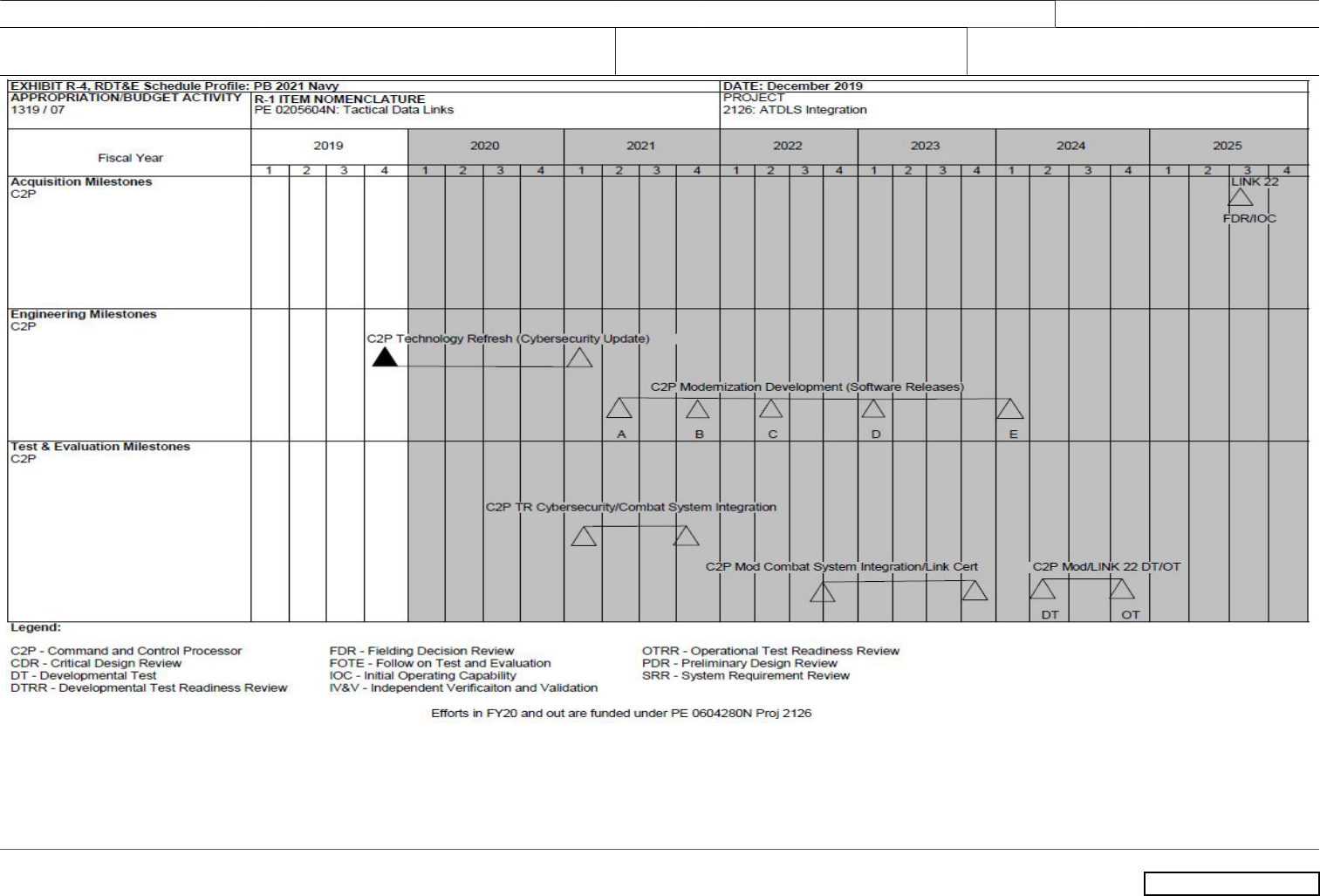
Navy Page 10 of 26 R-1 Line #220
Exhibit R-4, RDT&E Schedule Profile: PB2021Navy
Date: February 2020
Appropriation/Budget Activity
1319 / 7
R-1 Program Element (Number/Name)
PE 0205604N / Tactical Data Links
Project (Number/Name)
2126 / ATDLS Integration
Volume 5 - 510
UNCLASSIFIED
PE 0205604N: Tactical Data Links
UNCLASSIFIED
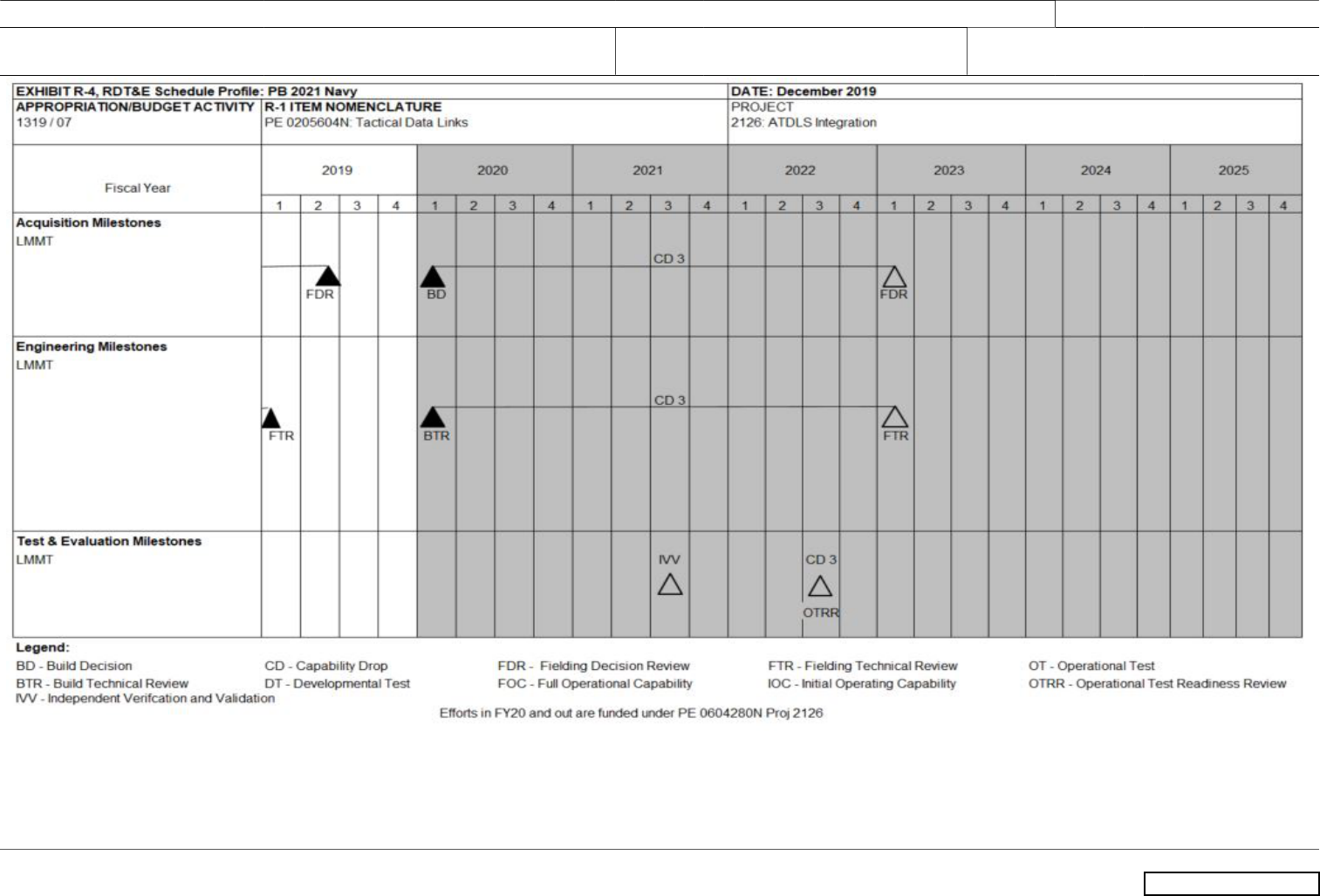
Navy Page 11 of 26 R-1 Line #220
Exhibit R-4, RDT&E Schedule Profile: PB2021Navy
Date: February 2020
Appropriation/Budget Activity
1319 / 7
R-1 Program Element (Number/Name)
PE 0205604N / Tactical Data Links
Project (Number/Name)
2126 / ATDLS Integration
Volume 5 - 511
UNCLASSIFIED
PE 0205604N: Tactical Data Links
UNCLASSIFIED
Navy Page 12 of 26 R-1 Line #220
Exhibit R-4, RDT&E Schedule Profile: PB2021Navy
Date: February 2020
Appropriation/Budget Activity
1319 / 7
R-1 Program Element (Number/Name)
PE 0205604N / Tactical Data Links
Project (Number/Name)
2126 / ATDLS Integration
Volume 5 - 512
UNCLASSIFIED
PE 0205604N: Tactical Data Links
UNCLASSIFIED
Navy Page 13 of 26 R-1 Line #220
Exhibit R-4A, RDT&E Schedule Details: PB2021Navy
Date: February 2020
Appropriation/Budget Activity
1319 / 7
R-1 Program Element (Number/Name)
PE 0205604N / Tactical Data Links
Project (Number/Name)
2126 / ATDLS Integration
Schedule Details
Start End
Events by Sub Project Quarter Year Quarter Year
Proj 2126
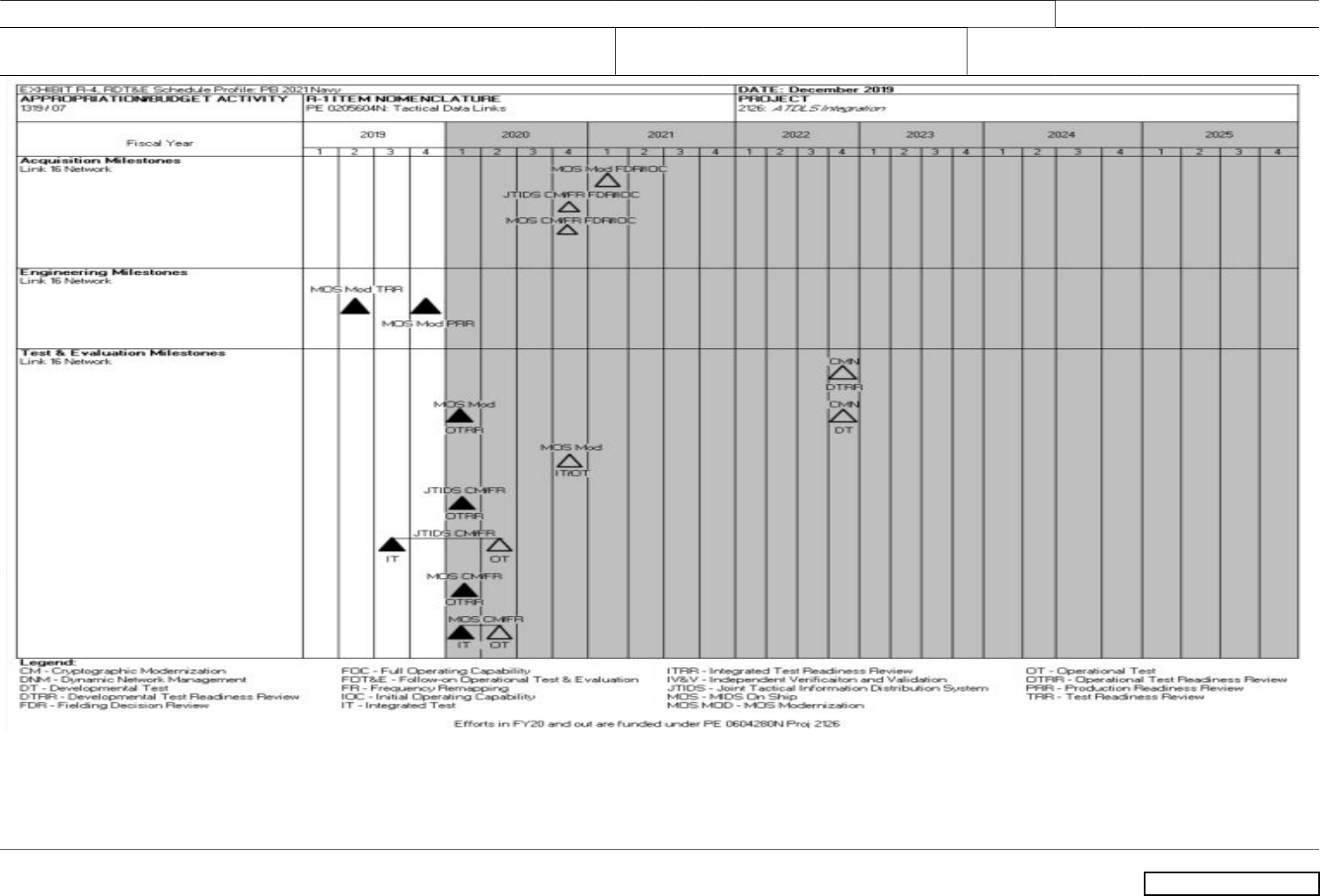
LMMT CD2 Fielding Technical Review 1 2019 1 2019
Link 16 MOS MOD Test Readiness Review 2 2019 2 2019
LMMT CD 2 Fielding Decision Review 2 2019 2 2019
Link 16 JTIDS CM/FR Integrated Test 3 2019 3 2019
C2P Technology Refresh (Cybersecurity Update) 4 2019 4 2019
Link 16 MOS Mod Production Readiness Review 4 2019 4 2019
Volume 5 - 513
UNCLASSIFIED
PE 0205604N: Tactical Data Links
UNCLASSIFIED
Navy Page 14 of 26 R-1 Line #220
Exhibit R-2A, RDT&E Project Justification: PB2021Navy
Date: February 2020
Appropriation/Budget Activity
1319 / 7
R-1 Program Element (Number/Name)
PE 0205604N / Tactical Data Links
Project (Number/Name)
3020 / MIDS/JTRS
COST ($ in Millions)
Prior
Years FY 2019 FY 2020
FY 2021
Base
FY 2021
OCO
FY 2021
Total FY 2022 FY 2023 FY 2024 FY 2025
Cost To
Complete
Total
Cost
3020: MIDS/JTRS
345.469 40.201 0.000 0.000 - 0.000 0.000 0.000 0.000 0.000 0.000 385.670
Quantity of RDT&E Articles - - - - - - - - -
Project MDAP/MAIS Code: 554
Note
Funding has been realigned out of PE 0205604N Project 3020, into PE 0604280N as part of RDTEN PE Consolidation starting in FY20.
A. Mission Description and Budget Item Justification
The Multifunctional Information Distribution System (MIDS) program office is the Lead Service for Department of Defense (DOD) Link 16 capability and consists of two
(2) product lines, MIDS Low Volume Terminal (LVT) (legacy hardware defined radio) and MIDS Joint Tactical Radio System (JTRS) (software defined radio). MIDS-LVT
effort is a cooperative development program between France, Germany, Italy, Spain, and the United States with United States joint service participation (Navy, Army,
Air Force), and has provided over 11,000 terminals to 48 Nations providing interoperability with North Atlantic Treaty Organization (NATO) and coalition partners. The
Department of Defense (DoD) established the program to design, develop, and deliver low volume, lightweight tactical information system terminals for U.S. and allied
fighter aircraft, bombers, helicopters, ships, and ground sites. MIDS-LVT significantly increases force effectiveness and minimizes hostile actions and friend-on-friend
engagements. The current development program for LVT is the Block Upgrade 2 (BU2) effort designed to meet the Cryptographic Modernization (CM) and Frequency
Remapping (FR) mandates required for all US and international users which occurs inside the FYDP. MIDS-LVT BU2 was executed as an ECP and provides the critical
upgrades to the MIDS-LVT Terminal to enable U.S., Coalition and International partners' ability to meet the National Security Agency (NSA) mandated timelines for CM
and the National Telecommunications and Information Agency (NTIA) and Federal Aviation Agency (FAA) mandated timelines for FR.
MIDS JTRS, designed as a Pre-Planned Product Improvement (P3I) and executed as an Engineering Change Proposal (ECP) to the production MIDS-LVT
configuration, and is fully compatible with MIDS-LVT. The MIDS JTRS Core Terminal achieved Full Fielding & Production (FP&F) in March 2012. It facilitated the JTRS
incremental approach for fielding advanced JTRS transformational networking capability and transformed the MIDS-LVT into a 4-channel, Software Communications
Architecture (SCA) compliant, Joint Tactical Radio. A form-fit-function replacement to MIDS-LVT, MIDS JTRS also adds three programmable 2 Megahertz (MHz)
to 2 Gigahertz (GHz) channels capable of hosting the JTRS legacy and networking waveforms. In addition to Link 16, Tactical Air Navigation (TACAN), and voice
functionality found in MIDS-LVT, MIDS JTRS has four channels and adds capabilities such as Link 16 Enhanced Throughput (ET), Link 16 Frequency Re-mapping (FR),
software programmability, Cryptographic Modernization (CM), and Four Net Concurrent Multi-Netting with Concurrent Contention Receive (CMN-4).
MIDS JTRS Tactical Targeting Network Technology (TTNT), is a block upgrade to the MIDS JTRS CMN-4 Terminal provides an Internet Protocol-based networking
capability on tactical aircraft. TTNT is a low latency, high throughput waveform that has the capability to support data exchange between fast-moving tactical aircraft,
weapons, and unmanned aircraft, in addition to air, land, and sea-based command and control nodes, in a variety of air-to-air and air-to-ground missions including
time sensitive targeting, air warfare, close air support, non-traditional ISR, and anti-surface warfare. TTNT capability integration into the MIDS JTRS directly supports
Naval Integrated Fire Control (NIFC) capability requirements. These capabilities provide Joint Airborne Network-Tactical Edge functionality to run advanced mission
applications in a cross-platform/cross-domain tactical network enterprise.
Volume 5 - 514
UNCLASSIFIED
PE 0205604N: Tactical Data Links
UNCLASSIFIED
Navy Page 15 of 26 R-1 Line #220
Exhibit R-2A, RDT&E Project Justification: PB2021Navy
Date: February 2020
Appropriation/Budget Activity
1319 / 7
R-1 Program Element (Number/Name)
PE 0205604N / Tactical Data Links
Project (Number/Name)
3020 / MIDS/JTRS
B. Accomplishments/Planned Programs ($ in Millions, Article Quantities in Each)
FY 2019 FY 2020
FY 2021
Base
FY 2021
OCO
FY 2021
Total
Title: MIDS
Articles:
FY 2020 Plans:
FY20 funding has been realigned to PE 0604280N Project 3020 as part of PE Consolidation.
FY 2021 Base Plans:
FY21 funding has been realigned to PE 0604280N Project 3020 as part of PE Consolidation.
FY 2021 OCO Plans:
N/A
40.201
-
0.000
-
0.000
-
0.000
-
0.000
-
Accomplishments/Planned Programs Subtotals
40.201 0.000 0.000 0.000 0.000
C. Other Program Funding Summary ($ in Millions)
Line Item FY 2019 FY 2020
FY 2021
Base
FY 2021
OCO
FY 2021
Total FY 2022 FY 2023 FY 2024 FY 2025
Cost To
Complete Total Cost
• RDTE/0604280N/3020:
MIDS/JTRS
0.000 39.214 47.579 - 47.579 66.030 67.849 54.500 32.342 Continuing Continuing
Remarks
D. Acquisition Strategy
Multifunctional Information Distribution System Joint Tactical System (MIDS JTRS) development was initiated as a major modification to the MIDS-LVT using an
Engineering Change Proposal to the existing production contracts. The U.S. prime contractors from the MIDS-LVT program, Data Link Solutions (DLS) and Viasat Inc.,
cooperatively designed and developed each of the MIDS JTRS terminal variants and Block Upgrade 2 for MIDS-LVT. The U.S. implemented a continuous competition
strategy between DLS and ViaSat that will be maintained throughout the MIDS-LVT and MIDS JTRS production phases. This strategy has been successfully used on all
MIDS variants.
Volume 5 - 515
UNCLASSIFIED
PE 0205604N: Tactical Data Links
UNCLASSIFIED
Navy Page 16 of 26 R-1 Line #220
Exhibit R-3, RDT&E Project Cost Analysis: PB2021Navy
Date: February 2020
Appropriation/Budget Activity
1319 / 7
R-1 Program Element (Number/Name)
PE 0205604N / Tactical Data Links
Project (Number/Name)
3020 / MIDS/JTRS
Product Development ($ in Millions)
FY 2019 FY 2020
FY 2021
Base
FY 2021
OCO
FY 2021
Total
Cost Category Item
Contract
Method
& Type
Performing
Activity & Location
Prior
Years Cost
Award
Date Cost
Award
Date Cost
Award
Date Cost
Award
Date Cost
Cost To
Complete
Total
Cost
Target
Value of
Contract
Product Development Prior
Years
Various Various : Various 281.737 0.000 0.000 0.000 - 0.000 0.000 281.737 254.622
TTNT Development
Contract (L Band)
C/CPFF
DLS : Cedar Rapids,
IA
22.076 9.329 Oct 2018 0.000 0.000 - 0.000 0.000 31.405 Continuing
Link 16 Waveform
Development
WR
NIWC PAC : San
Diego, CA
3.644 0.560 Nov 2018 0.000 0.000 - 0.000 0.000 4.204 Continuing
Investigation Reports C/CPFF
DLS : Cedar Rapids,
IA
1.275 5.217 Dec 2018 0.000 0.000 - 0.000 0.000 6.492 1.556
Investigation Reports C/CPFF Viasat : San Diego 0.802 0.885 Jan 2019 0.000 0.000 - 0.000 0.000 1.687 0.792
Link 16 hardware upgrade C/CPFF
DLS : Cedar Rapids,
IA
0.000 9.305 Mar 2019 0.000 0.000 - 0.000 0.000 9.305 Continuing
Link 16 hardware upgrade C/CPFF
ViaSat : San Diego,
CA
0.000 7.685 Mar 2019 0.000 0.000 - 0.000 0.000 7.685 Continuing
Subtotal
309.534 32.981 0.000 0.000 - 0.000 0.000 342.515 N/A
Support ($ in Millions)
FY 2019 FY 2020
FY 2021
Base
FY 2021
OCO
FY 2021
Total
Cost Category Item
Contract
Method
& Type
Performing
Activity & Location
Prior
Years Cost
Award
Date Cost
Award
Date Cost
Award
Date Cost
Award
Date Cost
Cost To
Complete
Total
Cost
Target
Value of
Contract
Modeling and Simulation MIPR
MIT Lincoln Labs :
Lexington, MA
0.000 1.500 Nov 2018 0.000 0.000 - 0.000 0.000 1.500 -
Multi-level security
analysis
WR
NAVAIR : China
Lake, Ca
0.393 0.000 0.000 0.000 - 0.000 0.000 0.393 0.393
Modeling and Simulation WR
NAVAIR : China
Lake, Ca
4.682 0.200 Jan 2019 0.000 0.000 - 0.000 0.000 4.882 Continuing
Subtotal
5.075 1.700 0.000 0.000 - 0.000 0.000 6.775 N/A
Remarks
Consolidated Automated Support System (CASS) Test Program Sets (TPS)
Volume 5 - 516

UNCLASSIFIED
PE 0205604N: Tactical Data Links
UNCLASSIFIED
Navy Page 17 of 26 R-1 Line #220
Exhibit R-3, RDT&E Project Cost Analysis: PB2021Navy
Date: February 2020
Appropriation/Budget Activity
1319 / 7
R-1 Program Element (Number/Name)
PE 0205604N / Tactical Data Links
Project (Number/Name)
3020 / MIDS/JTRS
Test and Evaluation ($ in Millions)
FY 2019 FY 2020
FY 2021
Base
FY 2021
OCO
FY 2021
Total
Cost Category Item
Contract
Method
& Type
Performing
Activity & Location
Prior
Years Cost
Award
Date Cost
Award
Date Cost
Award
Date Cost
Award
Date Cost
Cost To
Complete
Total
Cost
Target
Value of
Contract
Test and Eval Prior Years Various Various : Various 8.144 0.000 0.000 0.000 - 0.000 0.000 8.144 8.144
MIDS JTRS CMN-4/MIDS
Mod GFAQT and JTEL
LAB
WR
NIWC PAC : San
Diego, CA
1.485 0.250 Oct 2018 0.000 0.000 - 0.000 0.000 1.735 Continuing
COMOPTEVFOR MIPR
COMOPTEVFOR :
Norfolk, VA
0.056 0.066 Jan 2019 0.000 0.000 - 0.000 0.000 0.122 0.056
JTEL Testing Support C/CPFF G-2 : San Diego, CA 0.137 0.050 Aug 2019 0.000 0.000 - 0.000 0.000 0.187 Continuing
Subtotal
9.822 0.366 0.000 0.000 - 0.000 0.000 10.188 N/A
Management Services ($ in Millions)
FY 2019 FY 2020
FY 2021
Base
FY 2021
OCO
FY 2021
Total
Cost Category Item
Contract
Method
& Type
Performing
Activity & Location
Prior
Years Cost
Award
Date Cost
Award
Date Cost
Award
Date Cost
Award
Date Cost
Cost To
Complete
Total
Cost
Target
Value of
Contract
Management Services
Prior Years
Various Various : Various 1.307 0.000 0.000 0.000 - 0.000 0.000 1.307 1.201
Systems Engineering
Support
MIPR MITRE : Bedford, MA 7.703 0.526 Jan 2019 0.000 0.000 - 0.000 0.000 8.229 Continuing
Government Engineering
Support TTNT
WR
NIWC PAC : San
Diego, CA
8.971 2.072 Dec 2018 0.000 0.000 - 0.000 0.000 11.043 Continuing
Govt Program Support
NIFC-CA
WR
NAVAIR : Pax River,
MD
0.969 0.058 Nov 2018 0.000 0.000 - 0.000 0.000 1.027 0.969
Infomation Assurance MIPR
CERDEC : Aberdeen
Proving Ground, MD
0.000 0.268 Jan 2019 0.000 0.000 - 0.000 0.000 0.268 -
COR and Logistics
Support
WR
NIWC Atlantic :
Charleston, SC
0.151 0.064 Nov 2018 0.000 0.000 - 0.000 0.000 0.215 Continuing
Contractor Engineering/
Programmatic Support
C/CPFF
Sentek : San Diego,
Ca
1.449 0.675 Nov 2018 0.000 0.000 - 0.000 0.000 2.124 Continuing
ARL SIPRNET Connection MIPR ARL : Adelphi, MD 0.192 0.101 Jan 2019 0.000 0.000 - 0.000 0.000 0.293 Continuing
Contractor Program
Management and Financial
Support
C/CPFF G2 : San Diego, CA 0.296 1.390 Nov 2018 0.000 0.000 - 0.000 0.000 1.686 Continuing
Subtotal
21.038 5.154 0.000 0.000 - 0.000 0.000 26.192 N/A
Volume 5 - 517

UNCLASSIFIED
PE 0205604N: Tactical Data Links
UNCLASSIFIED
Navy Page 18 of 26 R-1 Line #220
Exhibit R-3, RDT&E Project Cost Analysis: PB2021Navy
Date: February 2020
Appropriation/Budget Activity
1319 / 7
R-1 Program Element (Number/Name)
PE 0205604N / Tactical Data Links
Project (Number/Name)
3020 / MIDS/JTRS
Prior
Years FY 2019 FY 2020
FY 2021
Base
FY 2021
OCO
FY 2021
Total
Cost To
Complete
Total
Cost
Target
Value of
Contract
Project Cost Totals
345.469 40.201 0.000 0.000 - 0.000 0.000 385.670 N/A
Remarks
FY20-FY21 cost data is provided under PE 0604280N Project 3020.
LCM - MIDS-LVT Crypto Module WF - Waveform BU2 - Block Upgrade 2 BC3 - Block Cycle 3
TTNT - Tactical Targeting Network Technology CSS/PCP - Cryptographic Sub System/Protected Core Processor
ER0F - Engineering Release 0F ER0G - Engineering Release 0G DLS - Data Link Solutions
NIFC-CA - Naval Integrated Fire Control - Counter Air PDR - Preliminary Design Review CDR - Critical Design Review
TRR - Test Readiness Review DT - Development Test IR - Information Repository JTEL - Joint Test and Evaluation Lab
CFAQT - Contractor First Article Qualification Test GFAQT - Gov't First Article Qualification Test
Volume 5 - 518
UNCLASSIFIED
PE 0205604N: Tactical Data Links
UNCLASSIFIED
Navy Page 19 of 26 R-1 Line #220
Exhibit R-4, RDT&E Schedule Profile: PB2021Navy
Date: February 2020
Appropriation/Budget Activity
1319 / 7
R-1 Program Element (Number/Name)
PE 0205604N / Tactical Data Links
Project (Number/Name)
3020 / MIDS/JTRS
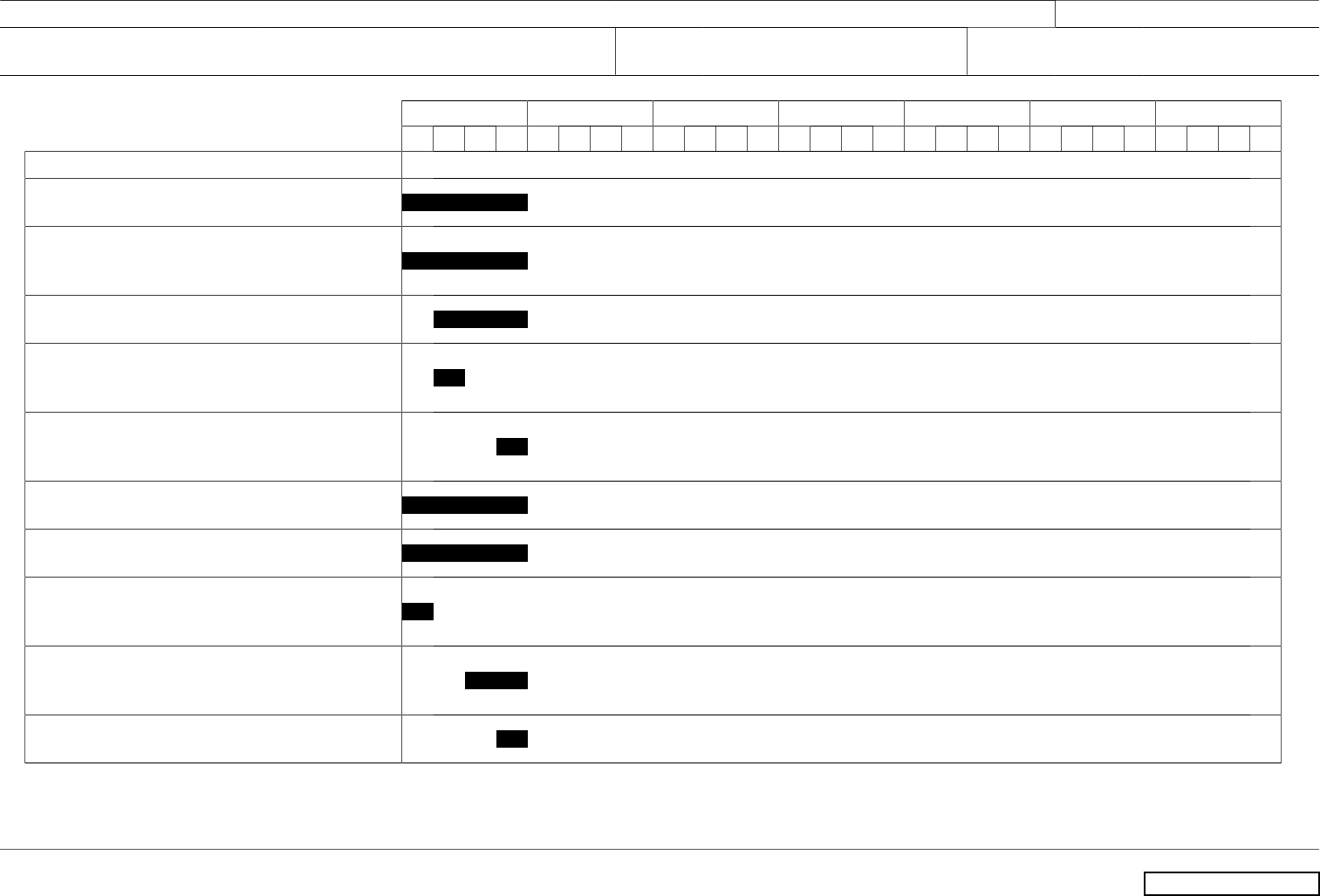
FY 2019 FY 2020 FY 2021 FY 2022 FY 2023 FY 2024 FY 2025
1 2 3 4 1 2 3 4 1 2 3 4 1 2 3 4 1 2 3 4 1 2 3 4 1 2 3 4
MIDS
MIDS JTRS Block Cycle 3 (BC3): Block Cycle
3+ (ER 3A & 3B)
MIDS JTRS Tactical Targeting Networking
Technology (TTNT): TTNT Full Development
Contract
MIDS JTRS Tactical Targeting Networking
Technology (TTNT): CFAQT and GFAQT
MIDS JTRS Tactical Targeting Networking
Technology (TTNT): TTNT Technolgy
Readiness Review (TRR)
MIDS JTRS Tactical Targeting Networking
Technology (TTNT): Developmental Test/
Operational Assessment
MIDS Link 16 and TTNT Waveform: Link 16
Waveform Development Fixes and Updates
MIDS Link 16 and TTNT Waveform: TTNT
Waveform Development Fixes and Updates
MIDS JTRS Link 16 Hardware Tranceiver
Upgrade: MIDS Modernization (Now Link 16
hardware) Spec Development/Risk Reduction
MIDS JTRS Link 16 Hardware Tranceiver
Upgrade: Link 16 hardware Full Development
Effort
MIDS JTRS Link 16 Hardware Tranceiver
Upgrade: MIDS Mod PDR
Volume 5 - 519
UNCLASSIFIED
PE 0205604N: Tactical Data Links
UNCLASSIFIED
Navy Page 20 of 26 R-1 Line #220
Exhibit R-4A, RDT&E Schedule Details: PB2021Navy
Date: February 2020
Appropriation/Budget Activity
1319 / 7
R-1 Program Element (Number/Name)
PE 0205604N / Tactical Data Links
Project (Number/Name)
3020 / MIDS/JTRS
Schedule Details
Start End
Events by Sub Project Quarter Year Quarter Year
MIDS
MIDS JTRS Block Cycle 3 (BC3): Block Cycle 3+ (ER 3A & 3B) 1 2019 4 2019
MIDS JTRS Tactical Targeting Networking Technology (TTNT): TTNT Full
Development Contract
1 2019 4 2019
MIDS JTRS Tactical Targeting Networking Technology (TTNT): CFAQT and GFAQT 2 2019 4 2019
MIDS JTRS Tactical Targeting Networking Technology (TTNT): TTNT Technolgy
Readiness Review (TRR)
2 2019 2 2019
MIDS JTRS Tactical Targeting Networking Technology (TTNT): Developmental Test/
Operational Assessment
4 2019 4 2019
MIDS Link 16 and TTNT Waveform: Link 16 Waveform Development Fixes and
Updates
1 2019 4 2019
MIDS Link 16 and TTNT Waveform: TTNT Waveform Development Fixes and Updates 1 2019 4 2019
MIDS JTRS Link 16 Hardware Tranceiver Upgrade: MIDS Modernization (Now Link 16
hardware) Spec Development/Risk Reduction
1 2019 1 2019
MIDS JTRS Link 16 Hardware Tranceiver Upgrade: Link 16 hardware Full
Development Effort
3 2019 4 2019
MIDS JTRS Link 16 Hardware Tranceiver Upgrade: MIDS Mod PDR 4 2019 4 2019
Volume 5 - 520

UNCLASSIFIED
PE 0205604N: Tactical Data Links
UNCLASSIFIED
Navy Page 21 of 26 R-1 Line #220
Exhibit R-2A, RDT&E Project Justification: PB2021Navy
Date: February 2020
Appropriation/Budget Activity
1319 / 7
R-1 Program Element (Number/Name)
PE 0205604N / Tactical Data Links
Project (Number/Name)
3341 / Network Tactical Common Data Link
COST ($ in Millions)
Prior
Years FY 2019 FY 2020
FY 2021
Base
FY 2021
OCO
FY 2021
Total FY 2022 FY 2023 FY 2024 FY 2025
Cost To
Complete
Total
Cost
3341: Network Tactical Common
Data Link
103.135 31.943 0.000 0.000 - 0.000 0.000 0.000 0.000 0.000 0.000 135.078
Quantity of RDT&E Articles - - - - - - - - -
Note
Funding has been realigned out of PE 0205604N Project 3341, into PE 0604280N as part of RDTEN PE Consolidation starting in FY20.
A. Mission Description and Budget Item Justification
Network Tactical Common Data Link (NTCDL) provides the ability to transmit/receive real-time Intelligence, Surveillance, and Reconnaissance (ISR) data simultaneously
from multiple sources (surface, airborne, sub-surface, man-portable), and exchange command and control information (voice, data, imagery, and Full Motion Video)
across dissimilar joint, service, coalition, and civil networks. NTCDL provides warfighters with the capability to support multiple, simultaneous, networked operations with
currently fielded Common Data Link (CDL)-equipped air platforms (e.g. F/ A-35, P-3, and MH-60R), in addition to next generation manned and unmanned platforms
(e.g., P-8, Triton, MQ-25 (Stingray), small tactical unmanned aircraft systems (STUAS) and Fire Scout). NTCDL is an incremental capability (surface, airborne, sub-
surface, man-portable) providing modular, scalable, multiple-link networked communications. NTCDL benefits the fleet by providing a horizon extension for line-of-
sight sensor systems for use in time-critical strike missions and supports tasking, collection, processing, exploitation, and dissemination (TCPED) via its ISR networking
capability. NTCDL supports Resilient Command and Control (RC2) through its relay capability, and supports TCPED through its ISR networking capability.
B. Accomplishments/Planned Programs ($ in Millions, Article Quantities in Each)
FY 2019 FY 2020
FY 2021
Base
FY 2021
OCO
FY 2021
Total
Title: Network Tactical Common Data Link (NTCDL)
Articles:
Description: NTCDL is the only High Data Rate (HDR), Line of Sight (LOS) solution delivering Intelligence,
Surveillance, and Reconnaissance (ISR), sensor control information and unmanned aircraft system (UAS)
command and control. NTCDL uses Joint Department of Defense specifications for Common Data Link (CDL)
waveforms and LOS networks across the allocated CDL frequency spectrum. New technical specifications
require increasing number of simultaneous CDL links to support increasing number of CDL/ISR platforms and
missions. The software for NTCDL is developed by both contractor and government. The contractor software
development is responsible for the internal control of the NTCDL hardware whereas the Government Furnished
Software (GFS) is responsible for interfacing with various external networks (e.g. Automated Digital Network
System (ADNS)) and users (e.g. Consolidated Afloat Networks and Enterprise Services (CANES)). Engineering
Development Model (EDM) development is a multi-year effort that includes two EDMs being delivered in
FY21. EDM 1 will undergo Development Test for Operational Assessment, and EDM 2 will go through shock,
environmental, and cyber testing. At the same time the two EDMs are going through testing, BAE Systems will
31.943
-
0.000
-
0.000
-
0.000
-
0.000
-
Volume 5 - 521
UNCLASSIFIED
PE 0205604N: Tactical Data Links
UNCLASSIFIED
Navy Page 22 of 26 R-1 Line #220
Exhibit R-2A, RDT&E Project Justification: PB2021Navy
Date: February 2020
Appropriation/Budget Activity
1319 / 7
R-1 Program Element (Number/Name)
PE 0205604N / Tactical Data Links
Project (Number/Name)
3341 / Network Tactical Common Data Link
B. Accomplishments/Planned Programs ($ in Millions, Article Quantities in Each)
FY 2019 FY 2020
FY 2021
Base
FY 2021
OCO
FY 2021
Total
continue development of the X/Ku antennas. EDM 2 will be repaired after testing and given the X/Ku antennas.
Both EDMs will provide Full Capability and will be installed in FY23.
FY 2020 Plans:
FY20 funding has been realigned to PE 0604280N Project 3341 as part of PE Consolidation.
FY 2021 Base Plans:
FY21 funding has been realigned to PE 0604280N Project 3341 as part of PE Consolidation.
FY 2021 OCO Plans:
N/A
Accomplishments/Planned Programs Subtotals
31.943 0.000 0.000 0.000 0.000
C. Other Program Funding Summary ($ in Millions)
Line Item FY 2019 FY 2020
FY 2021
Base
FY 2021
OCO
FY 2021
Total FY 2022 FY 2023 FY 2024 FY 2025
Cost To
Complete Total Cost
• RDTEN/0604280N/3341: Network
Tactical Common Data Link
0.000 30.776 34.520 - 34.520 8.887 6.889 6.424 6.554 Continuing Continuing
• OPN/2950: Network Tactical
Common Data Link (CDL)
6.223 5.193 4.150 - 4.150 22.511 20.699 20.980 21.394 Continuing Continuing
Remarks
The FY2019-FY2021 OPN deltas are is the funding for the CDLS Tech Refresh. NTCDL is he follow-on program for CDLS. OPN funds for NTCDL are accurately
reflected.
D. Acquisition Strategy
NTCDL will utilize the evolutionary acquisition approach for: surface, air, sub-surface, man-portable.
Volume 5 - 522

UNCLASSIFIED
PE 0205604N: Tactical Data Links
UNCLASSIFIED
Navy Page 23 of 26 R-1 Line #220
Exhibit R-3, RDT&E Project Cost Analysis: PB2021Navy
Date: February 2020
Appropriation/Budget Activity
1319 / 7
R-1 Program Element (Number/Name)
PE 0205604N / Tactical Data Links
Project (Number/Name)
3341 / Network Tactical Common Data Link
Product Development ($ in Millions)
FY 2019 FY 2020
FY 2021
Base
FY 2021
OCO
FY 2021
Total
Cost Category Item
Contract
Method
& Type
Performing
Activity & Location
Prior
Years Cost
Award
Date Cost
Award
Date Cost
Award
Date Cost
Award
Date Cost
Cost To
Complete
Total
Cost
Target
Value of
Contract
Product Development Various Various : Various 26.755 0.000 0.000 0.000 - 0.000 0.000 26.755 -
NTCDL Product
Development
C/CPIF
BAE Systems, Int :
Wayne, NJ
33.069 25.803 Dec 2018 0.000 0.000 - 0.000 0.000 58.872 -
NTCDL Software
Development
WR
NIWC PAC : San
Diego, CA
4.942 2.177 Nov 2018 0.000 0.000 - 0.000 0.000 7.119 -
NTCDL Software
Development
C/IDIQ
Technology
Unlimited Group :
San Diego, CA
1.021 0.814 Mar 2019 0.000 0.000 - 0.000 0.000 1.835 -
Subtotal
65.787 28.794 0.000 0.000 - 0.000 0.000 94.581 N/A
Support ($ in Millions)
FY 2019 FY 2020
FY 2021
Base
FY 2021
OCO
FY 2021
Total
Cost Category Item
Contract
Method
& Type
Performing
Activity & Location
Prior
Years Cost
Award
Date Cost
Award
Date Cost
Award
Date Cost
Award
Date Cost
Cost To
Complete
Total
Cost
Target
Value of
Contract
NTCDL Systems
Engineering
WR
NIWC PAC : San
Diego, CA
14.997 1.510 Oct 2018 0.000 0.000 - 0.000 0.000 16.507 -
NTCDL Systems
Engineering
C/IDIQ
Technology
Unlimited Group :
San Diego, CA
9.546 0.554 Mar 2019 0.000 0.000 - 0.000 0.000 10.100 -
Subtotal
24.543 2.064 0.000 0.000 - 0.000 0.000 26.607 N/A
Test and Evaluation ($ in Millions)
FY 2019 FY 2020
FY 2021
Base
FY 2021
OCO
FY 2021
Total
Cost Category Item
Contract
Method
& Type
Performing
Activity & Location
Prior
Years Cost
Award
Date Cost
Award
Date Cost
Award
Date Cost
Award
Date Cost
Cost To
Complete
Total
Cost
Target
Value of
Contract
NTCDL Test and
Evaluation
WR
NIWC PAC : San
Diego, CA
5.769 0.720 Oct 2018 0.000 0.000 - 0.000 0.000 6.489 -
NTCDL Test and Review MIPR
JITC : Fort
Huachuca, AZ
0.529 0.018 Feb 2019 0.000 0.000 - 0.000 0.000 0.547 -
NTCDL Waveform
certification
MIPR
COMOPTEVFOR :
Norfolk, VA
0.678 0.010 Jul 2019 0.000 0.000 - 0.000 0.000 0.688 -
Subtotal
6.976 0.748 0.000 0.000 - 0.000 0.000 7.724 N/A
Volume 5 - 523
UNCLASSIFIED
PE 0205604N: Tactical Data Links
UNCLASSIFIED
Navy Page 24 of 26 R-1 Line #220
Exhibit R-3, RDT&E Project Cost Analysis: PB2021Navy
Date: February 2020
Appropriation/Budget Activity
1319 / 7
R-1 Program Element (Number/Name)
PE 0205604N / Tactical Data Links
Project (Number/Name)
3341 / Network Tactical Common Data Link
Management Services ($ in Millions)
FY 2019 FY 2020
FY 2021
Base
FY 2021
OCO
FY 2021
Total
Cost Category Item
Contract
Method
& Type
Performing
Activity & Location
Prior
Years Cost
Award
Date Cost
Award
Date Cost
Award
Date Cost
Award
Date Cost
Cost To
Complete
Total
Cost
Target
Value of
Contract
Program Management WR
NIWC PAC : San
Diego, CA
1.000 0.000 0.000 0.000 - 0.000 0.000 1.000 -
Program Management
Support
C/CPFF BAH : San Diego, CA 4.829 0.337 Nov 2018 0.000 0.000 - 0.000 0.000 5.166 -
Subtotal
5.829 0.337 0.000 0.000 - 0.000 0.000 6.166 N/A
Prior
Years FY 2019 FY 2020
FY 2021
Base
FY 2021
OCO
FY 2021
Total
Cost To
Complete
Total
Cost
Target
Value of
Contract
Project Cost Totals
103.135 31.943 0.000 0.000 - 0.000 0.000 135.078 N/A
Remarks
FY20 and FY21 cost data is provided under PE 0604280N Project 3341.
Volume 5 - 524
UNCLASSIFIED
PE 0205604N: Tactical Data Links
UNCLASSIFIED
Navy Page 25 of 26 R-1 Line #220
Exhibit R-4, RDT&E Schedule Profile: PB2021Navy
Date: February 2020
Appropriation/Budget Activity
1319 / 7
R-1 Program Element (Number/Name)
PE 0205604N / Tactical Data Links
Project (Number/Name)
3341 / Network Tactical Common Data Link
Volume 5 - 525
UNCLASSIFIED
PE 0205604N: Tactical Data Links
UNCLASSIFIED
Navy Page 26 of 26 R-1 Line #220
Exhibit R-4A, RDT&E Schedule Details: PB2021Navy
Date: February 2020
Appropriation/Budget Activity
1319 / 7
R-1 Program Element (Number/Name)
PE 0205604N / Tactical Data Links
Project (Number/Name)
3341 / Network Tactical Common Data Link
Schedule Details
Start End
Events by Sub Project Quarter Year Quarter Year
Proj 3341
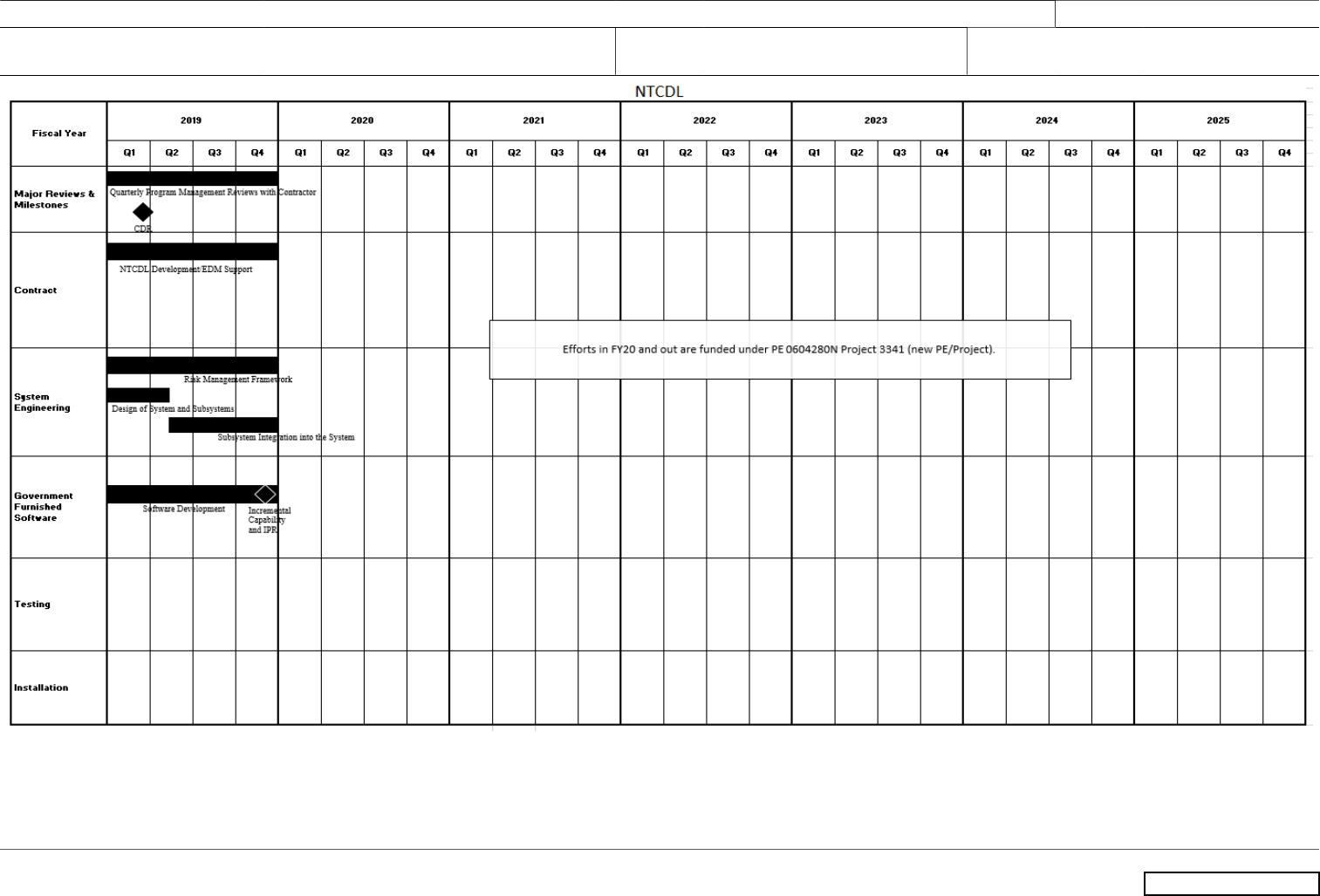
NTCDL - Design of System and Subsystems 1 2019 2 2019
NTCDL - Government Furnished Software (GFS) Development 1 2019 4 2019
NTCDL - Development Contract 1 2019 4 2019
NTCDL - Risk Management Framework (RMF) 1 2019 4 2019
NTCDL - Quarterly Program Management Reviews with Contractor 1 2019 4 2019
NTCDL - Critical Design Review (CDR) 1 2019 1 2019
NTCDL - Subsystem Integration into the System 2 2019 4 2019
NTCDL - GFS Incremental Capability and IPR 4 2019 4 2019
Volume 5 - 526
