UNCLASSIFIED
PE 0604373N: Airborne Mine Countermeasures
UNCLASSIFIED
Navy Page 1 of 17 R-1 Line #122
Exhibit R-2, RDT&E Budget Item Justification: PB2021Navy
Date: February 2020
Appropriation/Budget Activity
1319: Research, Development, Test & Evaluation, Navy / BA 5: System
Development & Demonstration (SDD)
R-1 Program Element (Number/Name)
PE 0604373N / Airborne Mine Countermeasures
COST ($ in Millions)
Prior
Years FY 2019 FY 2020
FY 2021
Base
FY 2021
OCO
FY 2021
Total FY 2022 FY 2023 FY 2024 FY 2025
Cost To
Complete
Total
Cost
Total Program Element
63.930 8.024 10.916 10.909 - 10.909 11.092 11.322 11.550 11.782 Continuing Continuing
4026: Net-Centric Sensor
Analysis for Mine Warfare
(NSAM)
55.608 7.148 9.984 9.956 - 9.956 10.120 10.330 10.538 10.749 Continuing Continuing
9179: Surf Navy Integ Undersea
Tactical Tech
8.322 0.876 0.932 0.953 - 0.953 0.972 0.992 1.012 1.033 Continuing Continuing
A. Mission Description and Budget Item Justification
The Airborne Mine Countermeasures (AMCM) Program Element (PE) provides resources to develop an advanced Mine Countermeasures (MCM) system to counter
known and projected mine threats, as well as to develop post mission analysis software, integrated tactics and tactics training for mine warfare operations, and post
mission analysis proficiency training.
The MCM systems provide mobile, quick reaction forces capable of land or sea-based minehunting and minesweeping operations worldwide. Resources are for
developing and deploying advanced mine-sweeping systems and the intelligence and oceanographic capabilities that will enable mine warfare superiority. Tactics and
techniques used vary across a diversity of environments and threats, including both asymmetric and emerging.
Resources provide for systems and support of mine warfare systems and expeditionary systems to allow for continuous operations of the Navy's warships and support
vessels, other military vessels, and commercial vessels. Core capabilities include forward presence, deterrence, sea control, power projection, maritime security,
humanitarian assistance and disaster response to maintain freedom of the seas. Capability improvements include reducing post-mission analysis time, reducing detect,
classify, and identify decision time, improving neutralization time, improving network communications, automatic target recognition, and achieving in-stride detect-to-
engage capability. Concept of operations includes development of cooperative, modular systems with a common post mission analysis system providing advanced
tools to automate the complex problem of contact management for the thousands of recorded detections, the establishment of capable networked command and control
systems, and standing up an accurate and interactive environmental system with the ability to form and disseminate a Common Environmental Picture. Efforts benefit
the MCM force by transforming the Navy from the platform-centered legacy set of systems to a capability-centered force that is distributed, networked, and able to
provide unique maritime influence and access across the entire maritime domain. The Airborne Mine Countermeasures (AMCM) programs will provide detection,
classification, localization, identification, neutralization, influence sweep, and post mission analysis capabilities. This capability will be of critical importance in littoral
zones, confined straits, choke points, and the Amphibious Objective Area (AOA).
Project 4026 Strat Into Medal, Tactics & Trng Organic Force has been renamed Net-Centric Sensor Analysis for Mine Warfare (NSAM). Post Mission Analysis (PMA)
currently includes two projects: the legacy Organic Post Mission Analysis (OPMA) system and the next generation Net-Centric Sensor Analysis for Mine Warfare
(NSAM) system.
Volume 3 - 681

UNCLASSIFIED
PE 0604373N: Airborne Mine Countermeasures
UNCLASSIFIED
Navy Page 2 of 17 R-1 Line #122
Exhibit R-2, RDT&E Budget Item Justification: PB2021Navy
Date: February 2020
Appropriation/Budget Activity
1319: Research, Development, Test & Evaluation, Navy / BA 5: System
Development & Demonstration (SDD)
R-1 Program Element (Number/Name)
PE 0604373N / Airborne Mine Countermeasures
Post mission analysis software is transitioning from legacy Organic Post Mission Analysis system to a next generation system called Net-centric Sensor Analysis
for Mine Warfare (NSAM). NSAM will be the single tactical and environmental PMA system for all Mine Warfare (MIW) sensor data, and provide integrated contact
management capabilities, which will automate contact management for the thousands of recorded detections by the MCM sensor systems. This next generation system
will provide an extensible architecture to integrate current and future sensors and advanced algorithms. It will also create a collaborative, multi-user environment with
the purpose of reducing the PMA timeline.
The Integrated Tactics project develops MIW tactics across multiple MCM communities, namely, airborne MCM, surface MCM, underwater and remote off-board. The
project develops new tactics theory for emerging systems and operations and provides Fleet reach-back support and Fleet tactics training. Theory and tactics are
documented and published into doctrine for Fleet users.
Project 9179 Surface Navy Integrated Undersea Tactical Technology (SNIUTT) is a software-only tool which provides PMA proficiency training. SNIUTT resides as a
plug-in on existing PMA systems and focuses on providing contact recognition training, which is a perishable skill.
B. Program Change Summary ($ in Millions)
FY 2019 FY 2020 FY 2021 Base FY 2021 OCO FY 2021 Total
Previous President's Budget 8.351 10.916 10.916 - 10.916
Current President's Budget 8.024 10.916 10.909 - 10.909
Total Adjustments -0.327 0.000 -0.007 - -0.007
• Congressional General Reductions - -
• Congressional Directed Reductions - -
• Congressional Rescissions - -
• Congressional Adds - -
• Congressional Directed Transfers - -
• Reprogrammings - -
• SBIR/STTR Transfer -0.327 0.000
• Rate/Misc Adjustments 0.000 0.000 -0.007 - -0.007
Change Summary Explanation
Program Adjustments:
FY19: $327K SBIR
FY20: No changes
FY21: $7K rate adjustment
Volume 3 - 682
UNCLASSIFIED
PE 0604373N: Airborne Mine Countermeasures
UNCLASSIFIED
Navy Page 3 of 17 R-1 Line #122
Exhibit R-2A, RDT&E Project Justification: PB2021Navy
Date: February 2020
Appropriation/Budget Activity
1319 / 5
R-1 Program Element (Number/Name)
PE 0604373N / Airborne Mine
Countermeasures
Project (Number/Name)
4026 / Net-Centric Sensor Analysis for Mine
Warfare (NSAM)
COST ($ in Millions)
Prior
Years FY 2019 FY 2020
FY 2021
Base
FY 2021
OCO
FY 2021
Total FY 2022 FY 2023 FY 2024 FY 2025
Cost To
Complete
Total
Cost
4026: Net-Centric Sensor
Analysis for Mine Warfare
(NSAM)
55.608 7.148 9.984 9.956 - 9.956 10.120 10.330 10.538 10.749 Continuing Continuing
Quantity of RDT&E Articles - - - - - - - - -
A. Mission Description and Budget Item Justification
Post Mission Analysis (PMA) currently includes two projects: the legacy Organic Post Mission Analysis (OPMA) system and the next generation Net-Centric Sensor
Analysis for Mine Warfare (NSAM) system. OPMA provides PMA capabilities for the Airborne Laser Mine Detection System (ALMDS), the AN/AQS-20A sensor, and the
Airborne Mine Neutralization System (AMNS); OPMA also contains a separate module for contact management. NSAM will be the replacement for OPMA and will begin
fielding in FY21. NSAM will be the single tactical and environmental PMA system for all MIW sensor data and will provide integrated contact management capabilities.
NSAM creates a collaborative, multi-data set, multi-user environment with the goal of reducing the mission timeline and increasing the mission effectiveness.
Additionally, NSAM provides a training mode for operators to maintain proficiency and PMA skill sets.
NSAM is designed with an extensible architecture, to ease integration of additional sensors and advanced algorithms. The NSAM architecture and software
development processes will reduce the cost for adding PMA and contact management capabilities of future MCM systems.
NSAM will be developed in incremental builds; efforts through FY19 integrated ALMDS, AMNS, AN/AQS-20A sensor PMA and contact management (B1.0); efforts
through FY20 will add contact management for the AN/AQS-20C sensors (B1.1) and begin full AN/AQS-20C PMA integration (B1.3); FY21 efforts will begin UISS
contact management (B1.2). Future incremental builds will add support for additional MCM sensor weapons systems. Additionally, NSAM will implement cybersecurity
requirements using the new Risk Management Framework (RMF) process.
The Integrated Tactics project comprises integrated tactics development, theory development, and integrated tactics training. To date, the project has been focused on
the Littoral Combat Ship (LCS) MCM Mission Module (MM), and all the related integrated tactics support from planning, execution, post-mission analysis and includes
contact management automation methods. Additionally, the project develops doctrinal updates as well as new overall MCM theory.
B. Accomplishments/Planned Programs ($ in Millions, Article Quantities in Each)
FY 2019 FY 2020
FY 2021
Base
FY 2021
OCO
FY 2021
Total
Title: NSAM Product Development
Articles:
FY 2020 Plans:
Continue NSAM software development based on the requirements package for Build 1.1 to integrate AN/
AQS-20C contact management. Begin software development based on the requirements package for B1.3, AN/
3.815
-
5.127
-
5.114
-
0.000
-
5.114
-
Volume 3 - 683
UNCLASSIFIED
PE 0604373N: Airborne Mine Countermeasures
UNCLASSIFIED
Navy Page 4 of 17 R-1 Line #122
Exhibit R-2A, RDT&E Project Justification: PB2021Navy
Date: February 2020
Appropriation/Budget Activity
1319 / 5
R-1 Program Element (Number/Name)
PE 0604373N / Airborne Mine
Countermeasures
Project (Number/Name)
4026 / Net-Centric Sensor Analysis for Mine
Warfare (NSAM)
B. Accomplishments/Planned Programs ($ in Millions, Article Quantities in Each)
FY 2019 FY 2020
FY 2021
Base
FY 2021
OCO
FY 2021
Total
AQS-20C PMA integration. Continue applying RMF guidelines and implement continuous monitoring strategy to
continue to adhere to the ATO requirements. Continue annual update to add four chapters to the "Susceptibility
of Ships to Threat Mines," Navy Tactical Reference Publication (NTRP) 3-15.2.2. Develop threat-specific tactics
and procedures against Fleet validated threat list. Support tactics training needs for the LCS MCM mission
package, and MIW Staffs by conducting tactics training continuums and wargames.
FY 2021 Base Plans:
Continue NSAM software development based on the requirements package for Build 1.3 AN/AQS-20C PMA;
Begin software development for Build 1.2 UISS contact management. Continue applying RMF guidelines and
implement continuous monitoring strategy to continue to adhere to the ATO requirements.
Continue annual update to add four chapters to the "Susceptibility of Ships to Threat Mines," Navy Tactical
Reference Publication (NTRP) 3-15.2.2.
Develop tactical memorandum to document threat-specific tactics and procedures against Fleet validated threat
list. Support tactics training needs for the LCS MCM mission package, and MIW Staffs by developing wargame
scenarios and conducting wargames.
FY 2021 OCO Plans:
N/A
FY 2020 to FY 2021 Increase/Decrease Statement:
Funding level remains consistent for NSAM development efforts.
Title: Engineering Services/ILS:
Articles:
FY 2020 Plans:
Perform systems engineering and cybersecurity tasks to support NSAM Build 1.1 AN/AQS-20C contact
management development. Develop specifications and interface documentation to inform future systems'
integration with NSAM. Commence NSAM systems engineering and requirements analysis for B1.3 AN/
AQS-20C PMA. Continue updates to required logistics documents. Prepare NSAM training curriculum for B1.0
and B1.1.
FY 2021 Base Plans:
1.904
-
3.285
-
3.280
-
0.000
-
3.280
-
Volume 3 - 684
UNCLASSIFIED
PE 0604373N: Airborne Mine Countermeasures
UNCLASSIFIED
Navy Page 5 of 17 R-1 Line #122
Exhibit R-2A, RDT&E Project Justification: PB2021Navy
Date: February 2020
Appropriation/Budget Activity
1319 / 5
R-1 Program Element (Number/Name)
PE 0604373N / Airborne Mine
Countermeasures
Project (Number/Name)
4026 / Net-Centric Sensor Analysis for Mine
Warfare (NSAM)
B. Accomplishments/Planned Programs ($ in Millions, Article Quantities in Each)
FY 2019 FY 2020
FY 2021
Base
FY 2021
OCO
FY 2021
Total
Perform systems engineering and cybersecurity tasks to support B1.2 UISS contact management and B1.3 AN/
AQS-20C PMA development. Support NSAM IOC. Complete training curriculum for B1.0 and B1.1.
FY 2021 OCO Plans:
N/A
FY 2020 to FY 2021 Increase/Decrease Statement:
Funding level remains consistent for NSAM engineering efforts.
Title: Test and Evaluation
Articles:
FY 2020 Plans:
Provide NSAM B1.0 ALMDS, AMNS, AN/AQS-20A test report. Develop NSAM Build 1.1 AN/AQS-20C contact
management test procedures and support quarterly engineering deliveries to the LCS mission package
application software lab. Conduct NSAM Build 1.1 AN/AQS-20C contact management testing and provide final
test report.
FY 2021 Base Plans:
Develop NSAM Build 1.2 UISS contact management test procedures and support quarterly engineering
deliveries to the LCS mission package application software lab.
FY 2021 OCO Plans:
N/A
FY 2020 to FY 2021 Increase/Decrease Statement:
Funding level remains consistent for NSAM test and evaluation efforts.
1.138
-
1.249
-
1.242
-
0.000
-
1.242
-
Title: Management Support
Articles:
FY 2020 Plans:
Continue to plan, track, follow-up and report on cost, schedule, and performance status of the project. Continue
preparations for Milestone B.
FY 2021 Base Plans:
0.291
-
0.323
-
0.320
-
0.000
-
0.320
-
Volume 3 - 685
UNCLASSIFIED
PE 0604373N: Airborne Mine Countermeasures
UNCLASSIFIED
Navy Page 6 of 17 R-1 Line #122
Exhibit R-2A, RDT&E Project Justification: PB2021Navy
Date: February 2020
Appropriation/Budget Activity
1319 / 5
R-1 Program Element (Number/Name)
PE 0604373N / Airborne Mine
Countermeasures
Project (Number/Name)
4026 / Net-Centric Sensor Analysis for Mine
Warfare (NSAM)
B. Accomplishments/Planned Programs ($ in Millions, Article Quantities in Each)
FY 2019 FY 2020
FY 2021
Base
FY 2021
OCO
FY 2021
Total
Continue to plan, track, follow-up and report on cost, schedule, and performance status of the project. Conduct
Milestone B and close-out actions following the Milestone B review.
FY 2021 OCO Plans:
N/A
FY 2020 to FY 2021 Increase/Decrease Statement:
Funding level remains consistent for NSAM management efforts.
Accomplishments/Planned Programs Subtotals
7.148 9.984 9.956 0.000 9.956
C. Other Program Funding Summary ($ in Millions)
N/A
Remarks
D. Acquisition Strategy
The Organic Post-Mission Analysis (OPMA) capability was developed by the Naval Surface Warfare Center (NSWC) Panama City Division (PCD), Panama City, FL.
NSAM is the follow-on system to OPMA and is intended to be the Navy's single mine warfare post mission analysis system. NSAM will utilize government teams at
NSWC PCD and Naval Research Laboratory - Stennis Space Center (NRL-SSC) to develop the system and provide significant improvements to OPMA for ALMDS,
AMNS, and AN/AQS-20A with regards to contact management, data fusion techniques, and environmental PMA. NSAM is currently a pre-acquisition category IV-
monitor program and plans to enter the acquisition process at Milestone B. NSAM will follow the DoD acquisition model for incrementally deployed software-intensive
systems.
The Integrated Tactics project is a Fleet support project, executed by NSWC PCD. The project is an on-going/continuous project, which provides mine warfare tactics
for areas where multiple MCM communities intersect. The project requirements and priorities are identified through close coordination and regular meetings with fleet
users. Operational fleet units identify requirements and the project consults with fleet users to prioritize individual tasks each year. The project develops and updates
tactics as fleet needs evolve, provides MCM tactics training to the fleet users, and updates tactics algorithms and databases with new threats, environmental data and
system performance.
Volume 3 - 686

UNCLASSIFIED
PE 0604373N: Airborne Mine Countermeasures
UNCLASSIFIED
Navy Page 7 of 17 R-1 Line #122
Exhibit R-3, RDT&E Project Cost Analysis: PB2021Navy
Date: February 2020
Appropriation/Budget Activity
1319 / 5
R-1 Program Element (Number/Name)
PE 0604373N / Airborne Mine
Countermeasures
Project (Number/Name)
4026 / Net-Centric Sensor Analysis for Mine
Warfare (NSAM)
Product Development ($ in Millions)
FY 2019 FY 2020
FY 2021
Base
FY 2021
OCO
FY 2021
Total
Cost Category Item
Contract
Method
& Type
Performing
Activity & Location
Prior
Years Cost
Award
Date Cost
Award
Date Cost
Award
Date Cost
Award
Date Cost
Cost To
Complete
Total
Cost
Target
Value of
Contract
Hardware Software
Development
WR
NSWC PCD :
Panama City FL
29.127 3.225 Nov 2018 4.230 Nov 2019 4.220 Nov 2020 - 4.220 Continuing Continuing Continuing
Hardware/Software
Development
WR
NRL-SSC : Bay St.
Louis, MS
3.451 0.590 Dec 2018 0.897 Nov 2019 0.894 Nov 2020 - 0.894 Continuing Continuing Continuing
Subtotal
32.578 3.815 5.127 5.114 - 5.114 Continuing Continuing N/A
Support ($ in Millions)
FY 2019 FY 2020
FY 2021
Base
FY 2021
OCO
FY 2021
Total
Cost Category Item
Contract
Method
& Type
Performing
Activity & Location
Prior
Years Cost
Award
Date Cost
Award
Date Cost
Award
Date Cost
Award
Date Cost
Cost To
Complete
Total
Cost
Target
Value of
Contract
Engineering Services WR SSC-PAC : Various 0.040 0.000 0.000 0.000 - 0.000 0.000 0.040 -
Engineering Services WR
NSWC PCD :
Panama City FL
14.529 1.011 Nov 2018 2.098 Nov 2019 2.095 Nov 2020 - 2.095 Continuing Continuing Continuing
Engineering Services WR
NRL-SSC : Bay St.
Louis, MS
1.082 0.327 Dec 2018 0.328 Nov 2019 0.328 Nov 2020 - 0.328 Continuing Continuing Continuing
ILS WR
NSWC PC : Panama
City FL
2.939 0.566 Nov 2018 0.859 Nov 2019 0.857 Nov 2020 - 0.857 Continuing Continuing Continuing
Subtotal
18.590 1.904 3.285 3.280 - 3.280 Continuing Continuing N/A
Test and Evaluation ($ in Millions)
FY 2019 FY 2020
FY 2021
Base
FY 2021
OCO
FY 2021
Total
Cost Category Item
Contract
Method
& Type
Performing
Activity & Location
Prior
Years Cost
Award
Date Cost
Award
Date Cost
Award
Date Cost
Award
Date Cost
Cost To
Complete
Total
Cost
Target
Value of
Contract
NSAM Test and Evaluation WR
NSWC PC : Panama
City, FL
1.660 1.023 Nov 2018 0.775 Nov 2019 0.770 Nov 2020 - 0.770 0.000 4.228 -
NSAM Test and Evaluation WR
NRL-SSC : Bay St
Louis, MS
0.532 0.115 Dec 2018 0.124 Nov 2019 0.122 Nov 2020 - 0.122 0.000 0.893 -
NSAM Test & Evaluation WR
JHU-APL : Laurel,
MD
0.000 0.000 0.350 Nov 2019 0.350 Nov 2020 - 0.350 0.000 0.700 -
Subtotal
2.192 1.138 1.249 1.242 - 1.242 0.000 5.821 N/A
Volume 3 - 687
UNCLASSIFIED
PE 0604373N: Airborne Mine Countermeasures
UNCLASSIFIED
Navy Page 8 of 17 R-1 Line #122
Exhibit R-3, RDT&E Project Cost Analysis: PB2021Navy
Date: February 2020
Appropriation/Budget Activity
1319 / 5
R-1 Program Element (Number/Name)
PE 0604373N / Airborne Mine
Countermeasures
Project (Number/Name)
4026 / Net-Centric Sensor Analysis for Mine
Warfare (NSAM)
Management Services ($ in Millions)
FY 2019 FY 2020
FY 2021
Base
FY 2021
OCO
FY 2021
Total
Cost Category Item
Contract
Method
& Type
Performing
Activity & Location
Prior
Years Cost
Award
Date Cost
Award
Date Cost
Award
Date Cost
Award
Date Cost
Cost To
Complete
Total
Cost
Target
Value of
Contract
Management Support WR
NSWC PC : Panama
City FL
2.235 0.291 Nov 2018 0.323 Nov 2019 0.320 Nov 2020 - 0.320 Continuing Continuing Continuing
Acquisition Workforce
Fund
Various Various : Various 0.013 0.000 0.000 0.000 - 0.000 0.000 0.013 -
Subtotal
2.248 0.291 0.323 0.320 - 0.320 Continuing Continuing N/A
Prior
Years FY 2019 FY 2020
FY 2021
Base
FY 2021
OCO
FY 2021
Total
Cost To
Complete
Total
Cost
Target
Value of
Contract
Project Cost Totals
55.608 7.148 9.984 9.956 - 9.956 Continuing Continuing N/A
Remarks
Volume 3 - 688
UNCLASSIFIED
PE 0604373N: Airborne Mine Countermeasures
UNCLASSIFIED
Navy Page 9 of 17 R-1 Line #122
Exhibit R-4, RDT&E Schedule Profile: PB2021Navy
Date: February 2020
Appropriation/Budget Activity
1319 / 5
R-1 Program Element (Number/Name)
PE 0604373N / Airborne Mine
Countermeasures
Project (Number/Name)
4026 / Net-Centric Sensor Analysis for Mine
Warfare (NSAM)
Volume 3 - 689

UNCLASSIFIED
PE 0604373N: Airborne Mine Countermeasures
UNCLASSIFIED
Navy Page 10 of 17 R-1 Line #122
Exhibit R-4A, RDT&E Schedule Details: PB2021Navy
Date: February 2020
Appropriation/Budget Activity
1319 / 5
R-1 Program Element (Number/Name)
PE 0604373N / Airborne Mine
Countermeasures
Project (Number/Name)
4026 / Net-Centric Sensor Analysis for Mine
Warfare (NSAM)
Schedule Details
Start End
Events by Sub Project Quarter Year Quarter Year
Proj 4026
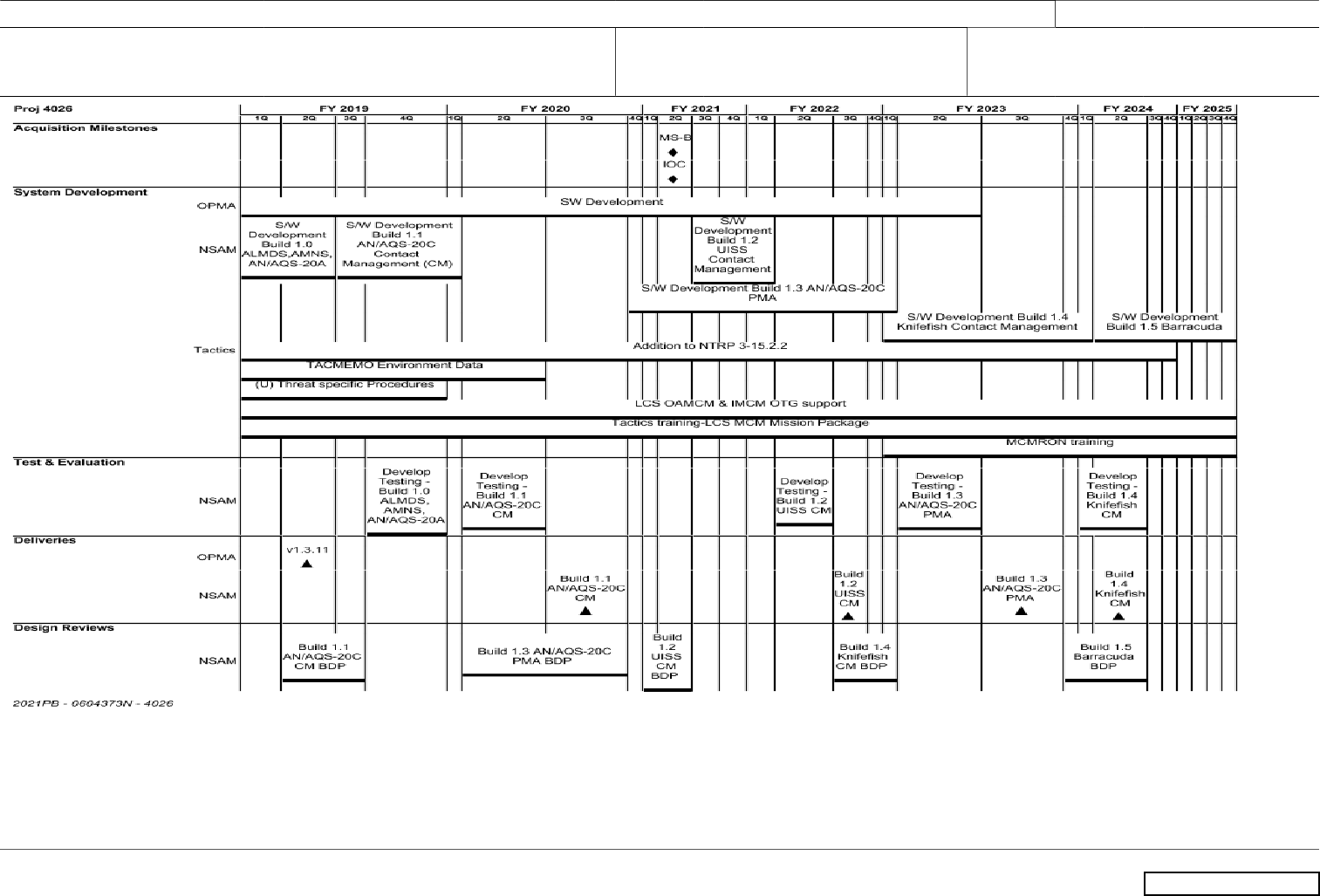
Acquisition Milestones: NSAM: Milestone B 2 2021 2 2021
Acquisition Milestones: NSAM: Initial Operational Capability 2 2021 2 2021
System Development: OPMA: OPMA: Maintain & Support; Software 1 2019 2 2023
System Development: NSAM: NSAM: S/W Development Build 1.0 ALMDS,AMNS, AN/
AQS-20A
1 2019 2 2019
System Development: NSAM: NSAM: S/W Development Build 1.1 AN/AQS-20C
Contact Management (CM)
3 2019 1 2020
System Development: NSAM: NSAM: S/W Development Build 1.2 UISS Contact
Management
3 2021 1 2022
System Development: NSAM: NSAM: S/W Development Build 1.3 AN/AQS-20C PMA 4 2020 1 2023
System Development: NSAM: NSAM: S/W Development Build 1.4 Knifefish Contact
Management
1 2023 1 2024
System Development: NSAM: NSAM: S/W Development Build 1.5 Barracuda 2 2024 4 2025
System Development: Tactics: Add additional Mines to NTRP 3-15.2.2 Susceptibility of
Ships to Threat Mines
1 2019 4 2024
System Development: Tactics: Tactics: TACMEMO Environment Data for LCS MCM
Systems
1 2019 2 2020
System Development: Tactics: Tactics: (U) Threat specific Tactics and Procedures 1 2019 4 2019
System Development: Tactics: Tactics: Reachback LCS OAMCM & IMCM OTG
support
1 2019 4 2025
System Development: Tactics: Tactics: Conduct contact management tactics and
integrated tactics training for LCS MCM Mission Package
1 2019 4 2025
Volume 3 - 690

UNCLASSIFIED
PE 0604373N: Airborne Mine Countermeasures
UNCLASSIFIED
Navy Page 11 of 17 R-1 Line #122
Exhibit R-4A, RDT&E Schedule Details: PB2021Navy
Date: February 2020
Appropriation/Budget Activity
1319 / 5
R-1 Program Element (Number/Name)
PE 0604373N / Airborne Mine
Countermeasures
Project (Number/Name)
4026 / Net-Centric Sensor Analysis for Mine
Warfare (NSAM)
Start End
Events by Sub Project Quarter Year Quarter Year
System Development: Tactics: Tactics: Transition wargame functionality into official
MCMRON training
1 2023 4 2025
Test & Evaluation: NSAM: NSAM: Developmental Testing Build 1.0 ALMDS, AMNS,
AN/AQS-20A
4 2019 4 2019
Test & Evaluation: NSAM: NSAM: Developmental Testing Build 1.1 AN/AQS-20C
Contact
2 2020 2 2020
Test & Evaluation: NSAM: NSAM: Developmental Testing Build 1.2 UISS Contact
Management
2 2022 2 2022
Test & Evaluation: NSAM: NSAM: Developmental Testing Build 1.3 AN/AQS-20C PMA 2 2023 2 2023
Test & Evaluation: NSAM: NSAM: Developmental Testing Build 1.4 Knifefish Contact
Management
1 2024 2 2024
Deliveries: OPMA: OPMA: Update OPMA v1.3.11 for LCS 2 2019 2 2019
Deliveries: NSAM: NSAM: Build 1.1 AN/AQS-20C Contact Management 3 2020 3 2020
Deliveries: NSAM: NSAM: Build 1.2 UISS Contact Management 3 2022 3 2022
Deliveries: NSAM: NSAM: Build 1.3 AN/AQS-20C PMA 3 2023 3 2023
Deliveries: NSAM: NSAM: Build 1.4 Knifefish Contact Management 2 2024 2 2024
Design Reviews: NSAM: NSAM: Build 1.1 AN/AQS-20C Contact Management Build
Development Package (BDP)
2 2019 3 2019
Design Reviews: NSAM: NSAM: Build 1.2 UISS Contact Management Build
Development Package (BDP)
1 2021 2 2021
Design Reviews: NSAM: NSAM: Build 1.3 AN/AQS-20C PMA Build Development
Package (BDP)
2 2020 3 2020
Design Reviews: NSAM: NSAM: Build 1.4 Knifefish Contact Management Build
Development Package (BDP)
3 2022 1 2023
Design Reviews: NSAM: NSAM: Build 1.5 Barracuda Build Development Package
(BDP)
4 2023 2 2024
Volume 3 - 691
UNCLASSIFIED
PE 0604373N: Airborne Mine Countermeasures
UNCLASSIFIED
Navy Page 12 of 17 R-1 Line #122
Exhibit R-2A, RDT&E Project Justification: PB2021Navy
Date: February 2020
Appropriation/Budget Activity
1319 / 5
R-1 Program Element (Number/Name)
PE 0604373N / Airborne Mine
Countermeasures
Project (Number/Name)
9179 / Surf Navy Integ Undersea Tactical
Tech
COST ($ in Millions)
Prior
Years FY 2019 FY 2020
FY 2021
Base
FY 2021
OCO
FY 2021
Total FY 2022 FY 2023 FY 2024 FY 2025
Cost To
Complete
Total
Cost
9179: Surf Navy Integ Undersea
Tactical Tech
8.322 0.876 0.932 0.953 - 0.953 0.972 0.992 1.012 1.033 Continuing Continuing
Quantity of RDT&E Articles - - - - - - - - -
A. Mission Description and Budget Item Justification
Surface Navy Integrated Undersea Tactical Technology (SNIUTT) is a software-only tool, which develops post mission analysis (PMA) software training modules
for MCM sensor systems. SNIUTT provides PMA classroom and operator training to teach mine contact recognition when performing PMA. The software runs in
conjunction with existing PMA systems to reinforce training of PMA procedures and operator target recognition, either in the classroom or at the squadrons. SNIUTT
currently provides PMA proficiency training for the legacy AN/AQS-24A/B sensors, and for ALMDS, COBRA and MCM-USV towed AN/AQS-20A/C sensor training
modules.
B. Accomplishments/Planned Programs ($ in Millions, Article Quantities in Each)
FY 2019 FY 2020
FY 2021
Base
FY 2021
OCO
FY 2021
Total
Title: Engineering and Integration and Logistics Services
Articles:
FY 2020 Plans:
Develop high-level and derived requirements for SNIUTT software products.
Continue to maintain and update the current online source code repository and SNIUTT requirements and
documents.
Continue SNIUTT software testing as part of the Agile software development process. Develop test cases and
follow a test-fix-test process on beta builds; provide updated beta build to tactics teams for validation. Provide
test results and generate test reports. Continue risk management framework process to obtain SNIUTT authority
to operate.
FY 2021 Base Plans:
Develop high-level and derived requirements for SNIUTT software products.
Continue to maintain and update the current online source code repository and SNIUTT requirements and
documents.
Continue SNIUTT software testing as part of the Agile software development process. Develop test cases and
follow a test-fix-test process on beta builds; provide updated beta build to tactics teams for validation. Provide
0.057
-
0.105
-
0.118
-
0.000
-
0.118
-
Volume 3 - 692
UNCLASSIFIED
PE 0604373N: Airborne Mine Countermeasures
UNCLASSIFIED
Navy Page 13 of 17 R-1 Line #122
Exhibit R-2A, RDT&E Project Justification: PB2021Navy
Date: February 2020
Appropriation/Budget Activity
1319 / 5
R-1 Program Element (Number/Name)
PE 0604373N / Airborne Mine
Countermeasures
Project (Number/Name)
9179 / Surf Navy Integ Undersea Tactical
Tech
B. Accomplishments/Planned Programs ($ in Millions, Article Quantities in Each)
FY 2019 FY 2020
FY 2021
Base
FY 2021
OCO
FY 2021
Total
test results and generate test reports. Continue risk management framework process and ensure SNIUTT
compliance with authority to operate.
FY 2021 OCO Plans:
N/A
FY 2020 to FY 2021 Increase/Decrease Statement:
Funding level remains consistent for SNUITT development efforts.
Title: Hardware and Software Development
Articles:
FY 2020 Plans:
Complete development of embedded operator training and plug-ins to support proficiency training for
the Net-Centric Sensor Analysis for Mine Warfare (NSAM) application. Embedded training includes capabilities
to launch and auto-grade training lessons for the ALMDS and AN/AQS-20A sensors; the plug-ins include the
capability to create the training lessons for these sensors. Commence embedded training capability for NSAM.
Complete refresher scenario trainer modules for COBRA and AN/AQS-24B.
FY 2021 Base Plans:
Commence embedded training capability for COBRA BLK 2 and AN/AQS-20C.
FY 2021 OCO Plans:
N/A
FY 2020 to FY 2021 Increase/Decrease Statement:
Funding level remains consistent for SNUITT development efforts.
0.819
-
0.827
-
0.835
-
0.000
-
0.835
-
Accomplishments/Planned Programs Subtotals
0.876 0.932 0.953 0.000 0.953
C. Other Program Funding Summary ($ in Millions)
N/A
Remarks
D. Acquisition Strategy
Surface Navy Integrated Undersea Tactical Technology (SNIUTT) is a software-only PMA proficiency training tool, developed by NSWC PCD. SNIUTT is an on-going
project and continues to develop new training modules as new sensors become available. To date, SNIUTT has developed PMA training modules for AN/SQQ-32,
Volume 3 - 693
UNCLASSIFIED
PE 0604373N: Airborne Mine Countermeasures
UNCLASSIFIED
Navy Page 14 of 17 R-1 Line #122
Exhibit R-2A, RDT&E Project Justification: PB2021Navy
Date: February 2020
Appropriation/Budget Activity
1319 / 5
R-1 Program Element (Number/Name)
PE 0604373N / Airborne Mine
Countermeasures
Project (Number/Name)
9179 / Surf Navy Integ Undersea Tactical
Tech
Remote Environmental Measuring Units (REMUS), AN/AQS-24A, AN/AQS-20A, ALMDS, and COBRA sensors. Specific SNIUTT training capabilities include refresher
scenario-based contact recognition training, and the update and modification of contact recognition training (interactive web-based training) to support fleet operators.
Continued funding will develop training SNIUTT modules for additional NSAM systems.
Volume 3 - 694
UNCLASSIFIED
PE 0604373N: Airborne Mine Countermeasures
UNCLASSIFIED
Navy Page 15 of 17 R-1 Line #122
Exhibit R-3, RDT&E Project Cost Analysis: PB2021Navy
Date: February 2020
Appropriation/Budget Activity
1319 / 5
R-1 Program Element (Number/Name)
PE 0604373N / Airborne Mine
Countermeasures
Project (Number/Name)
9179 / Surf Navy Integ Undersea Tactical
Tech
Product Development ($ in Millions)
FY 2019 FY 2020
FY 2021
Base
FY 2021
OCO
FY 2021
Total
Cost Category Item
Contract
Method
& Type
Performing
Activity & Location
Prior
Years Cost
Award
Date Cost
Award
Date Cost
Award
Date Cost
Award
Date Cost
Cost To
Complete
Total
Cost
Target
Value of
Contract
Hardware Software
Development
WR
NSWC PC : Panama
City FL
7.053 0.819 Oct 2018 0.827 Oct 2019 0.835 Oct 2020 - 0.835 Continuing Continuing Continuing
Subtotal
7.053 0.819 0.827 0.835 - 0.835 Continuing Continuing N/A
Support ($ in Millions)
FY 2019 FY 2020
FY 2021
Base
FY 2021
OCO
FY 2021
Total
Cost Category Item
Contract
Method
& Type
Performing
Activity & Location
Prior
Years Cost
Award
Date Cost
Award
Date Cost
Award
Date Cost
Award
Date Cost
Cost To
Complete
Total
Cost
Target
Value of
Contract
ISEA WR
NSWC, PC :
Panama City FL
1.266 0.057 Oct 2018 0.105 Oct 2019 0.118 Oct 2020 - 0.118 Continuing Continuing Continuing
Subtotal
1.266 0.057 0.105 0.118 - 0.118 Continuing Continuing N/A
Management Services ($ in Millions)
FY 2019 FY 2020
FY 2021
Base
FY 2021
OCO
FY 2021
Total
Cost Category Item
Contract
Method
& Type
Performing
Activity & Location
Prior
Years Cost
Award
Date Cost
Award
Date Cost
Award
Date Cost
Award
Date Cost
Cost To
Complete
Total
Cost
Target
Value of
Contract
DAWDF Various Various : Various 0.003 0.000 0.000 0.000 - 0.000 0.000 0.003 -
Subtotal
0.003 0.000 0.000 0.000 - 0.000 0.000 0.003 N/A
Prior
Years FY 2019 FY 2020
FY 2021
Base
FY 2021
OCO
FY 2021
Total
Cost To
Complete
Total
Cost
Target
Value of
Contract
Project Cost Totals
8.322 0.876 0.932 0.953 - 0.953 Continuing Continuing N/A
Remarks
Volume 3 - 695
UNCLASSIFIED
PE 0604373N: Airborne Mine Countermeasures
UNCLASSIFIED
Navy Page 16 of 17 R-1 Line #122
Exhibit R-4, RDT&E Schedule Profile: PB2021Navy
Date: February 2020
Appropriation/Budget Activity
1319 / 5
R-1 Program Element (Number/Name)
PE 0604373N / Airborne Mine
Countermeasures
Project (Number/Name)
9179 / Surf Navy Integ Undersea Tactical
Tech
Volume 3 - 696
UNCLASSIFIED
PE 0604373N: Airborne Mine Countermeasures
UNCLASSIFIED
Navy Page 17 of 17 R-1 Line #122
Exhibit R-4A, RDT&E Schedule Details: PB2021Navy
Date: February 2020
Appropriation/Budget Activity
1319 / 5
R-1 Program Element (Number/Name)
PE 0604373N / Airborne Mine
Countermeasures
Project (Number/Name)
9179 / Surf Navy Integ Undersea Tactical
Tech
Schedule Details
Start End
Events by Sub Project Quarter Year Quarter Year
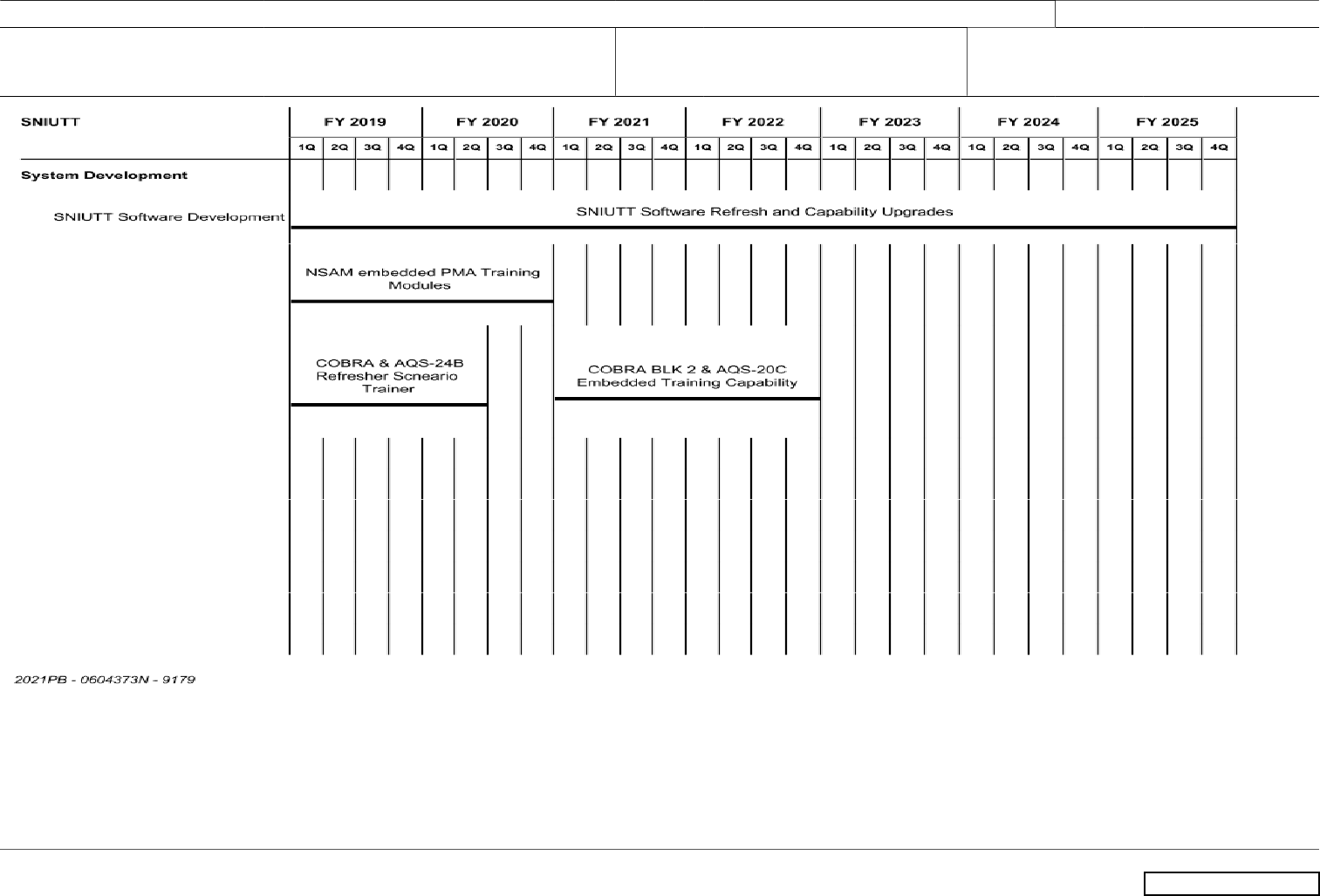
SNIUTT
System Development: SNIUTT Software Development: SNIUTT Software Refresh and
Capability Upgrades
1 2019 4 2025
System Development: SNIUTT Software Development: NSAM embedded PMA
Training Modules
1 2019 4 2020
System Development: SNIUTT Software Development: Refresher scenario trainer for
COBRA and AQS-24B
1 2019 2 2020
System Development: SNIUTT Software Development: COBRA BLK 2 & AQS-20C
Embedded Training Capability
1 2021 4 2022
Volume 3 - 697

UNCLASSIFIED
THIS PAGE INTENTIONALLY LEFT BLANK
UNCLASSIFIED
Volume 3 - 698
